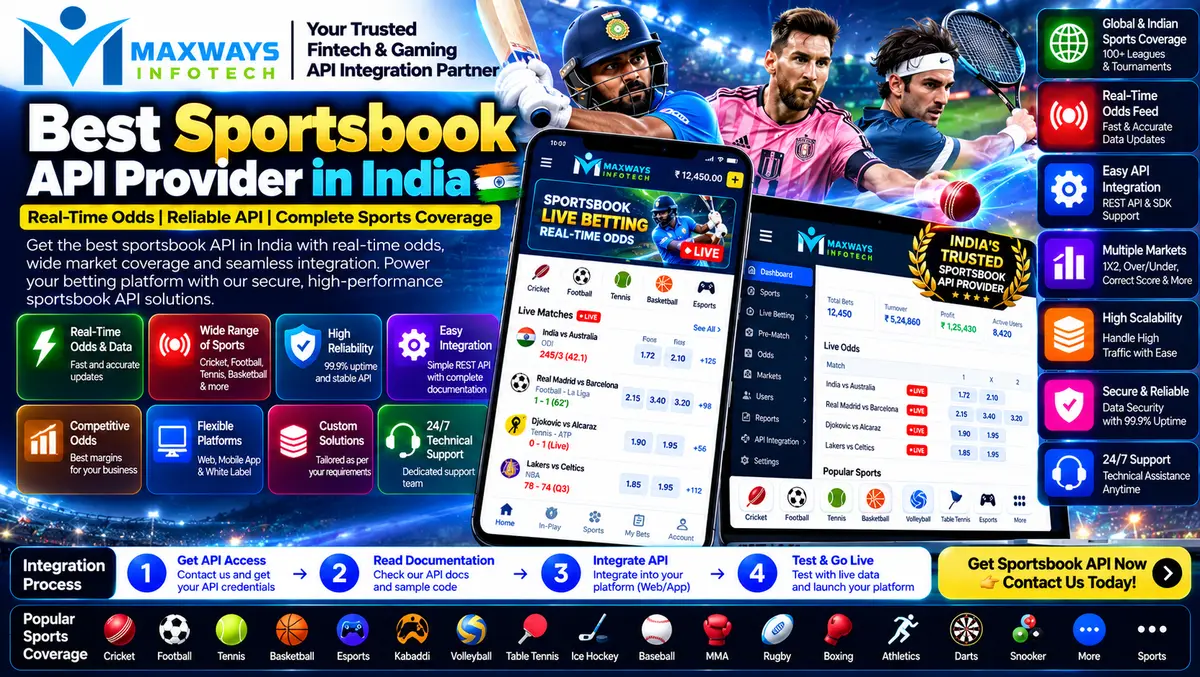
Learn how to evaluate sports data API providers in India by comparing data quality, API documentation, integration, pricing, security, and legal compliance.
Best Sportsbook API Provider in India: A Technology and Compliance Guide
Finding the best sportsbook API provider in India requires careful evaluation of data quality, integration capabilities, system reliability, and legal requirements. For businesses developing sports applications, the right API can help organise match schedules, team statistics, scores, historical records, and other structured sports information.
However, an API's technical capabilities do not automatically make every intended use lawful. Businesses must distinguish between permitted sports information services, non-wagering analytics applications, and activities involving real-money gaming. Before choosing a technology provider, it is essential to understand the applicable Indian legal framework and define the intended product clearly.
This guide explains how to evaluate sports data API technology, compare technical features, plan integrations, and assess compliance before committing to a provider.
What Is a Sportsbook API?
A sportsbook API is a software interface associated with sportsbook functionality or the data systems used by sports platforms. Depending on the provider, the API may expose fixtures, live scores, event status, statistics, odds data, or other information.
Not every sports API provides a complete platform. Some services focus only on delivering sports data, while other products may include additional application components. Businesses should verify the exact functionality rather than assume that every API includes all features.
Common categories include:
-
Sports data APIs: Provide fixtures, results, team information, and selected statistics.
-
Live score APIs: Deliver score updates and event-status changes.
-
Historical data APIs: Support research, reporting, and performance analysis.
-
Sports analytics APIs: Supply structured information for dashboards, statistical models, and research applications.
-
Odds data feeds: Provide odds-related information where access and intended use are permitted by the relevant agreements and laws.
The distinction matters because a data feed is not the same as a complete software platform. Data access, commercial usage rights, and permission to operate a particular service must be assessed separately.
Important Legal Considerations for India
Before evaluating any provider for a sportsbook-related project in India, businesses must review the current law and determine whether their proposed functionality is permitted.
India's Promotion and Regulation of Online Gaming Act, 2025 establishes prohibitions relating to online money games, including their offering, operation, facilitation, advertising, and promotion. The government also published the Promotion and Regulation of Online Gaming Rules, 2026. The official materials should be reviewed before making product or business decisions.
An API subscription or agreement with a technology vendor does not itself authorise a business to offer a prohibited service. Businesses should obtain qualified legal advice about their specific product, data usage, distribution model, and target markets before proceeding.
For projects focused on permitted sports information, statistical analysis, scoreboards, or other non-wagering applications, the provider evaluation can begin with the technical requirements described below.
What Makes a Sports Data API Provider Worth Evaluating?
The best technical fit depends on what the application needs to do. Instead of relying on a generic ranking, compare providers against a documented set of requirements.
1. Sports and Competition Coverage
Check whether the provider covers the relevant sports, competitions, teams, and event types.
For an application focused on cricket, for example, the development team may need fixtures, innings information, score updates, match status, and historical records. A football-focused application may need different event structures and statistical fields.
Ask for a sample dataset and verify that the information supports the intended application. Broad coverage is useful only when the data is relevant, accessible, and properly licensed for the intended purpose.
2. Data Accuracy and Update Frequency
Sports applications depend on timely and consistent information. A useful API should document how updates are delivered and how corrections or delayed records are handled.
Evaluate:
-
Timestamp formats and time-zone conventions.
-
Event identifiers and team-name consistency.
-
Update frequency for different data categories.
-
Handling of postponed, abandoned, or interrupted matches.
-
Historical corrections and revised results.
-
Availability of documentation for data fields.
Avoid assuming that every feed updates instantly. Measure performance in the provider's test environment and establish acceptable thresholds for the application.
3. API Documentation and Testing Tools
Clear documentation helps developers understand authentication, request formats, response fields, rate limits, error codes, and version changes.
A sandbox or test environment can help validate integration behaviour before deployment. If a provider does not offer test access, ask how developers can verify their implementation and reproduce errors safely.
Documentation should also explain how breaking changes are announced and how older API versions are retired.
4. Integration Compatibility
The API should work with the application's architecture and technical resources. Review supported protocols, response formats, authentication methods, pagination, and any available software development kits.
A well-designed integration layer can convert external data into a consistent internal structure. This is particularly helpful when an application uses several data sources or needs to replace a provider later.
5. Reliability and Support
Ask how service interruptions, maintenance, and data delays are communicated. Review any service-level commitments and check how availability is measured.
Technical support should have a defined process for handling authentication failures, missing data, integration errors, and changes to the provider's interface.
A provider's marketing claims should not replace practical testing and a clear support agreement.
How to Compare API Providers Using a Scorecard
A comparison scorecard helps a business make a decision based on evidence rather than broad claims.
Teams can score each area against their own priorities. For example, a historical analytics application may place more emphasis on data completeness, while a live scoreboard may prioritise update frequency and service reliability.
The result should be a documented technical decision, not an unsupported claim that one provider is universally the best.
Understanding API Integration for Sports Applications
A typical sports data integration includes several steps.
Step 1: Define the application. Decide whether the product is a scoreboard, statistics dashboard, research tool, sports news application, or another permitted use case.
Step 2: Select the required data. Identify the events, statistics, and historical information that the application actually needs.
Step 3: Verify access and usage rights. Confirm that the provider's agreement permits the intended storage, display, processing, and distribution of the data.
Step 4: Map the data model. Establish consistent identifiers for teams, competitions, events, and statistics.
Step 5: Build the integration. Implement authentication, request handling, response validation, and error management.
Step 6: Test data quality. Compare sample responses against documented expectations and check how missing or corrected records are handled.
Step 7: Monitor the service. Track failed requests, response times, update delays, and unexpected changes in data structure.
This process helps teams identify technical limitations before a data source becomes a critical dependency.
Security and Data Management
Even a sports information application needs appropriate security controls. API credentials should be stored securely, requests should use protected connections, and access should be limited to authorised components.
Developers should also consider:
-
Rate limiting and protection against excessive requests.
-
Validation of incoming data.
-
Safe handling of API errors.
-
Monitoring for unusual access patterns.
-
Backups for important internal records.
-
Data retention and deletion requirements.
-
Restrictions on redistribution of provider-supplied information.
If the application collects personal information, its data-handling practices should be assessed separately against the relevant privacy obligations.
A reliable implementation should make it possible to identify which system supplied a record, when it was received, and whether it was subsequently corrected.
Cost Factors When Choosing a Sports API
API pricing can depend on data coverage, update frequency, historical access, request limits, support arrangements, and commercial usage rights.
Before selecting a provider, ask for a clear explanation of:
-
Initial setup or onboarding fees.
-
Subscription charges and usage tiers.
-
Request limits and additional usage costs.
-
Access to historical records.
-
Support and service-level options.
-
Commercial display and redistribution rights.
-
Contract duration and termination conditions.
A low subscription price may not be the most economical choice if the data is incomplete or the integration requires extensive additional development.
Businesses should estimate the total cost of ownership, including implementation, monitoring, maintenance, and future changes.
Why Ongoing Monitoring Matters
An API integration can work correctly during initial testing and still encounter problems after deployment. Data sources may experience delays, external services may become unavailable, and providers may change their response formats.
Monitoring should track request success rates, response times, missing records, unexpected data changes, and authentication errors.
The team should also establish procedures for responding to incidents. If the data feed becomes unavailable, the application should communicate the limitation clearly rather than presenting stale information as current.
For data-driven applications, preserving timestamps and identifying the source of each record can make later investigations much easier.
How to Make the Final Provider Decision
Before signing an agreement, prepare a short evaluation document that records the application's intended purpose, required data, technical requirements, budget, usage rights, and compliance review.
Request documentation and sample responses from shortlisted providers. Test the most important workflows and compare the results against the acceptance criteria.
The final decision should reflect the needs of the actual application, the provider's documented capabilities, and the legal conditions under which the data will be used.
For businesses researching software development and technology options, visit the Maxways Infotech homepage to explore available company information and identify relevant project requirements.
For related software and financial technology topics, explore the Maxways Infotech fintech page. Any proposed integration should be assessed according to its specific functionality and permitted use.
Conclusion
Choosing the best sportsbook API provider in India requires more than comparing feature lists or promotional rankings. Data quality, competition coverage, documentation, integration compatibility, support, commercial terms, and legal requirements all matter.
For permitted sports information and analytics applications, a structured provider evaluation can reduce integration risk and help businesses build more maintainable products. Before proceeding with any sportsbook-related functionality, confirm the legal position and obtain appropriate professional advice.
For more software and technology articles, visit the Maxways Infotech blog.