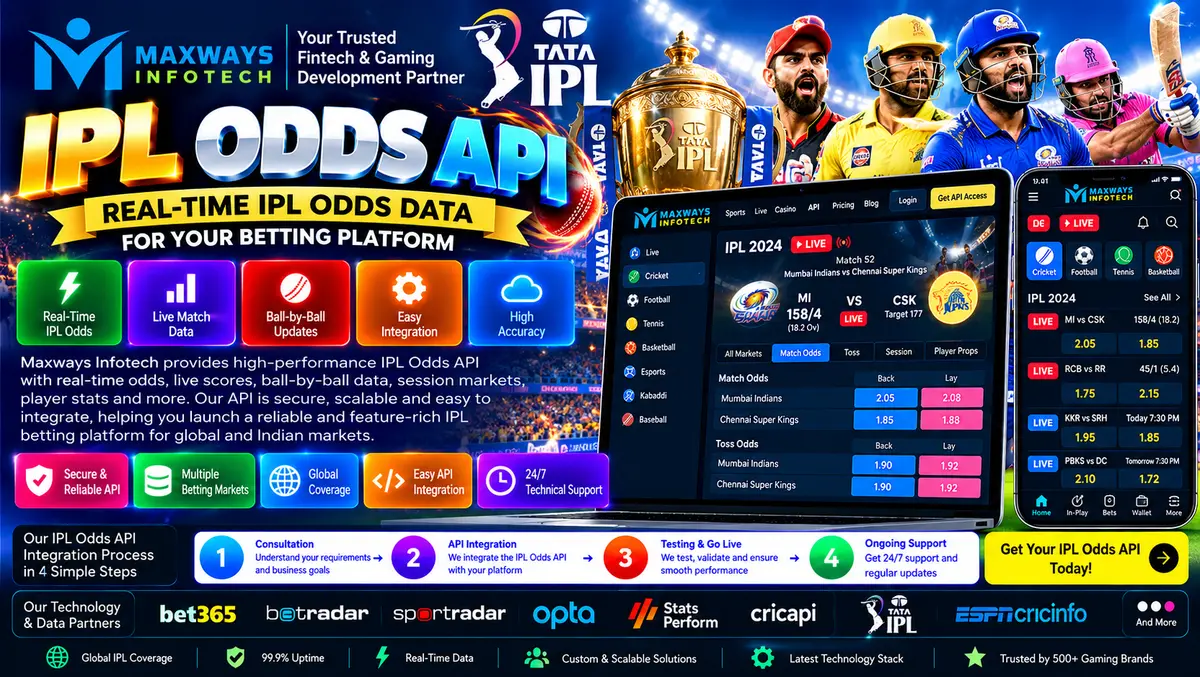
Learn how an IPL Odds API works, what cricket data it can provide, and how to manage integration, timestamps, caching, validation, security, and compliance.
IPL Odds API: A Developer’s Guide to Cricket Data Integration
An IPL Odds API helps software applications retrieve structured odds information associated with Indian Premier League cricket matches. For developers building cricket data dashboards, match information platforms, statistical tools, or permitted sports-data applications, an API can provide a consistent way to access event details and market data without manually collecting information from multiple sources.
The Indian Premier League presents a specific data challenge: a match moves through different phases, team and player information changes, and data may need to be refreshed while the match is underway. A reliable integration must therefore do more than retrieve a response. It must validate incoming data, map it to the correct fixture, handle updates, and display information with appropriate timestamps.
This guide explains how to evaluate an IPL Odds API, structure its data, plan an integration, and maintain data quality throughout a software project.
What Is an IPL Odds API?
An IPL Odds API is a software interface that can provide odds-related information for Indian Premier League fixtures, depending on the provider's coverage and subscription plan. Data may include match identifiers, participating teams, event start times, market names, available selections, quoted prices, and update timestamps.
For example, The Odds API documents cricket coverage that includes IPL fixtures, with match-winner markets and other coverage details depending on the available offering.
An API response commonly uses a structured format such as JSON, allowing an application to parse the data and map it into its own database or user interface.
Typical use cases include:
-
Cricket statistics and data dashboards.
-
Match information websites.
-
Sports-data research and analysis tools.
-
Historical data analysis where the provider offers an archive.
-
Internal data-quality and market-monitoring systems.
-
Permitted applications that display sports information under applicable rules.
The exact fields, update frequency, historical coverage, and permitted use of the data vary by provider. Always check the API documentation and licence before choosing a service.
Which Data Should an IPL Odds API Provide?
Before integrating a provider, create a list of the data fields your application actually needs. This avoids paying for unnecessary coverage or discovering late in development that a required field is unavailable.
1. Match and fixture information
Each match should have a stable identifier, participating teams, tournament information, and a scheduled start time. A stable event ID helps connect updates to the correct fixture even if team names are formatted differently across sources.
2. Market and selection information
A market describes the category of a quoted outcome. Each market may contain one or more selections and corresponding prices.
The application should preserve the provider's market identifiers and labels where available. Avoid assuming that two markets with similar names have identical settlement rules or meanings.
3. Pre-match and live data
Some APIs provide pre-match data, in-play updates, or both. These are separate coverage requirements that should be confirmed before purchase.
If live data is required, ask how frequently the provider updates each market, whether timestamps are included, and what happens when a market temporarily becomes unavailable.
4. Historical records
Historical odds can be useful for analysing past data, testing reporting systems, or studying how market information changed over time. Historical coverage may require a separate subscription and may not include every market or bookmaker.
Confirm the available date range, record granularity, and rights to store or redistribute historical records.
How to Integrate an IPL Odds API
A good integration process starts with the provider's documentation rather than immediately writing application code.
Step 1: Review the API contract
Read the authentication method, endpoint list, response schema, request limits, error codes, and usage terms. Identify the endpoints required for upcoming fixtures, match details, odds, and historical information, if available.
Step 2: Create a small test request
Use a development environment and a valid API credential to retrieve a sample response. Verify that the response contains the expected fixture, market identifiers, selections, and timestamps.
Do not expose API credentials in browser-side code, public repositories, or application logs.
Step 3: Map the response into a consistent schema
Providers may use different field names and identifier formats. Create an internal data model that separates the match, market, selection, quoted price, source, and observation timestamp.
A simplified conceptual structure might look like this:
This is an illustrative example only, not a live IPL quote or a guaranteed response schema. Use the actual field names and formats specified by your provider.
Step 4: Validate incoming records
Check that required fields are present, numeric values are valid, timestamps can be parsed, and event IDs correspond to known fixtures.
Treat incomplete or malformed records as data-quality issues instead of allowing them to silently overwrite valid records.
Step 5: Store updates with provenance
Record where each observation came from and when it was received. If the provider supplies a source-update timestamp, preserve that separately from the time your application fetched the record.
This distinction makes it easier to investigate delayed updates, compare historical snapshots, and understand discrepancies between systems.
Step 6: Test the full workflow
Verify the complete flow from API request to parsing, storage, and display. Test timeouts, rate limits, expired credentials, empty responses, duplicate events, and unexpected schema changes before releasing the integration.
Handling Live IPL Data and Match-State Changes
Live cricket introduces more complicated data conditions than a static fixture list. A match can be delayed, interrupted, resumed, or completed, while the underlying data may arrive late or out of order.
An integration should therefore treat event status and market availability as separate concepts. A match being marked as live does not necessarily mean every market is available or current.
Important design considerations include:
-
Timestamp validation: Check the age of each record before displaying it as current.
-
Duplicate handling: Use stable event and market identifiers to prevent repeated messages from creating duplicate records.
-
Out-of-order updates: Avoid replacing a newer observation with an older one simply because it arrived later.
-
Temporary gaps: Represent unavailable data clearly instead of displaying an old quote without a warning.
-
Status transitions: Handle scheduled, live, interrupted, and completed states according to the provider's documented definitions.
-
Clock consistency: Store timestamps in a consistent format, typically UTC, and convert them for display when needed.
A stale-data policy should define when a record is no longer suitable for display. The threshold should reflect the provider's documented update interval and the application's intended use.
Choosing Between Polling and Streaming
Providers may offer different methods for retrieving updates. The appropriate method depends on the required freshness, supported infrastructure, cost, and request limits.
Not every provider supports every method. Check the actual API documentation before selecting an integration design.
A practical implementation may use scheduled requests for fixture data and a different update method for frequently changing information, provided both approaches are permitted by the provider's terms.
API Performance, Caching, and Error Handling
Performance problems often arise not from the API itself but from unnecessary requests, inefficient processing, and poor handling of failures.
A production-ready integration should include:
Request management: Use timeouts and controlled retries. Avoid retrying authentication failures or invalid requests indefinitely.
Rate-limit awareness: Respect the provider's quota and any response headers that indicate remaining requests or retry timing.
Caching: Cache data according to its type and expected update frequency. Static tournament details may be cached longer than frequently changing match information.
Failure handling: Distinguish between authentication errors, rate limits, temporary server failures, and invalid parameters.
Observability: Record request latency, error rates, response status, and data freshness without logging secret credentials.
Schema resilience: Handle optional fields safely and monitor for changes to documented response structures.
These practices help keep the application predictable when the API experiences delays or returns incomplete information.
How to Evaluate an IPL Odds API Provider
Not every provider offers the same coverage. Compare potential suppliers using measurable criteria rather than relying only on broad claims about speed or reliability.
Review the following areas:
-
IPL coverage: Confirm which seasons, fixtures, and markets are included.
-
Update frequency: Ask how often pre-match and in-play data are refreshed.
-
Historical availability: Verify the archive's depth and the level of detail supplied.
-
Documentation: Look for clear examples, field definitions, authentication instructions, and error codes.
-
Service reliability: Review published uptime information, support arrangements, and incident procedures.
-
Usage limits: Understand request quotas, concurrency limits, and additional charges.
-
Data rights: Confirm storage, display, redistribution, and commercial-use permissions.
-
Support: Check response times and escalation options for production problems.
A short proof of concept can help test real response structures and reveal integration issues before the business commits to a longer contract.
Security and Data Governance
API credentials should be stored in a server-side secrets manager or an equivalent protected configuration system. Use the minimum permissions required, rotate credentials according to the provider's guidance, and restrict access to production secrets.
Applications should also avoid collecting unnecessary personal data. Keep technical logs focused on diagnostics, define retention periods, and restrict access to stored records.
If the application serves multiple markets, review the relevant privacy, licensing, and data-use obligations before launch.
Legal Considerations for IPL Odds Data in India
An odds-data API is a technical data service; its availability does not itself establish that every use of the data is legally permitted.
India's Promotion and Regulation of Online Gaming Act, 2025 and the Promotion and Regulation of Online Gaming Rules, 2026 establish restrictions concerning online money games and related advertising, promotion, and facilitation. The Rules came into force on 1 May 2026, according to the Ministry of Electronics and Information Technology.
Before building or operating a product that uses odds data, obtain qualified legal advice about the intended functionality, business model, audience, and target markets. Confirm both the legal position and the provider's contractual data-use rights. Do not assume that access to an API permits prohibited betting-related activity.
Explore Maxways Infotech
For company information, visit the Maxways Infotech homepage. You can also review its Fintech page for related technology-service information and read more articles on the Maxways Infotech blog.
When planning a data integration project, prepare a short requirements document describing the required IPL coverage, update expectations, storage needs, technical stack, and intended use. This makes it easier to assess whether a provider's API and licence meet the project's actual requirements.
Conclusion
An IPL Odds API can help developers access structured match and odds data for permitted applications, but successful integration requires more than making a request to an endpoint. Stable event mapping, timestamp validation, sensible caching, error handling, and careful provider evaluation are all important.
Start with the data fields and update requirements your application needs. Test the API with representative responses, document the internal schema, and confirm the legal and contractual conditions before release. A well-planned integration is easier to maintain, troubleshoot, and scale as data requirements evolve.