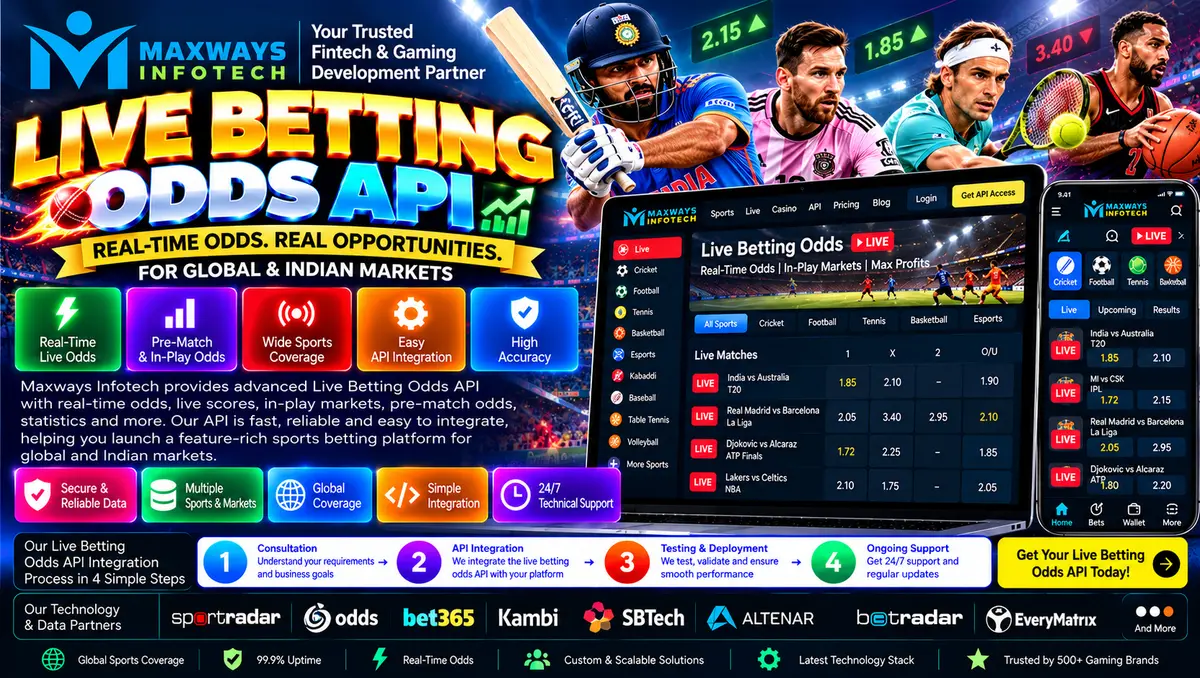
Explore Live Betting Odds API integration, real-time data updates, event mapping, timestamps, API security, data validation, and system reliability.
Live Betting Odds API: Real-Time Data Integration, Updates, and System Reliability
Introduction
A Live Betting Odds API is a data interface that delivers changing odds and event information while a sporting event is in progress. For developers building sports data dashboards, live score applications, statistical analysis platforms, or other permitted sports technology products, the main challenge is not simply retrieving odds. It is ensuring that incoming data is accurate, timestamped, correctly associated with the relevant event, and updated without unnecessary delays.
A well-planned integration helps applications process frequent updates, manage changing event conditions, and display information in a consistent format. Businesses exploring sports data infrastructure can learn more about the technology services offered through Maxways Infotech.
What Is a Live Betting Odds API?
A Live Betting Odds API provides structured information about odds and sporting events during live play. Depending on the data provider, available information may include event identifiers, participating teams, competition details, market names, selection values, timestamps, and market status.
The API typically returns information in JSON format through HTTP endpoints. Some providers also support WebSockets or Server-Sent Events (SSE) for receiving ongoing updates without repeatedly requesting the complete dataset.
For developers, the important consideration is understanding exactly what each response represents. A numerical odds value without an event identifier, market definition, or update timestamp can be difficult to interpret reliably.
Key Features of a Live Betting Odds API
1. In-Play Data Updates
Live events can generate frequent changes as the match progresses. An API should provide a documented method for retrieving these changes, whether through periodic requests or a persistent data stream.
Developers should verify the update frequency, supported sports, market coverage, and any provider-specific restrictions before selecting an integration method.
2. Event and Market Identification
Reliable event mapping is essential when working with multiple competitions. Each event should have a stable identifier, while markets and selections should use clearly defined identifiers or documented naming conventions.
This helps prevent information from one match or market from being incorrectly displayed against another.
3. Timestamps and Data Freshness
Every live data workflow should account for when an update was generated and when it was received. A timestamp allows an application to identify potentially outdated information and avoid presenting an old value as a current one.
Where available, developers should also use expiry information or freshness indicators supplied by the provider.
4. Market Status and Suspension Handling
An event may temporarily stop accepting updates, a market may become suspended, or a selection may be removed. The integration must process these status changes instead of assuming that every previously received value remains valid.
A clear status model helps the interface distinguish active information from suspended, unavailable, or outdated records.
5. Historical Data and Change Tracking
Some providers offer historical snapshots or change records. These can help technical teams study data movement, investigate discrepancies, test applications, and understand how an event's information changed over time.
Historical availability, retention periods, and permitted uses depend on the provider's terms.
How Live Odds Data Integration Works
A reliable integration usually follows a defined data-processing workflow.
Step 1: Authenticate the request. Store API credentials securely on the backend and use the authentication method specified by the provider.
Step 2: Discover available events. Retrieve supported sports, competitions, and event identifiers. Apply filters to reduce unnecessary data requests.
Step 3: Retrieve the initial snapshot. Load the latest available event and market records to establish the application's starting state.
Step 4: Receive updates. Use polling, WebSockets, or SSE according to the provider's capabilities and the application's latency requirements.
Step 5: Validate each update. Check identifiers, timestamps, data types, market status, and duplicate messages before processing a record.
Step 6: Update the application state. Apply valid changes to the relevant event and market records, then refresh the interface or downstream data service.
Step 7: Recover after interruptions. If a connection fails, reconnect using the provider's documented recovery mechanism. Fetch a new snapshot when the application cannot reliably reconstruct the current state.
This approach reduces inconsistencies and makes the integration easier to test and maintain.
Polling vs WebSockets vs Server-Sent Events
Different data-delivery methods suit different technical requirements.
No single method is ideal for every project. Polling can be easier to implement, while streaming can reduce repeated requests for frequently changing data. Actual performance depends on the provider, connection quality, update volume, and implementation.
For further information about the company's broader technical services, visit Maxways Infotech's service website.
Technical Challenges Developers Should Plan For
Handling Delayed or Out-of-Order Updates
Network delays can cause updates to arrive later than expected. Where the provider supplies sequence numbers, revision identifiers, or timestamps, use them to determine whether an incoming message should replace the stored state.
Avoid relying only on message arrival order.
Managing API Rate Limits
High request volumes can lead to rate-limit errors or unnecessary usage costs. Use appropriate request intervals, caching, event filters, and provider-recommended retry behaviour.
When a request is rate-limited, respect any supplied retry instructions instead of immediately sending repeated requests.
Preventing Duplicate Records
Streaming systems may resend messages during reconnection or recovery. Design update processing to be idempotent where possible, meaning that processing the same update more than once does not incorrectly duplicate or corrupt the stored state.
Monitoring Data Quality
Useful monitoring checks include missing event identifiers, invalid values, stale timestamps, unexpected status transitions, and gaps in update sequences.
Logging these conditions helps developers identify whether an issue originates with the provider, the network, or the application's own processing logic.
Protecting API Credentials
Keep secret keys on the server rather than exposing them in browser-side code. Apply access controls, rotate credentials when necessary, and avoid writing authentication secrets into application logs.
How to Evaluate a Live Betting Odds API Provider
Before integrating a provider, technical teams should review the following criteria:
-
Coverage: Confirm supported sports, leagues, events, and required data fields.
-
Documentation: Check endpoint descriptions, response schemas, error codes, and authentication instructions.
-
Update delivery: Understand refresh intervals, streaming options, and expected latency.
-
Data consistency: Review event identifiers, timestamps, market-status handling, and historical availability.
-
Reliability: Ask about service monitoring, incident communication, and documented service-level commitments.
-
Scalability: Check rate limits, connection limits, pagination, and pricing as usage grows.
-
Support: Confirm the availability of integration guidance, test environments, and technical assistance.
-
Usage rights: Verify contractual permissions for storing, displaying, redistributing, or analysing the data.
A provider should be selected on documented capabilities and verified testing results rather than claims of guaranteed real-time accuracy.
Security, Privacy, and Regulatory Considerations
A live data integration should use encrypted connections, secure credential storage, input validation, access controls, and appropriate logging. Applications should also avoid collecting personal information unless it is necessary and properly authorised.
Legal review is especially important when a product relates to betting or online money gaming. India's Promotion and Regulation of Online Gaming Rules, 2026 took effect on 1 May 2026, according to the Ministry of Electronics and Information Technology. The framework addresses the classification and regulation of online games, including restrictions concerning online money games. Applicability depends on the product and its activities, so businesses should obtain qualified legal advice before launching or facilitating a betting-related service
An API's technical availability does not establish that every proposed use is legally permitted. Compliance requirements should be assessed independently of integration requirements.
Testing Before Deployment
Testing should cover more than a successful API response. A practical test plan includes:
-
Valid and invalid authentication credentials.
-
Empty responses and unavailable events.
-
Repeated messages and out-of-order updates.
-
Suspended markets and changing event statuses.
-
Network interruptions and reconnection.
-
Rate-limit responses and retry behaviour.
-
High-volume event processing and application performance.
-
Validation of timestamps and stale-data indicators.
Use provider-approved test data or mock responses for automated tests. Production data should be handled according to the provider's licensing and access terms.
Conclusion
A Live Betting Odds API integration requires careful event mapping, reliable update delivery, data freshness checks, connection recovery, and secure backend processing. Choosing the right provider is only one part of the project; the surrounding architecture determines how consistently an application can process changing information.
Developers researching API architecture, data integration, and related technology topics can explore the Maxways Infotech blog for additional technical insights.
The best implementation is one that treats every update as data to validate, monitors failures clearly, and follows the legal and contractual requirements applicable to its intended use.