Explore live casino game development, including video streaming, frontend design, backend architecture, synchronisation, QA testing, and compliance.
Live Casino Game Development: Streaming Technology, Game Design, and Quality Assurance
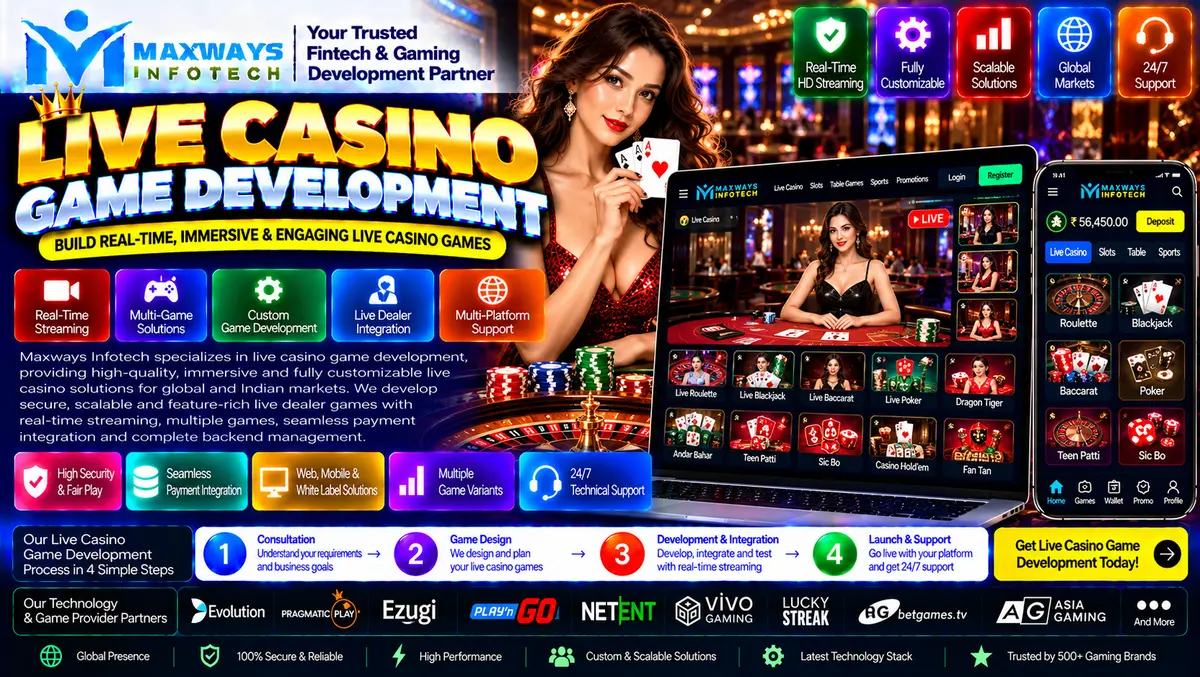
Live casino game development combines interactive software, video production, real-time communication, and interface design. Unlike a conventional browser game that renders most of its content locally, a live dealer experience must coordinate video from a studio with game information and user-interface updates.
For development teams, this creates a distinctive engineering challenge: the video, interface, and underlying application state must remain consistent while the experience works across different devices and network conditions.
A successful project begins with a clearly defined technical scope, a suitable media architecture, structured testing, and a thorough review of the laws that apply to the intended product.
What Is Live Casino Game Development?
Live casino game development refers to creating software that connects a live video experience with interactive digital interfaces and supporting backend services.
Depending on the project, development may include:
-
A browser-based interface for displaying live video.
-
Media delivery and playback controls.
-
Real-time messaging and application-state updates.
-
Administrative dashboards and operational monitoring.
-
Responsive layouts for desktop, tablet, and mobile.
-
Accessibility, security, and quality-assurance testing.
The exact scope varies according to whether a project involves a media demonstration, a simulated game, a licensed entertainment product, or a more complex third-party integration.
The Technology Behind a Live Gaming Experience
1. Video Capture and Media Delivery
The media pipeline begins with cameras and studio equipment that capture the live scene. Video and audio are then encoded and transmitted through infrastructure designed for real-time communication or low-latency distribution.
The choice of protocol depends on the intended interaction model, device support, network conditions, and infrastructure requirements. WebRTC, for example, supports real-time communication, while HTTP-based streaming approaches may suit different distribution scenarios.
Developers should evaluate startup time, buffering behaviour, playback compatibility, bandwidth usage, and recovery after a connection interruption.
A useful test is to examine performance under different network conditions rather than assuming that every viewer will have a fast, stable connection.
2. Synchronising Video and Interface State
A live video feed and an interactive interface are separate technical components. The video may arrive slightly later than an application event, or the browser may temporarily pause one component while the other continues updating.
To manage this, the application should define clear event timestamps, state-transition rules, and recovery behaviour. Developers can use sequence numbers or event identifiers to detect duplicate messages and prevent older updates from replacing newer state.
Testing should cover delayed events, temporary disconnections, browser refreshes, and reconnection after a device resumes from sleep.
The objective is a consistent interface that communicates its current state clearly, even when the network is imperfect.
3. Frontend Development and Rendering
The frontend presents video, navigation, information panels, controls, and status messages in a coherent layout.
Web technologies such as HTML, CSS, and JavaScript can support browser-based interfaces, while suitable rendering libraries may be used for specialised visual components.
The development team should avoid unnecessary visual effects that compete with the video or make important information difficult to read. Clear spacing, legible typography, predictable controls, and responsive layouts generally make an interface easier to use.
4. Backend Services and Application State
Backend services may manage sessions, configuration, content metadata, permissions, event notifications, and administrative operations.
A well-structured architecture separates responsibilities so that a problem in one component does not automatically interrupt unrelated services. The appropriate architecture may be a modular application or a collection of independently deployed services; the decision should be based on actual project complexity.
Developers should document service dependencies, define API contracts, and ensure that failures produce understandable error states rather than silent inconsistencies.
Designing for Different Devices
A live experience should be tested on more than one screen size. Desktop users may have room for a wide video panel and additional information, whereas mobile users need a layout that prioritises the most important elements.
Responsive testing should consider:
-
Portrait and landscape orientation.
-
Different screen sizes and pixel densities.
-
Touch controls and keyboard navigation.
-
Readable text and sufficient contrast.
-
Captions or other appropriate alternatives for audio content.
-
Video resizing without distorted proportions.
-
Playback recovery after switching applications or tabs.
Accessibility should be considered during the design process instead of being added only after the interface is complete.
Quality Assurance for Live Casino Games
Testing a live application requires more than confirming that the homepage loads and the video plays.
Functional Testing
Check navigation, interface controls, user permissions, configuration settings, and supported workflows. Each function should behave according to the written requirements.
Compatibility Testing
Test supported browsers, operating systems, devices, and playback environments. Browser differences can affect media playback, fullscreen behaviour, and interactive controls.
Performance Testing
Measure video startup time, playback interruptions, resource consumption, server response times, and behaviour during concurrent sessions. Use representative test conditions and document the limitations of the test environment.
Resilience Testing
Simulate network interruptions, delayed messages, unavailable dependencies, and expired sessions. Verify that the application recovers safely and communicates its status to the user.
Security Testing
Review authentication, authorisation, session handling, input validation, secret storage, and logging. Use controlled security testing to identify weaknesses before a product is released.
Formal testing or certification may also be required depending on the product, jurisdiction, and applicable standards. Passing internal quality checks does not automatically establish regulatory approval.
Common Development Challenges
Video latency: Delays can make an interactive interface appear out of sync with the live feed. Measure end-to-end performance and test suitable media delivery options.
Unstable connections: Mobile networks and congested Wi-Fi can interrupt playback. Define appropriate buffering, reconnection, and error-message behaviour.
Device limitations: Older devices may struggle with high-resolution video or complex animations. Test performance and provide suitable playback options where supported.
Integration dependencies: External media services and software components may change or become unavailable. Maintain version records, document dependencies, and establish a process for testing upgrades.
Insufficient test coverage: Testing only ideal conditions leaves edge cases undiscovered. Include realistic device, network, and recovery scenarios in the test plan.
Planning a Live Casino Game Development Project
A structured project can be divided into six phases.
-
Requirements discovery: Document the intended experience, supported devices, media requirements, integrations, and applicable legal constraints.
-
Architecture design: Define the media pipeline, frontend, backend responsibilities, data flows, and failure-handling strategy.
-
Prototype development: Build a limited proof of concept to validate playback, interface behaviour, and communication between components.
-
Feature implementation: Develop the approved interface, supporting services, configuration tools, and required integrations.
-
Testing and review: Run functional, compatibility, performance, resilience, security, and accessibility tests.
-
Release and maintenance: Deploy through a controlled process, monitor system health, document incidents, and plan future updates.
The timeline and budget should be estimated after requirements and dependencies have been reviewed. A simple media interface and a complex real-time application have very different engineering needs.
Selecting a Software Development Partner
When comparing development companies, look for evidence of sound engineering practices rather than relying solely on a presentation or feature list.
Ask potential partners about their experience with real-time media, browser compatibility, testing automation, secure development, deployment procedures, and ongoing support.
The project agreement should also identify deliverables, acceptance criteria, source-code ownership, third-party dependencies, maintenance responsibilities, and how changes to the original scope will be handled.
For more information about the company's technology services, visit Maxways Infotech. You can also explore its fintech page for related software topics and the Maxways Infotech blog for additional technology articles.
Legal and Regulatory Considerations
The legality of a live casino product depends on its actual functionality, business model, target market, and applicable jurisdiction. A development contract or access to third-party technology does not itself establish permission to offer a product.
In India, the Promotion and Regulation of Online Gaming Act, 2025 addresses online money games and related activities. The Promotion and Regulation of Online Gaming Rules, 2026 were announced with an effective date of 1 May 2026. Businesses should obtain qualified legal advice before developing or deploying gambling-related functionality.
Legal review should take place before the project commits to its final product design, distribution plan, or monetisation model.
Conclusion
Live casino game development brings together video delivery, frontend engineering, backend services, application-state synchronisation, and quality assurance. Each component needs to be tested individually, but the complete experience must also be evaluated as a connected system.
By planning the media architecture carefully, designing for different devices, testing failure scenarios, documenting third-party dependencies, and reviewing applicable laws, development teams can make better technical decisions and create software that is easier to maintain.