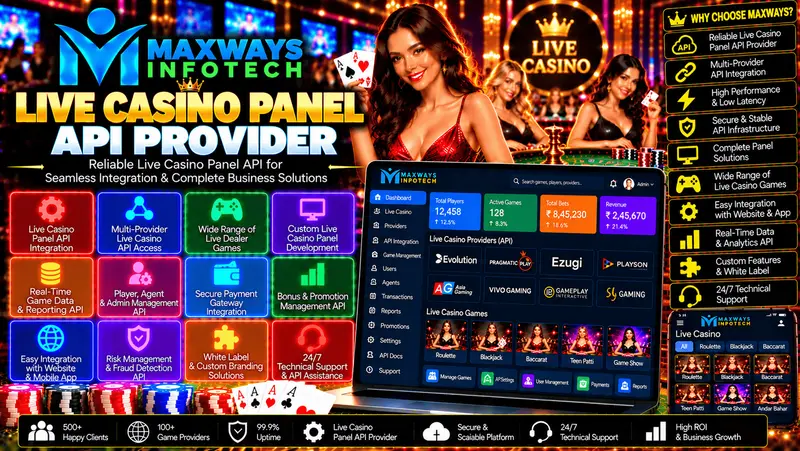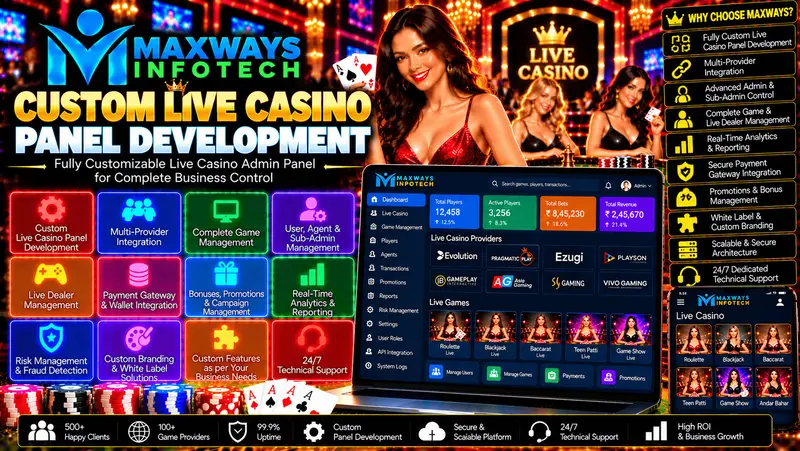
Explore live casino platform development services, including backend architecture, API integration, responsive interfaces, security, testing, and maintenance.
Live Casino Platform Development Services: Features, Architecture, and Solutions
Live Casino Platform Development Services need to understand which components should be built from scratch, which can be integrated from existing software, and how the finished system will be tested and maintained.
A well-planned development process begins with clear requirements, a suitable technical architecture, and an understanding of the relevant provider agreements and legal obligations.
At Maxways Infotech, businesses can explore software and game development capabilities when planning digital products. This guide explains the essential components of a live casino platform, the development workflow, technical considerations, and questions to ask before selecting a development partner.
What Are Live Casino Platform Development Services?
Live casino platform development services involve designing, building, integrating, testing, and maintaining software used to support an online live gaming experience.
Depending on the project scope, the work may include:
-
Frontend development: Responsive interfaces and navigation.
-
Backend development: Application logic, request processing, and service communication.
-
API integration: Connections to authorised third-party software providers.
-
Database development: Structured data storage and retrieval.
-
Administrative tools: Configuration, permissions, and operational management.
-
Reporting and monitoring: Tools for reviewing application health and technical events.
-
Quality assurance: Functional, performance, compatibility, and security testing.
-
Ongoing maintenance: Defect resolution, software updates, and integration support.
The precise features depend on the requirements, selected technology, third-party services, and agreed deliverables.Live Casino Platform Development Company | Maxways Infotech
Essential Features of a Live Casino Platform
A successful development project should start with a defined feature set instead of assuming that every platform needs the same components.
1. Responsive Frontend Design
The frontend is the part of the platform that users interact with. A responsive design adapts the interface to supported screen sizes and devices.
Important considerations include:
-
Clear navigation and page structure.
-
Consistent interface components.
-
Readable text and accessible controls.
-
Appropriate loading and error messages.
-
Optimised images and other assets.
-
Compatibility with supported browsers.
Usability testing helps identify issues before the platform is released.
2. Backend Application Architecture
The backend processes requests, applies application rules, communicates with databases, and connects with external services.
A maintainable architecture should define the responsibilities of each component and establish how errors, timeouts, and unavailable services will be handled.
The architecture should fit the actual project requirements. A smaller application may work well with a modular backend, while a more complex system may benefit from separating selected services.
3. Live Game API Integration
Where external game services are required, the platform needs a supported and authorised integration method.
Depending on the API, this may involve retrieving game information, requesting authorised sessions, processing provider responses, or receiving supported status updates.
Developers should confirm the available endpoints, authentication requirements, testing environment, provider restrictions, and ongoing maintenance arrangements.
For more technical detail, read the ive-casino-gaming-platform-developers, which covers API connectivity, session management, callbacks, and backend monitoring.
4. Database and Data Management
The database stores the information required by the application. A good design establishes clear relationships between records, suitable identifiers, and rules for updating information.
Depending on the project, database work may include:
-
Schema design and query optimisation.
-
Data validation.
-
Access permissions.
-
Backup and recovery procedures.
-
Data-retention policies.
-
Migration planning.
-
Record reconciliation where connected systems exchange data.
Sensitive information should be collected and retained only as required, with appropriate controls in place.
5. Administrative Dashboard
An administrative dashboard may help authorised staff manage supported settings, review integration status, and access operational reports.
The available functionality depends on the project. Access should be restricted by role, and important administrative actions should be recorded where appropriate.
6. Reporting and Monitoring
Monitoring helps technical teams identify failed requests, service interruptions, response delays, and other operational issues.
A useful implementation should define which metrics are tracked, how alerts are triggered, and who is responsible for responding to incidents.
How Live Casino Platform Development Works
A structured development lifecycle makes the project easier to plan, test, and maintain.
Step 1: Requirement Analysis
Identify the intended platform, required features, supported devices, external integrations, budget, and operational requirements.
Document essential deliverables, optional features, third-party dependencies, and acceptance criteria.
Step 2: Technical Architecture Planning
Define the frontend, backend, database, API integrations, security controls, and deployment environment.
Decide which system is responsible for each important type of information and how components will communicate.
Step 3: UI and UX Design
Create page layouts, navigation, and reusable interface components. Review the designs with stakeholders before full implementation begins.
Step 4: Frontend and Backend Development
Build the user interface and server-side functionality according to the approved requirements.
Use consistent coding practices, documented interfaces, secure configuration, and appropriate access controls.
Step 5: API Integration
Connect authorised third-party services using their documented interfaces.
Implement authentication, request validation, response mapping, error handling, and monitoring as required by the integration.
Step 6: Testing and Quality Assurance
Test expected workflows alongside invalid requests, timeouts, unavailable services, expired sessions, and other failure conditions.
Performance and security testing should reflect the intended production environment.
Step 7: Deployment
Deploy after the agreed acceptance criteria have been met. Configure production credentials, access permissions, monitoring, backups, and incident-response procedures.
Step 8: Maintenance and Updates
After launch, the platform may require bug fixes, security reviews, dependency updates, API compatibility changes, and performance improvements.
The development agreement should clearly define who handles these responsibilities.
Technology Stack for Platform Development
The appropriate technology stack depends on the project's complexity, existing infrastructure, integration requirements, and maintenance needs.
| Component | Example technologies |
|---|---|
| Frontend | HTML, CSS, JavaScript, React |
| Backend | Node.js, PHP, or another suitable server-side technology |
| Database | MySQL, PostgreSQL, or another appropriate database |
| API connectivity | REST APIs or other provider-supported interfaces |
| Testing | Unit, integration, and end-to-end testing |
| Deployment | Cloud or dedicated infrastructure |
| Monitoring | Structured logging, metrics, and error tracking |
These are examples rather than mandatory choices. The development team should explain why the selected technologies suit the project.
Custom Platform Development vs. White Label Software
Businesses may choose a custom-built platform, an existing white label solution, or a combination of both.
Custom Development
Custom development creates software around specific project requirements. It may offer greater control over architecture, functionality, and integration choices, but requires development time, testing, documentation, and maintenance.
White Label Software
A white label solution uses an existing software foundation that can be configured for a business's brand, subject to the provider's capabilities and contract.
It may reduce initial development work, but businesses should check customisation limits, integration options, recurring costs, data ownership, and exit conditions.
For a related overview, read the live-casino-website-development-services.
Choosing the Right Approach
Compare the required features, total cost, delivery expectations, provider dependencies, and long-term maintenance requirements. The right approach is the one that meets the documented needs and can be operated responsibly.
Security Requirements for Live Casino Platforms
Security should be incorporated into the design and development process from the beginning.
Credential protection: Keep private API keys and service credentials on the server and restrict access.
Request validation: Validate input data and enforce permissions before processing protected operations.
Secure communications: Use appropriate encrypted connections and follow provider security requirements.
Callback verification: Verify incoming callbacks using the documented authentication or signature mechanism.
Access controls: Apply role-based permissions and review privileged access regularly.
Error handling: Avoid exposing credentials, internal stack traces, or confidential system details.
Monitoring: Track relevant operational failures and suspicious activity while minimising sensitive information in logs.
Recovery planning: Establish appropriate backup, incident-response, and recovery procedures.
The precise controls should reflect the system architecture, the information processed, and applicable regulatory requirements.
Common Challenges in Platform Development
API Compatibility
Different providers may use different authentication methods, data formats, and session workflows. Developers should verify the documentation and test integrations before production deployment.
Performance Problems
Slow database queries, inefficient code, and external API delays can affect responsiveness. Monitoring and profiling help identify the actual cause.
Inconsistent Data
Connected services may process updates at different times. Stable identifiers, clear data ownership, and reconciliation procedures can help investigate discrepancies.
Service Interruptions
External services may become temporarily unavailable. Appropriate timeouts, bounded retries, and clear error handling help prevent uncontrolled retry behaviour.
Changing Requirements
Late changes can affect scope, testing, cost, and delivery dates. A documented change-management process helps stakeholders assess the impact before approval.
Ongoing Maintenance
Software dependencies and third-party APIs can change after launch. Establish responsibility for monitoring updates, testing compatibility, and resolving production issues.
How to Choose a Live Casino Platform Development Company
When evaluating development partners, consider these questions:
-
Relevant experience: Can the company demonstrate comparable software or API integration projects?
-
Technical approach: Is the proposed architecture clearly documented and appropriate for the requirements?
-
Security: How will credentials, permissions, and sensitive information be protected?
-
Testing: What functional, integration, performance, and security tests are included?
-
Documentation: What technical and operational documents will be delivered?
-
Maintenance: Who handles defects, API changes, and production incidents?
-
Ownership: Who owns the custom code, design assets, and project documentation?
-
Compliance: Have the necessary provider permissions, licences, and market-specific requirements been verified?
Businesses can visit Maxways Infotech to explore software development services and discuss their project requirements.
SEO Considerations for a Gaming Software Website
SEO should be planned alongside the website structure, rather than treated as a final publishing task.
Useful practices include:
-
Writing original content for distinct search intents.
-
Using descriptive page titles and meta descriptions.
-
Organising content with a logical heading hierarchy.
-
Linking to genuinely relevant service pages and supporting articles.
-
Using natural anchor text instead of repeating exact-match keywords everywhere.
-
Adding descriptive alt text to meaningful images.
-
Maintaining accurate sitemap and canonical URL settings.
-
Avoiding near-identical articles created solely to target keyword variations.
Frequently Asked Questions
1. What are live casino platform development services?
They involve planning, building, integrating, testing, and maintaining software components that support a live gaming platform. The scope depends on the project requirements and available technology.
2. Can a platform be developed for mobile devices?
Yes. A platform can be designed for supported mobile browsers or applications, subject to the requirements of the frontend, APIs, media services, and target devices.
3. Does platform development include API integration?
It can. API integration connects compatible external services with the platform. The required endpoints, authentication methods, and supported functions must be confirmed from the provider's documentation.
4. How long does platform development take?
The timeline depends on the number of features, technical complexity, integrations, testing requirements, third-party approvals, and available resources. A reliable estimate follows requirements analysis.
5. Is maintenance necessary after launch?
Yes. Maintenance may include bug fixes, dependency updates, security reviews, monitoring, performance improvements, and compatibility changes.
6. What should be tested before deployment?
Test core functionality, authentication, permissions, API responses, error handling, supported devices, performance, and recovery from service interruptions.
7. What should be checked before choosing a development partner?
Review technical experience, project scope, testing practices, security, documentation, maintenance responsibilities, ownership terms, and applicable compliance requirements.
Conclusion
Choosing suitable Live Casino Platform Development Services requires a clear understanding of the application's features, backend architecture, authorised integrations, security controls, and long-term maintenance needs.
A structured development process helps teams manage technical dependencies, test both successful and failed workflows, and establish clear responsibilities before launch. Businesses should also verify third-party permissions and applicable legal requirements before deploying any live casino-related product.
To explore software development options and discuss your requirements, visit Maxways Infotech.
Compliance note: Live casino-related software should only be developed and operated where legally permitted. Confirm applicable licences, provider permissions, age safeguards, privacy protections, responsible-use measures, and regulatory obligations before launch.Live Casino Backend Development Services | Maxways Infotech