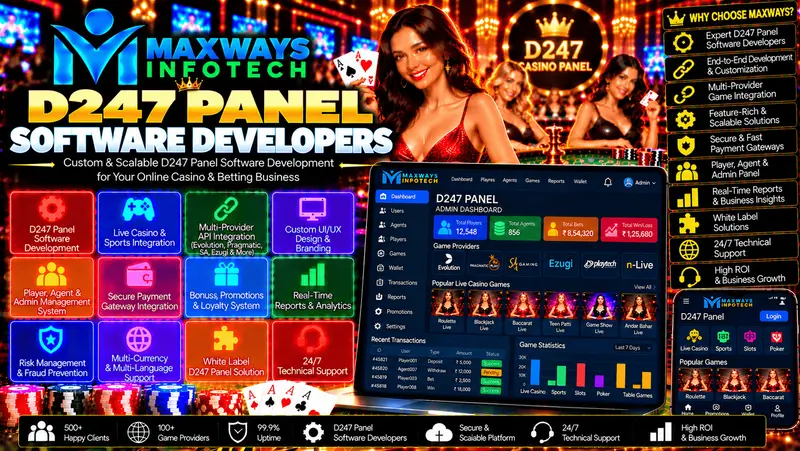
Explore live casino website software providers, platform features, customisation, API integration, security, technical support, and maintenance.
Live Casino Website Software Providers: Features, Solutions, and Selection Guide
Live Casino Website Software Providers offer software platforms, website technology, or related development services for live casino-related digital experiences. Depending on the provider, solutions may include website interfaces, content management, administrative tools, API connectivity, technical support, and software maintenance.
However, providers differ in their capabilities, licensing arrangements, customisation options, and support models. Evaluating these differences before making a decision can help businesses identify a solution that matches their technical requirements and budget.
At MaxWays Infotech, businesses can explore digital technology and software development topics. This guide explains what live casino website software providers offer, which features to evaluate, and how to assess a platform before committing to a project.
What Are Live Casino Website Software Providers?
Live casino website software providers supply or develop technology used to build, operate, or maintain websites associated with live casino services.
Some providers offer an existing software platform that can be configured for a business's branding and requirements. Others specialise in custom website development, integration services, or specific technical components.
Depending on the provider and agreement, services may include:
-
Website software and interface components.
-
Responsive website design and development.
-
Content management and administrative tools.
-
Backend development and approved API integrations.
-
Security and access-control features.
-
Performance testing and technical maintenance.
-
Documentation and technical support.
Not every provider offers a complete platform. Businesses should clarify which components are included, which are supplied by third parties, and which require additional development.
For a broader explanation of platform connectivity, explore the live-casino-website-developers-in-bengaluru.
Types of Live Casino Website Software Solutions
1. Ready-Made Website Platforms
A ready-made platform provides an existing software foundation that can be configured for an agreed set of requirements.
This approach may reduce the need to develop every component independently. However, businesses should review the platform's limitations, supported integrations, customisation options, and ongoing costs.
Before choosing this model, confirm whether the software supports the required design changes and whether the provider allows future migration to another system.
2. White-Label Software Solutions
White-label software allows an eligible business to present supported software or website functionality under its own brand, subject to the provider's contract and applicable legal requirements.
Customisation may include logos, colours, page layouts, and selected interface elements. The extent of customisation varies between providers.
Businesses interested in this model can read the live-casino-website-software-development to understand how API-based services can form part of a wider software arrangement.
A white-label agreement does not automatically transfer software ownership, grant unrestricted source-code access, or provide all licences required to operate a gambling service.
3. Custom Website Software Development
Custom development creates website components around a project's specific requirements. It may provide greater control over design, workflows, integrations, and the underlying architecture.
This approach can be useful when existing platforms do not support important requirements. However, it may involve additional design work, development effort, testing, and long-term maintenance.
Businesses should assess whether the additional flexibility justifies the total project cost.
4. API and Integration Solutions
Some providers specialise in connecting software components rather than supplying a complete website platform.
These services may help a website communicate with authorised external systems through documented APIs. The exact capabilities depend on the provider's supported functions and permissions.
Review the live-casino-management-software-providers for additional context about casino-related API integration.
An API provider should clearly explain its documentation, authentication requirements, data handling, limitations, and support arrangements.
Essential Features to Evaluate
Website Customisation
A suitable platform should support the design changes required for the project.
Evaluate branding options, navigation, page layouts, typography, content sections, and responsive behaviour. Ask which changes can be made through configuration and which require custom development.
A consistent design system can help maintain the website's visual identity across different pages and devices.
Responsive User Interface
A responsive interface adapts to desktops, tablets, and smartphones. This is important for usability because visitors may use different devices and screen sizes.
Check whether the software supports mobile-friendly navigation, readable typography, flexible layouts, accessible controls, and compatibility with the browsers relevant to your audience.
Ask for a working demonstration rather than relying only on screenshots.
Content and Administrative Management
Administrative tools can help authorised staff manage website content, settings, and other supported functions.
Before selecting a provider, establish which features are included, how user permissions are controlled, and whether the interface supports the tasks your team needs to perform.
The provider should also explain how configuration changes are documented and backed up.
API Compatibility
Integration capabilities can influence whether a platform fits your technical requirements.
Review supported API functions, authentication methods, data formats, rate limits, error responses, and versioning policies. Confirm whether the provider offers a testing environment and technical documentation.
Private credentials should be stored securely and should not be exposed in browser code or public repositories.
Security and Privacy Controls
Security features should be evaluated as part of the software selection process.
Depending on the system, relevant controls may include encrypted connections, secure authentication, role-based permissions, protected credentials, activity logging, and timely software updates.
If the website processes personal or financial information, confirm which privacy and data-protection obligations apply and how data access and retention are managed.
Scalability and Performance
A platform should be suitable for its expected workload and allow reasonable improvements as requirements evolve.
Ask how the provider approaches performance testing, monitoring, infrastructure capacity, and service interruptions.
Avoid paying for unnecessary infrastructure before understanding the project's actual requirements.
Technical Support and Maintenance
Ongoing support can be important when a website depends on external APIs, hosted services, or provider-managed software.
Confirm whether the agreement includes updates, defect fixes, troubleshooting, security patches, backups, and integration maintenance.
The contract should also explain support availability, response expectations, escalation procedures, and additional charges.
How to Compare Live Casino Website Software Providers
Choosing a provider involves more than comparing feature lists. Businesses should evaluate the full technical and commercial arrangement.
Review the Provider's Experience
Ask for relevant portfolio examples, product demonstrations, and technical documentation.
Check whether the provider has experience with the required website architecture, integrations, responsive design, and maintenance processes.
Verify that the features demonstrated are included in the proposed service rather than available only through separate arrangements.
Compare Features and Limitations
Prepare a requirements checklist before requesting proposals. Separate essential features from optional enhancements.
Compare each provider's capabilities against the checklist and document any limitations, third-party dependencies, or additional development requirements.
This makes comparisons more useful than relying on broad claims about being a complete or all-in-one solution.
Understand Pricing and Contract Terms
The total cost may include initial setup, software licensing, hosting, customisation, integration, maintenance, and third-party services.
Ask for an itemised quotation that distinguishes one-time fees from recurring charges. Confirm how prices may change when the project grows or provider requirements change.
Confirm Ownership and Data Access
The agreement should explain who owns custom code, design assets, documentation, and project data.
Also confirm whether the business can export its data, access the necessary configuration, and migrate to another provider if the relationship ends.
Evaluate Support Quality
Ask how the provider handles outages, security issues, API changes, and urgent technical problems.
A documented support process helps establish who is responsible for investigating an issue and how updates will be communicated.
Software Provider vs Custom Development Company
A software provider and a custom development company may offer different types of value.
Software provider: Supplies an existing product or platform with defined features, configuration options, and support terms.
Custom development company: Builds or modifies website components around project-specific requirements.
Hybrid arrangement: Combines an existing platform with custom-built features or integrations.
The right option depends on the available software, the amount of customisation required, the budget, and the business's long-term technical plans.
Businesses should compare total ownership costs, maintenance responsibilities, data portability, and contractual restrictions before selecting a model.
The Software Evaluation and Implementation Process
Step 1: Define Business and Technical Requirements
Document the website's purpose, required pages, expected features, branding, integrations, budget, and maintenance expectations.
Identify any legal or regulatory requirements relevant to the intended service and markets.
Step 2: Shortlist Suitable Providers
Use the requirements checklist to identify providers whose documented capabilities match the project's needs.
Request demonstrations and ask questions about missing features or technical limitations.
Step 3: Review Documentation and Permissions
Examine the software documentation, API access, licensing terms, content rights, security arrangements, and support scope.
Do not assume that access to a platform automatically includes every integration or commercial right.
Step 4: Test the Proposed Solution
Where possible, evaluate a demonstration or testing environment before making a commitment.
Check responsive behaviour, navigation, configuration options, integration reliability, and administrative controls.
Step 5: Agree on Scope and Responsibilities
The contract should specify deliverables, fees, exclusions, acceptance criteria, support responsibilities, and ownership arrangements.
Clearly document which party is responsible for the website, third-party services, data, and ongoing compliance.
Step 6: Deploy and Maintain
Once the solution meets the agreed requirements, follow a controlled deployment process.
Establish monitoring, backup procedures, support contacts, and maintenance responsibilities before launch.
SEO Considerations for Live Casino Website Software
Search engine optimisation should be considered when planning the website's content and technical structure.
Keyword and Content Planning
Use the primary keyword, Live Casino Website Software Providers, naturally in the page title, main heading, introduction, and relevant supporting sections.
Related terms should appear only where they accurately describe the subject. Avoid excessive keyword repetition or publishing multiple pages with nearly identical content.
Unique Titles and Meta Descriptions
Each important page should have a distinct title and meta description that accurately reflect its content.
Avoid repeating the same metadata across every service page or promising software features that the provider does not offer.
Useful Internal Links
Internal links help readers find relevant resources and help search engines understand the website's content structure.
Use descriptive anchor text, check that links work, and link only to pages that provide relevant information.
Technical SEO
Review mobile usability, page performance, HTTPS, crawlable navigation, canonical URLs, and XML sitemap accuracy.
Optimise images and provide meaningful alt text for informative visuals. Avoid unnecessary duplicate pages and ensure that important content can be accessed through working links.
Legal and Regulatory Considerations
Software availability does not automatically authorise a business to offer gambling services.
Before launch, verify the applicable licences, supplier permissions, content rights, age safeguards, privacy requirements, and responsible-use obligations in every intended market.
Contracts should identify the responsibilities of the business, software provider, and any other service partners. Qualified legal and compliance advice may be needed to assess the proposed operating model.
Frequently Asked Questions
What do live casino website software providers offer?
Depending on the provider, offerings may include website software, responsive interfaces, administrative tools, API integration, hosting, maintenance, and technical support.
How do I choose a live casino website software provider?
Compare the provider's capabilities, customisation options, security practices, documentation, pricing, licensing terms, support, and ownership arrangements.
What is the difference between white-label software and custom development?
White-label software starts with an existing solution that can be presented under an approved brand. Custom development builds or modifies components around specific requirements.
Do all providers include API integration?
No. Integration capabilities vary. Confirm which APIs are supported, whether access is included, and whether separate development or commercial agreements are required.
How much does live casino website software cost?
Costs depend on licensing, setup, customisation, integrations, hosting, support, and maintenance. Request a detailed quotation that separates initial and recurring charges.
Can software providers guarantee SEO rankings?
No provider can guarantee specific search rankings. Good technical SEO, useful content, clear navigation, and appropriate internal linking can support a website's search visibility, but outcomes depend on many factors.
Conclusion
Selecting suitable Live Casino Website Software Providers requires careful evaluation of platform features, customisation, integration capabilities, security, pricing, and ongoing support.
Businesses should begin with clear requirements, compare providers against a documented checklist, and test important functionality before committing. Reviewing licensing terms, ownership rights, data access, and maintenance responsibilities can also reduce uncertainty over the life of the project.Bookies Website Software Providers | Maxways Infotech
Compliance note: Live casino and gambling-related services must only be offered where legally permitted, with the required licences, age safeguards, privacy protections, and responsible-use measures in place.