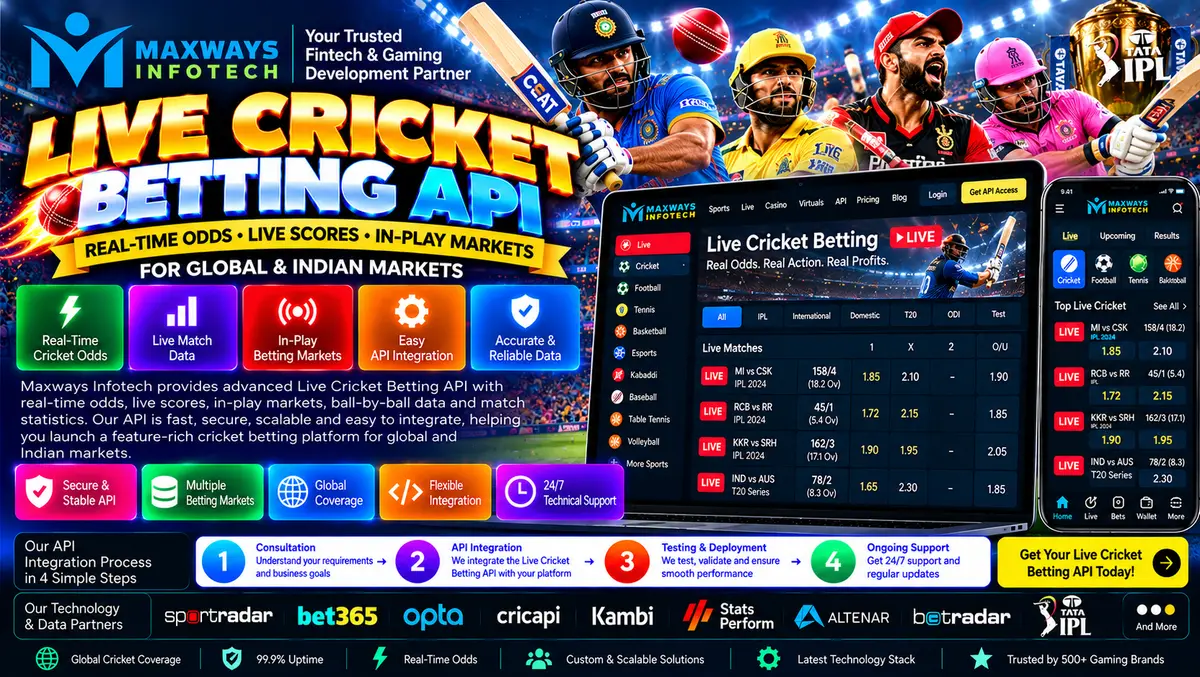
Learn about Live Cricket Betting API integration, ball-by-ball events, innings updates, data validation, API architecture, security, and compliance.
Live Cricket Betting API: Ball-by-Ball Data, Match Updates, and Integration
Introduction
Cricket is a constantly changing sport. A single delivery can produce a boundary, a wicket, a no-ball, or a change in the match situation. For applications that process live cricket information, these events create a technical challenge: data must be received, interpreted, and connected to the correct match state without introducing inconsistencies.
A Live Cricket Betting API is a data interface that may provide live cricket odds alongside match information, depending on the provider and subscription. Developers researching this technology should look beyond the odds feed itself. Ball-by-ball events, innings changes, over calculations, timestamps, and market-status records can all affect how an application processes and presents information.
This guide explains the technical components, integration considerations, data validation methods, and compliance checks involved in working with live cricket data. To learn more about the technology solutions and services offered by Maxways Infotech, explore the company's website.
What Is a Live Cricket Betting API?
A Live Cricket Betting API provides structured data associated with cricket matches in progress. Depending on the provider, a feed may contain several categories of information:
-
Live match identifiers and competition details
-
Team names, innings information, and match status
-
Ball-by-ball events and score updates
-
Overs, wickets, runs, and other match statistics
-
Odds records and market status, where supplied
-
Update timestamps and data version information
Not every API includes all these fields. Some providers specialise in scores and match statistics, while others offer separate odds feeds. Before choosing a service, developers should confirm which datasets are available and whether their intended use is covered by the provider's licence.
Why Cricket Data Requires Special Handling
Unlike sports with a comparatively simple clock-based structure, cricket has multiple innings, legal and illegal deliveries, changing partnerships, and format-specific rules. These details influence how data should be interpreted.
1. Ball-by-Ball Event Processing
A cricket feed may report an ordinary delivery, a wide, a no-ball, a wicket, or an extra run. The integration must interpret the event according to the provider's schema rather than assuming every delivery increments the over in the same way.
For example, an over display should not be updated merely because the application receives another event. The backend should use the provider's documented over and delivery fields, validate the event, and reconcile the resulting match state.
2. Innings and Match-State Transitions
An innings ending is a significant change in the match data. The application may need to refresh the batting team, bowling team, scorecard, target information, and other dependent fields.
The data model should distinguish states such as scheduled, in progress, innings break, interrupted, completed, and abandoned whenever the provider supports them. This prevents an application from treating an innings break as a completed match.
3. Correcting Delayed or Revised Events
Live feeds may arrive late or contain revised records. A robust integration should retain event identifiers and timestamps where available, detect duplicate messages, and reconcile changes against the latest valid match state.
This is particularly important when multiple updates arrive close together. The newest message is not necessarily the most authoritative unless the provider's documentation establishes how updates should be ordered.
Essential Features to Check in a Live Cricket Betting API
Cricket Format and Competition Coverage
Check whether the provider supports the formats and competitions required by your application, such as Test cricket, One Day Internationals, T20 Internationals, domestic tournaments, and other licensed competitions.
Coverage should be assessed by actual event availability, not just a general claim of cricket coverage.
Structured Match Identifiers
Stable identifiers help connect fixtures, scorecards, event records, and any separately supplied odds data. Avoid matching records only by team names because names may be abbreviated, translated, or written differently across feeds.
A mapping layer should associate the provider's event ID with the application's internal match ID.
Odds and Market Metadata
If odds data is included, inspect the market identifiers, selection identifiers, value formats, timestamps, and status fields. Determine whether the provider supplies decimal odds, fractional odds, American odds, or another documented format.
The application should preserve the source value and its format before applying any display conversion. This makes testing and troubleshooting easier.
Delivery Method and Update Frequency
Providers may deliver updates through REST polling, WebSockets, or server-sent events. Confirm the available method, documented update frequency, connection limits, and recovery procedure.
A provider's advertised update interval should not be confused with a guarantee that every update will arrive instantly.
Historical Records and Test Access
Historical event records can help developers replay innings transitions, investigate data discrepancies, and test edge cases. A sandbox or sample dataset can also make it easier to validate the integration before connecting to live production feeds.
Check retention periods, historical access, and permitted storage in the provider agreement.
How to Integrate a Live Cricket Betting API
A well-designed integration separates external data collection from application presentation.
Step 1: Review the documentation.
Identify the authentication scheme, endpoints, response formats, available cricket competitions, rate limits, and data-use conditions. Make a list of the fields your application actually needs.
Step 2: Build the event mapping layer.
Create a consistent internal model for matches, teams, innings, scorecards, and event identifiers. If odds are supplied separately, map them to the correct match and market using documented identifiers.
Step 3: Load the initial match snapshot.
Retrieve the latest available match state before processing incremental updates. This provides a baseline against which later changes can be checked.
Step 4: Process incoming events.
Receive updates using the supported transport. Validate their structure and timestamps, handle duplicates, and apply changes in the order defined by the provider's documentation.
Step 5: Reconcile the match state.
Compare important fields, such as the current innings, over, score, and match status, with the latest authoritative snapshot when necessary. If a gap is detected, request a fresh snapshot or use the provider's recovery mechanism.
Step 6: Update the application interface.
Send the validated state to the frontend through your backend. Keep the interface clear about data freshness and distinguish current information from stale or unavailable records.
Step 7: Monitor and test.
Log API failures, processing delays, schema errors, missing events, and reconnection activity. Use test fixtures and replayable sample data to check the behaviour of the integration before deployment.
For information about the company's wider technology offerings, visit Maxways Infotech's services page.
Recommended Architecture for Live Cricket Data
A layered architecture makes it easier to troubleshoot problems and change providers later.
Data provider → Ingestion service → Validation and event mapping → Cache or database → Application backend → User interface
Each layer has a separate responsibility:
-
Ingestion service: Retrieves data and manages connections.
-
Validation layer: Checks event structure, timestamps, identifiers, and data types.
-
Event mapping: Converts provider-specific fields into a consistent internal format.
-
Cache and database: Stores current state and any historical information permitted by the licence.
-
Application backend: Exposes the required information to authorised clients.
-
User interface: Presents the processed data and indicates when information is unavailable or delayed.
Keeping provider credentials on the server is an important security measure. It also gives the application greater control over request limits, caching, and access permissions.
Common Integration Problems and Their Solutions
Duplicate Ball Events
Repeated messages can create incorrect score changes if the application processes every message as a new event. Use stable event IDs or documented sequence identifiers to recognise duplicates.
Missing Updates After a Disconnection
A reconnection does not always guarantee that every missed event will be replayed. Follow the provider's recovery guidance and fetch a fresh snapshot when necessary.
Inconsistent Team or Match Names
Use stable provider IDs and a maintained mapping table instead of relying on free-text names. This reduces the chance of joining data from different fixtures.
Incorrect Over Calculations
Do not calculate the displayed over by incrementing a counter for every received delivery. Use the provider's documented over, ball, and extras fields, and validate the resulting state against the scorecard.
Stale Odds or Market Records
Where odds are supplied, track the update timestamp and market status. If information becomes too old according to the application's defined freshness policy, mark it as stale rather than presenting it as current.
Unexpected API Responses
Validate response schemas and handle missing or newly added fields safely. Record enough diagnostic information to identify the problem without exposing authentication keys or other secrets in logs.
How to Evaluate a Live Cricket API Provider
Before making a selection, compare providers against measurable requirements.
A short technical proof of concept is often more useful than selecting a provider based on promotional claims. Test representative match scenarios, including an innings change, a rain interruption, a delayed update, and a completed match.
Security and Legal Compliance
Secure API integration should include encrypted connections, server-side credential storage, least-privilege access, input validation, and sensible log retention. Applications should also protect any personal information they collect.
Legal compliance requires separate consideration. India's Promotion and Regulation of Online Gaming Act, 2025 and the Promotion and Regulation of Online Gaming Rules, 2026 establish restrictions on online money games and related facilitation. The Rules took effect on 1 May 2026, according to the Ministry of Electronics and Information Technology. The official government materials explain the distinction between prohibited online money games and permitted categories of online gaming.
A cricket data API does not itself establish that a betting-related product or its intended use is lawful. Businesses should obtain qualified legal advice and verify applicable national and state requirements before deploying any product involving odds, wagering, or related services.
Conclusion
A Live Cricket Betting API integration requires more than receiving a score or odds value. Cricket-specific event processing, innings transitions, stable identifiers, timestamp validation, recovery mechanisms, and clear market-status handling all contribute to reliable data processing.
The strongest technical approach is to separate ingestion, validation, state reconciliation, and presentation. This makes the application easier to maintain and helps teams identify data problems before they affect users.
For more technology articles, implementation insights, and related development topics, explore the Maxways Infotech blog.