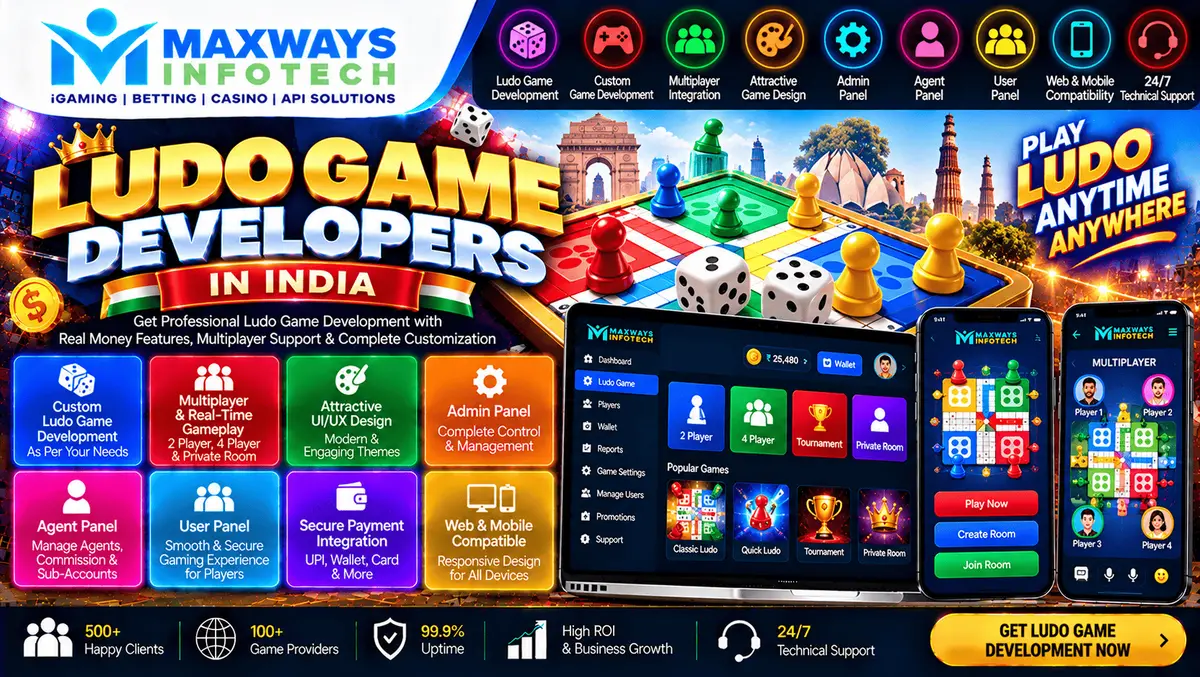
Looking for Ludo game developers in India? Explore custom Ludo game app development, multiplayer features, technology, cost factors and development process.
Ludo Game Developers in India: Custom Ludo Game App Development Guide
Introduction
Ludo has become a familiar choice for digital board-game experiences, bringing traditional gameplay to mobile devices and web platforms. Businesses planning to launch their own Ludo game can work with Ludo game developers in India to explore custom game design, multiplayer functionality, mobile application development, and backend infrastructure.
A successful Ludo game requires more than an attractive board and colourful tokens. It needs accurate game rules, smooth animations, reliable multiplayer communication, intuitive navigation, and testing across supported devices. Depending on the project, it may also include private rooms, player profiles, leaderboards, tournaments, virtual rewards, and administration tools.
Maxways Infotech offers game and software development services through its website. Businesses can visit the Maxways Infotech homepage to explore its services and discuss their project requirements.
This guide covers the essential features, technology options, development stages, cost factors, and practical considerations for choosing a Ludo game development company in India.
What Do Ludo Game Developers in India Do?
Ludo game developers design and build digital versions of the classic board game for mobile devices, browsers, and other supported platforms.
Depending on the project scope, their work may include:
-
Game design: Planning rules, board layouts, turn sequences, player limits, and winning conditions.
-
UI/UX design: Creating clear menus, player screens, game rooms, and settings.
-
Game programming: Implementing dice rolls, token movement, turn management, and rule validation.
-
Multiplayer development: Connecting players in private rooms or online matches.
-
Backend development: Managing accounts, game sessions, configuration, and other server-side functions.
-
Quality assurance: Testing gameplay, device compatibility, network interruptions, and edge cases.
-
Post-launch support: Fixing bugs, improving performance, and releasing updates.
The exact services vary between development companies. Before signing an agreement, clarify which features are included and whether the project requires original development, customisation of an existing game, or both.Live casino game devlopers in rajasthan | Maxways Infotech
Types of Ludo Games You Can Develop
Choosing a game format early helps determine the design, architecture, and estimated project effort.
1. Classic Ludo Game
A classic Ludo game follows familiar board-game rules, including dice rolls, token movement, turns, and reaching the finishing area.
Potential features include:
-
Standard game rules and board layouts.
-
Two-player and four-player modes, where supported.
-
Animated dice and token movement.
-
Clear turn indicators.
-
Sound effects and gameplay settings.
The rules should be documented before development begins so that the behaviour remains consistent across all supported devices.
2. Online Multiplayer Ludo
An online multiplayer Ludo game allows participants to play together over an internet connection.
Typical development requirements include matchmaking, session management, synchronised game states, reconnection handling, and server-side validation of moves.
Multiplayer functionality requires special attention to latency and interrupted connections. The system should prevent players from taking invalid turns or submitting conflicting actions.
3. Private Room Ludo
Private rooms allow users to create or join a match using an invitation or room code.
Possible features include room creation, joining permissions, player readiness, match settings, and clear handling of expired or full rooms.
The development team should specify how room codes work, how long rooms remain available, and what happens when a player disconnects before the game begins.
4. Ludo With AI Opponents
A Ludo game can include computer-controlled opponents for single-player or practice modes.
AI difficulty may be adjusted to provide different playing experiences. The rules engine should remain consistent with the same legal-move restrictions used for human players.
5. Custom-Branded Ludo Game
A branded Ludo application can use custom colours, illustrations, animations, sounds, and interface layouts.
A business may also request multiple language options, accessibility improvements, player profiles, or additional game modes. All requested features should be documented and approved before implementation.
Essential Features of a Modern Ludo Game App
A strong feature plan balances usability, gameplay quality, and technical reliability.
Smooth Gameplay and Rule Validation
The game engine should handle dice results, legal moves, token positions, player turns, safe squares, and victory conditions accurately.
Game outcomes and important state changes should be validated by the appropriate game logic rather than relying only on interface animations.
User Registration and Guest Play
Depending on the product, users may be able to play as guests or create accounts.
If accounts are supported, the application should handle authentication, session expiry, account recovery, and privacy requirements appropriately.
Matchmaking and Room Management
Matchmaking can help players find suitable opponents, while private rooms support matches between invited participants.
The system should manage waiting rooms, timeouts, player departures, and unsuccessful matchmaking attempts.
Leaderboards and Player Statistics
Leaderboards and statistics can display information such as completed matches, wins, and other defined performance measures.
The application should explain how statistics are calculated and avoid exposing private player information.
Rewards and In-Game Items
A casual game may include cosmetic items, virtual rewards, achievements, or progression levels.
If the product includes purchases or other monetisation, disclose the relevant terms clearly and follow applicable platform policies and legal requirements.
Notifications and Social Features
Where appropriate, the application may support invitations, match reminders, friend lists, or in-game communication.
Social features should include suitable privacy settings and safeguards against harassment, spam, and misuse.
Admin Panel and Analytics
An administration dashboard can help authorised staff manage supported settings, review technical issues, and monitor application performance.
Analytics can identify loading problems, unsuccessful matches, recurring errors, and user experience issues. Data collection should be limited to legitimate purposes and handled according to the application's privacy policy.
Technologies Used for Ludo Game Development
The technology stack depends on the intended devices, visual complexity, multiplayer requirements, and available development resources.
Unity
Unity can be suitable for mobile and cross-platform games that require interactive 2D or 3D graphics, animation, and game logic.
HTML5 and JavaScript
HTML5-based development can support browser-accessible games. This approach may be appropriate when users need to play without installing a separate application.
Backend Technologies
Backend technologies such as Node.js or PHP can support APIs, authentication, match management, configuration, and communication with other application services.
Databases
A database may store account information, game configuration, statistics, and other application records. The design should include appropriate access controls, backup arrangements, and data-retention rules.
Real-Time Communication
Multiplayer games need a reliable way to synchronise game state. WebSockets or another suitable communication method may be used, depending on the architecture.
The server should validate important game actions and handle reconnection, delayed messages, and duplicate requests safely.
Android and iOS Development
A project may target Android, iOS, or both. The development plan should include device testing, screen-size compatibility, performance checks, and any relevant app-store requirements.
The Ludo Game Development Process
A structured development process helps businesses control scope and review progress before launch.
Step 1: Define the Game Concept
Decide the game type, target audience, platforms, rules, supported player counts, and essential features.
Prepare a feature list that separates must-have functionality from optional enhancements.
Step 2: Create UI/UX Designs
Design the board, menus, player profiles, game rooms, settings, and results screens.
A prototype can help stakeholders review the navigation and gameplay flow before full development starts.
Step 3: Build the Game Engine
Implement the rules, dice behaviour, token movement, turn sequence, and win conditions. Test the logic independently before connecting it to the complete interface.
Step 4: Develop Multiplayer and Backend Services
If online play is required, implement matchmaking, room management, synchronisation, reconnection handling, and server-side validation.
Step 5: Integrate Supporting Features
Add the agreed features, such as user accounts, leaderboards, notifications, virtual items, or analytics.
Third-party services should be integrated only where necessary and according to their documentation and terms.
Step 6: Test the Application
Test gameplay rules, network conditions, device compatibility, usability, and security. Multiplayer testing should cover disconnected players, simultaneous actions, invalid requests, and server interruptions.
Step 7: Deploy and Maintain
Prepare the application for the selected platforms, complete release checks, and provide the required documentation.
After launch, monitor issues, update dependencies, and plan improvements based on user feedback and observed performance.
How Much Does Ludo Game Development Cost in India?
There is no single development price that applies to every Ludo game. The cost depends on the required features, technical complexity, delivery schedule, and ongoing support arrangements.
Key cost factors include:
-
Game complexity: A basic offline game generally requires a different scope from a real-time multiplayer product.
-
Number of platforms: Android, iOS, and browser versions may require additional design, development, and testing.
-
Multiplayer infrastructure: Matchmaking, session management, reconnection, and synchronisation affect implementation effort.
-
Visual design: Custom illustrations, animations, sound, and visual effects increase the design workload.
-
Additional features: Accounts, private rooms, tournaments, leaderboards, and administration dashboards add complexity.
-
Testing requirements: More devices, game modes, and network conditions require broader quality assurance.
-
Maintenance: Hosting, monitoring, updates, and ongoing technical support contribute to long-term costs.
To obtain a useful estimate, prepare a requirements document and ask developers to provide a written breakdown of features, exclusions, milestones, dependencies, and maintenance costs.
Avoid selecting a developer based on a low headline price alone. Compare the deliverables and ownership terms behind each proposal.
How to Choose the Right Ludo Game Development Company in India
The development partner you select can affect product quality, delivery, maintainability, and the ability to introduce future features.
Review Relevant Experience
Ask for examples of comparable game projects and confirm which components the team developed. A portfolio should help you assess gameplay quality, interface design, and technical capability.
Evaluate Multiplayer Expertise
If your game requires online play, ask how the developer will handle synchronisation, connection failures, invalid moves, and server-side validation.
Request a Detailed Proposal
The proposal should define the game modes, supported devices, features, deliverables, timeline, payment milestones, and acceptance criteria.
Clarify Source Code Ownership
The contract should specify ownership and access rights for custom source code, artwork, design files, documentation, and deployment configuration. It should also identify any third-party assets or licences.
Check Testing and Maintenance
Confirm how bugs are reported and fixed, how updates are released, and whether support is included after deployment.
Discuss Monetisation Transparently
If the game uses advertising, in-app purchases, or other revenue models, make sure the implementation complies with relevant platform rules and applicable laws.
Real-money gaming features require additional legal and compliance review. Do not assume that a game can be offered in every Indian state or market under the same conditions.
Why Consider Maxways Infotech for Game Development?
Maxways Infotech's website describes game and software development services, including mobile and web solutions. Businesses exploring a Ludo project can begin at the Maxways Infotech homepage to review the available services and discuss their requirements.
For a project involving multiple game modes or online multiplayer functionality, ask the team to confirm its relevant Ludo development experience, the technology it proposes, the delivery scope, and the support available after launch.
You can also review the company's Rummy Software Development page for an example of its published game-software service information. Experience with one type of game does not automatically confirm experience with every Ludo-specific feature, so request details that match your project.
Frequently Asked Questions
1. Who are Ludo game developers in India?
They are developers or companies that design, program, test, and maintain digital Ludo games for supported platforms. Their services may include game logic, graphics, multiplayer features, backend systems, and deployment.
2. Can a Ludo game be developed for Android and iOS?
Yes. A project can target Android, iOS, or both, depending on the selected technology and requirements. Device compatibility and release requirements should be included in the project plan.
3. Can developers build online multiplayer Ludo?
Yes. Online multiplayer functionality can include matchmaking, private rooms, synchronised turns, and reconnection handling. The architecture should validate game actions and manage network interruptions.
4. Can I customise the design of my Ludo game?
Yes. A custom project can include branded boards, original artwork, animations, sound effects, menus, and other agreed features. The development contract should clarify which design assets are included.
5. How long does it take to develop a Ludo game?
The timeline depends on the number of game modes, platforms, multiplayer requirements, design complexity, and testing scope. Request a milestone-based estimate after defining the features.
6. What technologies are used for Ludo game development?
Possible technologies include Unity, HTML5, JavaScript, backend frameworks, databases, and real-time communication protocols. The right combination depends on the product requirements.
7. What affects the cost of developing a Ludo game?
The main factors include game complexity, custom artwork, multiplayer infrastructure, number of platforms, additional features, testing, and ongoing maintenance.
8. Can a Ludo game include private rooms and leaderboards?
Yes, if these features are included in the development scope. Private rooms require room-management logic, while leaderboards need defined statistics and appropriate data handling.
9. What should I receive from a Ludo game development company?
Depending on the contract, deliverables may include the application, source code, design assets, technical documentation, deployment configuration, test results, and agreed support services.
10. Can a Ludo game include real-money features?
That depends on the intended product, jurisdiction, applicable laws, and platform requirements. Obtain qualified legal advice before developing or launching real-money functionality.
Conclusion
Choosing the right Ludo game developers in India starts with a clear plan for gameplay, platforms, multiplayer features, design, security, and ongoing maintenance. A well-defined project scope makes it easier to compare development proposals and reduce misunderstandings during delivery.Live casino game devlopers | Maxways Infotech
Whether the goal is a simple digital board game or a more advanced multiplayer application, prioritise accurate game logic, intuitive design, reliable performance, transparent ownership terms, and thorough testing.Ludo Game Development Company | Maxways Infotech
Visit Maxways Infotech to explore its game and software development services and discuss your Ludo game requirements.
Note: This article is for general software development information. Any monetisation or real-money functionality should be reviewed against applicable laws, platform policies, and licensing requirements before launch.