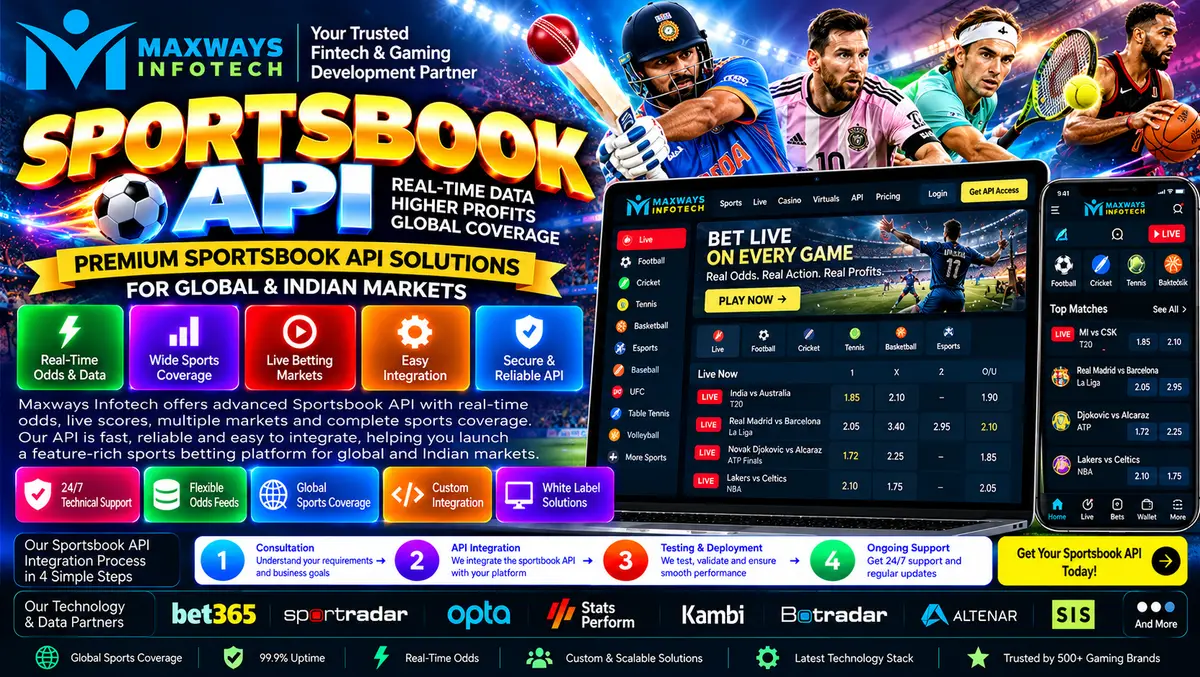
Learn how a Sportsbook API works, including sports data integration, event mapping, API performance, data validation, security, provider selection, and compliance.
Sportsbook API: Features, Integration, and Sports Data Management
A Sportsbook API provides a structured way for software applications to access sports events, fixtures, team information, market data, and other information offered by a data provider. Developers can use these interfaces to build sports information portals, statistical dashboards, data analysis tools, and other applications designed for legally permitted uses.
The main challenge is not simply connecting an API. A dependable integration must organise information from different sports, handle changing event schedules, validate incoming records, and maintain consistency across the application. These requirements become more important when a platform supports multiple competitions, data sources, and display formats.
This guide explores how a Sportsbook API works, which technical capabilities to evaluate, and how developers can build a reliable sports data integration.
What Is a Sportsbook API?
A Sportsbook API is a software interface that exposes sports-related data through documented requests and responses. Depending on the provider, available information may include fixtures, competitions, team details, event status, market definitions, selections, prices, and historical records.
Most modern APIs return structured data, often in JSON format, which developers can process using server-side applications, databases, and frontend interfaces.
Common technical use cases include:
-
Sports fixture and schedule dashboards.
-
Match statistics and data visualisation.
-
Sports research and reporting applications.
-
Historical sports data analysis.
-
Event monitoring and data-quality systems.
-
Permitted sports information platforms.
Not every provider supplies every data category. Before choosing a service, review its documentation, coverage, commercial terms, and permitted uses.
Key Features to Evaluate in a Sportsbook API
A suitable API should match the application's data requirements instead of offering a large number of features that may never be used.
1. Multi-Sport Coverage
Some projects need information from a single sport, while others require football, cricket, basketball, tennis, and additional competitions.
Check whether the provider supports the specific leagues and events you need. Also confirm whether coverage differs by region, season, competition, or data category.
2. Event and Fixture Management
Event information forms the foundation of a sports data application. Each fixture should have a stable identifier, competition details, participating teams, scheduled start time, and documented event status.
Stable identifiers help developers connect incoming updates to the correct event even when names or display formats change.
3. Market and Selection Data
Where permitted and included in the subscription, a provider may supply market definitions, selection identifiers, and associated price information.
The integration should preserve these identifiers and the provider's definitions. Two markets with similar display names should not automatically be treated as equivalent because their underlying rules may differ.
4. Historical Data Access
Historical records can support reporting, trend analysis, and the development of analytical dashboards. However, historical coverage varies considerably between providers.
Ask about archive depth, timestamp precision, available fields, retention policies, and whether historical records can be stored or redistributed under the agreement.
5. Documentation and Developer Support
Clear documentation reduces development time and helps teams diagnose integration issues. Look for authentication examples, endpoint descriptions, response schemas, error codes, request limits, and version-change policies.
A test environment or sample dataset is useful for validating the integration before it uses production credentials.
How to Integrate a Sportsbook API
A well-designed integration separates the external provider from the application's internal data model. This reduces the amount of application code that needs to change if a provider modifies its response structure.
Step 1: Define the Data Requirements
List the sports, competitions, events, data fields, refresh expectations, and historical records the application needs.
Identify which fields are essential and which are optional. This makes it easier to compare API providers and estimate integration effort.
Step 2: Review Authentication and API Limits
Determine how the provider authenticates requests and whether it applies quotas, concurrency limits, or usage-based charges.
Store API credentials securely on the server. Avoid placing secret keys in public JavaScript, mobile application bundles, or source-code repositories.
Step 3: Retrieve and Inspect Sample Data
Make a test request using the provider's documented endpoint. Examine the response structure and confirm that the required identifiers, timestamps, and fields are present.
Test more than one event so that the implementation can handle differences in optional fields and event status.
Step 4: Create a Normalised Internal Schema
Different providers may represent the same concept using different field names or formats. A normalisation layer converts those responses into a consistent internal structure.
For example, the application might maintain separate records for:
-
Sport and competition.
-
Event and participants.
-
Market and selection.
-
Source observation and timestamp.
-
Event status and data availability.
Keep the original provider identifiers alongside internal identifiers to simplify troubleshooting and data reconciliation.
Step 5: Validate Incoming Records
Check that required values exist, timestamps are valid, identifiers are consistent, and numeric fields follow the provider's specification.
Invalid or incomplete records should be flagged instead of silently replacing valid information.
Step 6: Test the Complete Data Flow
Verify that records can move from the API through parsing and storage to the final interface. Include authentication failures, timeouts, empty responses, duplicate events, and unexpected field changes in the test plan.
A successful API request is only the first step; the application must also process and display the response correctly.
Understanding API Data Formats and Odds Representation
Sports data providers may use different formats for identifiers, timestamps, market labels, and price values. A robust application should not assume that these fields are interchangeable.
If price information is included, confirm the representation and any conversion rules documented by the provider. For example, decimal, fractional, and American odds use different conventions. Converting between formats requires careful validation and appropriate handling of invalid values.
Other important considerations include:
-
Preserving the provider's original value for audit and debugging.
-
Recording the source and observation time.
-
Distinguishing a missing value from a value of zero.
-
Avoiding unintended rounding during calculations.
-
Clearly labelling the display format.
-
Applying documented rules when information is unavailable.
A consistent data model makes the application easier to test and reduces discrepancies between stored records and displayed values.
Real-Time Updates, Polling, and Streaming
Some applications need only scheduled fixture updates. Others require more frequent information from providers that support live feeds.
The update mechanism should be chosen according to the actual requirements and the provider's capabilities.
Not every API supports every method. Confirm the available options before designing the application.
For frequently changing data, record both the source timestamp and the time the application received the update. This helps distinguish a delayed feed from a processing delay inside your own system.
Managing Data Quality and Event Changes
Sports schedules and event information can change. Matches may be postponed, participants may change, and event status can move from scheduled to live or completed.
An integration needs clear rules for handling these changes.
Stable event matching: Use documented identifiers instead of relying exclusively on team names or event descriptions.
Duplicate detection: Identify repeated records so that the same update does not create duplicate entries.
Timestamp ordering: Avoid allowing an older observation to overwrite a newer one without a documented reason.
Status validation: Use the provider's definitions for scheduled, active, suspended, and completed events.
Stale-data detection: Establish an age threshold beyond which a record should be marked as outdated or unavailable.
Data reconciliation: Compare records from different sources only after confirming that their event identifiers, market definitions, and timestamps refer to equivalent information.
These controls help improve consistency and make it easier to investigate discrepancies.
API Performance, Caching, and Scalability
The quality of a sports data application depends on more than the provider's response time. Poor request management and inefficient processing can create bottlenecks even when the external API is performing normally.
A practical performance plan should include:
-
Caching relatively stable event and competition information.
-
Refreshing frequently changing records according to documented requirements.
-
Respecting request quotas and retry instructions.
-
Using timeouts and bounded retries for temporary failures.
-
Separating data collection from frontend page rendering.
-
Monitoring latency, error rates, and data freshness.
-
Testing expected traffic and peak workloads.
Caching rules should reflect the data type. A competition name may remain unchanged for a long period, while a live event field may need much more frequent validation.
For larger projects, a queue or scheduled processing layer can help separate data collection from database writes and frontend requests. The architecture should remain as simple as practical for the expected workload.
Security and API Maintenance
API integrations should be designed with security and maintainability in mind from the beginning.
Keep credentials in protected server-side configuration, restrict access to authorised services, and rotate keys according to the provider's recommendations. Avoid logging secrets or collecting unnecessary personal information.
Maintenance responsibilities should cover dependency updates, monitoring, error investigation, schema changes, and recovery procedures.
Before choosing a provider, ask how version changes are announced, how long older endpoints remain supported, and whether technical support is available for production incidents.
Documenting these procedures makes it easier for another developer to maintain the integration if the original project team changes.
How to Choose the Right Sportsbook API Provider
Compare providers against a consistent evaluation checklist rather than relying only on marketing claims.
A proof of concept is often the best way to validate the provider's actual data structure before making a long-term commitment.
Legal and Responsible Use of Sports Data in India
Access to a Sportsbook API does not automatically authorise every use of the information it provides.
India's Promotion and Regulation of Online Gaming Act, 2025 and the Promotion and Regulation of Online Gaming Rules, 2026 establish restrictions concerning online money games and related advertising, promotion, and facilitation. The Rules came into force on 1 May 2026, according to the Ministry of Electronics and Information Technology
Before launching a product that uses sports or odds data, obtain qualified legal advice about its intended functionality, business model, target users, and relevant jurisdictions. Review the provider's data licence separately to confirm which forms of storage, display, analysis, and redistribution are allowed.
Do not assume that a data subscription makes a prohibited activity lawful. The technical design and commercial use must both be assessed before development proceeds.
Explore Maxways Infotech
For company information, visit the Maxways Infotech homepage. You can also explore the Fintech page for related technology-service information and browse the Maxways Infotech blog for additional articles.
If you are preparing a sports data project, start with a requirements document describing the sports coverage, expected update frequency, required fields, technology stack, storage needs, and permitted use. These details will help you assess whether a provider's API is suitable for the project.
Conclusion
A Sportsbook API can provide structured sports information for applications that are permitted under applicable laws and data licences. Reliable implementation requires careful provider selection, consistent data mapping, timestamp validation, appropriate caching, and well-tested error handling.
Begin with clearly defined requirements, validate the provider's documentation using representative data, and establish monitoring before release. A maintainable integration should make it possible to identify data problems, handle provider changes, and adapt the application without rewriting its entire architecture.