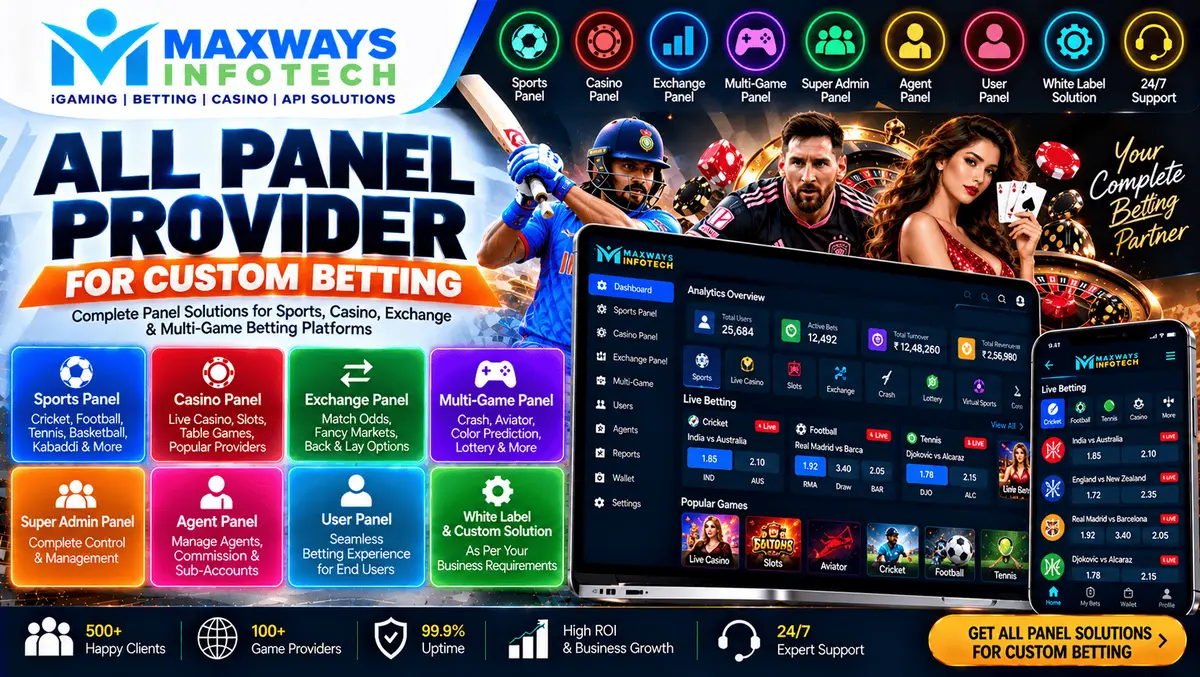
all panel provider for custom betting, including features, custom development, API integration, security, pricing, and support.
All Panel Provider for Custom Betting: Features, Development and Selection Guide
Choosing an all panel provider for custom betting software requires careful evaluation of technology, customisation options, integrations, security, pricing, and ongoing support. Businesses exploring sports platform development need to understand what a provider actually delivers before selecting a ready-made solution or commissioning a custom-built website.
An all panel solution may refer to a software package that combines multiple administrative modules, user-facing interfaces, reporting tools, and supported third-party integrations. However, the meaning of “all panel” varies between providers, so the exact features must be confirmed before making a decision.
This guide explains how to evaluate providers, compare custom development options, plan API integration, and identify the technical requirements that matter for a maintainable platform.
What Is an All Panel Provider for Custom Betting?
An all panel provider is a software vendor or development company that offers a collection of connected platform components. Depending on the product and agreed scope, these components may include a website interface, administration dashboard, reporting modules, user-management tools, and integrations with authorised third-party services.
A custom solution may be designed around a business's particular requirements instead of relying entirely on a fixed software package.
Common components to evaluate include:
-
Website interface: Page layouts, navigation, responsive design, and content management.
-
Administration panel: Configuration settings and operational controls for authorised staff.
-
Reporting dashboard: Reports and summaries based on available application data.
-
API integration: Connections to compatible and authorised external data services.
-
Access management: User roles, permissions, and administrative activity logs.
-
Technical infrastructure: Hosting configuration, backups, monitoring, and maintenance.
Not every provider includes all these components. Ask for a written feature list and demonstration of the actual product before assuming a module is included.
Businesses researching software development options can visit MaxWays Infotech to explore its services and discuss their technical requirements.
Why Businesses Consider Custom Betting Platform Development
A standard software package may be sufficient for a project with straightforward requirements. Custom development becomes worth considering when the business needs greater control over its interface, workflows, integrations, or technical architecture.
1. Customised User Interface
A custom interface allows the development team to plan navigation, page layouts, visual branding, and supported user workflows around a defined project scope.
Responsive design is particularly important because visitors may access a website through different devices and screen sizes.
2. Centralised Administration
A centralised administration interface can help authorised staff manage supported settings, review reports, and maintain website content from one location.
The precise administrative functions should be documented in advance. Sensitive operations should be restricted to appropriately authorised roles.
3. Flexible API Integration
A platform may need to connect to external sports data or other business services. An integration layer can receive supported data, validate responses, and make information available to the relevant application components.
The availability of an integration depends on provider documentation, compatible technology, access permissions, subscription terms, and applicable laws.
4. Reporting and Operational Visibility
Reporting modules can help teams understand system activity and monitor selected operational metrics.
Before commissioning a reporting feature, define which records are available, how metrics will be calculated, who can access the reports, and how long the underlying data should be retained.
5. Maintainability and Future Updates
A well-designed platform should be supported by organised code, technical documentation, testing procedures, and a clear maintenance plan.
Customisation should not come at the expense of security or maintainability. Every additional module introduces potential testing, support, and update requirements.
Essential Features to Evaluate in an All Panel Solution
When comparing all panel providers for custom betting projects, evaluate the actual capabilities of each solution rather than relying on a general feature list.
User and Role Management
Check whether the software supports suitable account permissions and separate administrative roles. The system should follow the principle of least privilege, giving each user only the access needed for their responsibilities.
Administrative Dashboard
Review the dashboard's navigation, available reports, configuration options, audit history, and ease of use. Request a demonstration of the functions that matter most to the project.
Custom Website Design
Check whether the provider offers changes to layouts, colours, branding, content structure, and responsive behaviour. Clarify which changes are included in the quoted price and which require additional development.
API and Data Connectivity
Confirm which third-party APIs can be integrated and whether the necessary access rights are available. Ask how the software handles invalid responses, rate limits, unavailable services, and delayed information.
Database and Data Management
Review database architecture, access controls, backup policies, retention requirements, and recovery procedures. The design should reflect the project's actual data needs rather than collect unnecessary information.
Security and Monitoring
Ask about authentication, secure session management, access logging, dependency updates, vulnerability testing, and incident response.
Security responsibilities should be divided clearly between the software provider, hosting provider, and business operating the application.
Documentation and Technical Support
Confirm whether the project includes installation instructions, API documentation, source-code documentation, training, and post-launch support.
Also ask who is responsible for fixing compatibility problems when an external API changes.
Ready-Made Software vs Custom Development
The right approach depends on the required features, budget, delivery timeline, ownership expectations, and long-term maintenance needs.
| Factor | Ready-made solution | Custom development |
|---|---|---|
| Initial setup | May be quicker when requirements match existing features | Requires requirements analysis and implementation |
| Customisation | Limited by the product and licence | Can be designed around agreed requirements |
| Initial cost | May be lower for standard functionality | Depends on scope and complexity |
| Source-code rights | Depend on the vendor's licence | Depend on the development contract |
| Integrations | Limited to supported or compatible services | Can be designed for selected authorised APIs |
| Maintenance | Depends on vendor support and contract | Requires an agreed maintenance arrangement |
A hybrid approach is another option. A business may use an existing content management system while commissioning custom modules or a tailored integration layer.
Compare total cost of ownership, including setup, subscriptions, infrastructure, licensing, security updates, and support, rather than comparing only the initial quotation.
How to Choose an All Panel Provider
A structured evaluation helps reduce uncertainty before committing to a development project.
Step 1: Define Your Project Requirements
Prepare a list of required website pages, administrative functions, reporting needs, integrations, supported devices, and technical constraints.
Separate essential features from optional enhancements so providers can quote against the same scope.
Step 2: Review the Provider's Actual Product
Request a demonstration, sample documentation, or a technical discussion. Confirm which features already exist and which would need to be developed.
Avoid assuming that a product supports a particular function simply because it is described as an all panel solution.
Step 3: Check Integration Compatibility
Review the API documentation, authentication methods, supported data fields, usage limits, and licensing terms for each required external service.
Confirm who will obtain access credentials and who will maintain the integration after launch.
Step 4: Evaluate Security Practices
Ask how the provider protects credentials, manages administrative permissions, updates dependencies, handles backups, and responds to security issues.
Where appropriate, arrange an independent technical review before deploying a significant system.
Step 5: Confirm Ownership and Contract Terms
Clarify the ownership and permitted use of custom code, designs, documentation, and project assets.
Identify any recurring subscription fees, third-party licence costs, hosting charges, and restrictions on transferring the software to another development team.
Step 6: Compare Support and Maintenance
Check the scope of technical support, response expectations, bug fixes, update policies, and future enhancement costs.
A low initial price may be less attractive if essential maintenance is excluded.
Step 7: Verify Legal and Operational Requirements
Before deployment, establish whether the intended platform and its features are permitted in each target jurisdiction. Obtain qualified legal advice and any required authorisations.
API Integration for a Custom Platform
API integration connects an application to external services through documented software interfaces. The integration process should be designed around the provider's actual capabilities and the intended use of the data.
Requirement Analysis
Identify the data or functions the application needs, the expected request volume, and the response times required by the project.
Authentication and Access
Use the authentication method supported by the provider. Keep private credentials on the server, restrict access, and follow the provider's security guidance.
Data Validation and Mapping
Validate responses and convert incoming records into a consistent internal format. Handle missing fields, invalid values, duplicate records, and unexpected response structures.
Error Handling
Plan for network timeouts, rate limits, expired credentials, and temporary service interruptions. The application should not present old or incomplete information as if it were current.
Testing and Monitoring
Test the integration before release and monitor response times, error rates, and data freshness. Document how updates to the external API will be handled.
For related technical information, visit the Sports Betting API page.
Security Best Practices
Security should be part of the platform's design rather than an optional feature added after development.
Authentication: Use appropriate authentication and secure session handling, with stronger protections for privileged accounts where necessary.
Role-based access: Restrict sensitive actions to authorised users and periodically review permissions.
Credential protection: Keep API keys and secrets out of browser code, public repositories, and client-side application bundles.
Input validation: Validate data received from users and external services to reduce the risk of malformed input and application errors.
Secure updates: Maintain dependencies, review security advisories, and test updates before deploying them.
Logging and monitoring: Record important system events and administrative changes while limiting access to sensitive logs.
Backups and recovery: Maintain suitable backups and test restoration procedures to confirm that recovery works as intended.
Independent testing: Consider code review and security testing appropriate to the project's complexity and risk.
Pricing Factors for Custom Betting Software
The cost of an all panel solution varies according to its scope and the provider's commercial model. No single price applies to every project.
Common cost factors include:
-
Number and complexity of website and administration modules.
-
Custom design and development requirements.
-
Third-party API subscriptions and licensing.
-
Database, hosting, and infrastructure needs.
-
Security testing and quality assurance.
-
Data migration and integration work.
-
Documentation and technical handover.
-
Ongoing maintenance, monitoring, and support.
Request an itemised quotation that distinguishes one-time development charges from recurring costs. Ask the provider to document feature exclusions, assumptions, payment milestones, and charges for future changes.
A phased delivery plan can help a business validate essential functionality before investing in additional modules.
How MaxWays Infotech Fits Into Your Research
Businesses evaluating custom software and API integration can explore MaxWays Infotech and review the available development resources.
For a more specific comparison of custom website requirements, read Custom Bookies Website Developers. This related topic covers requirements planning, tailored features, technical implementation, testing, and maintenance.
You can also review Betting Website Source Code to understand source-code structure, customisation, security, and ownership considerations.
The right development approach depends on the project's requirements. Confirm the proposed features, delivery scope, integration responsibilities, commercial terms, and support arrangements directly with the provider before making a decision.
Frequently Asked Questions
1. What does an all panel provider mean?
The term usually refers to a vendor offering multiple connected software modules or administrative interfaces. The exact meaning varies, so confirm the included functions and limitations in writing.
2. Can an all panel solution be customised?
Customisation depends on the product's architecture, available configuration options, source-code access, licence, and development agreement. Some solutions support extensive modifications, while others permit only limited changes.
3. What features should I compare between providers?
Compare the administrative dashboard, user permissions, responsive design, API compatibility, reporting, security, documentation, ownership terms, pricing, and ongoing support.
4. Is ready-made software cheaper than custom development?
It can be less expensive for standard requirements, but subscription fees, customisation, integrations, and maintenance can affect the total cost. Compare complete project costs over the expected operating period.
5. Can a custom platform integrate with sports data APIs?
Yes, if the technology is compatible and the business has the required access and usage rights. The implementation must follow the external provider's documentation and terms.
6. Who owns the custom source code?
Ownership depends on the contract and applicable third-party licences. Clearly define rights to the code, designs, documentation, and project assets before development begins.
7. What affects the cost of an all panel solution?
The number of modules, custom features, integrations, infrastructure, security requirements, and maintenance arrangements all affect the overall cost.
8. What should I check before choosing a provider?
Review the actual product, technical documentation, security practices, licensing, ownership terms, support policy, and legal requirements applicable to the intended project.
Conclusion
Selecting an all panel provider for custom betting software involves more than comparing product names or feature lists. Businesses should evaluate customisation, integration compatibility, security, documentation, ownership rights, pricing, and long-term support.
Start with a clearly documented scope, compare providers against the same criteria, and test the proposed solution before deployment. This process helps establish a realistic foundation for a maintainable software project.
Visit MaxWays Infotech to explore software development and API integration services.
Compliance note: This article is intended for software-development and technology-planning purposes. Any wagering-related functionality must be developed and operated only where legally permitted, with required authorisations, appropriate third-party data rights, and relevant consumer-protection safeguards.