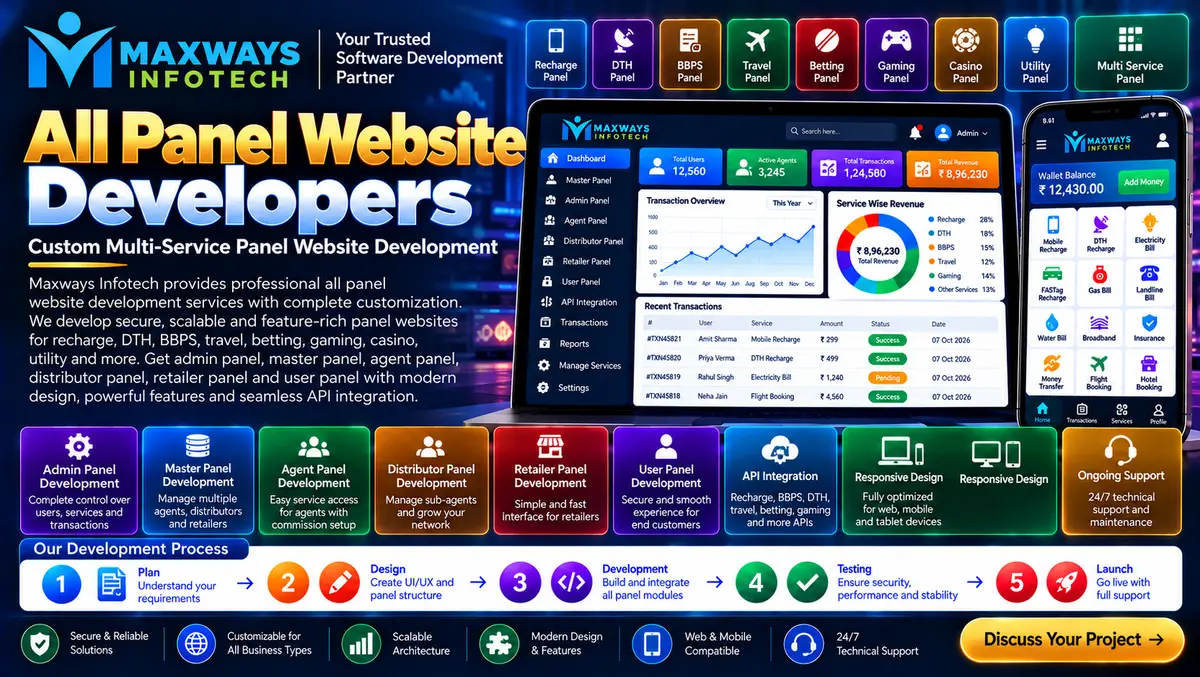
All panel website developers planning a customized web application with connected dashboards and business workflows
All Panel Website Developers: Custom Solutions for Business Requirements
All panel website developers help businesses create web platforms that bring different operational tasks into a single, organized environment. Depending on the project, the website may include management dashboards, partner portals, customer accounts, reporting tools and other connected modules. The objective is to build a system that matches the business workflow rather than forcing every team to work with the same interface.
Choosing a development team requires more than comparing designs or prices. Businesses should understand how the developers approach customization, data management, integrations, testing and future changes. These decisions influence how useful the platform will be after launch.
What Makes an All Panel Website Different?
A standard business website mainly presents information about a company, its services and its contact details. An all panel website may also support day-to-day operations through private dashboards and connected application modules.
For example, a business platform could include:
-
An administration area for configuration and system oversight.
-
A management dashboard for assigned operational tasks.
-
A partner portal for approved business accounts.
-
A customer area for profile and service information.
-
A reporting module for activity summaries.
-
An integration module for managing approved external connections.
These are examples, not mandatory features. A developer should recommend the modules that fit the business requirements and avoid adding unnecessary complexity.
Different Business Needs Require Different Panels
The value of a customized platform comes from how well it supports the work people actually do.
For service-based businesses
A service business may need enquiry management, customer records, task assignment, service status updates and performance reports. Connecting these functions can make it easier for staff to understand which tasks require attention.
For distributors and business partners
A partner-based operation may require separate accounts, assigned customer records, permission-controlled information and activity reports. The application should ensure that each partner can access only the information authorized for that account.
For online platforms
A digital platform may need content management, user administration, operational reporting and integration monitoring. The design should account for the expected volume of activity and the consequences of system errors.
For businesses with financial workflows
Financial applications can require additional controls around sensitive information, transaction records and external service connections. Technical development alone does not establish regulatory approval; businesses must verify the permissions and legal requirements applicable to their activities.
If you are exploring software-related information for financial technology projects, visit Maxways Infotech's fintech section.
How Developers Turn a Business Idea Into a Working Platform
A useful development project begins by understanding the problem, not by immediately selecting a programming language.
Step 1: Identify the business problem
Developers should ask which tasks are difficult to manage, where information is duplicated and what users need to accomplish through the platform.
Step 2: Define the users
List the people who will use the website and document the permissions required for each role. This creates a clear basis for dashboard design and access control.
Step 3: Prepare the feature specification
Write down the required modules, reports, workflows, integrations and expected outcomes. Separate essential features from optional improvements.
Step 4: Design the user journey
Create wireframes or prototypes that demonstrate how a user moves from login to the relevant task. Review the layouts before the development team builds the complete application.
Step 5: Develop and connect modules
Implement the interface, backend logic and database. Integrations should be added with suitable authentication, validation and error-handling procedures.
Step 6: Validate the complete workflow
Test common tasks from beginning to end. For example, if a user submits a request, verify that it is stored correctly, appears in the appropriate dashboard and follows the intended permission rules.
Step 7: Launch with a maintenance plan
Before deployment, establish the hosting environment, backups, monitoring, documentation and process for reporting technical issues.
What to Check in a Developer's Technical Proposal
A development proposal should explain how the team plans to build and deliver the application.
Project scope: The proposal should list the panels, modules, user roles and integrations included in the price.
Technology choices: Developers should explain why the proposed framework, database and hosting approach suit the requirements.
Data structure: The plan should describe how important records relate to each other and how data consistency will be maintained.
Security controls: Ask how the team will implement authorization, secure sessions, password handling and protection for sensitive operations.
Testing process: The proposal should cover functional testing, browser and device compatibility, performance and security checks.
Ownership and documentation: Confirm the contractual terms for source code, design assets, deployment access and technical documentation.
Support after launch: Clarify the period for bug fixes, the maintenance options and how additional features will be priced.
Businesses can explore Maxways Infotech's website as a starting point for learning about the company before evaluating whether its published information aligns with their project requirements.
Important Features That Support Long-Term Use
An all panel website should be planned for everyday operation as well as future maintenance.
Permission-based access
Users should receive only the permissions required for their responsibilities. These checks must be enforced by the backend rather than relying on hidden buttons in the interface.
Useful reporting
Reports should answer real business questions. Developers should agree on how each metric is calculated and which users are allowed to view it.
Error handling
The application should handle unavailable APIs, invalid inputs and failed operations predictably. Users need clear messages, while technical teams need enough diagnostic information to investigate issues without exposing confidential data.
Responsive interfaces
Dashboards should remain usable on desktop computers, tablets and mobile devices. Tables, filters, forms and navigation need particular attention on smaller screens.
Maintainable code
Organized modules, clear naming, documentation and appropriate automated tests make future changes easier to manage.
Backup and recovery
The project should define backup frequency, access restrictions and recovery procedures. Backups should be tested instead of simply assuming that saved copies will work during an incident.
Common Mistakes When Hiring All Panel Website Developers
Selecting a team based only on price: A low quotation may omit testing, documentation, deployment or maintenance. Compare the complete scope before making a decision.
Building too many features at once: Unnecessary modules increase complexity. Start with the workflows that matter most and add optional functions when there is a clear need.
Ignoring staff feedback: The people who use the platform daily can identify practical issues that may not be visible during an initial design review.
Failing to document integrations: Without API documentation and clear configuration records, troubleshooting and future changes can become unnecessarily difficult.
Leaving security until launch: Authentication, authorization, data validation and secure configuration should be considered throughout development.
Not defining acceptance criteria: Agree in advance on what each module must do and how its completion will be verified.
Questions to Ask Before Finalizing a Project
Before selecting a development team, consider these questions:
-
How will the proposed system support our current workflow?
-
Which features are included in the agreed budget?
-
How will the application handle user permissions and sensitive data?
-
What testing will be performed before launch?
-
Will the team provide documentation and a technical handover?
-
What are the source-code ownership and licensing terms?
-
How will future improvements and maintenance be managed?
Written answers help turn a general idea into a project that can be planned, evaluated and maintained.
Frequently Asked Questions
What do all panel website developers build?
They build web applications containing multiple connected dashboards or portals for different user roles and operational functions.
Can an all panel website be customized for a specific business?
Yes. Its modules, permissions, reports and workflows can be tailored to documented business requirements, subject to the agreed development scope.
Which programming technologies can be used?
Depending on the project, developers may use technologies such as HTML, CSS, JavaScript, React, PHP, Laravel, Node.js and databases such as MySQL or PostgreSQL. The technology stack should be selected according to the application's requirements.
How should I compare two development companies?
Compare their proposed scope, technical approach, testing process, documentation, contractual ownership terms, maintenance arrangements and total cost—not only their initial quotations.
Does every all panel website need an API?
No. APIs are useful when the application needs to exchange information with other systems or expose defined services. A project that does not require external integration may not need additional API functionality.
Conclusion
All panel website developers help transform business requirements into connected web applications. The most important decisions involve defining the right workflows, selecting suitable technology, protecting sensitive data and making the system practical to maintain.
Before starting a project, document the required modules, user roles, integrations and acceptance criteria. Then compare development proposals against those requirements. This approach makes it easier to understand what is being built, what the business will receive and how the platform can be maintained in the future.
For more technology and software-related reading, explore the Maxways Infotech blog. Use relevant articles as background information while independently confirming the technical, commercial and compliance requirements of your project.