Learn about Live Cricket Odds API architecture, data validation, streaming, caching, recovery, security and integration costs.
Live Cricket Odds API: Real-Time Data Processing and Integration
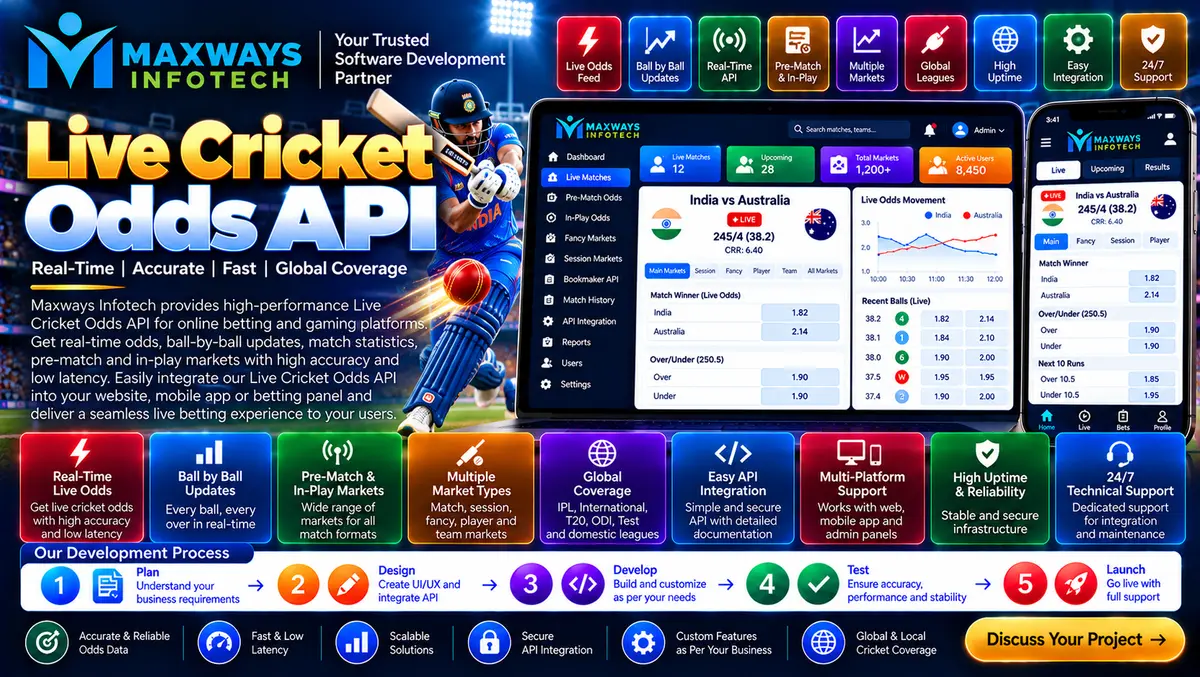
A Live Cricket Odds API enables compatible websites and applications to retrieve odds information for supported cricket matches while they are in progress. Depending on the provider, the feed may include event details, market prices, selection identifiers, status information and timestamps.
For businesses developing cricket-data applications, the real challenge is processing frequent updates without confusing users or overwhelming the underlying infrastructure. A useful integration must identify the correct event, validate incoming information, recover from interrupted connections and make data freshness visible.
This guide explores the practical engineering decisions involved in building a live cricket odds data application.
Turning Live Odds Into Usable Application Data
Receiving a response from an API is only the first step. The application needs to convert the response into a consistent structure that its own services can understand.
A typical data-processing workflow includes:
-
Event mapping: Match incoming records to the correct fixture.
-
Market identification: Preserve the market and selection associated with each price.
-
Data validation: Check required fields and supported formats.
-
Timestamp processing: Record when the source updated the information.
-
Status handling: Respect unavailable or suspended market states.
-
Storage and delivery: Make validated information available to authorized application components.
This separation makes it easier to investigate errors and update the user interface without changing the external API integration every time a design requirement changes.
Designing a Live Cricket Odds Data Pipeline
A well-organized pipeline separates data collection, processing, storage and presentation.
1. Data collection
The backend retrieves supported data through the provider's documented endpoints or approved streaming connection. Credentials should remain protected on the server.
2. Normalization
The application maps incoming fields into a consistent internal model. It should preserve source identifiers so that a record can be traced back to its origin.
3. Validation
The system checks that required fields exist, identifiers are valid and timestamps can be interpreted correctly. Invalid records should not silently replace a previously accepted snapshot.
4. State management
The application maintains the latest validated state for each event and market. If the provider supplies update identifiers or resume tokens, the integration can use them according to the documented recovery procedure.
5. Delivery
The frontend receives the relevant data through an internal endpoint or a supported streaming mechanism. This prevents every browser from needing direct access to the external provider.
6. Monitoring
The application tracks response delays, parsing errors, connection interruptions and rate-limit events. These measurements help the team identify problems before they become persistent.
Polling, Streaming and Hybrid Updates
The best update method depends on the provider and the application's requirements.
Polling: The backend requests an updated snapshot at a controlled interval. This is straightforward to implement, but the interval must respect the provider's rules and the application's freshness requirements.
Streaming: A supported streaming connection delivers updates as messages arrive. It can reduce repeated snapshot requests, but requires connection management and recovery logic.
Hybrid approach: The application retrieves an initial snapshot and then applies streaming updates where supported. If the stream becomes inconsistent or requires resynchronization, the application fetches a fresh snapshot.
Not every API supports streaming, and not every project needs it. The implementation should follow the actual capabilities documented by the chosen provider.
Keeping the Interface Accurate During Interruptions
Live applications must account for delays, connection failures and missing data.
Suppose the backend receives a valid snapshot and then loses its connection to the provider. The last saved values may still exist, but they should not automatically be treated as current.
A sensible interface can distinguish between:
-
Recently updated information.
-
Information awaiting refresh.
-
Data that has become stale.
-
Markets reported as suspended or unavailable.
-
Data that could not be retrieved.
The application should show timestamps or suitable status messages when freshness matters. It should never invent replacement values or silently present old information as current.
Managing Data Volume and Infrastructure
The number of active matches, supported markets and simultaneous visitors can influence infrastructure requirements.
A backend can reduce unnecessary work through shared caching, selective data retrieval and controlled update delivery. For example, many visitors viewing the same event may be able to use a shared validated snapshot instead of generating separate external API requests.
The design should also account for:
-
Cache expiration rules supplied by the provider.
-
Memory and storage requirements.
-
Request quotas and subscription limits.
-
Database indexing and cleanup.
-
Traffic spikes during popular matches.
-
Monitoring and operational costs.
These decisions should be based on measured traffic and provider limits rather than assumptions about how frequently data must be refreshed.
Selecting a Live Cricket Odds API Provider
Before committing to a provider, evaluate the technical details that determine whether its data can support your application.
Competition coverage
Confirm which competitions and formats are available under the proposed subscription. Do not assume that every cricket event is covered.
Data fields
Review the actual response schema, including event identifiers, market information, prices, timestamps and status fields.
Update behaviour
Check whether the provider supplies request-based snapshots, streaming updates or both. Verify the documented freshness and recovery behaviour.
Error responses
Understand how the API reports invalid credentials, unsupported events, rate limits and temporary service failures.
Licensing
Confirm whether the intended application may access, store, display or redistribute the supplied information.
Documentation and support
Review examples, versioning guidance, sandbox access and support arrangements before beginning implementation.
Businesses exploring technology and software services can visit Maxways Infotech to review the company's published information and determine whether it matches their project needs.
Security for Live Data Integrations
A live feed should not become an unnecessary security risk for the application.
Developers should store API credentials securely, use HTTPS, restrict permissions and validate incoming responses. Secret keys should not be embedded in public JavaScript files or exposed in browser network requests.
Monitoring logs should contain enough detail to diagnose failures without recording confidential credentials. Development and production access should also be separated wherever possible.
For projects involving financial software or related data workflows, Maxways Infotech's fintech section is a relevant resource to explore for the company's published fintech information. Any betting-related product requires its own review of provider permissions, data licensing and applicable laws.
Testing a Live Cricket Odds Application
Testing should verify both data correctness and recovery behaviour.
A useful test plan covers:
-
Correct mapping of event and market identifiers.
-
Missing, malformed or unexpected response fields.
-
Old timestamps and stale snapshots.
-
API timeouts and interrupted connections.
-
Rate-limit responses and controlled retries.
-
Recovery after a stream reconnects.
-
Correct handling of unavailable or suspended markets.
-
Performance under expected concurrent traffic.
-
Protection of API credentials.
-
Monitoring alerts for repeated failures.
Where a provider supports a sandbox, use it to test error scenarios before enabling production access.
Common Mistakes in Live Cricket Odds Integration
Refreshing without considering quotas: Excessive requests can trigger rate limits and increase costs.
Treating every response as valid: Successful retrieval does not guarantee that the content is complete or suitable for display.
Ignoring event identifiers: Incorrect mapping can associate data with the wrong fixture.
Failing to recover after interruptions: A stream may need a fresh snapshot or a documented resume procedure after reconnecting.
Using a single freshness rule for every field: Different data types may have different update expectations.
Skipping monitoring: Without visibility into delays and failures, problems may remain unnoticed.
Ignoring data rights: Technical access does not automatically authorize commercial redistribution or every possible use.
What is a Live Cricket Odds API?
It is an API that supplies supported cricket odds information for ongoing matches, subject to the provider's coverage and access terms.
Is streaming always required?
No. Some applications can use controlled snapshot requests. Streaming may be appropriate when the provider supports it and the application's requirements justify the added complexity.
How can an application identify stale data?
It can compare source timestamps and local receipt times against a defined freshness policy, then mark old information as stale or unavailable.
Can one backend serve multiple visitors?
Yes. Depending on the architecture, a backend can share validated snapshots through caching and deliver updates to multiple clients while controlling external API usage.
What should be checked before choosing a provider?
Review competition coverage, response fields, update behaviour, rate limits, documentation, licensing, security and support.
Where can I find more software-related articles?
Explore the Maxways Infotech blog for additional technology and software-related reading. Check the selected API provider's official documentation for exact technical specifications.
Conclusion
A Live Cricket Odds API integration requires a clear plan for collecting, validating, storing and delivering changing data. The most useful architecture is one that preserves event identity, respects source timestamps, handles interruptions predictably and protects API credentials.
Before launch, verify provider coverage, data rights, update behaviour and usage limits. Test recovery and stale-data scenarios as carefully as normal requests. These practices help make a live cricket-data application more maintainable and reliable.