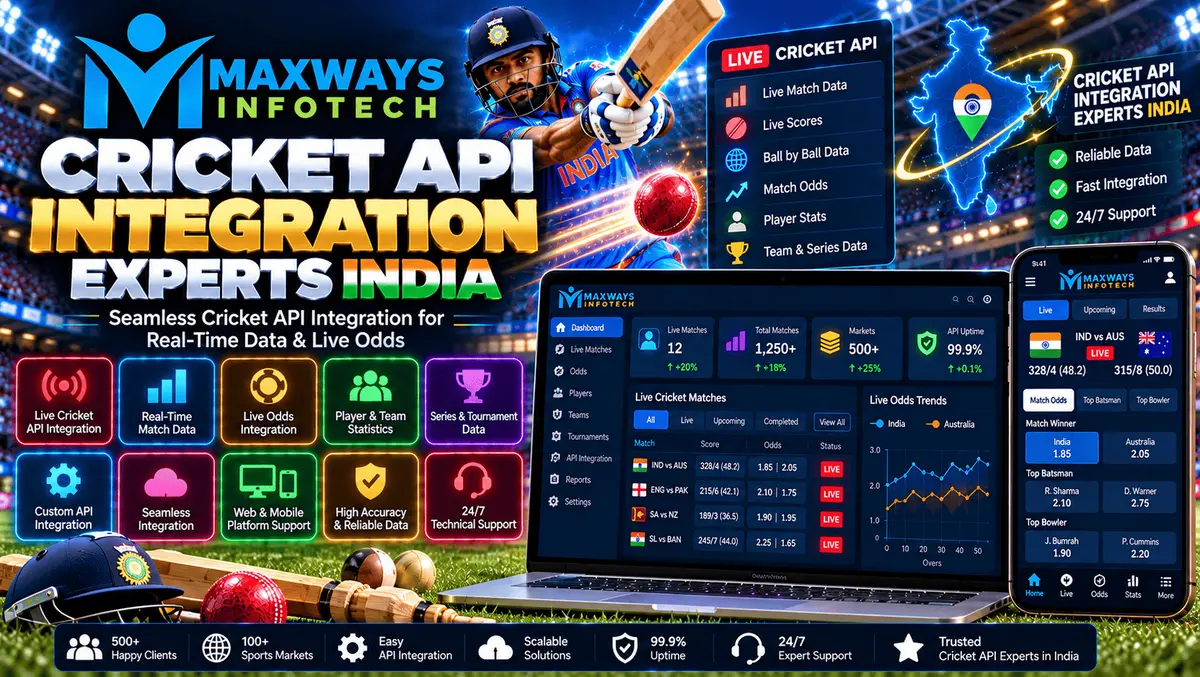
Cricket API Integration Experts India, live score updates, API testing, caching, error handling, and application integration.
Cricket API Integration Experts India: A Practical Guide for Websites and Apps
Cricket applications depend on accurate data, reliable integrations, and a user experience that remains useful as matches progress. Businesses searching for Cricket API Integration Experts India need a development team that can connect cricket data services to an existing website or application, organize incoming information, handle unexpected errors, and maintain the integration after launch.
Connecting an API is only one part of the work. A production-ready implementation also requires data mapping, secure credential management, update scheduling, caching, monitoring, and testing against real-world scenarios.
Maxways Infotech provides software, web, and application development services. Businesses can visit the Maxways Infotech website to explore its technology services and discuss their cricket API integration requirements.
What Is Cricket API Integration?
Cricket API integration connects an application to an external data service that provides cricket-related information. The application sends authorized requests, receives structured responses, processes the returned data, and displays relevant information through its interface.
Depending on the selected provider and subscription, the integration may support:
-
Match schedules and fixtures
-
Live scores and innings summaries
-
Ball-by-ball match information
-
Player and team statistics
-
Tournament and series details
-
Historical match results
-
Scorecards and match status
The available fields, competition coverage, and update frequency vary by provider. Before development begins, the team should confirm that the selected service supplies the exact data the application needs.
Why Businesses Need Cricket API Integration Experts
A basic API request may be straightforward, but integrating a cricket data service into a functioning product involves several technical decisions.
Consistent Data Across the Application
Different endpoints may return separate information about matches, teams, players, and tournaments. Developers need to connect these records correctly so that a scorecard, match page, and statistics section refer to the same event.
Reliable Match Updates
Cricket data changes as a match progresses. The integration must handle new innings, wickets, extras, completed overs, interruptions, and changes in match status without displaying inconsistent information.
Efficient API Usage
Many providers impose request limits or charge according to usage. Developers need to choose sensible refresh intervals, reuse suitable responses, and avoid requesting the same information unnecessarily.
Easier Maintenance
A well-organized integration is easier to troubleshoot when a provider changes its response format, introduces a new endpoint, or temporarily experiences an outage.
Cricket API Integration Services to Consider
The exact services required depend on the application, but the following areas are commonly important.
1. API Setup and Authentication
The first step is to establish access to the chosen provider. Developers review the documentation, configure the required credentials, and verify that the application can make authorized requests.
Private API keys should normally remain on a protected backend rather than being exposed in public browser code. Access credentials should also be kept out of public repositories and unnecessary application logs.
2. Live Score Integration
Live-score integration retrieves the latest supported match information and presents it through a scoreboard or match-centre interface.
The development team should decide which fields are essential, how frequently the data should refresh, and how the application will behave if an update is delayed.
The interface should not present old information as current. Where useful, display the last successful update time and a clear message when data is temporarily unavailable.
3. Ball-by-Ball Data Integration
Ball-by-ball data can support delivery timelines, over summaries, innings progression, and detailed match-centre pages.
This integration requires particular care because cricket events do not always follow a simple one-ball, one-run pattern. Wides, no-balls, extras, wickets, and other events can affect how an over and innings are represented.
Developers should follow the provider's documented data model instead of assuming that every response uses the same fields or scoring conventions.
4. Player and Team Statistics
Player profiles, team records, and historical statistics can make an application more useful beyond the live scoreboard.
The integration should map player and team identifiers consistently and clarify how statistics are updated. If multiple sources are used, the application should avoid combining fields that use incompatible definitions without a clear mapping.
5. Fixtures and Tournament Information
Fixture integration helps organize upcoming matches, match dates, competition details, venues, and completed results.
Developers should account for changes to scheduled times, abandoned matches, postponed fixtures, and differences between competition formats. These conditions should be reflected correctly in the application interface.
The Technical Process for Integrating a Cricket API
A structured workflow helps reduce implementation errors and makes it easier to maintain the application after launch.
Step 1: Define the Data Requirements
List the information your website or app needs. For example, a simple live-score page may need match status, innings totals, overs, and wickets, while a detailed scorecard may require batting and bowling figures as well.
Create a field checklist before selecting endpoints. This avoids requesting unnecessary data or discovering late in development that an essential field is unavailable.
Step 2: Review the Provider Documentation
Check authentication, endpoint paths, request parameters, response formats, rate limits, error codes, timestamps, and competition coverage.
The team should also understand the provider's licensing terms and permitted use of the data. Technical access does not automatically grant every type of commercial usage right.
Step 3: Build a Secure Backend Connection
The backend sends requests to the provider, validates the responses, and prepares the data for the frontend.
This approach helps protect credentials and gives developers one place to manage authentication, logging, error handling, and request limits.
Step 4: Map the Data Model
Incoming API fields should be mapped into the application's own data structure. Stable identifiers are especially important for linking matches, players, teams, and competitions.
If the provider supplies separate endpoints for match listings and scorecards, the integration should use documented identifiers to connect the records rather than relying only on display names.
Step 5: Implement Updates and Caching
Choose a refresh strategy supported by the provider. Depending on the service, this may involve periodic requests, webhooks, or a supported streaming connection.
Cache data where permitted and appropriate. Historical records can often be retained longer than frequently changing live-match information, while live data requires more careful freshness rules.
Step 6: Test and Validate
Test successful requests as well as failed requests, incomplete responses, expired credentials, rate limits, timeouts, and provider outages.
The goal is to confirm that the application handles unusual conditions predictably rather than merely displaying data when everything works perfectly.
Step 7: Deploy and Monitor
After testing, deploy the integration with suitable logging, error monitoring, and configuration management. Track whether updates are arriving on time and whether request usage remains within the provider's limits.
Documenting the setup makes it easier to investigate issues and maintain the integration later.
Common Cricket API Integration Challenges
Even when an API is documented, real-world integration can involve problems that need careful handling.
Inconsistent Match Identifiers
A provider may use different identifiers for fixtures, innings, and related match records. Developers should use the correct documented identifier for each request and maintain explicit mappings when multiple data sources are involved.
Delayed or Missing Updates
Network interruptions, provider delays, and incomplete data can affect the displayed match state. The application should record when information was received and distinguish between a current response and a stale one.
Duplicate Events
If a connection is retried or data is received through multiple delivery paths, the same event may be processed more than once. Where unique event identifiers are available, the system should use them to prevent duplicate updates.
Rate Limits
Repeated requests can exhaust a provider's quota. Developers should monitor usage, apply caching where appropriate, and handle rate-limit responses according to the provider's instructions.
Changes to API Responses
Providers may add fields, change versions, or modify response structures. A maintainable integration should validate incoming data and include tests that help detect breaking changes before they affect users.
Differences Between Cricket Formats
Test matches, ODIs, and T20 matches have different structures and match-state transitions. The application should not assume that every format has the same innings count, completion conditions, or available fields.
Security and Performance Best Practices
Security and performance are important parts of a reliable integration.
A practical implementation should consider:
-
Keeping private API credentials on the backend
-
Validating responses before using them
-
Applying suitable request timeouts
-
Handling temporary failures without uncontrolled retries
-
Respecting provider rate limits and licensing terms
-
Caching data according to its freshness requirements
-
Protecting logs from unnecessary sensitive information
-
Monitoring errors and data update delays
-
Testing backup and recovery procedures where appropriate
For high-traffic applications, developers may also assess queueing, background processing, and caching strategies to avoid overwhelming the external service or slowing down the main website.
The correct solution depends on the expected workload and the provider's capabilities. More complex infrastructure is not automatically better if the application's requirements are modest.
Choosing Cricket API Integration Experts in India
When comparing development companies, assess their technical approach rather than relying only on promotional claims.
Review Relevant Experience
Ask whether the team has experience with REST APIs, JSON data processing, backend development, database design, and integration testing. Relevant experience can help the team identify potential problems earlier.
Ask for a Clear Implementation Plan
The proposal should explain the endpoints to be integrated, the data fields required, the intended refresh strategy, error-handling rules, and testing responsibilities.
Clarify Ownership and Documentation
Confirm who will control the source code, hosting, repositories, and API account. Request documentation explaining how the integration works and how credentials and configuration are managed.
Evaluate Ongoing Support
Ask how provider outages, breaking API changes, and application bugs will be handled. Confirm whether monitoring and maintenance are included in the agreement or billed separately.
Compare the Total Cost
Consider development charges, API subscription fees, infrastructure, usage limits, and maintenance. A low initial quote may not include the ongoing work needed to keep a live data integration reliable.
How Much Does Cricket API Integration Cost?
The cost depends on the complexity of the application and the work needed to connect and maintain the data service.
Important factors include:
-
Number of endpoints and data fields
-
Frontend and backend requirements
-
Existing application architecture
-
Provider subscription and usage limits
-
Caching and update requirements
-
Testing and error handling
-
Deployment and monitoring
-
Ongoing maintenance and API changes
For an accurate estimate, provide the developer with your required data fields, supported competitions, intended platforms, expected traffic, and maintenance expectations.
A staged approach can help: first validate access to the data, then build a working integration, test it, and finally add optional features based on the project's priorities.
Legal and Data Licensing Considerations
Before using cricket data in a commercial product, verify the provider's licence and permitted uses. Access to an API does not necessarily mean that every field can be republished, redistributed, or used in every type of application.
If the intended product is connected to betting or money-based gaming, legal review is especially important. India's Promotion and Regulation of Online Gaming Act, 2025, and the Promotion and Regulation of Online Gaming Rules, 2026 establish a framework that includes prohibitions relating to online money games and associated services. Review the current requirements with a qualified legal professional before developing or launching such a product.
How Maxways Infotech Can Support Your Integration Project
Maxways Infotech provides software, web, and application development services. Businesses can discuss their cricket data requirements with the team to determine the appropriate integration scope, technical approach, and implementation plan.
You can also explore the Maxways Infotech blog for more technology and software-related articles.
Before requesting a proposal, prepare a brief covering the cricket data you need, required competitions, target platform, expected update frequency, existing technology stack, and support requirements. This will help the development team assess the integration more accurately.
Frequently Asked Questions
What do cricket API integration experts do?
They connect an application's backend to a cricket data provider, map incoming data, implement authentication, handle errors, test updates, and prepare the integration for ongoing maintenance.
Can a cricket API be integrated into an existing website?
Yes, if the existing architecture supports the integration and the provider offers the required data and access permissions. The developer should review the existing application before recommending an implementation approach.
Can cricket API integration support live scores and ball-by-ball data?
It can, provided the selected provider offers those endpoints and the relevant competition coverage. Update timing and available fields depend on the provider and subscription.
How can developers prevent incorrect live-score updates?
They can validate incoming data, use stable match and event identifiers, handle match-state transitions carefully, record update timestamps, and prevent older or duplicate events from overwriting valid newer information.
How long does cricket API integration take?
The timeline depends on the number of endpoints, the complexity of the data model, the existing application, testing requirements, and the provider's access process. A realistic estimate should follow a requirements review.
What should I check before selecting a cricket API provider?
Review data coverage, update frequency, documentation, authentication, rate limits, historical data, licensing, pricing, and technical support.
Conclusion
Choosing Cricket API Integration Experts India means finding a team that can do more than connect an endpoint. Reliable integration requires accurate data mapping, secure authentication, sensible refresh strategies, robust error handling, and thorough testing.
Businesses should confirm the provider's coverage, define the required data fields, protect credentials, and plan for delayed or missing updates before deployment. With a clear implementation process and appropriate ongoing monitoring, a cricket application can remain easier to maintain as its features and audience grow.