Cricket Exchange Panel Developers, cricket exchange panel development, cricket exchange software, cricket dashboard development, cricket API integration, exchange panel developers
Cricket Exchange Panel Developers: Features, Technology, and Platform Planning
A cricket exchange platform requires more than an attractive interface. Its administrative panel must help authorized teams manage cricket events, review market information, monitor platform activity, and respond to operational issues without unnecessary delays. Choosing experienced Cricket Exchange Panel Developers can help businesses plan these workflows around their operational needs.
The right development approach starts with a clear understanding of the platform, its users, the data it receives, and the controls required to operate it responsibly. Before selecting a development team, businesses should understand which features they need, how different systems will communicate, and how the finished panel will be tested.
What Do Cricket Exchange Panel Developers Do?
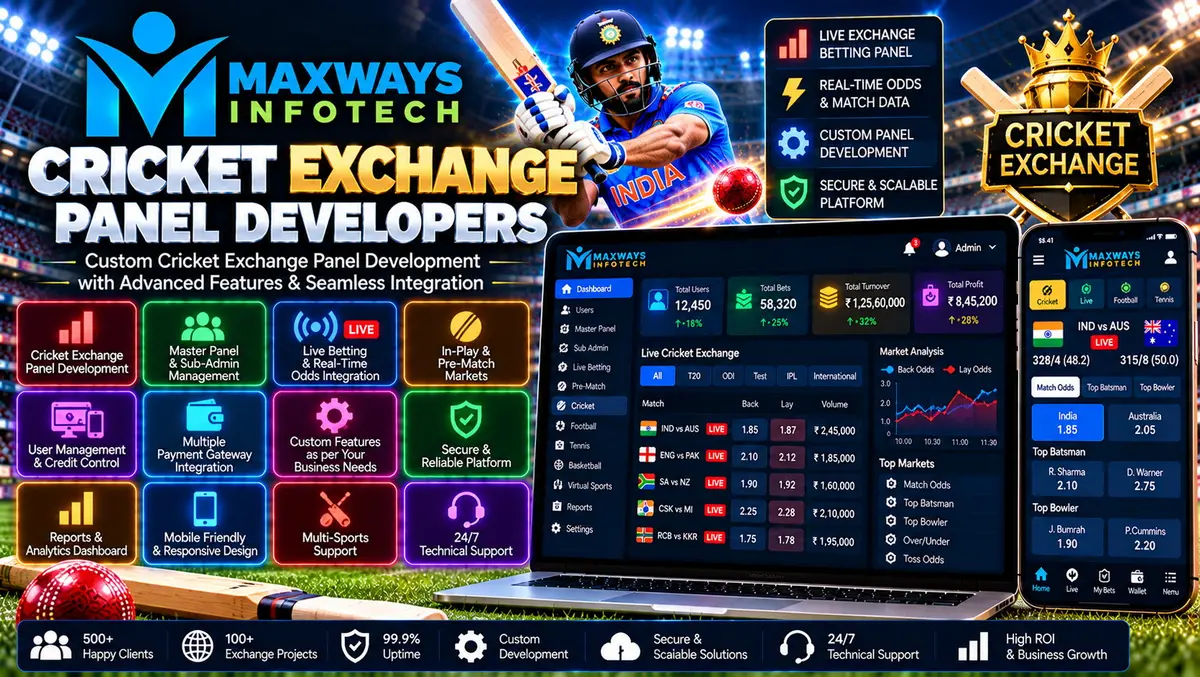
Cricket exchange panel developers design and build the administrative interfaces used to oversee a cricket-focused digital platform. Depending on the project scope, the panel may include event management, market-status monitoring, user administration, reporting, configuration settings, and system health indicators.
A development project may cover:
-
Event management: Organizing cricket matches, competitions, and event metadata.
-
Market status controls: Displaying configured market states and approved operational actions.
-
User and role management: Assigning permissions to administrators, support staff, and other authorized personnel.
-
Activity records: Maintaining logs of important changes and administrative actions.
-
Reporting dashboards: Presenting relevant operational figures and system summaries.
-
Integration management: Monitoring connections with authorized cricket data providers and other services.
The exact feature set should be based on documented requirements rather than a generic list of features supplied by a vendor.
Why the Administrative Panel Matters
An administrative panel connects day-to-day operations with the underlying platform. When its layout is confusing or its information is outdated, staff may struggle to identify issues or complete routine tasks.
A well-planned panel should make important information easy to locate. For example, an operator might need to check whether a match feed is updating, whether an event has changed status, or whether an administrative action failed.
The interface should distinguish between live information, delayed information, and unavailable data. Clear timestamps and status indicators help authorized staff understand what they are seeing instead of assuming every displayed value is current.
Businesses exploring different digital development services can visit Maxways Infotech to learn more about the company and its technology offerings.
Essential Features to Consider
1. Cricket Event Dashboard
The event dashboard provides a central view of scheduled and ongoing matches. Useful elements can include competition names, match start times, event identifiers, feed status, and the latest successful data update.
Filters for competition, date, event status, and provider can make the dashboard easier to use as the number of events increases.
2. Market and Event Status Management
Where a platform includes exchange-style market functionality, the panel should present market states clearly. Examples include scheduled, active, suspended, closed, and settled states, where applicable to the approved operating model.
Status changes should follow defined business rules. Important actions may require confirmation, appropriate permissions, and a recorded reason. This reduces accidental changes and makes later reviews more reliable.
3. User Roles and Permissions
Not every employee needs access to every administrative feature. A role-based permission model can separate routine support tasks from sensitive configuration and financial operations.
For example, a support representative might be permitted to view event information and create a support ticket, while a senior administrator can manage approved configuration settings. Privileged actions should be restricted and logged.
4. Data Feed Monitoring
Cricket data can arrive from third-party providers through APIs or other documented interfaces. The panel should help authorized staff identify connection failures, stale updates, missing fields, and unexpected changes in data quality.
Useful indicators include the last successful update, recent errors, request latency, and provider connection status. Alerting should be designed around meaningful failures rather than producing excessive notifications.
5. Reports and Audit History
Operational reports help teams investigate recurring problems and review system performance. Depending on the project, reports may cover event availability, integration failures, administrative changes, and support activity.
Audit records should capture relevant details, such as the action performed, timestamp, responsible account, and outcome. Access to sensitive logs should itself be controlled.
Technology Behind a Cricket Exchange Panel
The technology stack should match the scale, security requirements, and integration needs of the project.
Frontend: A responsive web interface built with an appropriate modern framework can provide searchable tables, filters, charts, and status indicators.
Backend: Server-side services handle authentication, permissions, business rules, data validation, and communication between platform components.
Database: A suitable database stores configuration, event metadata, administrative records, and other persistent information. Data retention and access policies should be defined during planning.
API integrations: Documented APIs connect the panel with authorized cricket data services and other approved systems. Validation, timeout handling, retries, and rate-limit management are important parts of integration design.
Infrastructure and monitoring: Deployment environments, centralized logs, health checks, backups, and recovery procedures help the team maintain the service and investigate incidents.
The final architecture should be selected after reviewing expected traffic, provider limitations, availability targets, and the team's maintenance capabilities.
Security Requirements for Administrative Access
A panel may provide access to sensitive operational settings, so security needs to be part of the original design rather than a last-minute addition.
Important measures include:
-
Multi-factor authentication for privileged accounts where supported.
-
Role-based access control and least-privilege permissions.
-
Secure session handling and appropriate session-expiry policies.
-
Encryption for data in transit and suitable protection for stored information.
-
Rate limiting, input validation, and protection against common web application vulnerabilities.
-
Audit logging for important administrative changes.
-
Regular dependency updates, security testing, and backup-recovery exercises.
Developers should also define how administrator accounts are created, disabled, and recovered if access is lost.
How to Evaluate Cricket Exchange Panel Developers
Comparing vendors only by price can leave important technical questions unanswered. Ask each development team to explain how it will deliver, test, and maintain the proposed system.
Review the project scope
Request a written list of included features, excluded features, integrations, expected deliverables, and acceptance criteria. Confirm whether the quote covers design, development, testing, deployment, documentation, and maintenance.
Examine integration experience
Ask how the team handles provider documentation, schema changes, missing data, failed requests, and API rate limits. A credible implementation plan should explain error handling instead of promising that integrations will always work perfectly.
Check the security approach
Ask about authentication, permission boundaries, audit records, vulnerability testing, incident response, and data protection. Clarify who is responsible for security updates after launch.
Confirm ownership and support
The contract should address source-code ownership, repository access, documentation, third-party licences, hosting responsibilities, support hours, and handover procedures. These details matter if the business later changes vendors.
For additional company and industry-related articles, explore the Maxways Infotech blog.
Development Process: From Requirements to Launch
A structured project can be divided into practical stages.
Stage 1 — Discovery: Document users, workflows, data sources, permissions, reporting needs, and compliance requirements.
Stage 2 — Interface planning: Prepare dashboard wireframes and agree on navigation, tables, filters, and confirmation flows.
Stage 3 — Architecture and integration: Define system boundaries, API contracts, data models, authentication, and failure-handling behaviour.
Stage 4 — Implementation: Build the agreed features in manageable increments, with code review and version control.
Stage 5 — Quality assurance: Test normal workflows, invalid inputs, permissions, concurrent updates, integration outages, and recovery scenarios.
Stage 6 — Deployment and handover: Configure production monitoring, document operational procedures, train authorized users, and agree on ongoing maintenance.
Each stage should have measurable acceptance criteria so the project team can identify unfinished work before launch.
Factors That Affect Development Cost
The cost of a cricket exchange panel depends on the complexity of the requirements, not simply the number of screens.
Common cost drivers include:
-
The number of dashboards, user roles, and administrative workflows.
-
The complexity and quantity of third-party integrations.
-
Data-processing and reporting requirements.
-
Security controls and audit requirements.
-
Testing depth, expected availability, and recovery targets.
-
Hosting, monitoring, maintenance, and future feature development.
Ask vendors to separate initial development costs from recurring infrastructure, provider fees, support, and future enhancements. A detailed estimate makes competing proposals easier to compare.
Compliance and Responsible Platform Planning
Before building or launching a cricket exchange platform, businesses should obtain appropriate legal advice for every jurisdiction in which the service will operate. Rules relating to online gaming, wagering, payments, identity verification, consumer protection, and advertising may vary and can change.
Developers should implement only functionality that has been reviewed and approved for the intended use. Technical delivery does not itself establish that a platform is legally permitted to operate.
Final Thoughts
Choosing the right Cricket Exchange Panel Developers involves evaluating operational workflows, integration reliability, security, documentation, and long-term support. A useful panel should help authorized staff understand system status, manage routine tasks, and investigate problems through clear information and controlled permissions.
Before committing to a vendor, prepare a written scope, verify the team's technical approach, agree on acceptance tests, and clarify ownership and maintenance responsibilities. These steps provide a stronger basis for building a maintainable platform than choosing a solution based on feature promises alone.
Note: All platform features should be implemented in accordance with applicable laws, data-provider terms, and security requirements.