Compare Cricket Odds API providers by data coverage, market availability, update behaviour, documentation, licensing and integration requirements.
Cricket Odds API Provider: How to Evaluate Data Coverage and Reliability
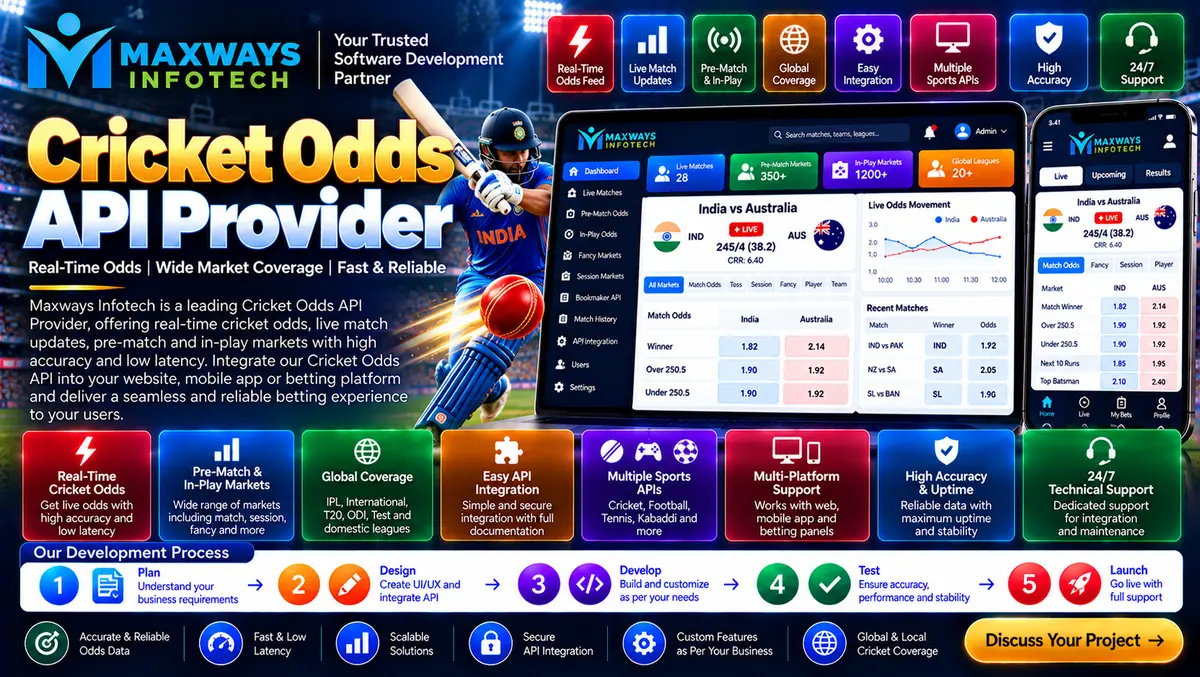
A Cricket Odds API Provider supplies access to structured cricket odds data that developers can integrate into compatible websites, dashboards and data-analysis applications. Depending on the provider, its services may include match fixtures, market prices, bookmaker information, historical snapshots and live-update capabilities.
Selecting a provider requires a clear understanding of the data your application needs. Two APIs may both advertise cricket odds but differ in competition coverage, supported markets, update schedules, historical access and usage restrictions. Evaluating these differences early can help avoid expensive integration changes later.
What Does a Cricket Odds API Provider Offer?
A cricket odds data provider makes supported market information available through documented API endpoints. Applications can request the data, validate the response and organize it for an approved use.
Typical capabilities may include:
-
Fixture discovery: Identifying supported upcoming and ongoing matches.
-
Odds retrieval: Accessing available prices for supported markets.
-
Market metadata: Understanding the type of market and its available outcomes.
-
Source information: Identifying the source associated with a price.
-
Historical records: Accessing past data where included in the service.
-
Update metadata: Checking timestamps and supported market-status information.
-
Developer documentation: Understanding authentication, request parameters and response formats.
Actual features vary by provider and subscription. For example, some providers publish primarily match-winner markets, while others document additional market types. Always check the current API specification instead of relying on general marketing descriptions. <Cite refs={["turn250019search2","turn250019search4"]}/>
Why Provider Selection Matters
An API becomes part of the application's technical infrastructure. Its limitations can influence the design, performance and maintenance requirements of the finished product.
Coverage affects the product scope
If a project needs data for specific cricket formats or competitions, the provider must support those events under the chosen plan. Missing coverage may require a different data source or a change in the application's scope.
Data structure affects development
Different APIs may use different identifiers, naming conventions and response formats. Developers should understand these differences before designing their internal data model.
Update policies affect freshness
A provider's refresh schedule determines how frequently new information may become available. The application must be designed around the actual update behaviour rather than an assumed refresh interval.
Licensing affects permitted use
Access to data does not automatically grant permission to redistribute it, store it indefinitely or use it for every commercial purpose. These rights must be verified separately.
Businesses exploring technology services can visit Maxways Infotech to review the company's published information before evaluating its relevance to a project.
Six Criteria for Comparing Cricket Odds API Providers
1. Competition and format coverage
Prepare a list of the competitions and formats required by your application. Ask the provider to confirm which are covered, how coverage is maintained and whether the subscription imposes any restrictions.
Do not assume that a provider supporting international cricket necessarily covers every domestic competition or franchise tournament.
2. Market availability
Review the market types and selection structures returned by the API. Check whether the provider supplies only a limited set of markets or a wider catalogue.
The application should preserve the meaning of each market and selection rather than treating all odds values as interchangeable.
3. Update behaviour
Ask whether data is delivered through request-based endpoints, streaming connections or a combination of methods. Verify documented update intervals, cache guidance and any relevant rate limits.
A service described as live should still be evaluated for the freshness and availability of its actual responses.
4. Historical data access
Historical records can be useful for permitted research, reporting and retrospective analysis. Confirm the date range, record granularity, storage rights and whether historical data requires a separate subscription.
5. Documentation and developer support
Look for complete endpoint descriptions, authentication guidance, sample responses, error codes and versioning information. Sandbox access can help the development team test the integration before production deployment.
6. Commercial terms and support
Confirm the subscription price, request quotas, permitted use, support arrangements and process for handling API changes. These terms affect the total cost of maintaining the integration.
A Practical Evaluation Process
A structured evaluation can help developers compare providers without relying solely on advertised features.
Step 1: Define the intended application. Document the data fields, competitions, update requirements and permitted use.
Step 2: Request the technical documentation. Review endpoints, authentication, response schemas and usage limits.
Step 3: Test representative data. Where a sandbox or trial is available, inspect responses for the events and markets relevant to the project.
Step 4: Validate data quality. Check event identifiers, market definitions, timestamps, missing fields and status information.
Step 5: Estimate usage and cost. Calculate the likely request volume and review the applicable subscription limits.
Step 6: Review licensing and support. Confirm commercial-use permissions, retention conditions, maintenance responsibilities and support terms before committing.
Data Quality and Reliability Checks
A successful API request does not automatically mean that the response is suitable for display or further processing.
A reliable integration should:
-
Validate required fields before storing records.
-
Confirm that data belongs to the intended event.
-
Preserve source timestamps.
-
Distinguish missing data from valid numerical values.
-
Respect the provider's market-status information.
-
Detect duplicate or inconsistent updates.
-
Handle temporary failures without presenting old information as current.
-
Record useful diagnostics without exposing secret credentials.
For applications that compare data from multiple sources, define how discrepancies will be identified and investigated. Different providers may publish different values because of differences in coverage, timing or source methodology.
API Integration and Technical Maintenance
After choosing a provider, the development team needs a clear implementation and maintenance plan.
The backend should handle authentication, request management, response validation and error processing. If the application uses caching, its expiration policy should follow the provider's documentation and the data's freshness requirements.
Developers should also prepare for API version changes. A modification to a response field can affect downstream services even if the external endpoint remains available.
For projects involving financial software and related technology, Maxways Infotech's fintech section is a relevant place to explore the company's published fintech information. Any cricket betting-related application needs a separate assessment of data licensing, provider authorization and applicable legal requirements.
Common Mistakes When Choosing a Provider
Comparing only the number of advertised markets: The required coverage and quality of the returned data are more important than an unverified headline figure.
Ignoring usage limits: Request quotas and subscription restrictions can affect the application's operating costs.
Assuming every provider offers live updates: Verify the actual delivery method and refresh behaviour.
Skipping a technical trial: A sample response can reveal missing fields or incompatible formats before development progresses.
Overlooking data rights: Confirm the permitted uses of the data, including display, retention and redistribution.
Not planning for maintenance: API changes, errors and infrastructure updates remain part of the application's lifecycle.
Cost Factors to Consider
The total cost includes more than the provider's subscription fee.
-
API access and competition coverage.
-
Request volume and usage limits.
-
Historical-data availability.
-
Backend integration and frontend development.
-
Hosting, caching and monitoring.
-
Testing and quality assurance.
-
Ongoing support and compatibility updates.
Request a written quotation that separates recurring fees from implementation costs. It should also explain how additional usage, new markets or future API changes may affect the price.
Frequently Asked Questions
What is a Cricket Odds API Provider?
It is a service that supplies documented API access to supported cricket odds data for compatible applications.
How do I compare different providers?
Compare required competition coverage, market availability, response formats, update behaviour, documentation, licensing, usage limits and support.
Does every provider supply historical odds?
No. Historical access varies by provider and subscription. Confirm the available date range and any additional fees.
Can I integrate cricket odds data into a website?
Yes, when the provider's terms permit the intended use. A typical implementation uses a backend to retrieve, validate and deliver the required data securely.
What should I check before purchasing an API subscription?
Confirm the required data is available, test the response structure where possible, review usage limits and verify the licence and support terms.
Where can I find more software development information?
Explore the Maxways Infotech blog for additional technology-related reading. Use the selected provider's official documentation for exact API specifications and current coverage.
Conclusion
Choosing a Cricket Odds API Provider is a technical and commercial decision. The right evaluation considers competition coverage, market structure, data freshness, documentation, usage limits, licensing and ongoing support.
Before committing to a subscription, define your requirements, inspect the API documentation and test representative responses. A clear integration plan can reduce development uncertainty and make the resulting application easier to maintain.