Explore Live Sports Odds API integration, market suspensions, update sequencing, traffic management, data quality monitoring, API security, and recovery strategies.
Live Sports Odds API: Live Event Processing, Market Status and Data Quality
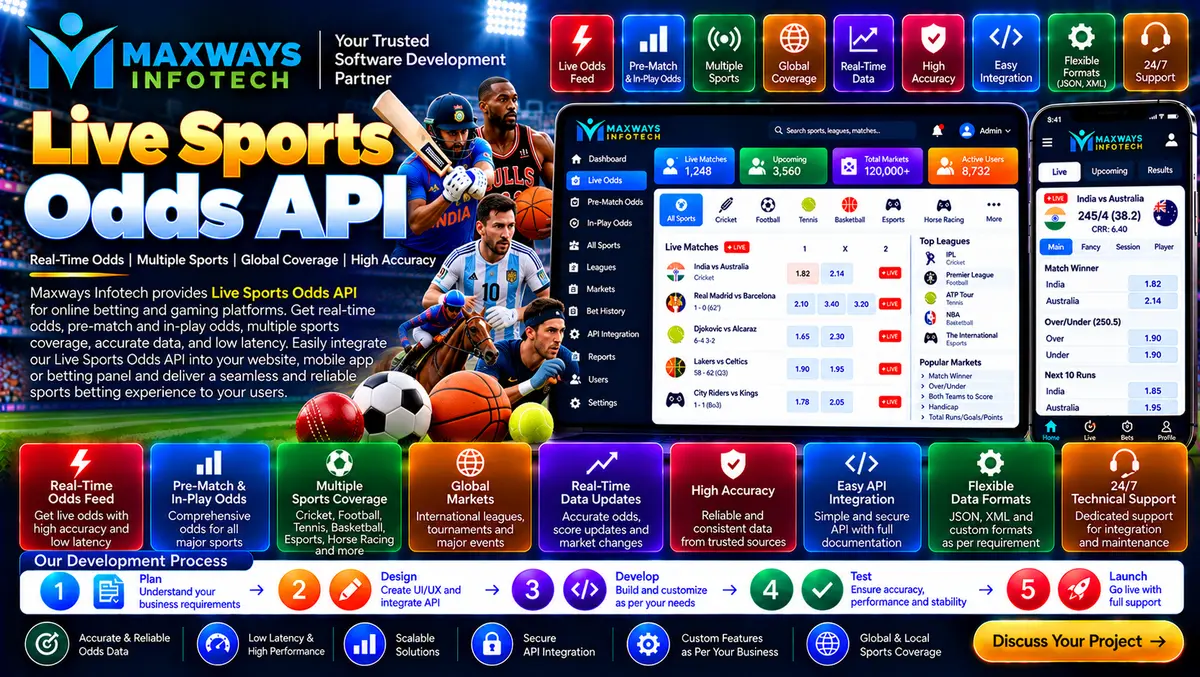
A Live Sports Odds API enables applications to retrieve changing sports odds and market information while sporting events are in progress. It can support live sports dashboards, data comparison platforms, sports statistics applications, and other authorised services that need information from ongoing matches.
The technical challenge is not simply displaying the latest value. A live event can generate frequent updates, temporary market suspensions, status changes, and sudden increases in traffic. If an application processes these changes incorrectly, users may see outdated information, duplicate updates, or data associated with the wrong event.
Building a reliable Live Sports Odds API integration therefore requires careful event processing, market-state management, update ordering, and monitoring throughout the data pipeline.
What Is a Live Sports Odds API?
A Live Sports Odds API provides access to odds-related information for supported sporting events while they are underway. Depending on the provider, the available response may include event identifiers, market names, selections, odds values, timestamps, and market availability status.
Some providers deliver information through standard HTTP endpoints, while others support streaming connections or event notifications. The available delivery methods, supported sports, and update frequency depend on the provider.
Typical applications include:
-
Live sports data dashboards.
-
Sports market comparison interfaces.
-
Match analytics applications.
-
Live event monitoring systems.
-
Sports statistics and reporting tools.
-
Authorised sports information platforms.
Before integrating an API, developers should identify which event types and markets are available and establish how the provider communicates updates, corrections, and interruptions.
Businesses researching software development options can start with the Maxways Infotech homepage to explore the company's published information.
How Live Odds Data Changes During a Match
Live sports data follows an event-driven pattern. Information may change because of an action on the field, an official decision, a change in match status, or an update from the data provider.
For example, a football match may experience a goal, penalty, red card, or half-time interval. A cricket match may include a wicket, an innings break, a revised target, or an interruption caused by weather.
These events do not necessarily affect every market in the same way. A particular market may temporarily become unavailable while the event is reviewed, while other match information continues to update.
A live-data application should therefore distinguish between three important concepts:
Event status: Describes the state of the sporting event, such as scheduled, in progress, interrupted, or completed.
Market status: Describes whether a particular market is available, suspended, or closed according to the provider's definitions.
Data freshness: Indicates how recently the information was observed or updated.
Keeping these concepts separate helps prevent an application from assuming that a match is unavailable simply because one market has been suspended.
Managing Market Suspensions and Reopening
Market suspension is an important state change in live sports data. A provider may temporarily mark a market as unavailable when new information requires processing or when the market's status changes.
An application should treat the status supplied by the authorised provider as meaningful data rather than assuming that every market remains available throughout a match.
A reliable implementation should:
-
Receive the market-status update.
-
Associate it with the correct event and market identifiers.
-
Update the internal market state.
-
Notify the relevant application components.
-
Display the current status accurately.
-
Process a reopening update only when the provider reports it.
The interface should not continue presenting an old market value as currently available when the market has been suspended.
It is also useful to preserve a record of important state changes. These records help developers investigate unexpected behaviour, identify missing updates, and understand how a market moved from one state to another.
Handling Update Ordering and Duplicate Messages
Live data can arrive through distributed systems, where network conditions and processing delays may affect the order in which messages are received.
Imagine an application receives two updates for the same market. The newer update arrives first, but an older message is delivered afterwards. If the application blindly applies both messages in arrival order, the older value may overwrite the newer one.
Duplicate messages can create a similar problem by causing the same update to be processed more than once.
Use version numbers or sequence identifiers
When a provider supplies sequence numbers, version identifiers, or unique event IDs, use them according to the documented protocol. They can help identify repeated updates and determine whether a record is newer than the current stored version.
Maintain a consistent market key
A market record should be associated with the appropriate event, market definition, selection, and source. This prevents updates from one event or selection from accidentally changing another record.
Apply updates atomically
Related fields should be updated together when the data model requires them to represent one consistent state. This reduces the risk of displaying a new value alongside an outdated status.
Reconcile after interruptions
If the connection is interrupted or a sequence gap is detected, the application should use the provider's supported recovery process. This may involve retrieving a fresh snapshot before continuing with incremental updates.
These techniques make live-data processing more predictable, particularly when multiple matches are active simultaneously.
Designing the Live Sports Odds API Architecture
A live-data application benefits from separating data retrieval, processing, storage, and delivery into distinct components.
A typical architecture follows this path:
Sports data provider → Ingestion service → Validation and event processor → Current-state store → Delivery service → Application interface
Ingestion service
The ingestion layer receives information through the provider's supported API methods. It handles authentication, connection management, subscriptions, and request limits.
Validation and event processor
The processor checks identifiers, timestamps, market states, and update versions. It also applies the mapping rules needed to convert provider-specific responses into a consistent internal format.
Current-state store
A database or cache maintains the latest accepted state for each event and market. Historical records may be stored separately when permitted and required.
Delivery service
A delivery layer sends relevant updates to connected application components. Depending on the requirements, it may use polling, server-sent events, WebSockets, or another supported mechanism.
Application interface
The frontend displays the latest valid information, market availability, and any relevant freshness indicators.
Separating these responsibilities makes it easier to test individual components and investigate failures without having to debug the entire application at once.
Choosing the Right Update Delivery Method
The best delivery method depends on the provider's capabilities, the number of active events, and how frequently the application needs to refresh its information.
REST polling: The application requests updated data at a configured interval. It is relatively straightforward to implement and can be suitable for simpler use cases, although frequent polling increases request volume.
WebSockets: A persistent connection can deliver updates as messages arrive, when the provider supports this method. The application must handle connection failures, reconnections, and message ordering.
Server-sent events: This approach supports server-to-client event delivery over a persistent connection and can suit interfaces that mainly receive updates.
Webhooks: A provider can send notifications to an application endpoint when supported events occur. The receiving service should verify the sender, handle retries safely, and avoid processing duplicate notifications more than once.
Streaming can reduce the delay introduced by repeated polling, but it cannot eliminate delays in the upstream source itself. Actual freshness depends on the provider's collection process, update schedule, network conditions, and application processing. <Cite refs={["turn144313search5","turn144313search8"]}/>
Preparing for Traffic Spikes During Major Events
Live sports applications rarely experience perfectly even traffic. Interest may rise sharply during important tournaments, finals, or decisive moments in a match.
A system that performs well under ordinary traffic may struggle when many users request the same event data simultaneously.
Developers can prepare for these conditions by applying several practices.
Cache suitable data: Reuse validated event information where the freshness requirements allow it. Suspended markets and rapidly changing records still need appropriate status handling.
Use event-based subscriptions: Where supported, subscribe only to the sports and events that the application actually needs.
Separate ingestion from delivery: Avoid making every browser request generate an independent upstream request.
Apply backpressure: Define what happens when incoming messages arrive faster than a downstream component can process them.
Scale services independently: The data ingestion layer and the frontend delivery layer may experience different workload patterns.
Run load tests: Simulate multiple active events and bursts of updates before launching the application.
Performance goals should be based on measured behaviour and the application's requirements rather than unsupported claims of guaranteed delivery times.
Monitoring Live Data Quality
A successful API response does not necessarily mean that the displayed data is current or correct. Monitoring should cover the complete path from the provider to the application interface.
Alerts should be based on the expected behaviour of each provider and market type. For example, an event that is temporarily interrupted should not necessarily trigger the same alert as a connection that has stopped receiving all updates.
Operational logs should include sufficient identifiers and timestamps for troubleshooting without exposing API secrets or unnecessary sensitive information.
Security and Data Access Requirements
Live sports data integrations should use secure credential management and well-defined access controls.
API keys should be stored on the server rather than exposed in browser code. Connections should use encryption, and credentials should have only the permissions required for their assigned functions.
Applications should also validate incoming messages, restrict unnecessary access, and record relevant operational events. If the service supports multiple data providers, each source should have a clearly defined identity and access policy.
Data rights require equal attention. Providers may impose restrictions on storage, redistribution, public display, or commercial use. Confirm those permissions before making the data available to customers or other systems.
For projects involving financial workflows or data-intensive business software, the Maxways Infotech fintech page is another resource to review when researching related development capabilities.
Any application involving betting-related functionality must also undergo appropriate legal review for its intended jurisdiction. Access to a data feed does not, by itself, authorise the operation of a betting service.
Testing a Live Sports Odds API Before Deployment
A good test plan should cover normal updates as well as the less frequent situations that can cause serious application errors.
Test scenarios should include:
-
Multiple matches updating at the same time.
-
A market changing from available to suspended.
-
A suspended market becoming available again.
-
Duplicate messages arriving from the provider.
-
Older updates arriving after newer updates.
-
A temporary network disconnection.
-
A provider returning rate-limit or server errors.
-
A fresh snapshot being loaded after recovery.
-
A sudden increase in connected users.
-
A stale record being prevented from appearing as current.
Where available, use a sandbox or simulated data to reproduce these situations. Confirm how the provider documents reconnection behaviour, message ordering, and recovery after a connection gap.
Testing should also verify that the user interface accurately distinguishes unavailable data from data that has not yet been refreshed.
Frequently Asked Questions
What is a Live Sports Odds API?
It is an API that supplies odds-related information for supported sports events while they are in progress. The available markets, update methods, and refresh frequency depend on the provider.
How does a Live Sports Odds API update information?
It may use repeated HTTP requests, WebSockets, server-sent events, webhooks, or a combination of supported methods. The correct approach depends on the provider's documentation and application requirements.
Why do live sports markets get suspended?
A provider may temporarily mark a market as unavailable during an event or while information is being processed. The application should respect the supplied market status rather than assume that every market is continuously available.
How can developers prevent outdated updates from overwriting newer data?
They can use provider-supported version identifiers, sequence numbers, timestamps, consistent market keys, and controlled recovery procedures. The exact approach depends on the available data fields.
What should be checked before integrating a Live Sports Odds API?
Review supported sports, market coverage, update frequency, timestamps, connection methods, recovery behaviour, request limits, security, data permissions, and applicable legal requirements.
For additional technical articles and software-related information, visit the Maxways Infotech blog.
Conclusion
A Live Sports Odds API integration must manage more than changing numerical values. Market suspensions, event-state changes, duplicate messages, out-of-order updates, and traffic spikes all affect the quality of the information shown to users.
A clear event-processing architecture, reliable state management, careful recovery procedures, and continuous monitoring help developers build applications that handle live data more consistently.
Before selecting a provider, define the required sports and markets, test the update behaviour, and establish how the system will respond when information becomes delayed or unavailable. Accurate status reporting and authorised data use should remain central to the implementation.