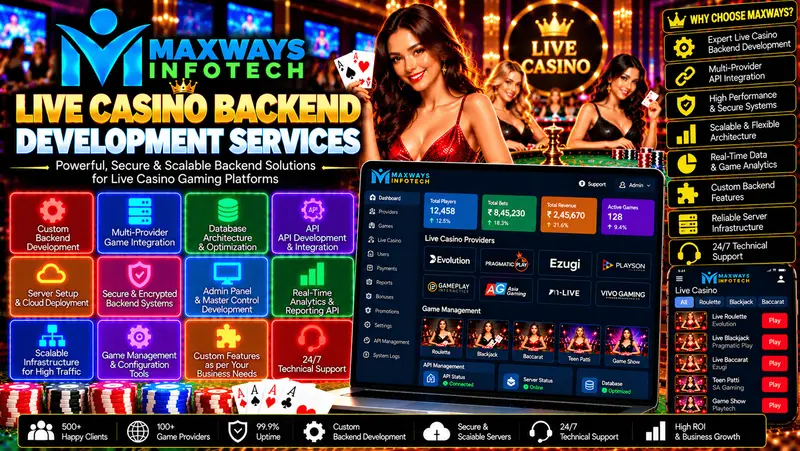
Explore custom live casino API development, backend architecture, secure integrations, testing, and maintenance for compatible software platforms.
Custom Live Casino API Development: Features, Integration, and Technical Guide
Custom Live Casino API Development involves designing, developing, or adapting software interfaces to meet the specific requirements of a live casino-related platform. Depending on the project, this work may include backend development, third-party API integration, session management, secure authentication, error handling, and technical testing.
Businesses considering a custom API should begin by defining their required functionality, identifying external dependencies, and confirming the permissions needed to use third-party services. At Maxways Infotech, businesses can explore software development resources when planning their technology requirements.
What Is Custom Live Casino API Development?
Custom live casino API development focuses on creating or extending software interfaces that allow compatible applications to exchange information according to defined rules.
Unlike a standard integration that connects an application to an existing API, custom development may involve building additional backend endpoints, application logic, data validation, or service connections.
Depending on the project requirements, development may cover:
-
Custom API endpoints and response formats.
-
Integration with authorised external gaming services.
-
Game catalogue and session connectivity where supported.
-
Authentication and access-control mechanisms.
-
Backend application logic and database communication.
-
Error handling and integration monitoring.
-
API documentation and automated testing.
-
Ongoing maintenance and version management.
Not every project needs every component. The final scope should reflect the platform's actual requirements and the capabilities of the selected external providers.
Why Businesses Consider Custom Live Casino API Development
1. Customised Technical Functionality
An existing API may not provide every function a business requires. Custom development can help address specific application requirements when the necessary data, permissions, and technical capabilities are available.
For example, a project may need a particular response format, an additional backend endpoint, or a defined workflow between its website and an approved external service.
2. Better Integration With Existing Systems
A platform may already have a website, database, account service, or administration dashboard. A custom API layer can help connect these components through documented interfaces.
Developers should define which system is responsible for each function to prevent duplicated logic and inconsistent data.
3. Greater Control Over Application Logic
Custom APIs can give the development team control over the business rules and data validation implemented in software it owns or is authorised to modify.
This does not mean that custom development overrides the restrictions of an external provider. Third-party functionality remains subject to its documentation, access permissions, and contractual terms.
4. Easier Maintenance and Future Updates
A well-designed API uses clear endpoint definitions, versioning, documentation, and consistent error responses. These practices make it easier for developers to maintain the system as requirements change.
Businesses researching wider gaming software capabilities can explore live-casino-api-software-developers when considering the supporting components of a custom platform.
Essential Features of a Custom Live Casino API
The exact feature set depends on the application's purpose and the services available through authorised providers.
Custom API Endpoints
API endpoints define how applications request or exchange information. Each endpoint should have a clear purpose, expected inputs, authentication requirements, response structure, and documented error conditions.
Consistent endpoint design helps other developers understand how to use the interface without relying on assumptions.
Game Catalogue Integration
Where supported, an API may provide information about available games, categories, identifiers, and availability status.
The application should handle missing metadata, unavailable content, and catalogue updates correctly. Only content that is authorised for the intended use should be displayed.
Game Session Management
Some providers support API operations for creating or validating game sessions. The integration should follow the provider's documented workflow and handle expired sessions, rejected requests, and connection failures.
Session identifiers and other sensitive information must be protected against unauthorised access.
Player Account Connectivity
If account-related functions are supported, the integration may exchange permitted account identifiers or other necessary information between systems.
Developers should define data ownership, validate incoming requests, and restrict access to sensitive information. Personal data should be processed only for authorised purposes.
Wallet and Transaction Integration
Wallet and transaction capabilities are not included in every API. Their availability must be confirmed with the provider before designing the system around them.
Where supported, transaction workflows should account for unique identifiers, duplicate-request protection, reconciliation, audit records, and clear processing states. An ambiguous timeout should not automatically be treated as proof that a transaction failed.
Administration and Monitoring
An API project may also require administrative functions for managing permitted configuration, reviewing service status, or investigating integration errors.
Access should follow the principle of least privilege, and sensitive administrative operations should be logged appropriately.
Custom API Development vs Existing API Integration
Businesses should determine whether they need a completely new API, a connection to an existing API, or a combination of both.
| Consideration | Custom API development | Existing API integration |
|---|---|---|
| Primary purpose | Create or extend software interfaces | Connect to an existing service |
| Custom business logic | Can be designed around requirements | Limited by available external functions |
| Documentation | Must be created and maintained for custom endpoints | Usually supplied by the provider |
| External dependency | Depends on the architecture | Usually depends on the provider |
| Development effort | Includes interface design and implementation | Includes connection and compatibility work |
| Maintenance | Requires ongoing support for custom code | Requires support for integration code and provider changes |
Custom development may be appropriate when an application requires functionality that an existing API does not offer. Existing integration may be more practical when a suitable authorised service already provides the required operations.
The decision should be based on technical feasibility, cost, permissions, and long-term maintenance.
The Custom Live Casino API Development Process
A structured workflow helps businesses define the deliverables and validate the implementation before launch.
Step 1: Requirement Analysis
Identify the purpose of the API, required functions, expected data flows, supported platforms, and external dependencies.
Separate essential features from optional improvements, and confirm that the intended use is legally permitted in the target market.
Step 2: API Architecture and Design
Define endpoints, request and response formats, authentication, error codes, versioning, and access policies.
Document which system owns each piece of data and how connected components should behave when a service becomes unavailable.
Step 3: Backend Development
Implement the required endpoints, business logic, validation rules, and database interactions. Keep confidential API credentials in secure server-side configuration rather than public frontend code.
Use code reviews and automated tests to maintain consistency as the project grows.
Step 4: Third-Party Integration
Where external gaming services are required, connect them using the provider's official documentation and approved access credentials.
Confirm supported operations, usage limits, compatibility, and commercial permissions before implementing dependent features.
Step 5: Testing and Quality Assurance
Test normal operation alongside invalid input, expired credentials, permission failures, delayed responses, and provider outages.
Verify that errors are handled consistently and that failed requests do not expose sensitive information or cause unintended duplicate operations.
Step 6: Deployment and Monitoring
Deploy through a controlled release process. Configure appropriate monitoring, error reporting, and operational logs.
After launch, review performance and provider updates. Maintain a documented process for investigating incidents and applying changes safely.
Security Best Practices for Custom API Development
Security should be part of the API architecture from the beginning rather than a final checklist.
Secure authentication: Use the authentication method supported by the API and verify permissions for every sensitive operation.
Credential protection: Store secrets securely on trusted backend systems and restrict access to authorised personnel and services.
Input validation: Validate incoming data against expected formats and permitted values before processing requests.
Access control: Apply role-based permissions and the principle of least privilege.
Safe logging: Record useful operational information without unnecessarily exposing passwords, tokens, personal information, or other confidential data.
Duplicate-request protection: Use appropriate idempotency controls for operations that should not be processed more than once.
Regular testing: Review dependencies, test security controls, and update software according to an established maintenance process.
The exact controls should reflect the API's capabilities, the sensitivity of the information handled, and applicable legal requirements.
Common Challenges in Custom Live Casino API Development
Incomplete External Documentation
Missing endpoint details or unclear response formats can delay integration. Developers should request clarification and test assumptions in an approved testing environment.
Incompatible Systems
An external API may not support a required function or technology. Review its documentation before committing to a development schedule.
Authentication Failures
Expired credentials, incorrect permissions, or configuration errors can interrupt communication. Secure credential management and appropriate monitoring help teams investigate these problems.
Unavailable Services
External services may respond slowly or become temporarily unavailable. Suitable timeouts, carefully designed retries, and clear error handling help reduce disruption.
Data Inconsistency
Connected systems may update information at different times. Define data ownership, validation rules, and reconciliation procedures to investigate conflicting records.
API Version Changes
Providers may change endpoints, request formats, or authentication requirements. Maintain documentation, monitor change notices, and test updates before production deployment.
How to Choose a Custom Live Casino API Development Company
Choosing a development partner requires evaluating technical capability, security practices, project management, and long-term support.
Consider these questions before making a decision:
-
Technical expertise: Can the team explain its API design and integration approach?
-
Project scope: Are endpoints, features, exclusions, and deliverables documented?
-
Security practices: How will authentication, credentials, and sensitive data be protected?
-
Testing process: Does the team test failure scenarios as well as successful requests?
-
Documentation: Will the project include API specifications and maintenance instructions?
-
Integration experience: Can the team work with the selected provider's official documentation?
-
Pricing: Are development fees, external provider charges, and maintenance costs clearly defined?
-
Compliance: Are the proposed services permitted in the intended jurisdiction?
Request a written proposal with milestones, dependencies, acceptance criteria, and post-launch responsibilities.
For additional technical reading, explore the live-casino-api-development-company. It discusses API architecture, session management, integration workflows, and the importance of verifying provider-specific capabilities.
SEO Considerations for a Custom API Website
A technically reliable API does not automatically improve search rankings. SEO depends on the website's content, structure, accessibility, performance, and relevance to visitors.
Important practices include:
-
Writing unique title tags and meta descriptions.
-
Using clear headings and descriptive URLs.
-
Keeping important content accessible to search engines.
-
Optimising images and page-loading performance.
-
Linking related service pages naturally.
-
Maintaining an accurate XML sitemap.
-
Avoiding duplicate pages created only for keyword variations.
-
Reviewing canonical URLs and indexing settings.
Internal links should provide a useful next step for the reader. Choose anchor text that describes the destination accurately rather than repeating the same phrase across every article.
Frequently Asked Questions
What is custom live casino API development?
It involves creating or extending software interfaces for a live casino-related platform, potentially including backend endpoints, validation, authentication, and connections to authorised external services.
What is the difference between custom API development and API integration?
Custom API development creates or modifies an interface. API integration connects an application to an existing interface. Some projects require both activities.
Can a custom API work with an existing website?
It may be possible if the website's architecture supports the required communication and the relevant systems provide the necessary access and permissions. A technical assessment should confirm feasibility.
How much does custom live casino API development cost?
Costs depend on the number of endpoints, complexity of business logic, third-party dependencies, security requirements, testing, and ongoing maintenance. A reliable estimate requires a defined scope.
How long does custom API development take?
The timeline depends on the project's size, documentation quality, existing infrastructure, integration requirements, and testing scope. The development team should estimate the timeline after reviewing the requirements.
How can businesses maintain API security?
Use secure authentication, restricted permissions, protected credentials, input validation, safe logging, regular testing, and a documented incident-response process.
Conclusion
Custom Live Casino API Development helps businesses design software interfaces that meet specific technical requirements and connect compatible applications with authorised external services. A successful implementation requires clear architecture, secure data handling, reliable error recovery, comprehensive testing, and ongoing maintenance.
Before starting a project, document the required functionality, review external API specifications, confirm permissions, and define maintenance responsibilities. Careful planning helps businesses select an appropriate development approach and build a system that remains manageable as requirements evolve.
To explore software development resources, visit Maxways Infotech. Any live casino-related platform should only be developed or operated where legally permitted, with appropriate licensing, age safeguards, privacy protections, and other applicable compliance measures.Custom Live Casino Website Development | Maxways Infotech