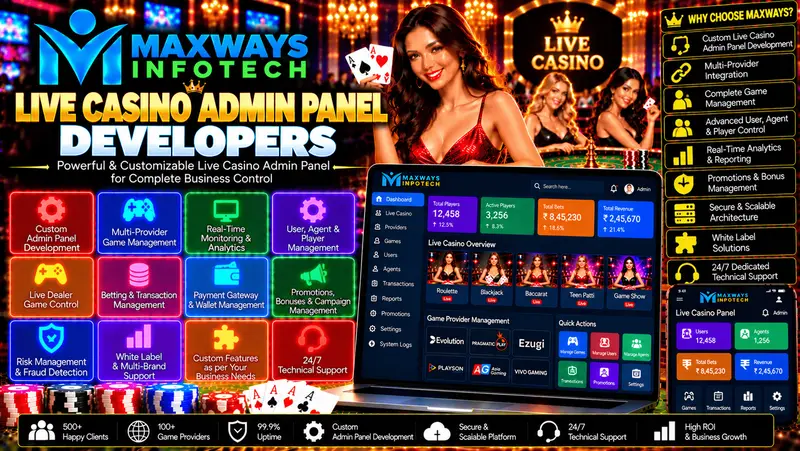
Discover live casino integration software developers, API connectivity, backend architecture, secure integrations, testing, and platform maintenance.
Live Casino Integration Software Developers: Complete Guide to APIs, Connectivity, and Platform Development
Live Casino Integration Software Developers often need help connecting compatible third-party services, organising application data, improving integration reliability, and maintaining their software as requirements change.
A successful integration project begins with clear technical requirements and an understanding of what each external API actually supports. The solution must also account for security, testing, maintenance, and the legal permissions required for the intended market.
At Maxways Infotech, businesses can explore software development and API-related services when planning their digital platforms. This guide explains the main integration components, the development workflow, common challenges, and how to choose an appropriate technology partner.
What Do Live Casino Integration Software Developers Do?
Live casino integration software developers connect compatible applications, backend systems, and authorised external services through documented APIs or other supported interfaces.
Their responsibilities depend on the project scope and may include:
-
API integration: Connecting the application with approved external services.
-
Backend development: Processing requests and applying application rules.
-
Data mapping: Converting provider responses into the application's internal data structures.
-
Session management: Handling supported session creation, expiry, and status changes.
-
Authentication: Protecting API credentials and validating authorised requests.
-
Error handling: Managing timeouts, rejected requests, and unavailable services.
-
Integration testing: Verifying normal workflows and failure scenarios.
-
Monitoring and maintenance: Tracking operational issues and updating integrations when requirements change.
Some projects require only one API connection, while others involve multiple providers and supporting services. Developers should define the required functionality before selecting the integration architecture.
Why Is Live Casino Software Integration Important?
A platform may rely on several independent services, each responsible for a different function. If those services do not exchange information correctly, the application can experience failed requests, inconsistent records, or difficult troubleshooting.
1. Reliable Communication Between Systems
An integration layer establishes how applications send requests and process responses. Clearly defined interfaces help reduce ambiguity and make it easier to identify where a failure occurred.
2. Consistent Data Handling
External providers may use different field names, identifiers, and response formats. A well-designed integration maps the required information into a consistent internal structure while preserving important source references.
3. Easier Integration Maintenance
Separating provider-specific code from the rest of the application can make future changes easier to manage. Developers may be able to update an individual integration without unnecessarily modifying unrelated features.
4. Better Operational Visibility
Structured logs and monitoring help technical teams investigate failed requests, response delays, and service interruptions.
5. Improved Application Security
Backend integration allows private credentials to remain on the server and enables the application to validate requests before communicating with external services.
Key Features to Consider in Live Casino Integration Software
The necessary features depend on the API, application architecture, and approved project scope. Confirm each feature against the provider's documentation before development begins.Live Casino API Integration Providers | Maxways Infotech
API Connectivity and Authentication
An API defines how software systems communicate. The integration may require API keys, signed requests, access tokens, or another documented authentication method.
Developers should verify credentials securely, protect private configuration, and ensure that requests use the correct environment and permissions.
Important considerations include:
-
Supported endpoints and request methods.
-
Required parameters and data formats.
-
Authentication and authorisation rules.
-
Rate limits and timeout behaviour.
-
API versioning and deprecation policies.
-
Documented error responses.
For a related technical overview, read the Diamond Casino API integration guide, which discusses API communication, session workflows, callbacks, and backend monitoring.
Game Catalogue Integration
Where supported, an API may provide information about available games and their associated metadata.
The application may need to organise game names, provider identifiers, categories, availability, and other documented fields. Developers should also account for changes in the catalogue and avoid assuming that all connected providers return identical information.
Game-Launch and Session Integration
Some APIs support launching an authorised game session or returning information required to open a supported experience.
The backend should validate the request, confirm the user's permissions, process the provider's response, and handle expired sessions or unsuccessful launches appropriately.
The exact workflow depends on the provider's technical specification.
Wallet and Transaction Connectivity
Wallet integration is a specialised requirement and is not included in every API.
If supported transaction functions are required, developers must understand the provider's transaction model, callback requirements, unique identifiers, error responses, and reconciliation procedures.
Repeated or delayed requests need particular attention because an interrupted connection does not necessarily mean the original operation failed.
Reporting and Monitoring
Reporting APIs may expose operational information or supported historical records. Confirm which data is available, how frequently it updates, and whether exports or monitoring alerts are included.
The application should also maintain suitable internal monitoring so the development team can investigate issues across its own components.
How Does Live Casino Integration Software Development Work?
A structured process helps ensure the integration meets technical requirements and behaves predictably in production.
Step 1: Analyse the Requirements
Identify the external services, required API functions, supported devices, expected workload, and target markets.
Document essential features, third-party dependencies, acceptance criteria, and any approvals that must be obtained before deployment.
Step 2: Review API Documentation
Study the provider's endpoints, authentication requirements, request formats, response fields, callbacks, rate limits, and error codes.
Where possible, obtain access to an approved sandbox or test environment before working with production credentials.
Step 3: Design the Integration Architecture
Determine how the frontend, backend, database, and external APIs will communicate.
Define which system owns each important type of information and how the application will respond when an external service is unavailable.
Step 4: Implement Secure API Requests
Develop the backend code that authenticates requests, validates parameters, applies permissions, and communicates with the external service.
Keep private credentials on the server and use appropriate access controls for integration settings.
Step 5: Map and Validate Responses
Convert supported provider responses into the application's internal data model where appropriate.
Validate response fields and account for missing information, unexpected status codes, and provider-specific differences.
Step 6: Test Normal and Failure Scenarios
Test successful requests alongside invalid parameters, expired sessions, timeouts, repeated callbacks, and unavailable services.
If transaction operations are part of the project, test duplicate prevention and reconciliation according to the documented transaction model.
Step 7: Deploy and Monitor
Deploy after the agreed acceptance criteria have been met. Configure production credentials, operational monitoring, logging, and incident-response procedures.
Step 8: Maintain the Integration
Review API updates, dependency changes, performance trends, and provider notifications. Test changes before releasing them to production and update the technical documentation.
Technical Architecture for API Integration
A maintainable architecture separates responsibilities so that each component can be tested and updated appropriately.
A typical implementation may include the following layers:
Frontend layer: Sends user requests to the platform backend and displays appropriate responses.
Backend application layer: Validates requests, enforces permissions, and applies application rules.
Integration layer: Handles provider-specific authentication, request formats, response mapping, and error handling.
Data layer: Stores the information the application is authorised to retain and retrieve.
Monitoring layer: Records relevant operational events and measures application health.
A dedicated integration layer can be particularly useful when a platform connects multiple providers. However, not every project needs a complex distributed architecture. The design should reflect the actual scale and maintenance requirements.
For a broader look at connected platform architecture, explore the bookies-management-software-developers.
Security Best Practices for Live Casino API Integration
Security should be built into the integration from the beginning.
Protect credentials: Store private API keys and other secrets on the server, restrict access, and rotate credentials according to an appropriate policy.
Validate incoming requests: Check parameters, data types, and permissions before processing protected operations.
Use secure communications: Follow the provider's requirements for encrypted connections and request authentication.
Verify callbacks: Validate incoming callbacks using the documented signature or authentication method.
Prevent duplicate processing: Apply supported idempotency controls and unique operation identifiers where relevant.
Handle errors safely: Do not expose credentials, internal stack traces, or sensitive system details in user-facing messages.
Maintain useful logs: Record relevant errors and operational events while avoiding unnecessary storage of sensitive information.
Review access permissions: Limit administrative and integration-setting access to authorised personnel.
Prepare for incidents: Establish procedures for investigating suspicious activity, revoking compromised credentials, and restoring affected services.
Security requirements depend on the actual architecture, data being processed, and applicable legal obligations.
Common Challenges Faced by Integration Developers
Incompatible Data Formats
Different APIs may return similar information in different formats. Developers should define mapping rules and validate data before passing it to other application components.
Authentication Failures
Incorrect credentials, expired tokens, or misconfigured environments can cause requests to fail. Keep test and production configuration separate and follow the provider's authentication instructions.
Timeouts and Service Interruptions
An external service may respond slowly or become temporarily unavailable. Appropriate timeouts, bounded retries, and clear error handling can help reduce the impact.
Duplicate Callbacks
Some providers retry callbacks when an acknowledgement is delayed. The application should recognise repeated events and process them according to the provider's documented rules.
Inconsistent Records
Connected systems may update records at different times. Stable identifiers, clear data ownership, and reconciliation procedures help developers investigate discrepancies.
API Version Changes
Providers may update endpoints or deprecate older functionality. Monitor release notices, review dependencies, and test changes before deploying them.
Difficult Troubleshooting
When several services are involved, a failure can occur at different points in the request path. Structured logging and correlation identifiers help trace the workflow without exposing sensitive data.
How to Choose the Right Live Casino Integration Software Developers
Selecting a development partner requires evaluating technical expertise and the way the project will be delivered.
-
Relevant experience: Ask for examples of comparable API or backend integration projects.
-
Technical approach: Review the proposed architecture, request handling, and data-mapping strategy.
-
Security practices: Understand how credentials, callbacks, permissions, and sensitive information will be protected.
-
Testing process: Confirm how normal workflows and failure scenarios will be tested.
-
Documentation: Establish which technical documents and handover materials will be delivered.
-
Maintenance support: Clarify responsibilities for defects, API changes, and production incidents.
-
Scope and pricing: Review deliverables, exclusions, dependencies, and ongoing support costs.
-
Compliance requirements: Verify the necessary licences, provider permissions, and market-specific requirements.
Businesses can visit live-casino-website-software-development to explore software development services and discuss their integration requirements.
Benefits of a Well-Planned Integration Strategy
A carefully designed integration strategy can provide practical advantages over ad hoc connections.
Reduced Rework
Clear API contracts and acceptance criteria help developers identify missing requirements before implementation.
Consistent Error Handling
A common approach to timeouts, rejected requests, and unexpected responses makes application behaviour easier to understand and test.
Improved Maintainability
Separating provider-specific logic from application business rules makes future changes easier to isolate.
Better Troubleshooting
Structured monitoring helps teams identify whether a problem originated in the frontend, backend, database, or external provider.
More Predictable Updates
Documented dependencies and regression tests help reduce the risk of breaking existing functionality when an API changes.
These benefits depend on the quality of implementation and the actual capabilities of the connected services.
SEO and Internal Linking for Gaming Software Websites
Businesses publishing gaming software development content should use SEO practices that support readers as well as search engines.
-
Write original articles for distinct search intents.
-
Use descriptive titles and meta descriptions.
-
Organise articles with a clear heading hierarchy.
-
Link to relevant service pages and supporting technical guides.
-
Use natural anchor text instead of repeating the same exact-match keyword everywhere.
-
Add descriptive alt text to meaningful images.
-
Maintain an accurate XML sitemap.
-
Avoid publishing near-identical articles solely to target keyword variations.
Frequently Asked Questions
1. What do live casino integration software developers do?
They connect compatible external services with an application through documented APIs or supported interfaces. Their work may include authentication, backend development, data mapping, error handling, testing, and maintenance.
2. Why is API integration important?
API integration allows separate software systems to exchange information. A well-designed implementation helps manage requests consistently and makes it easier to monitor and troubleshoot communication problems.
3. Can one platform connect to multiple APIs?
Yes, provided the necessary integrations are supported and authorised. Developers may use separate adapters or a shared integration layer, depending on the APIs and the application's architecture.
4. Does every live casino API support wallet integration?
No. Wallet and transaction functions vary between providers. Confirm the supported operations, callback requirements, and transaction-handling rules before implementation.
5. How long does live casino API integration take?
The timeline depends on API complexity, available documentation, existing software, required features, testing, and third-party approvals. A reliable estimate follows a technical assessment.
6. How can integration errors be reduced?
Use documented API contracts, validate requests, protect credentials, test failure scenarios, apply appropriate timeouts, and monitor operational errors. Testing should include repeated requests and interrupted connections where relevant.
7. What should be checked before deployment?
Verify that the integration meets acceptance criteria, credentials are protected, error handling works, monitoring is configured, documentation is complete, and all required permissions have been obtained.
Conclusion
Choosing suitable Live Casino Integration Software Developers involves evaluating their ability to connect external APIs securely, organise backend communication, validate data, and maintain integrations as software requirements evolve.
A successful project begins with clear requirements, reliable technical documentation, secure authentication, thorough testing, and well-defined maintenance responsibilities. These foundations help make integrations easier to monitor and update over time.
To explore software development options and discuss your project requirements, visit Maxways Infotech.
Compliance note: Live casino-related software should only be developed and operated where legally permitted. Confirm applicable licences, provider permissions, age safeguards, privacy protections, responsible-use measures, and regulatory obligations before launch.Live Casino API Software Developers | Maxways Infotech