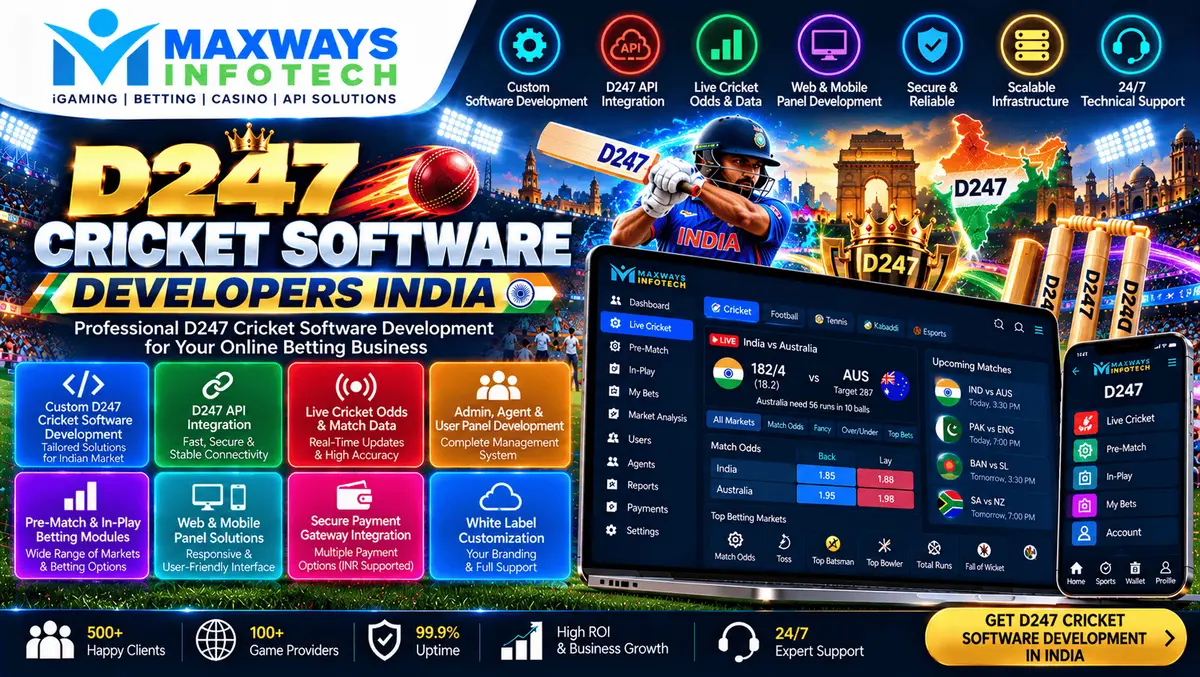
D247 Cricket Software Developers India, including custom websites, mobile apps, cricket API integration, secure architecture, and maintenance.
D247 Cricket Software Developers India: Custom Software, API Integration and Development
D247 Cricket Software Developers India is a target keyword for businesses researching cricket software development, custom platform solutions, and API integration services. Before selecting a developer, businesses should identify their project requirements, verify the software and data sources they intend to use, and confirm all applicable access rights.
MaxWays Infotech offers website, application, game, and software development services. Businesses can explore its technology capabilities and discuss whether their cricket-related project requirements fit the available development services.
This guide explains how cricket software is planned and developed, which technical features to consider, how API integration works, and what businesses should evaluate before choosing a development partner in India.
What Do Cricket Software Developers in India Do?
Cricket software developers design, build, integrate, test, and maintain digital applications that use cricket-related information or support cricket-focused workflows.
Depending on the project, development may include:
-
Cricket information websites and responsive web applications
-
Mobile applications for Android and iOS
-
Administrative dashboards and reporting tools
-
Cricket API integration and data processing
-
Match schedules, scorecards, and statistics interfaces
-
Database design and backend development
-
User accounts and permission management
-
Performance optimisation and ongoing maintenance
The exact scope depends on the project brief, available software, third-party integrations, and required functionality.
A development company should explain which features it can build directly, which depend on external providers, and which require separate licensing or subscriptions.
Why Choose an India-Based Cricket Software Development Team?
Businesses may consider Indian development companies because they want access to software engineering, web development, backend programming, design, testing, and maintenance services through a coordinated team.
However, location alone does not guarantee software quality. The best choice depends on technical expertise, communication, project management, security practices, and the ability to deliver the agreed scope.
1. Custom Development for Business Requirements
A custom project can be planned around the features a business actually needs. This may include a specialised dashboard, a unique website structure, integration with an authorised data source, or a mobile-friendly interface.
Clear requirements help developers avoid unnecessary modules and focus on the features that matter most.
2. Website and Mobile Application Development
Cricket-related applications may need to work across desktop browsers, mobile browsers, and native mobile applications.
A consistent backend can provide data to multiple interfaces while keeping authentication, validation, and business logic in a central place.
3. Integration With Existing Systems
Some projects need to connect an existing website or application to a third-party cricket data provider. Others may require a new backend, database, or reporting interface.
The integration approach should be selected after reviewing the current technology, API documentation, and the permissions available to the business.
4. Maintenance and Future Development
Software requirements change as an application grows. Planned maintenance can cover bug fixes, dependency updates, performance improvements, monitoring, and compatible feature enhancements.
A project agreement should specify which maintenance tasks are included and which are billed separately.
Types of Cricket Software Solutions
A cricket software project can take several forms. Choosing the right type early helps establish an achievable development plan.
Cricket Information Websites
A cricket information website can display fixtures, match summaries, scorecards, tournament details, player profiles, and historical results when the underlying data is available and licensed for the intended use.
Developers should organise content into clear page structures, ensure mobile usability, and handle missing or delayed information gracefully.
Cricket Mobile Applications
A mobile application may provide match listings, score summaries, player information, notifications, or other supported cricket features.
Development considerations include platform compatibility, application performance, accessibility, secure backend communication, and the requirements of the relevant app stores.
Cricket Administration Dashboards
Administrative dashboards help authorised staff manage application settings, user permissions, content, integration status, and reports.
The dashboard should be designed around specific workflows rather than adding controls that do not serve a clear purpose.
Cricket Data and Analytics Platforms
Analytics applications can organise historical and current cricket information into reports, tables, charts, and performance summaries.
The available analysis depends on the quality, completeness, and permitted use of the source data. Developers should document field definitions and handle incomplete datasets carefully.
Custom Sports Software
Some businesses require a broader sports application with cricket data alongside other sports information, reporting, or internal management tools.
For projects involving several data sources, a modular backend can simplify integration and allow individual components to be maintained separately.
Cricket API Integration for Websites and Applications
A cricket API allows compatible applications to request structured information from an external data provider. It can reduce manual data collection and help developers build features using documented data fields.
Depending on the selected provider and access plan, supported information may include:
-
Live or recently updated scores
-
Match schedules and fixtures
-
Innings scorecards and results
-
Ball-by-ball events
-
Player and team statistics
-
Tournament details
-
Historical match information
Businesses researching these capabilities can review the Cricket API Provider and Integration page for information about cricket data connectivity, supported API workflows, and integration considerations.
How Cricket API Integration Works
A typical integration follows these stages:
Step 1: Identify the required data. List the competitions, match formats, fields, and screens the application needs.
Step 2: Review the provider's documentation. Confirm authentication methods, endpoint availability, response structures, rate limits, and commercial permissions.
Step 3: Connect through the backend. Store private credentials securely and make authenticated requests from the server rather than exposing secret keys in the browser.
Step 4: Process the response. Validate the data, map fields to the application's model, and handle missing values or unexpected formats.
Step 5: Update the interface. Display the information in scorecards, match pages, statistics panels, or other agreed screens.
Step 6: Monitor the integration. Track errors, response times, data freshness, and provider usage limits.
The actual implementation depends on the selected API and the features supported by its documentation.
Live Score and Match Information
Live score interfaces require special attention to update timing and match state. An application should handle innings changes, wickets, extras, abandoned matches, and delayed responses correctly.
The D247 Cricket Panel Developers | Maxways Infotechresource provides further context on live data, scorecards, match updates, and API evaluation.
Before launching a live-data feature, verify the provider's coverage, update frequency, historical access, and permissions for displaying the data commercially.
Essential Technical Features for Cricket Software
A strong development plan considers the full application rather than only its visible interface.
Responsive User Interface
The interface should adapt to different screen sizes. Match tables, statistics, navigation menus, and scorecards must remain usable on mobile devices.
Developers should test common screen sizes and make loading, error, and delayed-data states easy to understand.
Backend Architecture
The backend handles data retrieval, validation, authentication, permissions, and application logic.
Separating these responsibilities from the frontend can make the system easier to maintain and reduce the exposure of sensitive credentials.
Database Design
A well-structured database helps maintain relationships between matches, teams, players, tournaments, and application records.
Where supported, stable source identifiers should be preserved to avoid linking records based only on display names.
Security and Access Control
Security should be included from the beginning of the project.
Recommended measures include secure authentication, least-privilege permissions, protected API credentials, input validation, HTTPS, logging, and regular dependency updates.
Performance and Scalability
Popular matches can create sudden traffic increases. Developers should consider caching, efficient database queries, appropriate request intervals, and monitoring.
Caching rules must respect the data provider's terms and the freshness requirements of each feature.
Testing and Quality Assurance
Testing should cover the normal user journey as well as expected failures, including unavailable data, invalid credentials, rate limits, network interruptions, and unexpected API responses.
A documented acceptance process helps confirm that the finished software matches the agreed requirements.
How to Select the Right Cricket Software Development Company in India
Comparing developers requires more than reviewing promotional descriptions. Evaluate the following areas before making a commitment.
Technical Experience
Ask the team to explain its approach to web development, backend systems, database design, API integration, mobile interfaces, and application testing.
Request relevant examples where available, while respecting client confidentiality.
Clear Project Scope
The proposal should list the included features, deliverables, dependencies, timeline, testing requirements, and exclusions.
This helps prevent misunderstandings about whether hosting, third-party API subscriptions, custom designs, or ongoing maintenance are included.
Security Practices
Discuss credential management, account permissions, secure deployment, backups, and incident handling.
For projects involving third-party data, confirm that the proposed usage is permitted by the provider's licence.
Communication and Project Management
Agree on review milestones, progress updates, feedback procedures, and the process for handling changes to requirements.
A clear communication process helps both sides identify risks early.
Support After Launch
Confirm who will handle software updates, bug fixes, monitoring, integration changes, and performance issues after deployment.
Check whether support is included in the initial project cost or offered under a separate agreement.
Custom Development Versus Ready-Made Software
The best option depends on how much control and customisation the project requires.
Ready-Made Software
An existing software package may be suitable when its supported features match the business requirements.
Potential benefits include a more defined setup process and fewer custom development tasks. However, the business may be limited by the software's architecture, licensing, and supported integrations.
Custom Software Development
Custom software can provide greater control over workflows, interface design, integration architecture, and future improvements.
It generally requires more planning, engineering, testing, and maintenance. Businesses should weigh those costs against the benefits of a solution tailored to their needs.
Hybrid Approach
A hybrid approach may use existing components alongside custom modules. For example, a project might retain an existing website while adding a new reporting dashboard or an authorised cricket data integration.
Before choosing this approach, assess compatibility, software ownership, security, licensing, and the long-term cost of maintaining multiple components.
For projects that also involve broader sports platform development, Custom Bookies Website Developers provides additional context on website planning, technical scope, testing, and maintainability. Any betting-related functionality must comply with applicable laws and licensing requirements.
Development Process: From Planning to Launch
A structured process helps turn a broad idea into a deliverable software project.
Phase 1: Discovery and Requirements
Document the intended users, business goals, core features, preferred platforms, third-party dependencies, and success criteria.
Prioritise essential features so that the first release has a manageable scope.
Phase 2: Design and Architecture
Prepare interface layouts, application flows, database structures, and the proposed integration architecture.
Review the design before implementation to identify missing workflows and technical dependencies.
Phase 3: Development
Build the frontend, backend, database, and authorised integrations according to the agreed scope.
Use version control and a repeatable development process to support collaboration and maintenance.
Phase 4: Testing
Test functional requirements, security controls, responsive layouts, data processing, and failure scenarios.
Where an external API is involved, verify its real documentation and access permissions rather than relying exclusively on sample responses.
Phase 5: Deployment
Deploy the application to the agreed environment. Configure the domain, HTTPS, monitoring, backups, and production settings as required.
Confirm that the launch environment meets the software's documented requirements.
Phase 6: Maintenance and Improvements
Monitor the application after launch and prioritise fixes based on their impact. Review dependencies, performance, error logs, and provider changes regularly.
New features should be assessed against the original architecture and maintenance requirements.
Common Challenges in Cricket Software Development
Delayed or Missing Data
Third-party data may be delayed or temporarily unavailable.
Recommended approach: Track timestamps, validate responses, and display clear stale-data or unavailable-data states.
API Limits and Integration Costs
Providers may impose request limits, usage restrictions, or separate subscription fees.
Recommended approach: Estimate expected usage, implement suitable caching, and confirm commercial terms before development begins.
High Traffic
Sudden increases in visitors can affect page speed and external API usage.
Recommended approach: Optimise database queries, reuse valid responses where permitted, and test under realistic traffic conditions.
Changing Project Requirements
New features added during development can affect costs and deadlines.
Recommended approach: Establish an agreed initial scope and use a documented change-request process for additional work.
Security and Maintenance Risks
Poor credential handling, outdated dependencies, and excessive permissions can increase security risks.
Recommended approach: Apply secure development practices, update dependencies, restrict access, and maintain tested backups.
Why Consider MaxWays Infotech?
Businesses researching D247 Cricket Software Developers India can use MaxWays Infotech's website to review its broader web, app, and software development capabilities.
Before beginning a cricket software project, discuss:
-
The exact product and features required
-
Whether an existing application needs modification or a new one needs development
-
The API provider, documentation, and required permissions
-
Hosting, deployment, and maintenance responsibilities
-
The project budget, timeline, and acceptance criteria
A technical review can help determine whether the requested features are feasible and what third-party dependencies must be resolved.
No particular D247 affiliation, API availability, or product feature should be assumed without verification.
Frequently Asked Questions
1. What does D247 Cricket Software Developers India mean?
It is a search keyword used by people researching cricket-related software development services in India. The exact software, product availability, and any relationship with a named provider must be confirmed separately.
2. What types of cricket software can developers build?
Depending on the project, developers may build cricket information websites, mobile applications, scorecards, data dashboards, reporting tools, and authorised API integrations.
3. Can cricket software connect to a live-score API?
Yes, if a compatible API is available and the required access permissions have been obtained. Update frequency and competition coverage depend on the provider and its agreement.
4. Is custom cricket software better than ready-made software?
Not in every case. Ready-made software may suit standard requirements, while custom development may be preferable for specialised workflows or integrations. The decision depends on budget, functionality, ownership, and maintenance needs.
5. How much does cricket software development cost in India?
Costs depend on the number of features, design requirements, technology stack, integrations, testing, deployment, and ongoing support. A detailed estimate requires a defined scope and review of third-party costs.
6. How long does cricket software development take?
The timeline depends on project complexity, available documentation, team size, feature scope, testing, and approval milestones. A realistic schedule should be prepared after requirements discovery.
7. Can the same backend support a website and mobile app?
Yes. A properly designed backend can serve multiple frontends, provided authentication, API design, performance, and application requirements are addressed.
8. What should I verify before hiring a development company?
Review technical capability, project scope, communication, security, testing, ownership terms, third-party permissions, maintenance, and the total cost.
9. Does API access automatically allow commercial data redistribution?
No. Commercial display, storage, and redistribution rights depend on the provider's licence and agreement. Verify the intended use before launch.
10. How can I start a cricket software development project?
Prepare a feature list, define the intended users and platforms, identify required data sources, and discuss feasibility, timeline, budget, and technical dependencies with a development team.
Conclusion
Choosing the right D247 Cricket Software Developers India solution starts with clear requirements and a realistic technical plan. Businesses should evaluate custom development options, cricket API compatibility, security, performance, testing, and long-term maintenance before committing to a project.D247 Cricket Panel Setup Services | Maxways Infotech
A reliable software development process focuses on verified functionality, documented deliverables, authorised integrations, and transparent support arrangements.
Visit MaxWays Infotech to explore software development services and discuss the technical requirements of your cricket-related project.
Important note: This article targets the requested search keyword and does not establish an official D247 affiliation or guarantee that a particular D247 product or API is available. All integrations and platform features should be verified with the relevant provider and operated in accordance with applicable laws, licensing terms, and data-use permissions.