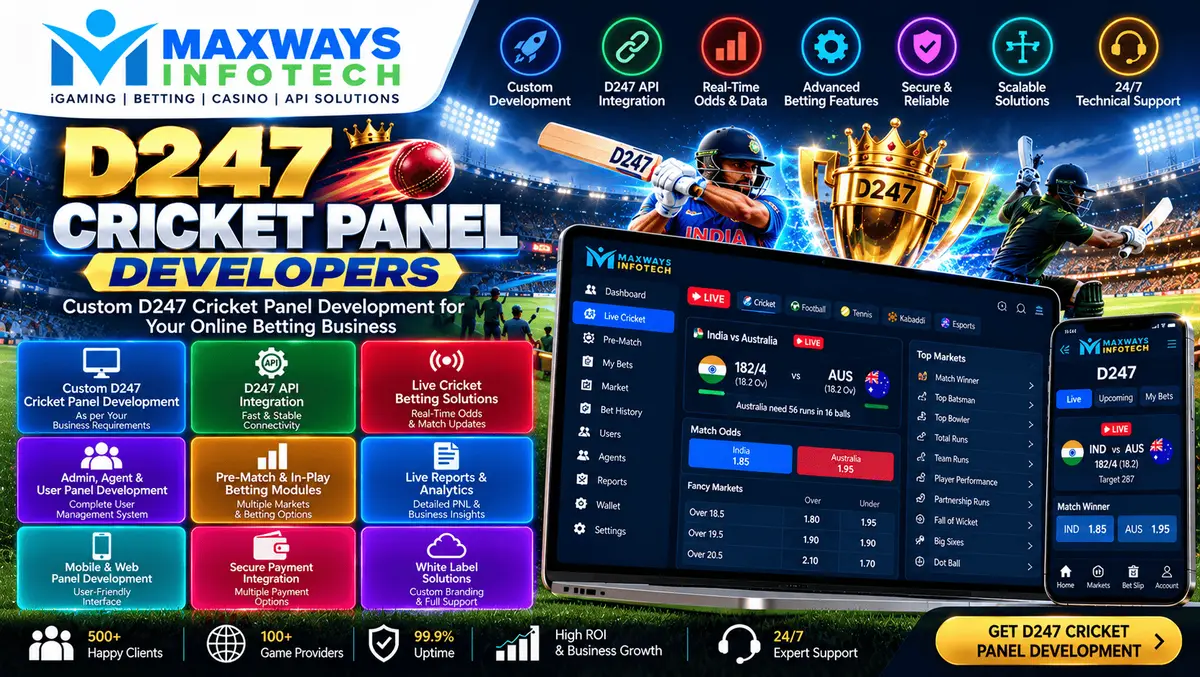
Explore D247 cricket panel developers for custom dashboard design, cricket data integration, secure administration, software testing, and technical support.
D247 Cricket Panel Developers: Custom Cricket Software and Dashboard Solutions
D247 Cricket Panel Developers should assess development capabilities, API compatibility, dashboard customization, security, and long-term maintenance. The right solution depends on the platform's intended use, the available technical documentation, and the permissions granted by the relevant service providers.
MaxWays Infotech is a starting point for exploring software development and digital platform technology services. Before selecting a development partner, businesses should confirm the actual features, deliverables, and technical support included in the project.
What Do D247 Cricket Panel Developers Do?
D247 cricket panel developers refers to a search term used by businesses researching customized cricket panel software and related development services. Depending on the project, developers may build dashboards, connect authorized cricket data APIs, create administrative functions, and maintain compatible applications.
The exact features of a D247-related platform must be confirmed through official documentation and the agreed project scope.
Development work may include:
-
Custom dashboard design and interface development.
-
Integration with authorized cricket data services.
-
Match information and statistics displays, where supported.
-
Administrative settings and access management.
-
Backend development and database configuration.
-
API testing, monitoring, and error handling.
-
Software maintenance and technical documentation.
A clear development plan helps ensure that the final product matches the actual technical requirements instead of relying on assumptions about available features.D247 Cricket Panel Provider | Maxways Infotech
Why Choose Custom Cricket Panel Development?
A ready-made interface may not meet every project's requirements. Custom development allows businesses to define how information is presented, which functions are available, and how the application connects to compatible services.
1. Customized Dashboard Design
Developers can organize the interface around the information users need. This may include match lists, competition details, supported statistics, search tools, and administrative views.
A responsive design also helps the panel work across desktop computers, tablets, and mobile devices.
2. Cricket Data Integration
A panel can connect to an authorized data API to retrieve supported match information. The integration should account for response formats, update frequency, authentication, and usage limits.
For more details, explore MaxWays Infotech's Cricket API provider and integration services.
3. Organized Administrative Functions
Administrative tools can help authorized personnel manage configuration, review system activity, and control access to different features.
Role-based permissions should be designed around each user's responsibilities.
4. Flexible Software Architecture
Separating the frontend, backend, database, and external integrations makes individual components easier to test and maintain. A modular design can also support future changes when the underlying APIs remain compatible.
5. Easier Monitoring and Maintenance
Monitoring, logging, and documented error handling help developers investigate failed requests, unavailable services, and unexpected data responses.
Essential Features to Discuss With Cricket Panel Developers
The feature list should be based on the intended application and the data sources that can be legally and technically accessed.
Cricket Match Dashboard
A dashboard may display supported match schedules, match status, results, and competition information. Developers should distinguish current data from delayed or unavailable information.
Score and Statistics Display
Where the data provider supports these fields, the panel may display scores, innings, overs, wickets, team details, player statistics, and historical results.
Coverage and update intervals depend on the selected provider and its subscription or licensing terms.
Competition and Match Organization
Match records can be organized by series, tournament, format, season, or match identifier. Consistent identifiers help avoid confusion when the same competition appears in different data feeds.
Administrative Dashboard
Administrative features may include user permissions, application configuration, data-source settings, system health, and operational reports.
Sensitive actions should be limited to authorized roles and recorded where appropriate.
API and Backend Connectivity
The backend can retrieve authorized data, validate responses, transform information into the application's data model, and provide it to the frontend.
API credentials should remain protected on the server rather than being exposed in public browser code.
Reporting and Data Management
Reporting tools can organize permitted records and help administrators review system activity. Retention policies should define how long information is stored and when it must be deleted.
How the Cricket Panel Development Process Works
A structured process helps businesses understand the work required before development starts.
Step 1: Define Requirements
Identify the platform's purpose, required features, target devices, data sources, user roles, and expected outcomes.
Separate essential features from optional improvements to keep the scope clear.
Step 2: Review Data Sources and API Access
Confirm which cricket information is available, which endpoints are supported, and whether the intended use is permitted.
Review authentication, data formats, request limits, update frequency, and commercial usage conditions.
Step 3: Plan the Software Architecture
Determine how the frontend, backend, database, and external APIs will communicate. Plan data validation, authentication, error handling, caching, and monitoring.
Step 4: Design the User Interface
Create dashboard layouts that prioritize important information and remain usable across supported devices. Review the interface before implementing the complete feature set.
Step 5: Develop and Integrate
Build the frontend and backend components, configure authorized API connections, and implement the required business logic.
Step 6: Test the Application
Test ordinary workflows, invalid requests, authentication failures, unexpected data, timeouts, and unavailable services. Confirm that errors are handled safely.
Step 7: Deploy and Maintain
Deploy through a controlled release process. Monitor application health, update dependencies, maintain documentation, and test compatibility when connected APIs change.
Cricket API Integration for Custom Panels
API integration can supply the information needed by a cricket dashboard, but developers must confirm the exact data available from the selected provider.
A typical integration may involve:
-
Obtaining authorized API credentials.
-
Reviewing endpoint documentation.
-
Configuring requests through the backend.
-
Processing and validating responses.
-
Mapping the data to the panel's internal structure.
-
Handling errors and rate limits.
-
Monitoring update times and service availability.
For applications that require live match information, the D247 API Technology Provider | Maxways Infotech is a related resource to explore.
The interface should display update timestamps where useful and avoid describing stale information as live. Data accuracy and update frequency depend on the underlying service.
Security Best Practices for Cricket Panel Development
Security should be considered from the start of the project.
-
Authentication: Use suitable methods to verify users and connected services.
-
Access control: Give each role only the permissions it requires.
-
Credential protection: Store API keys and tokens securely on the server.
-
Encrypted communication: Protect data transferred between applications.
-
Input validation: Validate data before processing or storing it.
-
Audit logging: Record important administrative actions where appropriate.
-
Monitoring: Track errors, service interruptions, and unusual access patterns.
-
Regular updates: Maintain software dependencies and apply security fixes.
-
Privacy controls: Apply appropriate data-retention and deletion policies.
Projects handling personal or sensitive information should also follow the privacy and security requirements applicable to their jurisdiction and use case.
Common Challenges in Cricket Panel Development
Delayed Match Updates
External providers may not deliver information instantly. Developers should understand the provider's update intervals and display the last successful update when relevant.
Inconsistent Data Formats
Different services may use different field names, identifiers, and timestamp formats. A documented mapping layer helps keep the information consistent.
API Rate Limits
An application that sends too many requests may be throttled. Caching, request scheduling, and sensible polling intervals can help manage usage within the provider's rules.
Authentication Problems
Expired credentials or missing permissions can interrupt data retrieval. Secure credential management and clear error handling help identify these problems.
High Traffic During Major Matches
Traffic may increase during popular tournaments. Capacity planning, caching, monitoring, and appropriate infrastructure help the application handle changing demand.
External API Changes
An updated endpoint or response structure can break an existing integration. Version tracking and regression testing help identify issues before changes reach production.
How to Choose the Right Cricket Panel Development Partner
Choosing a provider requires reviewing both technical capability and project transparency.
Review Relevant Experience
Ask how the team approaches frontend design, backend development, API integration, database structure, testing, and deployment.
Confirm the Feature Scope
Request a written list of included features, excluded functionality, third-party dependencies, and expected deliverables.
Verify API Permissions
Confirm that the necessary data and endpoints are available and that the intended use is authorized. Do not assume that a provider label establishes an official partnership or guarantees access.
Evaluate Security Measures
Discuss authentication, role-based access, credential storage, monitoring, and incident handling.
Clarify Ownership and Support
Determine who owns the source code, documentation, configuration, and deployment assets. Agree on the process for maintenance, bug fixes, and future updates.
Understand Integration Costs
Costs can depend on the number of features, API subscription fees, data coverage, infrastructure, customization, testing, and maintenance. Ask for a project-specific estimate rather than relying on a generic price.
Businesses researching related sports data connectivity can also review D247 API Development Services | Maxways Infotech for information about data sources, compatibility, and implementation requirements.
Why Consider MaxWays Infotech?
When evaluating a development partner, look for a clear project scope, realistic commitments, documented implementation steps, and defined post-launch support.
Visit the MaxWays Infotech website to review the company's published software and technology services. Discuss your requirements and confirm whether the available services match your project's needs.
Before starting development, agree on the required features, data sources, security controls, timeline, deliverables, ownership, and maintenance responsibilities.
Frequently Asked Questions
1. What are D247 cricket panel developers?
The phrase refers to developers being researched for cricket panel software associated with a D247-related environment. The actual features and services depend on the official documentation, authorization, and project scope.
2. What features can a cricket panel include?
Depending on the project, features may include match dashboards, supported score information, schedules, statistics, administrative controls, reporting, and API connectivity.
3. Can a cricket panel connect to a Cricket API?
Yes, provided the API supports the required data, the application is compatible, and the necessary access and usage permissions are available.
4. Can cricket panel software be customized?
Yes. Customization may cover interface design, dashboard layout, reporting, user roles, backend functions, and supported integrations.
5. How long does cricket panel development take?
The timeline depends on the feature scope, API documentation, data requirements, architecture, testing, and external dependencies. A realistic estimate should follow a technical assessment.
6. How can cricket panel software be secured?
Use appropriate authentication, role-based permissions, protected credentials, encrypted connections, input validation, monitoring, and regular security updates.
7. Does a cricket panel guarantee real-time scores?
No. Update timing depends on the data provider, API endpoint, competition coverage, network conditions, and subscription. Verify the available update frequency before deployment.
Conclusion
D247 Cricket Panel Developers is a keyword for businesses researching custom cricket dashboards, data integration, administrative features, and ongoing software maintenance. A successful project starts with clearly defined requirements, verified API access, secure architecture, and thorough testing.Live Casino Admin Panel Developers | Maxways Infotech
Before choosing a provider, compare the technical scope, data permissions, security measures, documentation, and long-term support arrangements.
Visit MaxWays Infotech to explore its published services and assess whether they align with your development requirements.
Compliance note: Any gaming-related panel or platform should be used only where legally permitted, with the required licences and authorizations, appropriate age safeguards, responsible-use measures, and applicable privacy and data-protection controls.