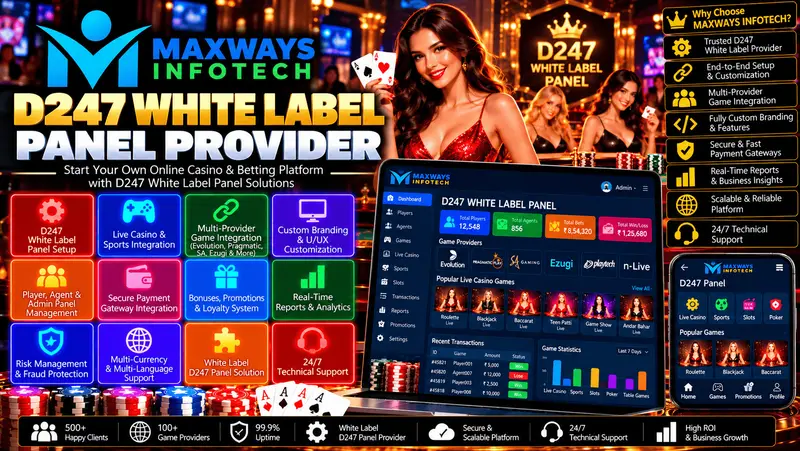
Explore D247 panel integration services, API connectivity, data mapping, secure configuration, compatibility testing, deployment, and technical support.
D247 Panel Integration Services: API Connectivity, Configuration, and Technical Support
Modern digital platforms often rely on multiple software components working together. From administrative dashboards to reporting systems and approved third-party applications, effective integration helps businesses organize workflows and manage information more efficiently. D247 Panel Integration Services focus on connecting compatible software components, configuring supported features, testing data exchanges, and maintaining reliable system communication.
At MaxWays Infotech, businesses can explore information about software development and digital platform solutions. Before choosing an integration provider, it is important to understand the technical requirements, supported APIs, security controls, deployment process, and ongoing maintenance arrangements.
What Are D247 Panel Integration Services?
D247 panel integration services involve configuring a panel-based application to communicate with compatible software systems through supported interfaces and documented integration methods.
Depending on the project scope, integration work may include connecting approved APIs, configuring authentication, mapping data fields, setting up error handling, and testing system communication.
Typical activities may include:
-
Reviewing the panel's technical architecture and documentation.
-
Identifying compatible third-party services.
-
Configuring authorized API connections.
-
Mapping data between supported applications.
-
Testing authentication, responses, and error handling.
-
Monitoring integrations and resolving technical issues.
The exact capabilities depend on the panel version, available documentation, provider permissions, and the requirements agreed upon for the project.
Key Features to Look for in a Panel Integration Provider
Not every integration project needs the same features. A suitable provider should assess the existing environment and recommend an approach based on actual technical requirements.
1. API Integration and Configuration
An application programming interface (API) allows compatible software systems to exchange information through defined requests and responses.
A professional integration process should include reviewing API documentation, checking authentication requirements, validating response formats, and confirming rate limits. Developers should also test how the system behaves when an API is unavailable or returns an error.
For more background, explore the sports-betting-api-integration-services.
2. Dashboard and Application Connectivity
A panel may need to communicate with a website, internal dashboard, reporting tool, or other approved application. Integration specialists should identify which components need to exchange information and how that communication should be managed.
Clear interface specifications help reduce compatibility issues and make future maintenance easier.
3. Data Mapping and Synchronization
When two applications use different data structures, developers may need to map fields and standardize formats before information can be transferred.
Depending on the use case, the integration may support real-time updates, scheduled synchronization, or controlled manual transfers. The correct method depends on the data volume, system capabilities, and business requirements.
4. Authentication and Access Control
Secure integrations should use appropriate authentication methods and restrict access to authorized systems. API credentials should be stored securely, rotated when required, and never exposed in public-facing code or logs.
Role-based permissions and access reviews also help limit the impact of compromised credentials.
5. Error Handling and Monitoring
Integrations can fail because of network interruptions, expired credentials, API changes, or unexpected responses. Reliable implementations should include appropriate error messages, logging, retry controls, and monitoring.
Retries must be designed carefully so that repeated requests do not accidentally create duplicate transactions or records.
6. Testing and Documentation
Testing should cover successful requests, invalid inputs, authorization failures, timeouts, and recovery scenarios. Clear technical documentation helps administrators understand the integration and enables future developers to maintain it.
Benefits of Professional D247 Panel Integration Services
A properly planned integration can improve the consistency and maintainability of a software environment.
More Efficient Workflows
Connecting compatible applications can reduce repetitive manual data entry and help teams follow consistent processes.
Better Data Consistency
Defined data mappings and validation rules can reduce discrepancies between connected systems. The result depends on the quality of the source data and the synchronization design.
Easier System Management
Centralized monitoring and documented integration settings make it easier to identify connection problems and investigate unexpected behaviour.
Improved Maintainability
A modular integration design can make it easier to update individual components when APIs or application requirements change.
More Informed Operational Decisions
Where appropriate reporting integrations are supported, teams can consolidate relevant information and review it through authorized dashboards.
How the D247 Panel Integration Process Works
A structured implementation process helps businesses understand the work involved and confirm that each stage meets the agreed requirements.
Step 1: Requirement Analysis
The provider reviews the existing panel, intended use, connected applications, required data flows, and expected outcomes.
The project scope should identify which systems are involved and which features are included.
Step 2: Compatibility Assessment
Developers review the available API documentation, software versions, authentication methods, and access permissions. If documentation or authorization is missing, the integration should not proceed until the issue is resolved.
Step 3: Integration Design
The technical team defines how systems will communicate, which data will be exchanged, how errors will be handled, and which security controls are required.
Step 4: Development and Configuration
The team configures the approved connections, maps data fields, implements validation rules, and sets up suitable monitoring.
Step 5: Testing and Verification
Testing checks expected functionality, access permissions, invalid responses, timeouts, and recovery procedures. Sensitive information should be protected throughout the testing process.
Step 6: Deployment and Maintenance
After approval, the integration can be deployed in the intended environment. Ongoing maintenance may include monitoring, compatibility updates, credential rotation, and troubleshooting under the agreed support terms.
How to Choose the Right D247 Panel Integration Company
Selecting an integration provider requires more than comparing quotations. Businesses should assess the provider's technical approach and its ability to support the integration over time.
Technical experience: Ask about relevant API, backend, database, authentication, and testing experience.
Documentation: Confirm that the provider can explain the proposed data flows, dependencies, and integration limitations.
Security practices: Review credential management, access controls, data protection, logging, and vulnerability handling.
Support arrangements: Clarify maintenance responsibilities, response times, update policies, and additional charges.
Project transparency: Request a written scope covering deliverables, testing criteria, timelines, and acceptance requirements.
Businesses comparing broader development options can also review best-sports-betting-api-integration-services to understand related platform development considerations.
White-Label Platforms and Integration Requirements
White-label software may offer existing functionality that can be presented under a business's branding, subject to licensing and provider terms. However, branding and integration are separate capabilities: a platform may support logo or interface customization without supporting every external API.
Before choosing a solution, confirm whether the required integrations are already available, require additional development, or depend on third-party approval.
The White Label iGaming API resource provides further context about API-based platform connectivity.
For projects that also require a customized web interface, explore custom bookies website development. If the project involves a wider website build, the bookies website development in India article offers another related topic to review.
Common Integration Problems and How to Prevent Them
Even well-planned integrations can encounter technical issues. The following practices help reduce common risks.
-
Incompatible API versions: Confirm version requirements and test changes before deployment.
-
Invalid credentials: Use secure credential storage and establish a rotation process.
-
Incorrect data mapping: Validate field formats and required values before transferring data.
-
Unstable connections: Use sensible timeouts, monitoring, and carefully controlled retry logic.
-
Duplicate requests: Apply idempotency controls where supported and appropriate.
-
Insufficient testing: Test normal operations alongside failures and recovery scenarios.
-
Missing documentation: Record configuration details, dependencies, and troubleshooting procedures.
A provider should explain which problems its service can address and which depend on third-party systems.
Why Explore MaxWays Infotech?
Businesses researching software integration and digital platform development can visit MaxWays Infotech to explore available company information and related technology topics.
Before selecting a service provider, define the systems you need to connect, request a written integration plan, and confirm the provider's capabilities, security practices, support arrangements, and contractual terms.
You can also browse the d247-panel-setup-provider for additional articles about software platforms, APIs, and development approaches.
Frequently Asked Questions
What are D247 Panel Integration Services?
These services involve configuring a panel to communicate with compatible applications or authorized third-party systems through supported interfaces and APIs.
Does every D247 panel support API integration?
No. Integration capabilities depend on the specific software version, available documentation, provider permissions, and supported interfaces. Confirm compatibility before beginning development.
How long does panel integration take?
The timeline depends on the number of connected systems, API complexity, data mapping, security requirements, testing, and access to documentation. A provider should estimate the work after reviewing the project scope.
Is API integration secure?
It can be implemented securely when appropriate authentication, permissions, encryption, credential management, logging, and testing are in place. Security also depends on the connected systems and how they are maintained.
What information should I provide to an integration developer?
Provide the intended use case, panel version, documentation for authorized APIs, a list of required integrations, expected data flows, security requirements, and acceptance criteria. Never share production passwords or secret API keys through unsecured channels.
Do integrations require ongoing maintenance?
Often, yes. API changes, software updates, expiring credentials, and changes in external services can require monitoring and maintenance. The service agreement should define these responsibilities.
Conclusion
D247 Panel Integration Services can help connect compatible applications, organize data exchange, improve operational workflows, and support ongoing system maintenance. The right approach begins with a clear scope, verified API compatibility, secure configuration, thorough testing, and documented support arrangements.
Visit MaxWays Infotech to explore related software development information and identify the technical requirements for your project.
Compliance note: Any betting, casino, or gaming-related platform must be used only where legally permitted and with all required licences and authorizations. Applicable age restrictions, responsible-use safeguards, privacy requirements, and data-protection obligations must also be followed.D247 Panel Software Provider | Maxways Infotech