i gaming casino api providers, game integration features, security, compatibility, pricing factors and best practices for API implementation.
iGaming Casino API Providers: Features, Integration and Selection Guide
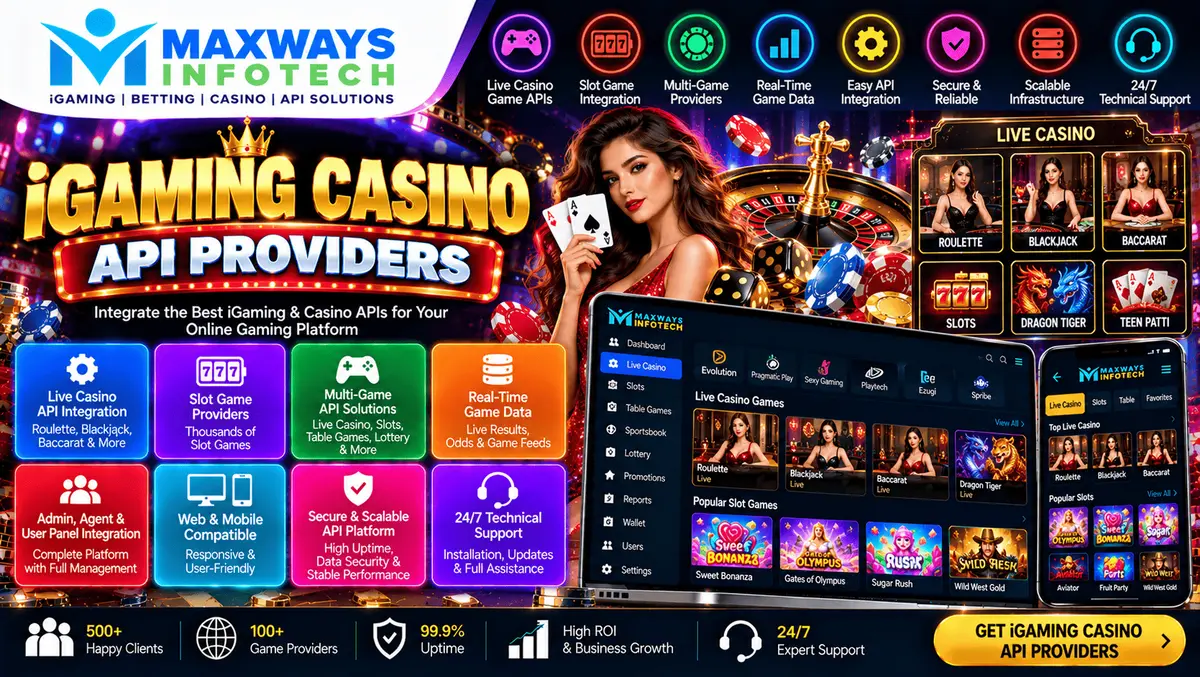
i gaming casino api providers is an important step for businesses planning to connect casino game content, platform services and third-party software. A suitable API can help compatible applications exchange information, retrieve supported game data and connect selected services through documented interfaces.
However, not every provider offers the same features. Some specialise in game catalogue information, while others provide game-launch integrations, platform connectivity or broader data services. Understanding these differences helps businesses evaluate compatibility, development requirements, pricing and ongoing maintenance before making a decision.
MaxWays Infotech provides software and API integration solutions for businesses exploring digital platforms. This guide explains how iGaming casino APIs work, which features to evaluate and how to plan an integration that fits your project's technical and commercial requirements.
What Is an iGaming Casino API Provider?
An iGaming Casino API Provider supplies a software interface that allows compatible applications to communicate with specified gaming services or data sources.
Depending on the provider and agreement, an API may support functions such as:
-
Retrieving supported game catalogue information
-
Connecting compatible game-launch services
-
Exchanging session-related information
-
Synchronising supported game or provider records
-
Accessing selected reporting data
-
Connecting authorised third-party platform services
These capabilities are not universal. A game API, a data API and a complete platform API can serve different purposes. Businesses should confirm exactly which endpoints and functions are included before choosing a provider.
For a broader overview of how connected services work together, explore MaxWays Infotech's iGaming Platform API guide.
Why Businesses Use Casino APIs
Casino APIs can help developers connect separate software components without implementing every function from scratch. Their value depends on the provider's capabilities and how well those capabilities match the intended application.
1. Game Catalogue Integration
A game catalogue API may provide supported information such as game names, identifiers, categories, provider names and other metadata.
This information can help a platform organise its catalogue, apply filters and keep supported records synchronised.
Before integration, check the available fields, update frequency, identifier stability and rights to display the returned information.
2. Game-Launch Connectivity
Some game-related APIs support launching compatible games through an authorised integration. Depending on the service, the workflow may involve a game identifier, session token, language, device settings and other required parameters.
Developers should follow the provider's documented session-creation process and handle expired sessions, unavailable games and interrupted connections appropriately.
Game-launch access should not be assumed to be included in a catalogue or data API.
3. Platform Connectivity
A broader platform API may connect components such as user account services, reporting tools, game content and other authorised systems.
Integration requires clear definitions of which system owns each data field, which services can update records and how errors are handled across the connected applications.
4. Reporting and Data Synchronisation
Where supported, APIs can help synchronise records and retrieve selected reports. This can reduce manual data handling and improve consistency between compatible systems.
Confirm which reporting endpoints are available, how frequently records change, and whether historical data can be retrieved or exported.
Businesses researching data-related functionality can also read the iGaming Data API Provider guide.
Essential Features to Evaluate in iGaming Casino API Providers
Not every provider offers the same technical capabilities. Use the following checklist when comparing potential services.
| Evaluation factor | What to check |
|---|---|
| Game coverage | Which games, categories and providers are supported? |
| API documentation | Are endpoints, parameters and response formats clearly explained? |
| Authentication | How are credentials issued, stored and validated? |
| Session handling | How are sessions created, expired and recovered? |
| Compatibility | Does the API work with your existing application architecture? |
| Request limits | Are there quotas, concurrency limits or usage restrictions? |
| Reliability | What service commitments and incident procedures are available? |
| Security | Are access controls, secure connections and credential protections documented? |
| Support | What technical assistance is available during integration? |
| Licensing | Is your intended use permitted by the agreement and applicable law? |
Ask shortlisted providers to demonstrate the actual endpoints you need. A feature mentioned in promotional material should not be treated as confirmed until it is supported by documentation and the commercial agreement.
How to Choose the Right iGaming Casino API Provider
Step 1: Define Your Project Requirements
Begin by identifying what the application needs to do. For example, your project might require a game catalogue, a game-launch connection, reporting or integration with an existing platform.
Separate essential features from optional requirements. This helps prevent unnecessary development and makes provider comparisons more objective.
Step 2: Review Official API Documentation
Request the latest technical documentation from each shortlisted provider.
Review authentication methods, endpoints, required fields, response formats, error codes, rate limits and versioning policies. Confirm whether the documentation covers your intended use case.
Step 3: Confirm Game and Provider Compatibility
If your application needs to connect to specific game providers, confirm which integrations are supported and whether additional approvals are required.
Ask whether each game or service needs separate credentials, a commercial agreement or technical configuration.
Step 4: Test the Integration
Use an authorised sandbox or test environment where available. Validate normal responses and failure scenarios, including invalid credentials, expired sessions, unavailable games, timeouts and rate-limit errors.
Testing should also check whether the application displays accurate status information when the external service is temporarily unavailable.
Step 5: Evaluate Security
Review how API credentials are issued and protected. Use encrypted connections, server-side credential storage, least-privilege access and appropriate logging.
Avoid exposing private API keys in public frontend code or mobile application bundles. Establish a process for credential rotation and incident response.
Step 6: Compare Total Cost
The total cost may include provider subscriptions, setup charges, integration development, hosting, testing and maintenance.
Request a written breakdown and confirm which features are included. Ask whether adding new games, increasing usage or changing integrations can affect the price.
Step 7: Check Licensing and Compliance
Confirm the provider's commercial usage terms, permitted territories, data rights and any restrictions on redistribution or platform functionality.
The availability of an API does not automatically authorise every business model or use case. Obtain appropriate legal advice and verify the requirements that apply to the intended product before launch.
iGaming Casino API Integration Process
A structured integration plan helps reduce development risks and makes the resulting software easier to maintain.
Requirements and Architecture
Document the services that need to communicate, the data each service owns and the expected request flow.
Define how the application will handle authentication, sessions, errors, timeouts and external service outages before implementation begins.
Backend Development
Build a backend integration layer that communicates with the provider, validates responses and converts external data into the application's internal format.
Keeping this logic separate from the user interface can make it easier to update endpoints or replace a provider later.
Data Mapping and Validation
Map external identifiers to internal records and validate the required fields before using the returned data.
Handle missing values, unexpected response formats and duplicate events consistently. Maintain enough logging to investigate integration problems without exposing sensitive credentials.
Testing and Deployment
Test normal requests, invalid credentials, expired sessions, slow responses and unavailable services.
Before deployment, review security, performance, error handling and any provider-specific requirements. Monitor response times and error rates after launch, and maintain a plan for API version updates.
For related integration services and sports-platform connectivity, see the Sports Betting API integration page.
iGaming Casino API vs. iGaming Data API
These API types can overlap, but they do not necessarily provide the same functionality.
An iGaming Casino API may support game-related operations, such as retrieving supported game information or connecting an authorised game-launch service.
An iGaming Data API generally focuses on supplying structured information for applications, reporting, synchronisation or analysis.
A broader iGaming Platform API may connect several services across an application, depending on the provider's offering.
Before selecting a solution, identify whether you need data retrieval, game integration, platform connectivity or a combination of these functions. This distinction helps avoid paying for an API that does not cover the required workflow.
White-Label and Custom Casino API Integration
Businesses may consider white-label software or custom integration depending on their requirements.
A white-label arrangement can provide an existing software foundation that may be configured with permitted branding and other supported options. Its scope depends on the provider's agreement.
Custom integration focuses on connecting compatible services to an existing or newly developed application. It may involve a custom backend, data mapping, interface development, testing and monitoring.
For more information about configurable API solutions, explore the White Label iGaming API guide.
Before choosing either approach, clarify software ownership, third-party permissions, customisation limits, data portability and ongoing support.
Common Challenges in Casino API Integration
Incompatible Data Formats
Different providers may use different field names, identifiers and response structures. A dedicated mapping layer can help maintain a consistent internal data model.
Session and Authentication Errors
Incorrect credentials, expired tokens and session timeouts can interrupt integration. Follow the provider's authentication rules and test renewal and recovery procedures.
Unclear API Limits
Request quotas and connection limits may affect performance. Confirm the limits before launch and monitor actual usage.
External Service Interruptions
An API may become temporarily unavailable. Use appropriate timeouts, bounded retries and clear status handling so the application can respond safely.
Unexpected Costs
Some integrations require additional subscriptions, game-provider approvals, hosting or maintenance. Request a complete estimate before development begins.
Licensing and Compliance Gaps
Technical access does not guarantee that an integration is authorised for every commercial purpose. Verify contractual rights, applicable licences and legal requirements before operating the service.
How MaxWays Infotech Can Support API Integration Planning
Businesses exploring iGaming-related software may need assistance with requirements analysis, backend development, API connectivity, data mapping and integration testing.
MaxWays Infotech offers software development and API integration services that can be assessed against a project's technical scope. Depending on the agreed requirements and authorised provider access, a project may involve:
-
API documentation review and technical planning
-
Backend and application integration
-
Data mapping and response validation
-
Authentication and credential management
-
Error handling and monitoring
-
Testing, deployment and maintenance planning
The exact features, provider access, delivery timeline and commercial terms should be confirmed for each project.
Visit the MaxWays Infotech homepage to explore the company's software development services.
Frequently Asked Questions
1. What is an iGaming Casino API Provider?
It is a provider that offers software interfaces for connecting compatible applications with supported casino-related data or services. Available functionality varies by provider and agreement.
2. What features can a casino API provide?
Depending on the service, it may support game catalogue information, game-launch connectivity, session handling, reporting or other platform integrations. Confirm the actual endpoints before selecting a provider.
3. How do I compare iGaming Casino API Providers?
Compare game coverage, documentation, compatibility, authentication, request limits, security, reliability, technical support, pricing and licensing.
4. Can a casino API be integrated into an existing website?
Potentially, yes. Compatibility depends on the website's architecture, the API's technical requirements and the provider's permissions. A technical review should precede implementation.
5. Does every casino API include game-launch functionality?
No. Some APIs provide catalogue or data access only. Confirm whether game launching, session management and any related functions are included in the selected service.
6. How much does iGaming Casino API integration cost?
Costs depend on the provider, required features, development complexity, hosting, testing and maintenance. Third-party subscriptions or licensing charges may be separate.
7. What security measures are important?
Protect credentials, use encrypted connections, restrict permissions, validate responses and monitor errors. Follow the provider's security documentation and establish a process for handling incidents.
8. Is a casino API legal to use in every market?
No. The permitted use depends on applicable laws, licences, contractual terms and the intended business model. Obtain qualified legal advice and verify relevant requirements before launch.
Conclusion
Choosing the right iGaming Casino API Provider requires a clear understanding of the features your application needs, the provider's technical capabilities and the terms under which the service can be used.
Review documentation, verify compatibility, test failure scenarios and compare total costs before committing to an integration. A secure architecture, well-defined data contracts and ongoing monitoring can make the resulting application easier to maintain as requirements evolve.
Businesses should prioritise verified capabilities, clear commercial terms and compliance over broad feature claims when evaluating potential providers.
Compliance note: Casino-related software should only be developed and operated where legally permitted, with appropriate licences, data rights and safeguards.