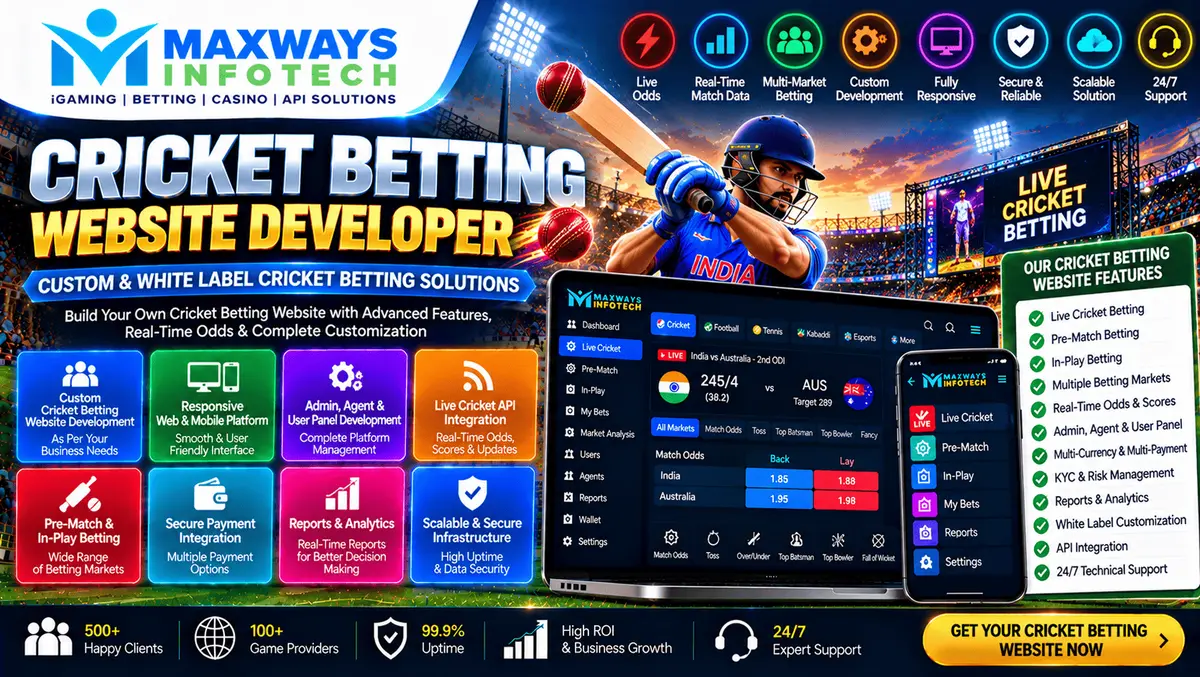
Looking for a cricket betting website developer? Explore website features, cricket API integration, security, SEO, development costs and maintenance.
Cricket Betting Website Developer: Features, Development and Integration Guide
Choosing the right Cricket Betting Website Developer is an important step for businesses planning a cricket-focused sports platform. A well-designed website requires more than an attractive interface. It also needs a suitable technical architecture, reliable data integration, responsive layouts, secure administration, search engine optimization and a practical maintenance plan.
Depending on the project's requirements, a cricket website may display match schedules, live scores, team statistics, tournament information and other supported sports data. More complex applications may require custom dashboards, third-party API integrations, reporting tools and additional backend functionality.
MaxWays Infotech provides website development and API integration services for businesses exploring digital products. This guide explains how cricket website development works, which features deserve attention and what to evaluate before selecting a development partner.
What Does a Cricket Betting Website Developer Do?
A cricket betting website developer plans, builds, integrates, tests or maintains website functionality according to the project's technical requirements and permitted use.
Depending on the agreed scope, development work may include:
-
Responsive website design and page layouts
-
Cricket match schedules, scorecards and team information
-
Integration with authorised cricket data APIs
-
Backend development and database configuration
-
Administrative dashboards and access permissions
-
Reporting and content management
-
Technical SEO implementation
-
Security testing, deployment and maintenance
Not every project needs every feature. A cricket information website may require a simpler architecture than a platform connecting multiple external services.
Businesses researching development options can explore Custom Bookies Website Developers for related information about requirements, custom functionality and software maintenance.
Essential Features of a Cricket Website
1. Responsive Website Design
A cricket-focused website should remain easy to use on desktops, tablets and mobile devices. Visitors may access match information from different screen sizes, so page layouts should adapt to the available space.
Important design considerations include readable scorecards, clear navigation, accessible controls, suitable typography and efficient page loading.
The development team should test the actual interface on supported devices instead of relying only on desktop previews.
2. Live Cricket Scores and Match Information
Live cricket data can help a website display match status, innings scores, overs, wickets and other information supported by its data source.
The required fields depend on the API and subscription selected for the project. Developers should confirm data coverage, update frequency, historical availability and usage rights before implementation.
The website should also handle delayed updates and missing information responsibly. If a feed becomes unavailable, the interface should not present old information as a current score.
For cricket-specific data integration, visit the Cricket API Provider page.
3. Fixtures and Tournament Pages
A well-organized cricket website can arrange information by tournament, series, team, match date or competition format.
Structured page templates can help users navigate between upcoming fixtures, match summaries and completed results. Each page should have a clear purpose and useful information rather than duplicating content across many URLs.
4. Team and Player Statistics
Where licensed data is available, a website may display team records, player profiles, batting and bowling statistics, scorecards and historical results.
The development team should establish consistent identifiers and validate incoming data before displaying it. Statistics should include appropriate context, and missing records should not be replaced with invented values.
5. Administrative Dashboard
An administrative dashboard helps authorised staff manage content, configuration and supported operational tasks.
Depending on the project, it may include content publishing, role-based access, activity logs, report exports and integration monitoring.
Permissions should be assigned according to responsibilities. Sensitive settings and credentials should remain accessible only to authorised personnel.
6. API Integration
A cricket website may connect to external APIs to obtain scores, fixtures, team information or other permitted data.
A reliable integration requires authentication, request validation, data mapping, error handling and monitoring. The application should also respect the provider's rate limits and commercial usage terms.
For broader integration requirements, see the Sports Betting API page.
How to Choose the Right Cricket Betting Website Developer
Selecting a development partner requires evaluating technical ability, project communication and long-term support.
Review Relevant Experience
Ask the developer to explain previous projects with similar requirements. Look for evidence of responsive design, API connectivity, backend development, testing and maintainable code.
A portfolio should demonstrate the team's actual contribution rather than rely only on broad service descriptions.
Request a Detailed Project Proposal
The proposal should identify the included features, exclusions, integrations, deliverables, milestones and assumptions affecting the estimate.
Clarify whether third-party subscriptions, data licensing, hosting and maintenance are included or billed separately.
Evaluate Technical Planning
The developer should be able to explain the proposed architecture, database design, integration approach, authentication model and deployment strategy in language your team can understand.
Ask how the system will handle external service failures, increasing traffic and future API changes.
Confirm Ownership and Handover
Before signing a contract, establish who owns the custom source code, design files, documentation and other project assets.
Clarify repository access, deployment instructions, third-party licences and the process for transferring the project to another development team if needed.
Understand Ongoing Support
A website needs maintenance after launch. Discuss bug fixes, security updates, integration changes, backups, monitoring and support response times.
Make sure the agreement states which services are included and which may incur additional charges.
Technology Used in Cricket Website Development
The right technology stack depends on the project's requirements, the team's expertise and the expected maintenance workload.
Frontend development: HTML, CSS, JavaScript and suitable frameworks can support responsive layouts, interactive scorecards and clear navigation.
Backend development: A server-side application handles business logic, authentication, API requests and data processing.
Database: A suitable database stores the records required by the application, including content, configuration and supported match information.
API integration: Documented interfaces connect the website to authorised external data services.
Hosting and deployment: Infrastructure should match the expected traffic, security needs, backup requirements and availability targets.
Monitoring and testing: Logging, error monitoring and automated testing can help the team identify issues and maintain service quality.
The goal is not to use the largest number of technologies. It is to select a maintainable stack that meets the actual project requirements.
Cricket Betting Website Development Process
A structured workflow makes it easier to track progress and confirm that the final website meets the agreed scope.
Step 1: Requirements Analysis
Define the website's purpose, intended audience, required pages, supported features and external dependencies.
Separate essential first-release features from optional improvements.
Step 2: Design and Prototyping
Create page structures, navigation layouts and responsive design concepts. Review important user journeys before beginning full implementation.
Step 3: Backend and Database Development
Build the backend services, database structures and administrative functionality required by the approved specification.
Define data ownership, validation rules and permission levels.
Step 4: Cricket API Integration
Review the API documentation, configure authentication and connect the required endpoints.
Map external data into the application's structure and implement suitable handling for missing fields, rate limits and service interruptions.
Step 5: Quality Assurance
Test functionality, mobile layouts, API responses, access controls, security and performance.
Verify that the website behaves appropriately when external data is delayed or unavailable.
Step 6: Deployment and Monitoring
Configure the production environment, backups, monitoring and access controls.
After launch, review error rates, response times and data freshness to identify problems that require attention.
Step 7: Maintenance and Improvement
Plan for software updates, dependency changes, integration maintenance and future feature requests.
Use real performance measurements and user feedback to guide improvements.
Cricket API Integration: What Developers Should Check
A cricket API can provide useful data, but the quality of the final website depends on how the integration is implemented.
Before connecting a provider, confirm the following:
-
Required tournaments and match formats are supported.
-
The available data fields meet the website's requirements.
-
Update frequency and timestamps are documented.
-
API authentication and request limits are understood.
-
Commercial use and redistribution are permitted.
-
Error responses and unavailable data are handled properly.
-
The provider's service and support terms are clear.
For live match information, developers should also consider caching and refresh strategies that respect the provider's conditions.
Read the Live Cricket API Provider guide for additional information about cricket data coverage, score updates and integration planning.
SEO Requirements for a Cricket Website
Search engine optimization should be included in the website's original architecture rather than added only after launch.
Unique Page Titles and Meta Descriptions
Create descriptive metadata for important pages. Each title should reflect the page's subject and help users understand what they will find.
Clear URL Structure
Use readable URLs that represent the site's content hierarchy. Configure redirects and canonical URLs appropriately when pages are moved or replaced.
Useful Original Content
Publish original, informative content that serves a clear user need. Avoid creating numerous nearly identical pages solely to target small keyword variations.
Relevant Internal Linking
Connect related pages using descriptive anchor text. For example, a cricket development article can link to relevant API integration resources and website development guides.
Internal links should help visitors discover useful information rather than repeat the same keyword unnaturally.
Mobile Usability and Performance
Optimize images, avoid unnecessary scripts and test layouts on mobile devices. Use performance measurements to identify bottlenecks.
Sitemap and Indexing
Maintain an accurate XML sitemap and ensure that important pages can be crawled and indexed as intended. Check for broken internal links, duplicate URLs and inappropriate indexing settings.
For more information about website architecture and code ownership, see the Betting Website Source Code guide.
What Affects Cricket Website Development Cost?
There is no single development price that applies to every cricket website. Costs depend on the functionality, integration scope, infrastructure and ongoing support requirements.
| Cost factor | Why it matters |
|---|---|
| Number of pages | More unique layouts require additional design and testing |
| Custom functionality | Complex workflows require more development effort |
| Cricket API access | Third-party subscription and licensing fees may apply |
| Backend complexity | Data processing, administration and reporting affect implementation |
| Design requirements | Custom interfaces require design and review time |
| Security and testing | Quality assurance and security controls require dedicated work |
| Hosting | Capacity depends on traffic, storage and availability needs |
| Maintenance | Updates, monitoring and integration changes create ongoing expenses |
Ask developers to provide an itemized quotation that separates initial development from recurring costs. This makes it easier to compare proposals and understand what is included.
Common Mistakes to Avoid
Choosing a Developer Only by Price
A low initial quotation may exclude testing, API integration, hosting or ongoing maintenance. Compare deliverables and total cost rather than price alone.
Ignoring API Restrictions
An API subscription does not automatically permit every type of commercial use. Confirm data rights, usage limits and integration requirements before launch.
Skipping Mobile Testing
A website that looks good on a desktop may be difficult to use on smaller screens. Test important pages and controls on supported devices.
Overlooking Security
Protect credentials, restrict administrative access and keep software dependencies updated. Security should be considered throughout development.
Neglecting Maintenance
External APIs and software dependencies can change. Establish a clear plan for updates, troubleshooting, backups and ongoing support.
Why Consider MaxWays Infotech?
Businesses evaluating cricket-focused website development can explore MaxWays Infotech's website development and API integration services.
Depending on the agreed scope and the availability of authorised third-party services, a project may involve requirements analysis, responsive interface development, backend implementation, cricket data integration, testing and ongoing maintenance.
Before starting, define the required functionality, expected deliverables, ownership terms, integration permissions and support arrangements.
Visit the MaxWays Infotech homepage to learn more about the company's software development offerings.
Frequently Asked Questions
1. What does a cricket betting website developer do?
A developer plans, builds, integrates, tests or maintains cricket-focused website functionality. The work may include responsive design, cricket data integration, backend services, administrative tools and SEO foundations.
2. Can a cricket website display live scores?
Yes, if a suitable data provider offers the required information and the website has the necessary access rights. Data coverage and update frequency depend on the selected provider.
3. Can I integrate a cricket API into an existing website?
Potentially, yes. Compatibility depends on the website's architecture, the API documentation, authentication requirements and permitted use.
4. How much does cricket website development cost?
The cost depends on the number of pages, custom features, integrations, hosting, testing and maintenance. Request a detailed quotation based on the actual project scope.
5. How long does it take to develop a cricket website?
The timeline varies with complexity, design requirements, API availability, content preparation and testing. A developer should estimate the schedule after reviewing the requirements.
6. Is SEO included in website development?
It can be included in the agreed scope. Technical SEO may cover page structure, metadata, responsive design, internal links, sitemap configuration and indexing settings. Rankings are not guaranteed by implementation alone.
7. What should I check before hiring a developer?
Review relevant experience, project proposals, source-code ownership, security practices, testing procedures, API permissions and post-launch support.
8. Are there legal requirements for cricket betting websites?
Requirements depend on the intended functionality, business model and applicable laws in the target jurisdiction. Obtain qualified legal advice and verify the necessary permissions before development or launch.
Conclusion
Choosing the right Cricket Betting Website Developer starts with a clear project scope and a realistic understanding of the technology involved. Responsive design, suitable cricket data integration, secure administration, technical SEO and ongoing maintenance all contribute to a sustainable website.
Compare developers using documented requirements, transparent pricing and clear ownership terms. Test the integration before launch and ensure that any regulated functionality and third-party data use are legally authorised.
Compliance note: Betting-related functionality should only be developed and operated where legally permitted, with the necessary licences, authorised data access and appropriate safeguards.