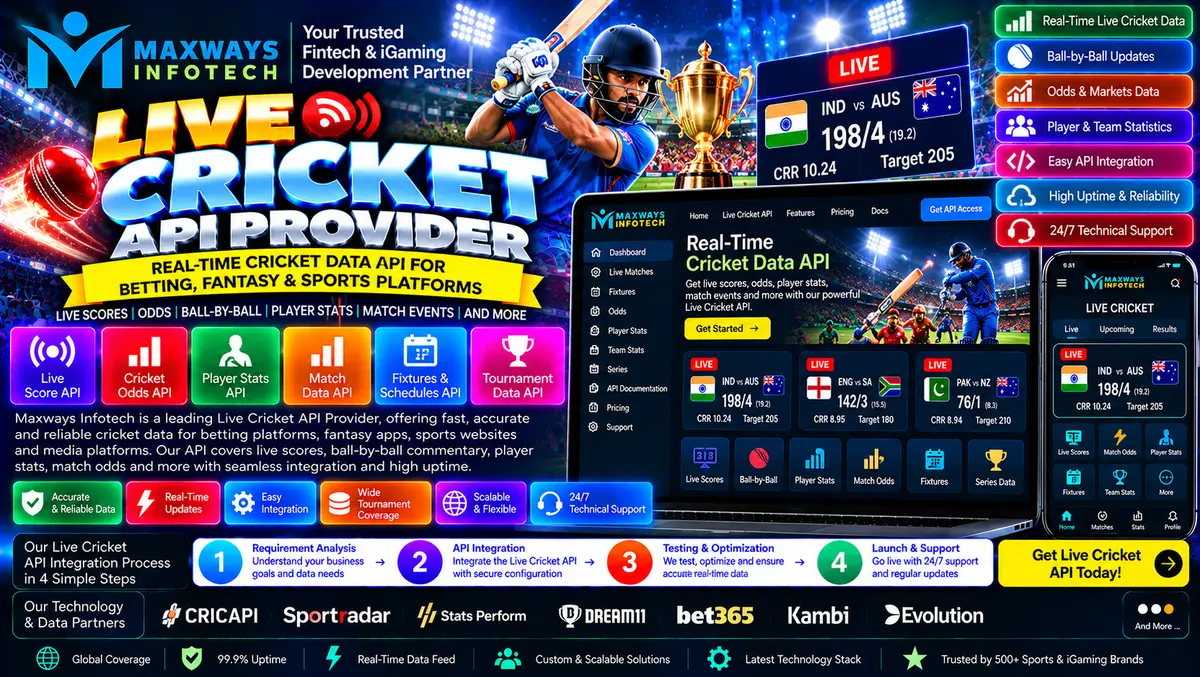
Explore how to choose a Live Cricket API Provider for real-time scores, ball-by-ball updates, scorecards, player statistics, and reliable data integration.
Live Cricket API Provider: Real-Time Cricket Data for Websites and Applications
Live Cricket API Provider supplies structured cricket data that developers can use to build live score pages, match centres, scorecards, commentary interfaces, player statistics, and cricket-focused applications.
The quality of a live cricket integration depends on more than displaying the latest score. Applications must also handle delayed updates, changing match states, missing information, and differences between data sources. A well-designed integration helps keep the displayed information consistent as a match progresses.
This guide explains how live cricket APIs work, which data features matter most, and how businesses can evaluate a provider before integrating cricket data into their products.
What Is a Live Cricket API Provider?
A Live Cricket API Provider makes cricket-related information available through documented software interfaces. Applications send requests to retrieve structured data, usually in a format such as JSON, and then use the responses to update their own interfaces or internal systems.
Depending on the provider and subscription, available information may include live scores, fixtures, innings scorecards, ball-by-ball events, team lineups, player statistics, tournament standings, and historical match results.
For example, a cricket website might retrieve a list of current matches, allow visitors to select a match, and then display the corresponding scorecard and recent deliveries. Each part of the page can use the appropriate data endpoint rather than requesting a large dataset for every visitor.
Businesses exploring software development services can visit Maxways Infotech to learn more about its digital technology offerings.
The available data, competition coverage, update frequency, and usage rights vary by provider. These details should be verified before choosing an API for a commercial application.
How Does a Live Cricket API Work?
A typical integration follows a straightforward process, although the details depend on the provider's architecture.
1. Retrieve the match schedule
The application requests upcoming, ongoing, or completed fixtures. The response may include match identifiers, participating teams, format, venue, scheduled start time, and current status.
Stable match identifiers are especially important because they allow the application to retrieve related information without relying on team names or display text.
2. Request the live match state
Once a match is selected, the application requests the latest available state. This may contain the current innings, runs, wickets, overs, batting and bowling details, and other supported fields.
The backend should validate the response before using it to update the interface.
3. Retrieve detailed match information
A scorecard or commentary endpoint can provide more detailed information than a compact live-score response. The application can request this information when a visitor opens a particular match, helping avoid unnecessary data transfer.
4. Refresh or process updates
The integration may periodically request new data, receive webhook notifications, or use another delivery method supported by the provider.
The correct method depends on update frequency, service limits, expected traffic, and the provider's documented capabilities.
5. Update the interface
The application transforms the returned data into a readable score display, scorecard, commentary timeline, or statistical view. It should also show when information is delayed or unavailable instead of presenting an old score as if it were current.
Essential Features to Look for in a Live Cricket API
Real-time or near-real-time score updates
A live-score API should clearly explain how frequently its data is refreshed and how quickly updates become available after events occur.
Do not rely only on phrases such as “instant” or “real-time.” Ask about the delivery method, typical update delay, service commitments, and behaviour during high-traffic matches.
For many applications, predictable and transparent update timing is more useful than an unsupported promise of zero delay.
Ball-by-ball match information
Ball-by-ball data can provide details about individual deliveries, including the over, ball outcome, batter, bowler, runs, extras, and wicket information where available.
This data can support detailed commentary timelines, over summaries, partnership displays, and match-progress visualisations.
Developers should confirm how the provider represents wides, no-balls, penalty runs, wickets, and other exceptional events. Cricket scoring includes situations that cannot always be represented as one ordinary delivery.
Complete innings scorecards
A scorecard may contain batting figures, bowling figures, extras, innings totals, fall of wickets, and other match details.
The exact fields can vary between formats and competitions. Test matches, one-day matches, and T20 matches do not always have the same innings structure.
A good integration should therefore accommodate format-specific differences instead of assuming every match has two innings.
Match fixtures and tournament coverage
Fixtures help applications organise matches before they begin and connect them with the correct tournament, season, venue, and match status.
Before choosing a provider, confirm coverage for the competitions your audience follows. International cricket, domestic tournaments, franchise leagues, women's competitions, and age-group matches may have different coverage levels.
Also check whether historical fixtures and completed results remain accessible under the proposed plan.
Player and team statistics
Player profiles and team statistics can make a cricket application more useful beyond the live scoreboard.
Depending on availability, these datasets may include player records, squad information, batting and bowling averages, recent performance, team details, or tournament standings.
Verify the definitions and update schedules for each statistic. Different data sources may calculate or label certain metrics differently, which can make direct comparisons misleading.
Historical match data
Historical records can support archive pages, past scorecards, player profiles, tournament summaries, and analytical reports.
Check the provider's available date range, level of detail, coverage gaps, and historical access restrictions. A provider may offer full scorecards for older matches while supplying detailed ball-by-ball data only for a smaller period.
Why Match-State Accuracy Matters
A live cricket match is not just a score that increases after every delivery. Its state changes throughout the game.
For example, a completed over may change the current bowler, an innings break may change the batting team, and a rain interruption may alter the match status. A super over or a multi-innings Test match requires additional handling.
A reliable application should maintain a clear match-state model that includes the fields needed for its use case.
Important checks include:
-
Confirming the match identifier before applying an update.
-
Keeping innings identifiers separate where required.
-
Handling wickets and extras correctly.
-
Recognising innings breaks and completed matches.
-
Preserving the source timestamp when available.
-
Rejecting older updates that would overwrite newer valid information.
-
Showing a clear delayed-data status if updates stop arriving.
These checks help prevent a technically successful API response from producing an incorrect scoreboard.
Choosing the Right Live Cricket API Provider
Evaluate coverage before pricing
Start by listing the competitions, match formats, and data fields required by your application. Then compare these requirements with the provider's actual coverage documentation.
A low-cost plan may not include every league, historical dataset, or detailed match endpoint. Confirm the exact package rather than assuming that all advertised features are available at every subscription level.
Examine documentation quality
Documentation should explain authentication, endpoints, response fields, timestamps, pagination, rate limits, errors, and versioning.
Look for examples of unsuccessful requests, unavailable matches, missing statistics, and interrupted updates. These examples help developers understand how to handle real operating conditions.
Test update timing
Run a trial during a suitable live match and record when updates become available. Measure the delay between received updates, monitor missing events, and observe what happens when the connection is interrupted.
A short demonstration cannot establish long-term performance, so test under realistic conditions wherever possible.
Review uptime and support
Ask how the provider communicates incidents, planned maintenance, and data-feed interruptions. Check support hours, escalation procedures, and any contractual service-level commitments.
A provider should explain how customers can diagnose authentication failures, rate-limit responses, missing match records, and delayed updates.
Understand licensing and usage rights
Technical access to data does not automatically grant permission to redistribute it in every context. Review the agreement for permitted display, storage, commercial use, redistribution, attribution, and geographic restrictions.
Businesses should verify that their intended application and target markets are covered by the provider's terms.
Integrating a Live Cricket API Into a Website or App
A structured integration can make development and maintenance easier.
Step 1: Define the required screens
List the features the application needs, such as a live-match listing, match detail page, scorecard, commentary feed, team profile, or tournament schedule.
Map each screen to the specific fields it needs. This avoids requesting detailed datasets for pages that only require a current score.
Step 2: Store stable identifiers
Use the provider's match, team, player, and competition identifiers wherever appropriate. Display names can change or vary, so they should not be the only means of linking records.
If the application combines multiple sources, maintain an explicit mapping between their identifiers.
Step 3: Keep API credentials on the backend
Store API credentials in a protected server-side configuration or secrets manager. Avoid exposing private keys in browser code, public mobile application bundles, or client-visible logs.
A backend service can authenticate with the provider and return only the required data to the front end.
Step 4: Choose a refresh strategy
Use the provider's supported polling, webhook, or streaming approach. Apply suitable caching and request limits so that every visitor does not trigger a separate request for the same match data.
Caching duration should reflect the data's purpose and acceptable delay. A live score may need a short cache, while a static team profile can often be cached for longer.
Step 5: Handle errors and missing fields
The application should distinguish between an empty result, an unavailable match, an authentication problem, and a temporary service failure.
If the latest request fails, it may be appropriate to retain the last valid score temporarily, provided the interface clearly indicates that the information may be delayed.
Step 6: Monitor data quality
Track update timestamps, failed requests, response times, and missing or inconsistent fields. Set alerts for prolonged update gaps during active matches.
Monitoring helps identify whether an issue originates with the data provider, the integration backend, or the user-facing application.
Businesses can explore Maxways Infotech blog for additional information about software and digital technology topics.
Managing High Traffic During Major Cricket Matches
Popular tournaments can create sudden increases in visitors. If every browser repeatedly requests the same live match data directly from an external API, request limits may be reached and page performance may suffer.
A more scalable design uses a backend service to retrieve data, cache suitable responses, and distribute updates to multiple visitors.
The backend can also group requests, reuse recent responses, and limit unnecessary calls to detailed endpoints. Frequently changing data should have a cache policy that balances freshness against traffic and provider restrictions.
For larger applications, teams may consider message queues or event-driven processing to distribute updates internally. Such systems should include safeguards against duplicate messages, out-of-order updates, and delayed processing.
Performance testing should reflect realistic traffic patterns, including peak match periods rather than only average daily usage.
Common Mistakes to Avoid
Choosing a provider without verifying competition coverage. Confirm that the competitions and formats your application needs are actually included.
Assuming every update arrives instantly. Measure update delay and establish a clear policy for displaying stale information.
Using display names as permanent identifiers. Names can change or be represented differently across data sources.
Exposing API credentials in the front end. Keep private keys on a secure backend.
Requesting more data than necessary. Use suitable endpoints, caching, and refresh intervals to reduce unnecessary calls.
Ignoring unusual cricket events. Extras, wickets, innings changes, rain interruptions, and super overs need explicit handling.
Failing to test recovery. Simulate timeouts, missing updates, rate limits, and provider outages before production launch.
Avoiding these problems makes the application easier to maintain and reduces the risk of incorrect match information reaching users.
Frequently Asked Questions
What does a Live Cricket API Provider offer?
Depending on the provider, services may include live scores, fixtures, scorecards, ball-by-ball data, commentary, player statistics, tournament information, and historical match records.
Can a live cricket API be used for a mobile application?
Yes. Developers can integrate a suitable API through a secure backend and use the returned data to display cricket information in a mobile app. Authentication, caching, and error handling should be designed for the application's expected usage.
How frequently does live cricket data update?
Update frequency varies by provider, competition, endpoint, and subscription. Confirm the documented refresh interval and measure actual delivery timing during testing.
What is the difference between a live score API and a ball-by-ball API?
A live-score endpoint usually returns a current match summary. A ball-by-ball endpoint provides more granular information about individual deliveries and related events. Some providers offer both through separate endpoints.
How can developers reduce API costs?
Use the appropriate endpoint for each screen, cache responses where permitted, reuse data across visitors, avoid unnecessary polling, and monitor usage against provider quotas.
What should businesses check before selecting a provider?
Evaluate data coverage, update speed, documentation, historical access, accuracy, security, support, pricing, service commitments, and permitted usage rights.
Conclusion
A Live Cricket API Provider can supply the structured information needed to build live scoreboards, match centres, detailed scorecards, and cricket-focused digital products. Choosing a suitable service requires more than checking whether a live-score endpoint exists.
Businesses should verify competition coverage, measure update timing, understand match-state changes, protect API credentials, and plan for missing or delayed data. Reliable caching, monitoring, and recovery procedures are equally important when an application serves large audiences.
With a clear integration strategy and realistic testing, developers can build cricket experiences that keep information organised and make it easier to maintain as their audience and feature requirements grow.