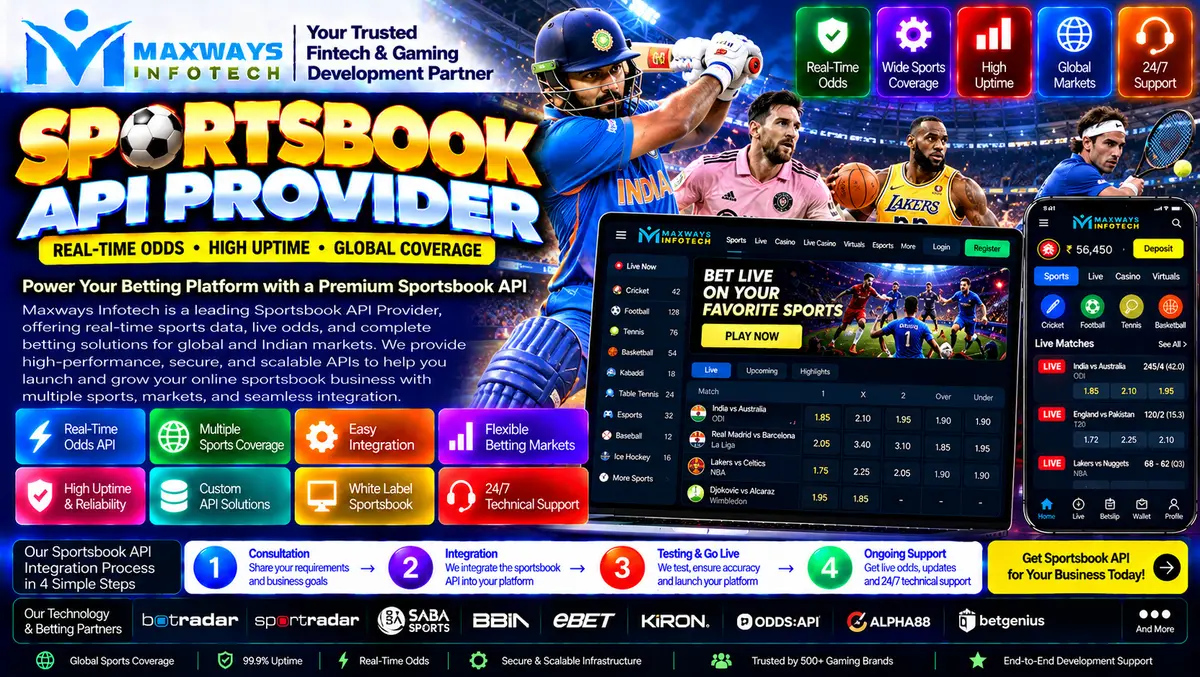
Learn how to evaluate a sportsbook API provider by data quality, coverage, documentation, update frequency, pricing, security, and integration needs.
Sportsbook API Provider: A Guide to Sports Data Integration
Choosing a sportsbook API provider is an important decision for businesses developing sports information platforms, live score applications, analytics dashboards, and other lawful sports-related digital products. The right API solution can help deliver structured event information, team statistics, schedules, and live updates through a consistent technical interface.
However, selecting a provider involves more than checking which sports it covers. Data accuracy, documentation, update frequency, system reliability, licensing terms, and integration requirements all affect the long-term value of the solution.
What Is a Sportsbook API Provider?
A sportsbook API provider supplies software interfaces that allow applications to retrieve sports-related information from an external service. Depending on the provider and subscription, available information may include fixtures, competition details, team statistics, event status, historical results, and other structured datasets.
An API can save development time because the application does not need to collect and maintain every data source independently. Instead, developers connect to the provider's service and transform the returned information into a format suitable for their application.
Before choosing an API, businesses should identify the exact data they need and confirm that the provider is authorised to supply it for the intended use.
1. Identify the Required Sports Data
Every project has different data requirements. A sports news application may primarily need schedules, scores, and team information, while a statistical research dashboard may require historical records and detailed event-level data.
Create a list of required data fields before comparing providers. This makes it easier to identify missing information and avoid paying for features that the project does not need.
Consider the following categories:
-
Event schedules: Dates, start times, competitions, and participating teams.
-
Live event information: Status updates and supported live statistics.
-
Historical results: Past scores and archived event records.
-
Team and player data: Available profiles and statistical information.
-
Competition information: League identifiers, season details, and standings where supported.
Not every API provides every category. Confirm the available fields, coverage, update frequency, and historical depth in the provider's documentation.
2. Evaluate Data Quality and Consistency
Data quality is one of the most important factors in API selection. Incorrect event times, inconsistent team names, duplicated fixtures, or delayed status updates can create problems throughout an application.
Ask how the provider sources its information, validates incoming records, corrects errors, and communicates data changes. A reliable vendor should document its data definitions and explain how corrections are represented in the API.
Testing should include real examples from different competitions and event types. Developers can compare returned records against authorised reference sources to identify discrepancies before the application goes live.
It is also useful to examine how the provider represents missing values, postponed events, cancellations, and corrected results. Consistent handling of these cases makes application logic easier to maintain.
3. Check API Documentation and Developer Support
Good documentation can significantly reduce integration time. Developers should be able to understand the available endpoints, authentication process, request parameters, response formats, error codes, and usage limits.
Before committing to a provider, review whether it offers:
-
Clear endpoint descriptions and data schemas.
-
Working request and response examples.
-
Test credentials or a sandbox environment.
-
Information about API versioning.
-
Documented rate limits and error responses.
-
A support process for technical questions.
A sandbox is especially useful because it allows developers to test their implementation without depending entirely on production data.
If the documentation leaves important questions unanswered, request clarification before estimating the development effort. Unclear API behaviour can create avoidable delays later in the project.
4. Understand Update Frequency and Delivery Methods
Different applications require different update patterns. A historical statistics dashboard may only need periodic refreshes, while a live information display may require more frequent updates.
Some providers support scheduled polling, while others offer streaming connections or webhook notifications. The appropriate option depends on the required freshness, network conditions, API limits, and application architecture.
Developers should not assume that an API labelled “live” provides instantaneous updates for every sport or competition. Ask for documented update intervals and any limitations that apply to the selected data package.
The integration should also handle delayed responses, duplicate notifications, interrupted connections, and temporary service failures. A clearly defined recovery process helps prevent stale or inconsistent information from appearing in the application.
5. Plan Data Normalisation and Storage
One of the more challenging parts of API integration is converting external data into a consistent internal structure.
Different providers may use different identifiers, naming conventions, date formats, and definitions for the same type of event. An application that combines multiple data sources needs a strategy for mapping these differences.
A data-normalisation layer can standardise event identifiers, team names, timestamps, competition records, and supported status values. It also provides a central place to manage changes when a provider modifies its response format.
Developers should decide which records need to be stored, how long they should be retained, and when cached information should expire. These decisions should follow the project's requirements, licensing terms, and privacy obligations.
6. Compare Pricing and API Usage Limits
API pricing may depend on request volume, data coverage, update frequency, historical access, or the number of products using the service.
Comparing only the headline subscription price can be misleading. A low-cost plan may lack the data fields or usage capacity required for the finished application, while an expensive plan may include services the project never uses.
Before signing an agreement, review:
-
Monthly and daily request limits.
-
Restrictions on concurrent connections.
-
Additional fees for particular sports or competitions.
-
Historical data availability.
-
Commercial display and redistribution rights.
-
Upgrade conditions and overage charges.
-
Support and service-level commitments.
Estimate usage using realistic application traffic and the expected number of data refreshes. This helps identify potential cost increases before launch.
7. Reliability, Monitoring, and Error Handling
An external API becomes part of the application's dependency chain. If the provider experiences an outage or returns incomplete information, the application needs a controlled way to respond.
Developers should monitor response times, error rates, failed requests, and usage limits. Automated alerts can help the technical team investigate recurring problems before they affect a large number of users.
The application should distinguish between a genuine empty response and a failed request. It should also avoid repeatedly retrying requests without limits, as this can increase load and make rate-limit problems worse.
Where permitted by the provider's terms, carefully managed caching can reduce unnecessary requests and help maintain responsiveness during temporary interruptions. Cached information should be clearly managed so that users are not shown outdated data as current.
8. Security and Access Management
API credentials should be treated as sensitive configuration values. They should not be exposed in public source code, browser-delivered scripts, or client-side application bundles when the provider requires server-side authentication.
Appropriate safeguards include protected environment variables or secret-management tools, restricted access to credentials, encrypted connections, and a documented key-rotation process.
Developers should also validate incoming data, monitor unusual request patterns, and ensure that only authorised components can access the relevant API services.
A security review should cover the full integration, including logs, error messages, administrative access, and third-party dependencies. This helps reduce the risk of accidental credential exposure or unauthorised use.
9. How to Choose a Suitable Sportsbook API Provider
The right provider should match the project's data requirements, technical capabilities, budget, and legal obligations. A structured evaluation makes it easier to compare vendors objectively.
Use a checklist covering these questions:
-
Does the provider cover the required sports and competitions?
-
Are the data fields and update intervals documented?
-
Is a sandbox available for integration testing?
-
How are data corrections and service interruptions handled?
-
What are the request limits and full pricing conditions?
-
Do the licence terms permit the intended display or redistribution?
-
What technical support and service commitments are included?
Run a proof of concept before building the complete application around a provider. Testing a small set of endpoints can reveal integration issues early and help confirm whether the service meets expectations.
For company information, visit Maxways Infotech. You can also explore its fintech page for related technology information and the company blog for more articles about digital platforms and software development.
10. Legal and Responsible Use Considerations
Businesses should review both the API provider's licence and the laws that apply to the finished product. Access to sports data does not automatically grant permission to redistribute it, use it commercially, or display it in every type of application.
In India, the Promotion and Regulation of Online Gaming Act, 2025 prohibits online money games and related activities, including offering, facilitating, advertising, and promotion. The Promotion and Regulation of Online Gaming Rules, 2026 came into force on 1 May 2026. Businesses should obtain qualified legal advice to assess how these requirements apply to their intended product and business model.
A project should be reviewed according to its actual features, purpose, and monetisation model rather than relying on its description alone. Data licensing, privacy, and other relevant legal requirements should also be checked before launch.
Conclusion
Choosing a sportsbook API provider requires a careful assessment of data quality, coverage, documentation, update frequency, pricing, security, and permitted use. The best technical solution is not necessarily the one with the largest catalogue; it is the one that consistently supplies the information the application actually needs.
By testing the API before full integration, planning for failures, normalising data, and reviewing licence and compliance requirements, businesses can make better-informed technology decisions and build more maintainable sports information products.