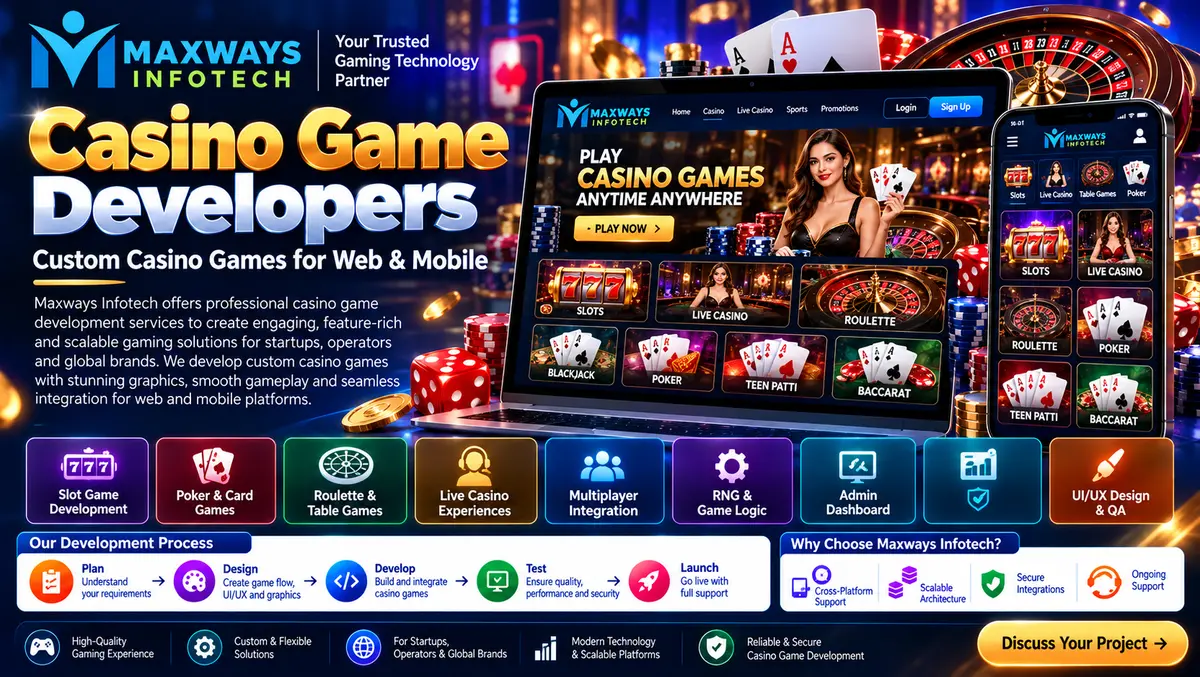
Discover how Casino Game Developers create custom games using suitable technology, game mechanics, artwork, testing, and platform integration.
Casino Game Developers: Skills, Technology, and Custom Game Creation
Casino Game Developers turn game concepts into interactive digital products by combining software engineering, visual design, game mechanics, animation, and testing. Their work can range from building a simple browser-based card game to developing a custom slot game or a multiplayer gaming experience with complex backend requirements.
For businesses planning a new casino-style game, choosing the right developers is about more than finding someone who can write code. The team must understand how the game should behave, how its components will communicate, what the user will see on screen, and how the finished product will be tested and maintained.
A clear development strategy helps businesses avoid unnecessary features, make better technology decisions, and establish realistic expectations before production begins.
What Do Casino Game Developers Actually Build?
Casino game developers work on the systems and interactive elements that make a game function. Their responsibilities depend on the game type, delivery platform, and project scope.
A development team may work on:
-
Game mechanics and rule implementation.
-
Frontend interfaces and interactive controls.
-
Game animations, sound effects, and visual assets.
-
Backend logic and session management.
-
Random number generation for applicable games.
-
Multiplayer communication and state synchronization.
-
Third-party API integration.
-
Testing, deployment, and software maintenance.
Some developers specialise in the visual experience, while others focus on backend engineering, mathematics, or testing. A larger project may require all these skills to work together.
For example, creating a card game involves more than displaying cards on a screen. The software must enforce the rules, process permitted actions, maintain the correct game state, and handle unexpected events without producing inconsistent results.
Different Specialisations Within Casino Game Development
Understanding the different development roles can help businesses build a team that matches their requirements.
1. Game Mechanics Developers
These developers implement the rules and behaviour of the game. They determine how a round starts, which actions are allowed, how the game progresses, and how the final state is calculated.
Their work is especially important when a game includes multiple stages, bonus features, or complex interactions.
2. Frontend Game Developers
Frontend developers build the part of the game that users interact with. They work on buttons, menus, animations, responsive layouts, and the presentation of game information.
Their goal is to make the experience understandable and responsive across supported devices.
3. Backend Game Developers
Backend developers manage the services that operate behind the interface. Depending on the project, these may include session handling, server-side validation, game-state management, and connections to external services.
For multiplayer products, the backend must maintain an authoritative state so that connected users receive consistent information.
4. Game Artists and Animators
Artists create the visual assets that give a game its identity. Their work may include symbols, backgrounds, character illustrations, card designs, icons, and interface elements.
Animators add movement and transitions, while sound designers create audio effects and other supporting elements.
These assets should support the game rather than distract from important controls or information.
5. QA and Game Testing Specialists
Quality assurance specialists check whether the game behaves according to its specification. They test gameplay, device compatibility, performance, security, and edge cases.
For games that require independent assessment, the development plan should also account for the relevant testing and certification process.
Choosing the Right Game Format
Before hiring developers, businesses should decide what kind of game they want to build. Each format has different design, programming, and testing requirements.
Slot-Style Games
Slot-style games typically combine visual symbols, animations, defined rules, and an outcome-processing system. Development may include original artwork, symbol layouts, paytable presentation, bonus features, and responsive controls.
The team must ensure that visual animations represent the actual game outcome rather than changing the result independently.
Card Games
Digital card games require clear rules, card-state management, and reliable handling of player actions. Multiplayer formats add further requirements around turn order, session recovery, and communication between participants.
Table Games
Games such as roulette and blackjack require a defined set of rules and an interface that presents the current game state clearly.
The developers should document the chosen game variant and test all supported actions against that specification.
Custom Interactive Games
Some projects use original mechanics rather than a familiar game format. These projects benefit from early prototyping because the team needs to test the idea before committing to a complete production build.
A prototype can reveal whether the interaction makes sense, whether the rules are sufficiently clear, and which technical challenges need further investigation.
How Developers Turn a Concept into a Working Game
A structured workflow helps the team move from an idea to a testable product without losing track of the original requirements.
Step 1: Define the Game Brief
The game brief describes the concept, intended platform, core mechanics, visual direction, and required features.
It should also identify which elements are essential for the first release and which can be considered later. This distinction helps prevent the project from growing beyond its original scope.
Step 2: Create a Playable Prototype
A prototype demonstrates the central interaction using simplified graphics and a limited feature set.
It gives stakeholders something concrete to evaluate before investing in final artwork, advanced animation, or complex integrations.
Step 3: Build the Game Assets
Once the basic concept is approved, the team can create the visual and audio assets. Consistent design rules help ensure that the game's screens, symbols, controls, and feedback messages feel connected.
Asset optimisation is also important. Large files can increase loading times and create performance problems on lower-powered devices.
Step 4: Implement the Game Logic
Developers translate the written rules into software. They implement the expected state transitions, validate user actions, and define how the game responds to errors or interrupted sessions.
Where randomness is involved, the outcome-generation system should be designed and tested against the documented mathematical requirements.
Step 5: Connect Required Services
If the game needs external APIs, account services, or platform integrations, the team implements and tests those connections.
Each integration should have defined request formats, authentication rules, error handling, and clear ownership of ongoing maintenance.
Step 6: Test and Refine
The team checks functionality, presentation, performance, security, and compatibility. Defects are recorded, prioritised, corrected, and retested.
Stakeholders then review the product against the agreed acceptance criteria before the release decision.
Choosing Technology for the Project
The best technology depends on the kind of game, the target devices, the team's experience, and the complexity of the required features.
HTML5 and JavaScript
HTML5-based development can be suitable for games intended to run in supported web browsers. It can make browser distribution practical without requiring a separate installation for every user.
Developers should still test browser compatibility, asset loading, input handling, and performance on representative devices.
Unity
Unity can be suitable for projects that require more advanced animation, interactive environments, or three-dimensional graphics.
The team should consider build size, device requirements, licensing terms, and long-term maintenance when choosing the engine.
Unreal Engine
Unreal Engine may fit projects with demanding 3D rendering or specialised visual requirements. It may be unnecessary for simpler games, so the additional technical complexity should be justified by the intended experience.
Backend and Database Technologies
Backend frameworks and databases support the parts of the game that require server-side processing or persistent records.
The architecture should be designed around the actual workload and data requirements. Security, maintainability, monitoring, and recovery procedures should be part of the technical plan.
For businesses exploring wider software engineering capabilities alongside game-related projects, Maxways Infotech provides a starting point for reviewing the company's services.
Reusable Game Components: A Practical Development Strategy
One way to organise a game project is to identify which components can be reused and which should be specific to the game.
A reusable component might handle common interface controls, sound settings, loading screens, or supported language options. A game-specific component might implement a unique rule set, bonus mechanic, or specialised animation.
This approach can reduce duplicated work when several games share similar technical requirements.
However, reusability should be planned carefully. Two games that look similar may still have different rules or backend requirements. Forcing them into the same logic can make the code harder to test and maintain.
A practical component strategy should answer three questions:
-
Which elements are genuinely shared across games?
-
Which elements need to remain independent?
-
How will changes to a shared component be tested across all dependent games?
Documenting these decisions helps the development team manage future updates without creating unnecessary dependencies.
Quality Assurance: More Than Finding Bugs
Testing is not limited to checking whether buttons work. A finished game must behave consistently under normal conditions and when something goes wrong.
Gameplay Validation
Test each defined rule, action, transition, and end state. The implementation should match the approved game specification.
Randomness and Mathematical Validation
For games using random outcomes, validate the outcome-generation process and mathematical model. Where applicable, arrange independent assessment through the relevant testing organisation.
Compatibility Checks
Test supported browsers, devices, operating systems, screen sizes, and input methods.
Performance Checks
Measure loading times, resource use, animation performance, and server responsiveness where relevant. Testing should reflect the expected environment rather than relying on a single developer machine.
Error and Recovery Testing
Check how the game behaves if a connection is interrupted, an external API returns an error, or a session expires.
Regression Testing
After a change, retest related functionality to ensure the update has not broken another feature. This becomes particularly important when multiple games share common components.
Integrating a Game with an Existing Platform
A game may be delivered as a standalone browser experience or integrated into a larger platform. Integration requirements should be defined before development begins.
Depending on the project, the integration may involve session creation, authentication, configuration, game events, or approved data exchange.
The development team should confirm:
-
What the external service supports.
-
Which authentication methods are required.
-
How errors and delayed responses are handled.
-
What test environments are available.
-
How the integration will be monitored.
-
Who maintains the connection when the external service changes.
Businesses interested in broader digital software services can also review Maxways Infotech's fintech page. This is a related software-services resource, not a claim that fintech software automatically includes casino game development.
What Affects the Cost of Hiring Casino Game Developers?
There is no single price for every casino game project. The budget depends on the required functionality, design, technology, integrations, testing, and ongoing support.
Game complexity: A simple game with a small set of interactions generally requires a different level of effort from a multiplayer product with numerous states and custom mechanics.
Artwork and animation: Original illustrations, detailed visual effects, custom sound, and 3D assets affect production time.
Platform support: Browser, mobile, and desktop requirements can introduce additional development and testing work.
Backend requirements: Server-side logic, session management, persistent records, and external integrations add to the engineering scope.
Testing and assessment: Functional testing, performance testing, security review, and any required independent certification should be included in planning.
Maintenance: Bug fixes, dependency updates, compatibility improvements, and technical support may create recurring expenses.
Before approving a quote, ask for a breakdown of one-time development costs and ongoing costs. The proposal should also identify exclusions, assumptions, payment milestones, and the process for handling new requirements.
How to Evaluate a Casino Game Development Team
Choosing a development partner is easier when the evaluation focuses on evidence rather than broad promises.
Review Relevant Projects
Ask the company to show examples it is permitted to share. Look for experience with comparable mechanics, visual complexity, target devices, and integration requirements.
Request a Technical Explanation
The team should be able to explain how it will implement the core game logic, manage errors, test the product, and support future changes.
Agree on Deliverables
Document what will be delivered, including source code where applicable, artwork, documentation, test results, deployment support, and maintenance terms.
Clarify Ownership
Confirm who owns custom code and artwork, and identify any third-party libraries, assets, or engines that have separate licensing conditions.
Check Communication and Support
Agree on progress reviews, milestone approvals, issue reporting, and post-release responsibilities.
Verify Compliance Requirements
Where the intended product is subject to gaming rules or independent certification, identify the applicable requirements before development begins. Developers should not claim that a game is certified unless the relevant certification has been issued.
Legal and Responsible Development
Casino-style games may be subject to different legal requirements depending on their mechanics, commercial model, and target market.
Before developing or launching a product involving wagers, monetary prizes, or real-money transactions, businesses should seek advice from qualified legal professionals familiar with the applicable jurisdiction and current law.
Depending on the product, planning may also need to cover privacy, data security, age-related controls, advertising restrictions, third-party licensing, and independent testing.
A technically complete game is not automatically authorised for commercial operation. Legal and regulatory requirements should be considered alongside engineering decisions, not left until the end of the project.
Maintaining Games After Release
A game may need updates long after its initial release. Operating systems change, browsers introduce new behaviour, external APIs evolve, and users may discover issues that were not apparent during testing.
A maintenance plan can cover:
-
Bug fixes and compatibility updates.
-
Security patches.
-
Performance improvements.
-
Integration changes.
-
Asset and content updates.
-
Backup and recovery procedures.
-
Documentation and release records.
Shared components should be updated carefully because a change may affect multiple games. Regression testing helps the team detect those effects before the update reaches production.
A clearly defined maintenance agreement also helps businesses understand which services are included and which require a separate budget.
Conclusion
Casino Game Developers combine programming, game mechanics, visual design, backend engineering, and quality assurance to create functional digital games. The right development approach depends on the game concept, technical requirements, target devices, integrations, and applicable rules.
Businesses should start with a clear specification, build a prototype where useful, choose technology based on the actual requirements, and agree on testing and ownership before production begins.
A capable development team should explain its technical decisions, define its deliverables, and provide a realistic plan for testing and maintenance. These foundations make it easier to manage project scope and improve the product over time.
For more articles about software development and digital technology, visit the Maxways Infotech blog.
Frequently Asked Questions
What do Casino Game Developers do?
They build game mechanics, interfaces, animations, backend functionality, integrations, and other software components required for digital casino-style games.
Which types of games can they develop?
Depending on their expertise, developers may work on slot-style games, card games, table games, multiplayer experiences, and custom interactive products.
Which technology is best for casino game development?
The choice depends on the game. HTML5 may suit browser-based experiences, while Unity or Unreal Engine may fit projects with more advanced visual requirements. Backend technologies are selected according to the application's needs.
Why is testing important?
Testing verifies that game rules, interfaces, integrations, performance, and security behave as intended. Games using random outcomes may also require specialised mathematical validation or independent assessment.
How can I estimate a game development budget?
Define the game type, features, target devices, artwork requirements, integrations, testing scope, and maintenance expectations. A detailed project brief helps a development team prepare a more useful estimate.
What should I check before hiring developers?
Review relevant experience, technical approach, project scope, ownership terms, testing plans, communication process, maintenance support, and applicable legal requirements.