Explore live casino game development, streaming technology, API integration, platform security, testing, and key factors for choosing developers.
Live Casino Game Developers: From Streaming Technology to Platform Launch
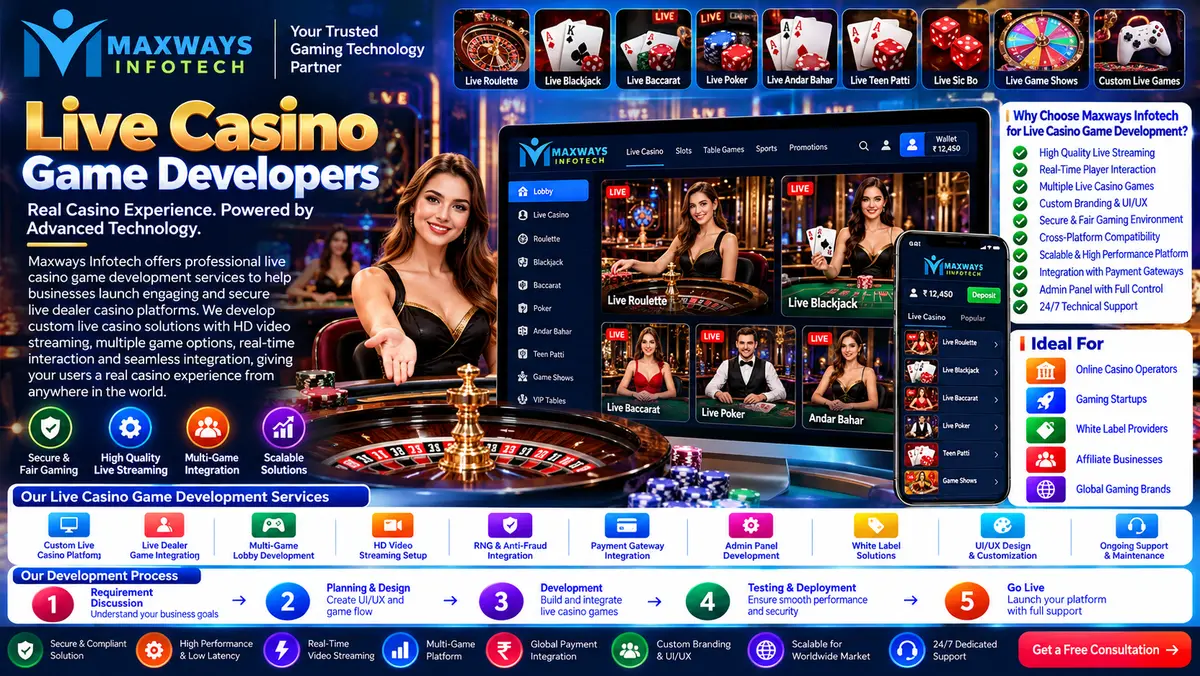
Live Casino Game Developers create the software systems that bring live video, interactive interfaces, real-time communication, and backend services together in one digital experience. Building this type of platform requires more than attractive graphics. Developers must consider streaming performance, system reliability, device compatibility, data security, and the complete user journey.
For businesses evaluating live gaming technology, one of the biggest decisions is how to turn an initial concept into a technically reliable product. The project may involve developing a new interface, connecting existing technology, creating administrative tools, or improving the performance of an established application.
A well-planned development process helps identify technical requirements early, reduce integration problems, and establish a clearer path from design to deployment.
What Makes Live Casino Game Development Different?
A conventional website mainly responds to user requests and displays information. A live gaming application may also need to receive a continuous video stream, process real-time events, and keep multiple interface elements synchronized.
This creates several engineering challenges.
Continuous media delivery: Video must remain watchable across supported devices and different network conditions.
Real-time communication: The application must handle relevant game events and session updates without displaying inconsistent information.
Multiple system dependencies: The frontend, backend, streaming infrastructure, databases, and third-party services may all need to work together.
Reliable session handling: The application needs a defined response when a user disconnects, a stream pauses, or an external service becomes unavailable.
Ongoing monitoring: Technical teams need visibility into performance and errors after the application goes live.
These requirements make architecture and testing just as important as visual design.
What Services Do Live Casino Game Developers Provide?
The scope of development depends on the project. Some businesses need a complete custom application, while others need selected components integrated into an existing product.
1. Custom Interface Development
The user interface determines how people navigate the application and understand what is happening on screen. Developers may create responsive layouts, video containers, game information panels, session indicators, navigation menus, and support screens.
The design should prioritize clarity. Important information should remain readable on smaller screens, and the interface should communicate loading states, errors, and connection interruptions in understandable language.
2. Backend Engineering
Backend services manage the application logic that users do not see directly. Depending on the project, these services may handle authentication, sessions, configuration, user permissions, event processing, and reporting.
A good backend design also separates responsibilities where practical. This makes it easier to update one component without creating unnecessary problems elsewhere.
3. Streaming Integration
Live video may be delivered through a third-party streaming provider or infrastructure designed for the project. The development team needs to understand the supported protocols, playback requirements, connection limits, and monitoring capabilities.
The goal is not simply to display video. The stream should start reliably, adapt to suitable network conditions, and provide clear feedback when playback cannot continue.
4. API and Third-Party Integration
APIs allow separate applications to exchange data and functionality. Depending on the approved service, an integration may provide content information, session creation, user authentication, or other supported features.
Developers should review documentation, test environments, authentication requirements, rate limits, error responses, and commercial terms before building around an external service.
5. Admin Dashboard Development
Administrative tools help authorized staff manage permitted platform settings and review system activity.
A dashboard may include account permissions, configuration management, operational reports, integration status, and audit records. The exact features should reflect the actual business requirements instead of adding unnecessary complexity.
For businesses exploring software engineering and digital platform services, Maxways Infotech provides a starting point for reviewing the company's technology offerings.
The Development Workflow: From Idea to Launch
A reliable project usually follows a series of defined stages. Skipping early planning can lead to expensive changes once development is already underway.
Stage 1: Requirement Discovery
The development team documents the product's purpose, target devices, expected usage, required integrations, and administrative needs.
At this stage, the team should also identify the intended market and obtain appropriate legal guidance for the proposed product. Technical feasibility does not automatically establish that a particular business model is lawful.
The output should be a written scope that identifies the required features, dependencies, assumptions, and exclusions.
Stage 2: Architecture Planning
Before coding begins, developers decide how the major components will communicate.
A simplified architecture may contain:
-
A frontend for the user interface.
-
Backend services for application logic.
-
A streaming layer for live media.
-
An API layer for external integrations.
-
A database for required application records.
-
Monitoring tools for performance and errors.
Not every project needs a separate service for every function. The architecture should fit the expected workload, maintenance resources, and future development plans.
Stage 3: UI/UX Design
Designers create wireframes and interface prototypes before the complete application is built. This allows stakeholders to review navigation, screen layouts, and interaction flows early.
The team should test the design on different screen sizes and consider accessibility, readable typography, clear feedback, and straightforward navigation.
Stage 4: Development and Integration
Frontend and backend components are implemented according to the agreed scope. External services are connected using their supported integration methods.
Developers should use separate development and testing environments wherever appropriate. API credentials, configuration settings, and sensitive information should be handled securely rather than embedded in publicly accessible code.
Stage 5: Quality Assurance
The completed components are tested together. The team checks normal operation as well as edge cases such as interrupted connections, delayed API responses, expired sessions, and unavailable services.
Problems found during testing should be documented, prioritized, fixed, and retested before release.
Stage 6: Deployment and Monitoring
Before launch, the team prepares the production environment, deployment configuration, backups where appropriate, and monitoring procedures.
After release, monitoring helps identify issues that were not visible during testing. A defined maintenance process makes it easier to investigate errors, apply updates, and manage changes safely.
Technologies Used in Live Gaming Platforms
The technology stack should be selected according to the application's requirements rather than a trend or a fixed list of tools.
Frontend Technologies
HTML, CSS, JavaScript, and modern frontend frameworks can be used to build responsive interfaces. The choice depends on the team's skills, design requirements, performance targets, and existing application architecture.
Backend Technologies
Server-side frameworks such as Node.js or PHP may support application logic, API endpoints, authentication, and administrative functions. Other technologies may also be suitable depending on the project.
The important factor is whether the selected stack can be maintained and monitored by the available team.
Real-Time Communication
WebSockets and other communication technologies can support event-driven updates where the application requires them. The correct option depends on the message flow, expected concurrent sessions, latency requirements, and infrastructure.
Streaming Infrastructure
Video delivery may use dedicated streaming services, content delivery networks, or other appropriate infrastructure. Developers should evaluate playback compatibility, delivery costs, monitoring, and recovery options.
Databases and Cloud Infrastructure
A database stores the application records required by the system. Cloud infrastructure may provide flexible capacity, deployment options, and monitoring tools.
The architecture should include appropriate access controls, backup procedures, and a plan for recovery from service interruptions.
Why Streaming Performance Needs Special Attention
Streaming performance is not determined by one setting. It depends on the entire delivery path, including video capture where applicable, encoding, network transport, content delivery, and playback on the user's device.
Measure the Complete Experience
Developers should evaluate the time taken for video to begin playing, interruptions during playback, quality changes, and recovery after a connection problem.
Measurements should be collected across representative devices and network conditions rather than relying on a single successful demonstration.
Plan for Network Variations
Users may connect through broadband, mobile data, or unstable networks. Adaptive delivery options can help where supported, but the team must verify that the chosen streaming solution behaves as expected.
Keep Video and Application Events Consistent
Video and application events may travel through different systems. If the application receives an event late, the interface should follow defined rules for displaying current status and handling delayed updates.
The goal is to avoid showing information that conflicts with the authoritative backend or integrated service.
Monitor Performance After Launch
Production monitoring can reveal recurring playback failures, slow responses, or problems limited to particular devices. These findings help developers prioritize practical improvements.
Security and Data Protection
Security requirements should be included in the project plan from the beginning. Live applications may involve account information, configuration data, session activity, and integration credentials.
Important practices include:
-
Access control: Restrict administrative and sensitive functions to authorized users.
-
Secure authentication: Protect accounts and apply stronger safeguards to privileged access where appropriate.
-
API credential protection: Keep secret keys out of public code and ordinary application logs.
-
Encrypted communication: Use suitable protection for data transmitted between application components.
-
Input validation: Validate incoming requests on the server.
-
Audit logging: Record important administrative actions and configuration changes.
-
Data minimization: Collect and retain only the information needed for legitimate purposes.
-
Incident preparation: Define how the team will investigate, contain, and resolve security or availability incidents.
Testing should also consider common application vulnerabilities and weaknesses in third-party integrations. No single security measure guarantees complete protection, so controls should be reviewed throughout the software lifecycle.
How to Test a Live Casino Application
A successful demonstration is not enough to establish production readiness. Testing should cover the entire application under realistic conditions.
Functional Testing
Check that screens, navigation, session handling, and supported interactions behave according to the specification.
Integration Testing
Verify that the frontend, backend, streaming layer, and external APIs exchange the expected information. Test error responses as well as successful responses.
Load Testing
Simulate expected levels of concurrent activity to identify resource bottlenecks. Testing should reflect the planned architecture and should be conducted in an appropriate environment.
Device and Browser Testing
Check supported browsers, operating systems, mobile devices, screen dimensions, and network conditions.
Recovery Testing
Test what happens when a connection drops, a session expires, a streaming service becomes unavailable, or an API returns an unexpected response.
Security Testing
Review authentication, permissions, input validation, data handling, and the protection of sensitive credentials.
Acceptance Testing
Before launch, stakeholders should confirm that the delivered features match the agreed scope. Any unresolved issues should be documented with their impact and an agreed plan.
Choosing the Right Live Casino Game Developers
A development partner should be selected based on technical fit, transparent delivery practices, and ongoing support—not simply on a long feature list.
Review Relevant Experience
Ask the company to explain its experience with real-time applications, streaming systems, API integration, backend engineering, and production monitoring.
Request examples that the company is permitted to share, and clarify which components were developed directly and which depend on external providers.
Examine the Project Scope
The proposal should identify deliverables for design, frontend development, backend services, integrations, testing, deployment, and maintenance.
It should also explain what is excluded, which third-party services are required, and how additional requests will be handled.
Understand Ownership and Licensing
Clarify ownership of custom source code, design assets, documentation, and deployment configurations. Review any licensing restrictions that apply to third-party libraries, streaming services, or integrated content.
Compare Total Project Costs
The overall budget may include design, development, hosting, streaming delivery, API charges, testing, maintenance, and future updates.
Ask for a breakdown of initial and recurring costs. A low initial quote may not cover the services needed to maintain the product after launch.
Check Support Arrangements
Ask how incidents are reported, who investigates them, what support hours are available, and how updates are released. A clear support process is particularly important for systems that rely on multiple external services.
Businesses researching financial technology and related digital solutions can also review Maxways Infotech's fintech services to learn more about its broader software development offerings.
Legal and Regulatory Planning
Legal review should take place before committing to a product design or commercial launch. The requirements may vary according to the product's features, business model, user location, and intended market.
Businesses should seek advice from qualified legal professionals who understand the relevant jurisdictions and current rules. They should also review any required permissions, third-party agreements, privacy obligations, advertising restrictions, and applicable testing or certification requirements.
A software developer can implement technical controls and provide documentation, but a development contract is not a substitute for the legal authorization required for a particular operation.
Where a project is intended for a market with specific gaming restrictions, the proposed use case should be assessed before development begins.
Future Improvements for Live Gaming Technology
A platform does not need every new technology to be effective. Improvements should address real user or operational problems.
Better Observability
More useful monitoring can help teams identify whether an issue originates in the frontend, backend, streaming service, or an external integration.
Automated Regression Testing
Automated tests can catch unexpected changes when developers update components or APIs. Real-device testing remains valuable for problems involving playback and network conditions.
Improved Localization
Multilingual interfaces can make navigation and support information clearer for different audiences. Localization should cover error messages and instructions as well as the main interface.
More Maintainable Architecture
Modular components can make updates easier when the system is designed carefully. However, additional architectural complexity should be justified by actual requirements and maintenance capacity.
Performance Optimization
Developers can use test results and production metrics to prioritize improvements to loading times, resource usage, API response times, and playback reliability.
Conclusion
Live Casino Game Developers work across interface design, backend engineering, streaming integration, real-time communication, testing, and production maintenance. A reliable platform depends on these components working together, supported by a clear development scope and a realistic plan for ongoing operations.
Businesses evaluating a development partner should review technical experience, architecture, security, testing methods, third-party dependencies, project costs, and support arrangements. Legal requirements for the intended product and market should also be reviewed before development and launch.
A structured process gives the team a clearer way to manage risks, measure performance, and maintain the application as requirements evolve.