Explore casino game development services, game engines, custom design, RNG testing, platform integration, project costs, and developer selection
Casino Game Development Company: Custom Games from Concept to Launch
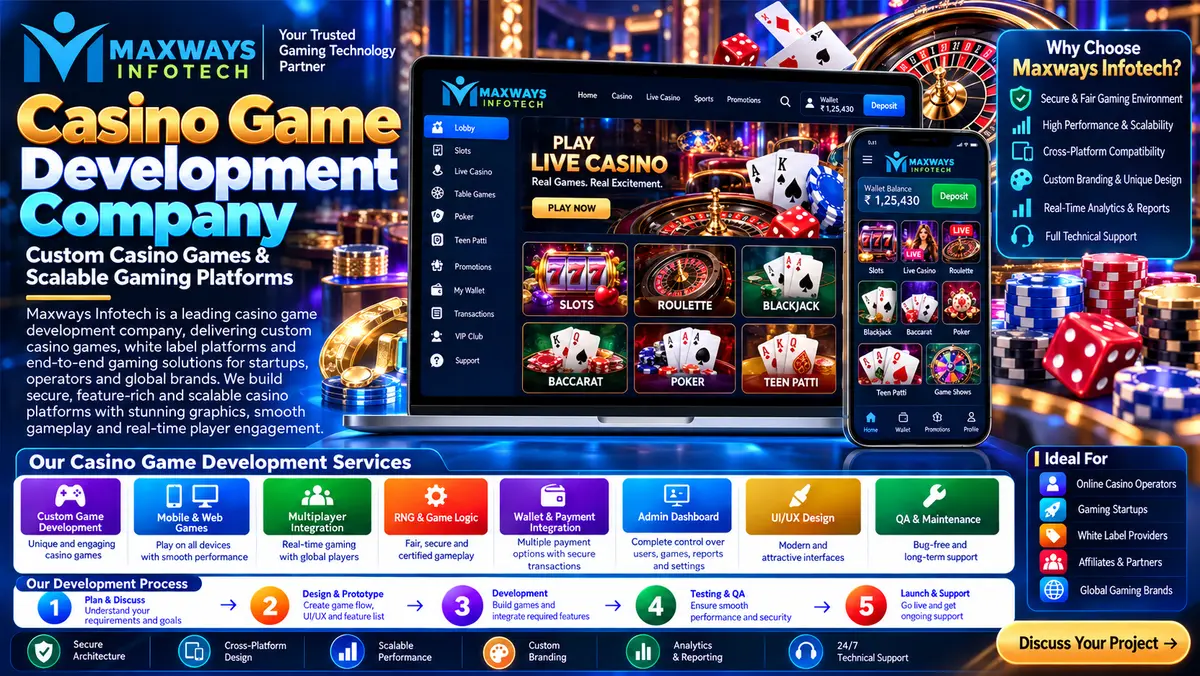
A Casino Game Development Company helps businesses transform a game idea into a functional digital product through game design, software engineering, artwork, mathematical modelling, testing, and deployment. Depending on the project, development may cover slot-style games, digital table games, card games, multiplayer experiences, and other casino-themed entertainment products.
Creating a casino game involves much more than designing reels, cards, buttons, or animations. Developers must define the rules, build the underlying game logic, create a consistent user experience, test every important outcome, and ensure that the software works across supported devices.
For businesses planning a new gaming product, the first step is to decide what kind of game they want to build and how it will be delivered. A clearly defined project makes it easier to estimate development effort, choose suitable technologies, and identify the testing and compliance requirements before launch.
What Does a Casino Game Development Company Do?
A casino game development company builds the software components that make a digital game function. Its responsibilities may begin with concept development and continue through design, programming, quality assurance, integration, and post-launch maintenance.
The exact services depend on the company's capabilities and the project's requirements.
Common development services include:
-
Custom casino game design and programming.
-
Two-dimensional and three-dimensional graphics.
-
Animation and sound integration.
-
Game mechanics and rules implementation.
-
Random number generator integration where required.
-
Backend and multiplayer functionality.
-
Web and mobile game development.
-
API and platform integration.
-
Performance testing and bug fixing.
-
Deployment support and ongoing maintenance.
Some companies focus on individual games, while others also develop the platform components needed to distribute and manage a game library.
Before selecting a development partner, businesses should establish whether they need a standalone game, a collection of games, or a complete platform with additional administrative functions.
Types of Casino Games a Development Company Can Build
Different game formats require different design approaches, technical components, and testing methods. Selecting the format early helps the development team plan the right architecture.
1. Slot Game Development
Slot-style games are built around visual symbols, defined game rules, animations, and outcome presentation. A project may use a classic visual theme or a completely original concept.
The development process can include:
-
Original symbol and background artwork.
-
Reel animations and transition effects.
-
Paytable and rule presentation.
-
Bonus-feature implementation.
-
Sound and visual feedback.
-
Responsive layouts for different screens.
The visual design should make the rules understandable without overwhelming the player with unnecessary effects.
Where outcomes are determined using randomness, the underlying implementation and mathematical model require appropriate validation. Animation should represent the authoritative result rather than determine it independently.
2. Blackjack Game Development
A digital blackjack game requires a clear representation of the rules, cards, player actions, and round progression.
Developers must implement the selected rule set consistently and ensure that the interface reflects the current game state. If the game includes a dealer, multiple players, or an external game service, additional synchronization and session-management requirements may apply.
Testing should cover ordinary rounds, unusual input sequences, interrupted sessions, and every supported action.
3. Roulette Game Development
Roulette software may include a virtual wheel, table layout, game rules, result display, and historical information where supported.
The development team must distinguish between the visual animation and the authoritative outcome logic. A result should be processed according to the defined game rules and displayed consistently throughout the application.
The project scope should identify the roulette variant, interface requirements, supported devices, and any required independent testing.
4. Poker and Card Game Development
Poker and other multiplayer card games may involve additional complexity because multiple users can interact with the same game session.
Depending on the format, developers may need to implement:
-
Table and session management.
-
Turn order and action validation.
-
Card and round state.
-
Player connection handling.
-
Server-authoritative game logic.
-
Match history and relevant records.
Multiplayer functionality requires careful testing because one player's action can affect the state shown to other participants.
5. Custom Casino-Themed Games
Some businesses prefer a game designed around a specific theme, visual identity, or original mechanic rather than a familiar format.
Custom development allows more flexibility in the interface, artwork, sound, progression, and feature set. However, originality also requires more planning because the team cannot rely entirely on an established template.
A useful starting point is a short game design document describing the concept, rules, screens, expected behaviour, and acceptance criteria.
The Game Design Process: Turning an Idea into a Specification
A game idea can sound simple when described in a sentence, but implementing it requires many smaller decisions.
Before development begins, the team should document the following areas.
Define the Core Gameplay
Describe what happens when a player starts a game, which actions are available, how a round progresses, and how the final outcome is presented.
The specification should cover normal gameplay and less common situations, such as interrupted sessions or invalid inputs.
Create a Game Design Document
A game design document provides a shared reference for designers, developers, artists, and testers. It may include the rules, screen layouts, game states, animations, audio requirements, and expected interactions.
Clear documentation reduces misunderstandings and helps stakeholders review progress against the original scope.
Plan the Visual Direction
The visual direction establishes the game's overall identity. This may include a colour palette, typography, symbol style, background design, animation approach, and sound direction.
Original artwork can help differentiate a product, but visual effects should not interfere with readability or make important information difficult to understand.
Build a Prototype
A prototype allows the team to test the main interaction before investing in every feature and asset.
It can help answer practical questions:
-
Is the game flow understandable?
-
Are the controls easy to use?
-
Does the main mechanic behave as intended?
-
Are additional screens or instructions needed?
-
Can the concept be implemented within the proposed budget?
A prototype is especially useful when the game includes unfamiliar mechanics or complex interactions.
Technologies Used in Casino Game Development
There is no single technology stack suitable for every casino game. The right choice depends on the target devices, graphics requirements, team experience, performance expectations, and integration needs.
HTML5 and JavaScript
HTML5-based games can run in supported web browsers and can be suitable for lightweight interactive experiences.
This approach may reduce the need for users to install a separate application, although browser compatibility and performance still require testing.
Unity
Unity can be suitable for projects requiring more advanced visual effects, animation, or three-dimensional environments.
The team should evaluate build size, device performance, platform support, and the maintenance requirements of the chosen implementation.
Unreal Engine
Unreal Engine may be appropriate for projects with demanding 3D visuals or specialised rendering requirements. It may be unnecessary for simpler games, so the additional development and resource costs should be justified by the product's needs.
Backend Technologies
Server-side technologies manage application logic, account sessions, multiplayer communication, and other services when required.
The selected backend should support the expected workload and provide a maintainable way to handle errors, data validation, access control, and integration changes.
Databases and Cloud Services
Databases store the records the application needs, while cloud infrastructure may support deployment, monitoring, backups, and scaling.
The architecture should reflect actual data requirements. Storing unnecessary information increases complexity without automatically improving the product.
Random Number Generators and Game Mathematics
For games that use random outcomes, mathematical design and implementation are central technical considerations.
A random number generator, or RNG, produces values used by the game's outcome logic. The surrounding implementation determines how those values are mapped to symbols, cards, game events, or other results.
An RNG alone does not establish that a complete game is fair or compliant. The game rules, mathematical model, implementation, configuration, and testing process all matter.
Mathematical Modelling
The mathematical model defines how outcomes are generated and how the game behaves over repeated rounds. Depending on the game, this may involve outcome probabilities, symbol distributions, paytables, and other defined parameters.
Developers should document the intended behaviour and validate that the implementation matches the specification.
Independent Testing
Where required, an independent testing laboratory may assess the relevant game components against applicable technical standards.
The scope and type of testing depend on the product and target jurisdiction. A development company should not describe a game as independently certified unless the relevant certification has actually been issued.
Keeping Visuals Separate from Outcome Logic
Animations should present the outcome, not secretly change it after the result has been determined.
Keeping presentation and outcome logic properly separated makes the system easier to test, audit, and maintain.
Why User Interface and Artwork Matter
A game's visual presentation influences how easily users understand the controls, rules, and available information. Strong artwork is valuable, but the interface must remain practical.
Consistent Visual Design
Symbols, buttons, headings, and feedback messages should follow a consistent visual system. This gives the game a recognisable identity and makes the interface easier to learn.
Responsive Layouts
A game may need to support phones, tablets, and desktop browsers. Developers should adapt the interface to different screen sizes rather than simply shrinking the desktop layout.
Animation Performance
Animations should remain smooth on the devices the product intends to support. Large assets, excessive effects, and inefficient rendering can increase loading time or reduce performance.
Accessibility and Readability
Text should be readable, controls should be easy to identify, and important information should not rely exclusively on colour. Audio controls and other accessibility considerations should be included where appropriate to the product.
Integration with Existing Gaming Platforms
A standalone game and a game integrated into an existing platform have different technical requirements.
An integrated game may need to communicate with external systems through documented APIs. These integrations can support functions such as launching a game session, retrieving configuration, exchanging approved game data, or recording relevant events.
Before implementation, the development team should confirm:
-
Which API endpoints and features are available.
-
How authentication and permissions work.
-
What request and response formats are required.
-
How failed and delayed requests should be handled.
-
How duplicate requests are prevented.
-
What test environment and documentation are supplied.
-
Who is responsible for integration support.
Integration testing should cover both successful responses and failure scenarios. An application should not assume that a request succeeded simply because it was sent.
Businesses can also explore Maxways Infotech's fintech services for information about its broader software development offerings. This link is relevant to businesses comparing digital software capabilities; it does not imply that financial software services automatically include casino game development.
Quality Assurance Before Release
Quality assurance helps identify defects before users encounter them. For casino game projects, testing should cover the game's functionality, presentation, technical performance, and applicable requirements.
Functional Testing
Test every defined game state, button, screen, rule, and supported interaction. Check that the actual behaviour matches the approved specification.
Mathematical and Outcome Testing
For games involving randomness, validate the implementation against the defined mathematical model. Where applicable, include independent testing and documentation requirements in the project plan.
Compatibility Testing
Test the game on supported devices, browsers, operating systems, and screen sizes.
Performance Testing
Measure loading times, memory use, rendering performance, and server response times where relevant. Simulate expected workloads in an appropriate test environment.
Security Testing
Review authentication, access controls, input validation, API protections, and sensitive-data handling.
Regression Testing
When a bug is fixed or a feature is changed, retest related functionality to make sure the update has not introduced another problem.
A documented testing process helps the team make release decisions based on evidence rather than a quick demonstration.
How Much Does Casino Game Development Cost?
The cost of developing a casino game depends on the scope and technical complexity. A simple browser-based game and a custom multiplayer product with advanced graphics and integrations can require very different levels of effort.
Important cost factors include:
Game complexity: The number of mechanics, game states, bonus features, and interactions affects development effort.
Artwork and animation: Original illustrations, advanced animation, sound production, and three-dimensional assets can increase the budget.
Technology selection: The chosen game engine and backend architecture influence implementation, testing, and maintenance costs.
Platform support: Supporting several devices and operating systems may require additional development and compatibility testing.
Third-party integrations: External services can introduce setup fees, licensing terms, usage charges, and ongoing maintenance responsibilities.
Testing and certification: Required testing, documentation, and independent assessment should be budgeted separately where applicable.
Post-launch support: Bug fixes, infrastructure monitoring, security updates, and new features create ongoing costs.
A useful proposal should separate one-time development expenses from recurring costs. It should also identify assumptions, exclusions, deliverables, and payment milestones.
How to Choose the Right Casino Game Development Company
Selecting a development partner requires more than comparing portfolios or advertised feature lists. Businesses should evaluate how the company approaches planning, engineering, testing, and long-term maintenance.
Review the Portfolio
Ask to see relevant projects or demonstrations that the company is authorised to share. Look for evidence of technical work that resembles your requirements.
A visually impressive portfolio is useful, but it does not by itself prove that the company can build the required backend, mathematical logic, or integrations.
Check Technical Capability
Discuss the proposed architecture, game engine, backend, testing approach, and third-party dependencies. A capable team should be able to explain why its recommendations fit the project.
Request a Clear Project Scope
The proposal should describe the expected features, design deliverables, source code, documentation, testing, deployment, and maintenance arrangements.
It should also explain how changes to the scope will be estimated and approved.
Clarify Intellectual Property
Confirm who will own the custom source code, artwork, animations, and documentation. Review any third-party assets or libraries that carry separate licence conditions.
Evaluate Communication and Support
A reliable development process includes progress updates, milestone reviews, documented decisions, and a defined method for reporting problems.
Ask who will provide support after delivery and how updates will be managed.
Check Legal and Testing Requirements
The intended game and business model should be assessed against the rules applicable to the target market. Where independent testing, certification, or licensing is required, identify the responsible parties before the project begins.
A software development contract does not itself authorise a business to operate a regulated gaming service.
Legal and Responsible Development Considerations
Casino-style entertainment products can fall under different rules depending on their mechanics, commercial model, and intended market.
Before developing or launching a product involving wagers, deposits, prizes, or monetary rewards, businesses should obtain advice from qualified legal professionals familiar with the relevant jurisdiction and current law.
The project may also need to address age-related restrictions, privacy, data security, advertising requirements, third-party content licences, and applicable testing standards.
Responsible design should include clear rules and accurate information. Where relevant to the product and law, additional safeguards may be required.
The legal position should be checked for the actual product and operating model rather than inferred from the fact that similar games are available elsewhere.
Post-Launch Maintenance and Game Updates
The release of a game is not necessarily the end of the development process. Software dependencies change, operating systems receive updates, and users may discover problems that were not visible during initial testing.
A maintenance plan can include:
-
Bug fixes and compatibility updates.
-
Performance monitoring.
-
Security patches.
-
Integration maintenance.
-
Backup and recovery procedures.
-
Documentation updates.
-
New features and approved content changes.
Updates should be tested before release, especially when they affect game rules, outcome logic, integrations, or stored data.
A clear maintenance agreement helps businesses understand what support is included and what may require a separate budget.
Conclusion
A Casino Game Development Company brings together game design, programming, artwork, mathematical modelling, integration, testing, and deployment to create a complete digital game.
The most suitable development partner is not necessarily the company offering the largest feature list. It is the one that understands the proposed game, explains its technical decisions, defines deliverables clearly, tests the software thoroughly, and identifies the relevant legal requirements.
By planning the game mechanics, visual design, technology stack, testing process, budget, and maintenance responsibilities before development begins, businesses can make more informed decisions and reduce avoidable project risks.
For additional software development insights and technology-related articles, visit the Maxways Infotech blog.