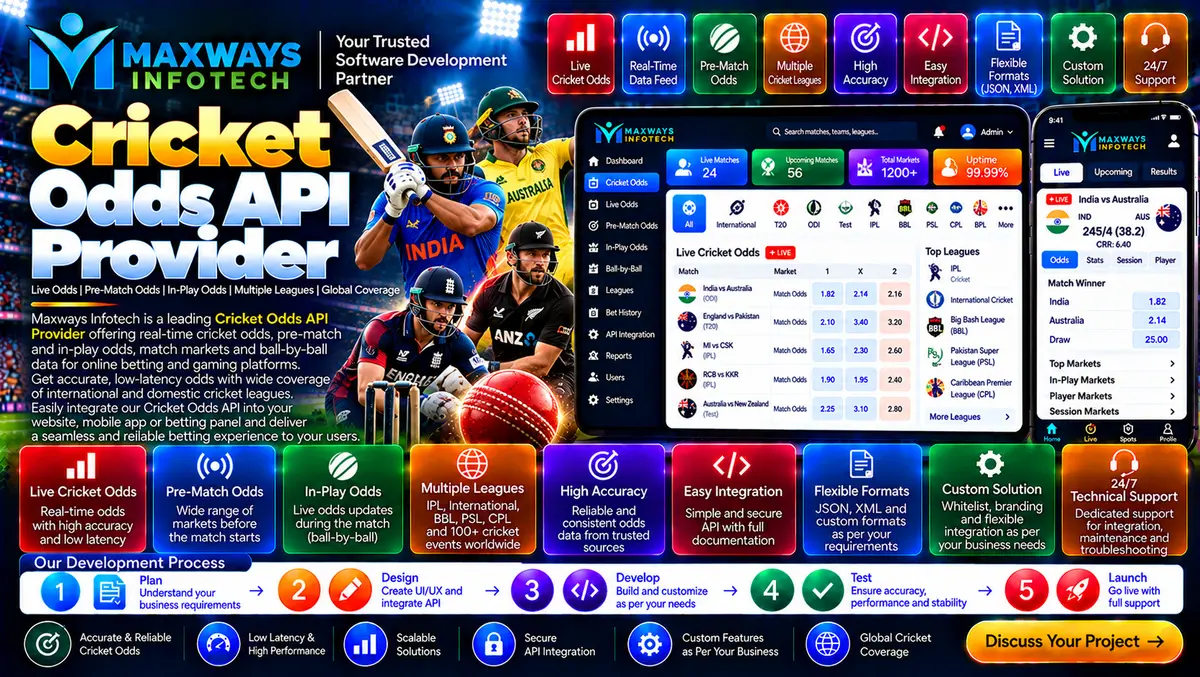
Explore how to choose a Cricket Odds API Provider by assessing odds accuracy, bookmaker coverage, historical data, market comparison, pricing, and licensing.
Cricket Odds API Provider: A Guide to Odds Analysis, Data Quality, and Market Comparison
A Cricket Odds API Provider helps developers access structured cricket odds data for applications such as odds comparison websites, sports analytics dashboards, statistical research tools, and other permitted sports technology products. The quality of this data can influence how accurately an application compares prices, measures market movements, and presents information to users.
However, choosing an API requires more than checking the number of bookmakers or cricket tournaments supported. Developers should also examine how odds are represented, whether different markets can be compared fairly, how historical observations are stored, and whether the provider supplies enough information to explain changes over time.
Businesses exploring technology solutions can begin by visiting Maxway Infotech and reviewing the company's published information. The right API choice will ultimately depend on the application's purpose, data requirements, budget, and permitted use of the information.
What Is a Cricket Odds API Provider?
A Cricket Odds API Provider makes odds information available through a software interface. Depending on its coverage and commercial plan, the service may supply pre-match prices, in-play odds, bookmaker information, market identifiers, event details, and historical snapshots.
An API can help developers avoid manually collecting and formatting information from multiple sources. Instead, the application receives structured responses that can be processed, stored, compared, and displayed through its own software.
For example, a cricket analytics dashboard might use an API to compare the prices reported by different bookmakers for the same match outcome. A research application could store timestamped observations to study how market prices changed before a match began.
The available data differs by provider, tournament, market, and subscription. Developers should verify the exact coverage instead of assuming every cricket API offers identical information.
1. Understand the Difference Between Odds and Probability
Odds and probability are related, but they are not the same thing.
Decimal odds express the total return per unit staked, including the original stake. For a decimal price (O), the corresponding implied probability is:
[
P_{\text{implied}}=\frac{1}{O}
]
For example, decimal odds of 2.50 correspond to an implied probability of 40%.
This calculation is useful for analytical applications, but it does not automatically reveal the true probability of an outcome. Bookmaker margins and other market factors can affect the relationship between displayed odds and an underlying probability estimate.
For a cricket odds analytics tool, developers should distinguish between:
-
The odds received from the provider.
-
The implied probability calculated from those odds.
-
Any adjusted probability produced by an analytical model.
-
The timestamp and source associated with each value.
Keeping these values separate makes reports easier to understand and prevents calculated estimates from being mistaken for directly supplied data.
2. Compare Equivalent Markets Before Comparing Prices
Two odds values should not be compared simply because they appear beside the same match.
The underlying market must represent the same outcome and use compatible rules. A match-winner market, a tournament-winner market, and a session-based market describe different events. Even markets with similar display names can have different conditions.
A reliable comparison workflow should identify:
Event: Which match or tournament does the record belong to?
Market: What specific outcome or proposition is being represented?
Selection: Which team or result does the price refer to?
Source: Which bookmaker or data source supplied the value?
Timestamp: When was the observation recorded?
Status: Is the market available, suspended, closed, or otherwise restricted?
Normalising these fields allows an application to compare equivalent records instead of accidentally mixing unrelated prices. It also creates a clearer foundation for reports and historical analysis.
3. Evaluate Bookmaker and Tournament Coverage
A provider may advertise broad cricket coverage while offering different levels of detail for individual competitions. Some tournaments may include only selected markets, while others may have a different update schedule or historical-data availability.
Before selecting a service, prepare a list of the competitions that matter to the project. This might include international cricket, domestic tournaments, franchise leagues, or women's competitions.
Then check the following details for each required competition:
-
Whether pre-match odds are available.
-
Whether in-play data is included.
-
Which market types are supported.
-
Which bookmaker regions are covered.
-
Whether historical observations can be retrieved.
-
Whether the relevant data is included in the intended plan.
The Odds API's published cricket documentation, for example, describes supported cricket tournaments and match-winner markets, with historical availability varying by competition. This illustrates why developers should inspect endpoint-level coverage rather than relying only on a provider's headline feature list.
A coverage spreadsheet can make the evaluation more practical by recording which requirements are confirmed, which need clarification, and which are unavailable.
4. Use Historical Odds for Better Market Analysis
Historical odds provide a record of prices at earlier points in time. When stored consistently, these observations can help researchers understand market behaviour and investigate how prices changed as a match approached or progressed.
A useful historical dataset should preserve the event identifier, market, selection, source, price, timestamp, and any available status information.
With those fields, analysts can investigate questions such as:
-
How frequently did a price change during a defined period?
-
Did different sources report comparable values at the same time?
-
How much variation existed between recorded prices?
-
How did pre-match observations differ from in-play observations?
-
Were there gaps in the historical record?
Historical data should be interpreted carefully. A missing observation does not necessarily mean the price remained unchanged, and an old price should not be presented as a current market value.
Researchers should also check the provider's data-retention policy, timestamp conventions, and rights for storing or reusing historical records.
5. Measure Data Quality With Practical Metrics
A Cricket Odds API Provider should be evaluated on the usability and consistency of its data, not just the volume of records returned.
Developers can build a quality-monitoring process around several metrics.
These metrics help distinguish a technically reachable endpoint from a dependable data source.
For example, an API may respond successfully but return records with missing timestamps. That can make it difficult to establish whether two prices were observed at comparable times.
Monitoring should therefore cover both service connectivity and the quality of the actual data returned.
6. Design a Clear Odds Analytics Dashboard
A useful dashboard should help users understand the data without presenting unsupported conclusions.
Depending on the project's purpose, it could display:
-
Match and tournament filters.
-
Market and bookmaker selectors.
-
Timestamped odds tables.
-
Historical price charts.
-
Source coverage indicators.
-
Data freshness indicators.
-
Missing-data and API error reports.
A historical chart should label its time range and identify whether the displayed observations are pre-match or in-play. If the latest record is old, the interface should make that clear instead of presenting it as current.
Developers can also include export functions for permitted analytical use. CSV exports, for example, can help research teams review records in spreadsheet software, provided that the provider's licence allows this use.
For applications involving financial data, permissions and auditability also matter. Related software architecture concepts can be explored through Maxway Infotech's fintech information, while the exact controls should be designed around the application's own requirements.
7. Keep the Odds Data Model Consistent
When data arrives from multiple sources, field names and structures may differ. One provider may use a particular identifier for a match, while another uses a different naming convention. Market labels, price formats, and timestamp representations can also vary.
An internal data model can make the application easier to maintain. A basic record might contain:
-
Event ID
-
Competition
-
Market ID
-
Selection ID
-
Provider or bookmaker ID
-
Odds value and format
-
Observation timestamp
-
Market status
-
Source record reference
The application can map each incoming response into this standard structure before it is used by reports or charts.
Validation rules should reject malformed values, preserve meaningful source information, and prevent unrelated records from being merged. If multiple sources are used, the original provider identifiers should remain available for troubleshooting.
This separation between source data and the application's internal model makes it easier to add a new data source or update an existing integration without redesigning every dashboard component.
8. Assess Pricing Based on the Data You Will Actually Use
A low advertised price does not always mean the service is inexpensive for a particular project. The required plan may exclude important tournaments, historical records, additional markets, or the volume of requests the application needs.
A prototype may need only a limited set of matches and markets. A commercial analytics product may require more extensive coverage, reliable historical records, and higher request capacity.
Choose the plan based on verified requirements rather than purchasing the largest package by default.
9. Verify Data Rights and Applicable Regulations
Access to an odds API does not automatically grant permission to redistribute its data or operate a betting service.
Before launching an application, review the provider's licence, restrictions on commercial display, storage and redistribution, and any requirements for attribution. If the product involves betting or real-money activity, obtain qualified legal advice on the laws and licensing obligations that apply in each relevant jurisdiction.
This is particularly important for businesses targeting India, where online money gaming and related activities can be subject to specific legal restrictions. A data subscription should never be treated as proof that a particular business model is lawful.
For projects focused on permitted statistics, research, media, or market analysis, developers should still confirm that the intended data use is expressly allowed.
Frequently Asked Questions
What does a Cricket Odds API Provider offer?
Depending on the service, it can provide structured cricket odds, event and bookmaker information, market details, and historical observations. Coverage and update frequency vary, so developers should check the documentation for their required competitions and markets.
Why is historical odds data useful?
Historical records allow analysts to study price movements, compare sources, identify data gaps, and build research reports. Their usefulness depends on reliable timestamps, consistent identifiers, sufficient historical depth, and permission to store the data.
How can I compare odds from different providers?
First confirm that the records represent the same event, market, selection, and compatible rules. Then account for source identity, observation timestamps, price formats, and market status before calculating differences.
What should I check before choosing an API?
Review tournament and bookmaker coverage, market definitions, data quality, historical access, documentation, usage limits, pricing, security, and commercial licence terms. Test the service using representative data before making a long-term commitment.
Can odds data be used in any commercial application?
Not automatically. The provider's licence and applicable laws determine what uses are permitted. Confirm redistribution rights and obtain legal advice where the application involves regulated activities.
Conclusion
Choosing a Cricket Odds API Provider requires a clear understanding of how odds are represented, how markets are matched, how historical observations are recorded, and how data quality is measured. Strong coverage is useful, but consistent identifiers, reliable timestamps, transparent pricing, and suitable data rights are equally important.
Start by documenting your required competitions and markets. Test the API against real project scenarios, measure the quality of its responses, and compare providers using the same criteria. This process can help you select a data source that supports meaningful analysis without adding unnecessary technical complexity.
For more software development insights and technology guides, visit the Maxway Infotech blog.