Explore Cricket Odds Data API architecture, database schema design, historical data storage, duplicate handling, data lineage, validation, and analytics.
Cricket Odds Data API: Building a Reliable Data Pipeline for Sports Analytics
A Cricket Odds Data API enables developers to collect structured odds information and transform it into useful datasets for sports analytics, market research, comparison dashboards, and historical reporting. The real challenge is not simply retrieving an API response. It is building a data pipeline that can organise records from different sources, preserve their original context, track changes over time, and make the information useful for analysis.
For example, a cricket analytics platform may need to connect match identifiers with market records, store timestamped odds observations, and generate reports without mixing data from unrelated matches. A carefully designed data architecture helps keep these records consistent as the dataset grows.
Businesses exploring software development solutions can visit Maxway Infotech to review the company's published technology information. The appropriate data architecture will depend on the intended application, the provider's API capabilities, and the rights granted for using and storing the data.
What Is a Cricket Odds Data API?
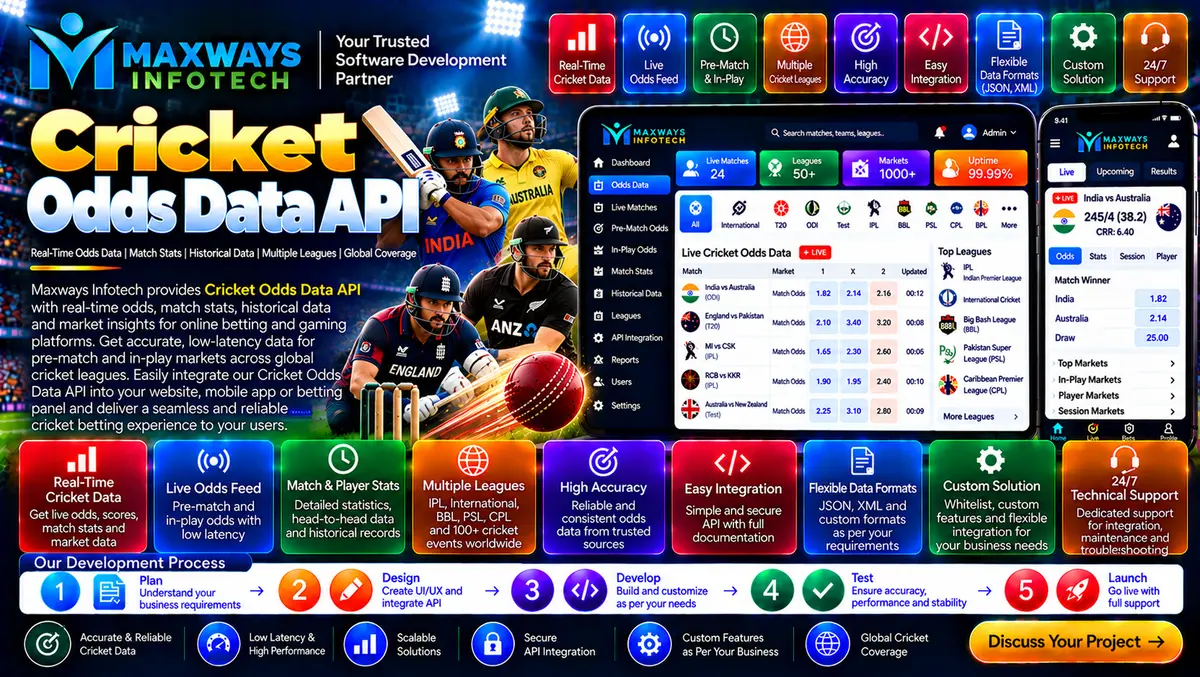
A Cricket Odds Data API provides structured access to odds information for supported cricket events and markets. Depending on the provider, responses may include event identifiers, competition details, bookmaker names, market types, selections, odds values, and timestamps.
Developers can use this information to build applications such as:
-
Cricket odds comparison dashboards.
-
Historical market research tools.
-
Sports data warehouses.
-
Statistical reporting platforms.
-
Data visualisation applications.
-
Research datasets for permitted analytical use.
Not every API supplies all these fields or supports every competition. Before designing the database, developers should review the provider's documentation and identify which data is actually available.
1. Design a Data Pipeline Before Building Reports
A data pipeline defines how information moves from its source into storage and eventually into an application or analytical report.
A typical architecture contains five stages:
-
Extraction: Request data from the API using the documented endpoints and authentication method.
-
Raw storage: Preserve the original response, subject to the provider's licence and retention rules.
-
Transformation: Convert source fields into consistent internal formats.
-
Validation: Check identifiers, timestamps, required fields, and data types.
-
Delivery: Make validated records available to dashboards, reports, and analytical queries.
Keeping these stages separate makes it easier to identify where a problem occurred. If a report shows an unexpected value, the team can investigate whether the issue originated in the source response, a transformation rule, or the reporting query.
A pipeline should also record when each extraction started, whether it succeeded, how many records it processed, and whether any records failed validation.
2. Create a Database Schema That Reflects Cricket Data
A poorly designed database can make even a good data source difficult to analyse. Storing every field in one large table often introduces duplication and makes relationships harder to maintain.
A more structured design can separate the main entities.
These are illustrative table names, not a universal API schema.
For example, one cricket match may have several markets, and each market may have multiple selections. Each selection can have multiple odds observations over time. Separating these relationships helps avoid storing repeated event details in every observation.
Use stable identifiers where the provider supplies them. If the source does not provide a reliable identifier, a carefully documented internal mapping may be necessary.
3. Preserve Raw Data Before Transforming It
Data transformations can introduce mistakes if the original response is discarded too early.
A raw-data layer preserves the information as it was received, along with relevant metadata such as the extraction time, source endpoint, and response version where available. Access to this layer should be controlled, and retention must comply with the provider's contractual terms.
A separate transformation layer can then standardise the fields needed by the application.
For example, one source might represent a timestamp in ISO 8601 format while another uses a Unix timestamp. The transformation process can convert both into a common internal representation while retaining the original value for debugging.
Similarly, team names may differ in spelling or formatting between sources. An explicit mapping table is safer than relying on text matching alone.
The objective is to make data easier to use without losing the ability to trace a transformed record back to its source.
4. Handle Duplicate Records and Incremental Updates
Repeated records are common in data collection systems. A scheduled API request may return information already stored during an earlier run, or a retry may retrieve the same observation again.
Without a duplicate-handling strategy, the database can grow unnecessarily and analytical reports may count the same observation more than once.
Developers should define what makes an observation unique. Depending on the source, this could involve a combination of event ID, market ID, selection ID, source ID, and observation timestamp.
A reliable ingestion process can then:
-
Check whether an equivalent observation already exists.
-
Insert genuinely new observations.
-
Update current-state records when appropriate.
-
Preserve historical observations when the goal is time-series analysis.
-
Record rejected or conflicting records for investigation.
The distinction between current state and historical history is important. A dashboard may need the latest known price, while a research dataset may need every permitted timestamped observation.
Do not overwrite historical records automatically if doing so would destroy information required for analysis.
5. Use Data Lineage to Improve Traceability
Data lineage describes where a record came from and how it was processed.
For a Cricket Odds Data API project, lineage can connect an analytical result to the original source, ingestion run, transformation rules, and resulting database record.
A practical lineage record may include:
-
Source or provider identifier.
-
Event and market identifiers.
-
Retrieval timestamp.
-
Ingestion run ID.
-
Transformation version.
-
Validation result.
-
Error or correction status, when applicable.
Suppose an analytics report shows a sudden change in a historical series. With appropriate lineage, the team can check whether the value came from the provider, a corrected response, a mapping change, or a processing error.
Lineage also helps teams explain the limitations of their reports. It cannot guarantee that the original source is correct, but it makes the processing path easier to audit.
6. Separate Current Data From Historical Data
Current-state applications and historical analytics have different storage needs.
A current-state table may keep only the latest validated observation for a particular selection and source. This is useful when a dashboard needs a compact representation of the most recently retrieved data.
A historical table can preserve multiple observations, allowing researchers to study changes over time. Historical storage requires a clear policy for timestamps, duplicates, corrections, and retention.
For instance, a report may compare two observations from different times. If one timestamp represents the scheduled match time and another represents the actual observation time, the comparison may be misleading.
Use clearly defined timestamp fields, and document whether each value refers to the source's update time, the API retrieval time, or the event's scheduled start.
Historical coverage also depends on what the provider actually supplies. Collecting data from today onward does not automatically create a complete historical archive.
7. Build Analytical Reports From Validated Data
Once the data is structured and validated, developers can build reports for research and operational monitoring.
Useful report types include:
Coverage reports: Show which competitions, events, sources, and markets are represented in the dataset.
Data-quality reports: Measure missing fields, duplicate observations, invalid values, and failed transformations.
Historical observation reports: Summarise the number of recorded observations across defined periods.
Source comparison reports: Compare compatible records from different sources while preserving their timestamps and market definitions.
Pipeline performance reports: Show ingestion success rates, processing duration, and unresolved errors.
Reports should clearly state their time range, data sources, and relevant limitations. A chart based on incomplete observations should not imply that every expected data point was captured.
For projects that include financial or account-related components, the wider software architecture may also need access controls, audit trails, and careful handling of sensitive information. Related technology topics can be explored through Maxway Infotech's fintech information.
8. Monitor Data Quality as the Dataset Grows
A pipeline that works with a small test dataset may behave differently when more matches, sources, and observations are introduced.
Thresholds should reflect the provider's documented update schedule and the application's requirements. A fixed freshness threshold may be inappropriate if some competitions are updated less frequently than others.
Monitoring should also distinguish between an API outage and a period when no new data is expected. That distinction reduces unnecessary alerts and helps engineers focus on genuine problems.
9. Plan for Growth Without Overcomplicating the System
The simplest architecture that satisfies the current requirements is often the best starting point. A small project may work well with a scheduled ingestion job and a relational database. A larger analytical platform may eventually need orchestration, partitioned historical tables, a dedicated warehouse, or separate reporting infrastructure.
Potential scaling considerations include:
-
Indexing frequently queried event and timestamp fields.
-
Partitioning large historical datasets when justified.
-
Scheduling collection jobs according to API limits.
-
Separating ingestion workloads from dashboard queries.
-
Monitoring storage growth and query performance.
-
Documenting recovery and backup procedures.
Avoid introducing complex infrastructure before there is a demonstrated need. Measure the workload, identify the bottleneck, and expand the architecture based on evidence.
10. Review Licensing, Security, and Data Retention
Before collecting or storing odds data, verify that the API licence permits the intended activity. Restrictions may apply to commercial use, historical retention, redistribution, display, and sharing with third parties.
API credentials should be stored securely on the server rather than exposed in public browser code or source repositories. Access to stored datasets should follow the principle of least privilege, and logs should avoid exposing credentials.
If the application is connected to betting or real-money services, seek qualified legal advice about the laws and licensing requirements that apply in each relevant jurisdiction. Businesses targeting India should pay particular attention to the applicable rules concerning online money gaming and related activities.
Access to an API does not itself establish that a particular business model is lawful.
Frequently Asked Questions
What is a Cricket Odds Data API used for?
It supplies structured odds information for supported cricket events and markets. Developers can use permitted data for analytics dashboards, research, comparison tools, and historical reporting.
Why should odds data be stored in separate tables?
Separating events, markets, sources, selections, and observations reduces unnecessary duplication and makes relationships easier to query. The exact schema should match the data supplied by the provider.
What is the difference between raw and transformed data?
Raw data preserves the source response as received, subject to permitted retention. Transformed data has been mapped, validated, or converted into a structure designed for the application.
How can duplicate odds records be avoided?
Define a suitable uniqueness rule using stable identifiers and timestamps, then check incoming records against that rule. Preserve historical observations when they are needed for analysis instead of overwriting them indiscriminately.
Does a Cricket Odds Data API automatically provide historical data?
Not necessarily. Some providers offer historical endpoints or archives, while others provide only current information. Confirm the available historical depth, update intervals, pricing, and permitted retention before planning the analytics system.
Conclusion
A Cricket Odds Data API becomes much more useful when its information is supported by a clear data architecture. Structured database relationships, raw-data preservation, duplicate handling, lineage, historical storage, and quality monitoring help developers create datasets that are easier to analyse and maintain.
Start with the data fields and reports the project genuinely needs. Build a straightforward ingestion pipeline, validate the source responses, and expand the infrastructure only when the workload requires it. Keep security, licensing, and data-retention requirements in the design from the beginning.
For more software development guides and technology insights, visit the Maxway Infotech blog.