Explore Cricket Sportsbook API architecture, cricket data models, transaction integrity, settlement workflows, security, testing, and reliable software integration.
Cricket Sportsbook API: Platform Architecture, Integration and System Reliability
A Cricket Sportsbook API connects the different software components required to manage cricket-related sports data, user accounts, market information, transaction records, and match-result processing. For businesses researching sports technology, understanding how these components communicate is essential before planning a platform or integrating third-party services.
Cricket presents some specific engineering challenges. A match can continue for several hours, conditions can change after every delivery, and different formats follow different rules. The software must also distinguish between an upcoming fixture, an active match, an interrupted game, and a completed event. Without clear data ownership and consistent processing rules, separate modules can display conflicting information.
This guide explains the architecture behind a Cricket Sportsbook API, the responsibilities of its major components, and the technical checks that matter during integration.
What Is a Cricket Sportsbook API?
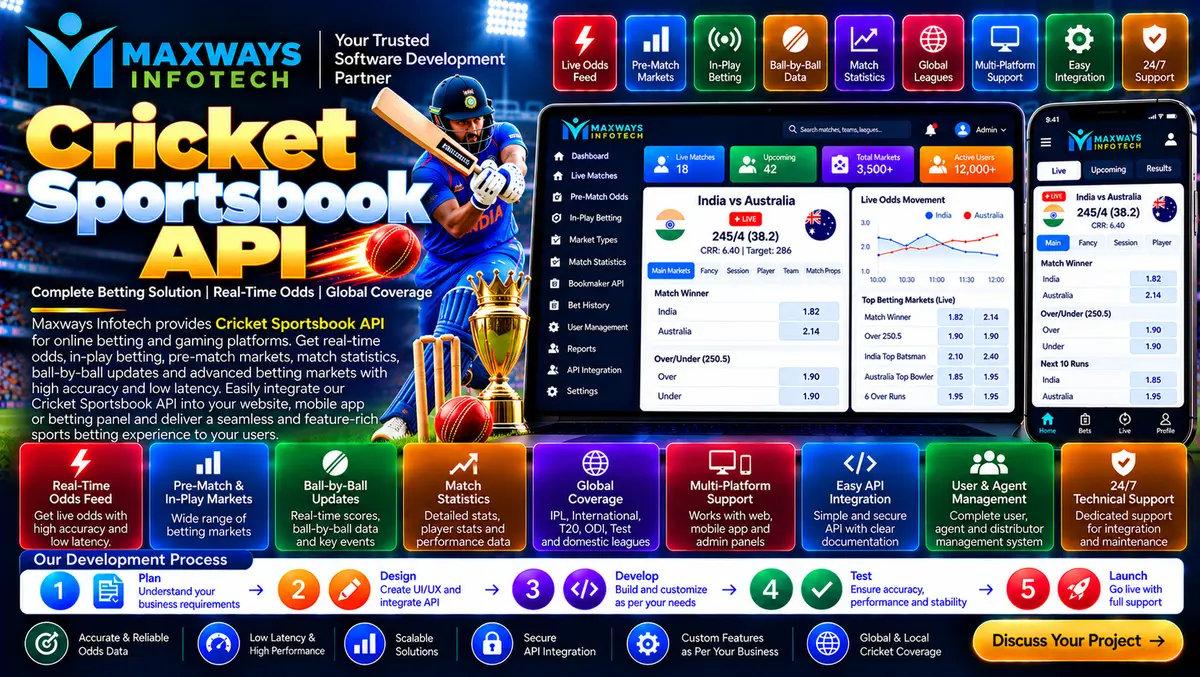
A Cricket Sportsbook API is an interface that allows authorised applications to exchange information with sportsbook-related services. Depending on the provider, its capabilities may include fixtures, cricket market data, event status, account operations, transaction records, and settlement information.
Not every API includes all these functions. Some providers supply sports data only, while others offer broader platform interfaces. Developers should establish which responsibilities belong to the API provider and which must be implemented separately.
A typical integration may involve these components:
-
Sports data service: Supplies match schedules, team information, scores, and supported market data.
-
Platform service: Manages application-level workflows and business rules.
-
Account management: Maintains user records, permissions, and account status.
-
Transaction service: Records authorised financial operations where legally permitted.
-
Settlement service: Processes supported event outcomes according to documented rules.
-
Reporting system: Provides operational records, reconciliation information, and performance metrics.
The purpose of integration is to connect these services through defined interfaces without allowing one component's failure to corrupt the others.
For an overview of the organisation behind this project research, visit the Maxways Infotech homepage.
Why Cricket Requires a Sport-Specific Data Model
A generic sports platform cannot always treat cricket as a simple match with a start time, score, and final result. Cricket includes different match formats, innings, overs, wickets, interruptions, and competition-specific rules.
A useful data model should account for the following distinctions.
Match formats
Test matches, One Day Internationals, and T20 matches have different structures and durations. The platform should identify the format explicitly instead of inferring it from the competition name.
Innings and match state
The system may need to distinguish between an innings in progress, an innings break, a scheduled interval, and a completed match. These states should be represented using documented values rather than inconsistent free-text labels.
Interruptions and revised conditions
Weather interruptions, abandoned matches, shortened games, and revised targets may affect how an event is represented or how certain markets are resolved. The API integration should preserve the official event status and follow the provider's documented result rules.
Competition and participant identity
Team names can appear in different formats across providers. Stable team and event identifiers help prevent duplicate records and incorrect associations when a competition is updated or data is imported from multiple sources.
These details make cricket-specific data modelling an important part of the overall architecture.
How the Main API Modules Work Together
A sportsbook application is usually a collection of connected services rather than one endpoint. Each service needs clear ownership of its data and a documented communication contract.
1. Fixture and event management
The fixture service provides scheduled matches and their identifiers. The application can use these records to organise competitions, display upcoming events, and associate later updates with the correct match.
A stable event identifier is particularly important when a scheduled start time changes or a fixture is moved.
2. Market and data management
A market-data interface may provide supported market descriptions, current values, and status changes. The integration should map the provider's identifiers into the application's internal model.
The application must not assume that every competition has identical market coverage or that all markets remain available throughout a match.
3. User and account management
Where a platform includes user accounts, its account service should control authentication, permissions, account status, and access to relevant features.
Account identity should be consistent across connected services. An identifier from one system should not automatically be treated as a trusted identity in another without appropriate verification.
4. Transaction records
Financial workflows require careful handling of repeated requests, incomplete responses, and network interruptions. An operation may succeed on the server even if the client never receives its response.
Idempotency controls, unique transaction identifiers, and reconciliation procedures help prevent the same operation from being recorded multiple times.
5. Result processing and settlement
A settlement service processes outcomes according to the applicable rules and authoritative result information. It should retain the event version, relevant timestamps, and any subsequent correction needed to explain a change.
For example, a match may initially be marked as interrupted and later receive an official final status. The system should process that transition according to the documented rules instead of assuming that the first status received is permanent.
Designing Reliable Communication Between Services
One of the most important design decisions is how the components exchange information.
Synchronous requests are useful when a service needs an immediate response, such as validating an account request or retrieving a specific event record.
Asynchronous messages are useful when an update needs to reach multiple systems, such as reporting, analytics, and event-status monitoring. A message queue can help separate the producer of an event from the services that consume it.
Webhooks or streaming interfaces, when supported, can notify applications about changes without requiring every component to repeatedly request the same information.
Whichever approach is selected, each message should have enough information for the receiver to identify its source, event, version, and processing status. The system should also define what happens when a message is delayed, duplicated, or received out of order.
Transaction Integrity and Reconciliation
A connected platform can experience temporary differences between services. For instance, a transaction service may confirm an operation while a reporting service is still processing its event.
These differences are not necessarily evidence of a failed transaction, but they must be visible and recoverable.
A reliable design should include:
-
Unique identifiers for transactions and processing events.
-
Idempotency keys for operations that may be retried.
-
Explicit success, pending, failed, and reversed states where applicable.
-
Immutable audit records for important state changes.
-
Scheduled or event-driven reconciliation between connected systems.
-
A documented process for investigating unresolved discrepancies.
The transaction record should be the source of truth for the operation it owns. A dashboard or cache should not independently invent a final status because it has not received the latest update.
These principles also apply to non-betting financial applications, where accurate records and recoverable workflows are equally important.
Security, Access Control and Regulatory Readiness
Security needs to be designed into the API architecture from the beginning. Exposed credentials, excessive permissions, and incomplete audit logs can create risks across multiple connected services.
Important safeguards include:
Server-side credential management: Keep secret API keys out of public frontend code and client application bundles.
Authentication and authorisation: Verify the identity of each service and restrict access to the operations it actually needs.
Input validation: Check incoming identifiers, formats, timestamps, and request parameters before processing them.
Rate limiting: Apply sensible limits to prevent accidental overload and abusive request patterns.
Audit logging: Record relevant access and state changes without placing passwords, secret keys, or unnecessary sensitive data in logs.
Dependency monitoring: Track API version changes, provider outages, and changes to authentication or response formats.
Projects involving financial technology may also require identity verification, payment controls, fraud monitoring, and jurisdiction-specific reporting. Businesses researching related development capabilities can explore the Maxways Infotech fintech page.
A technical integration does not by itself establish legal permission to operate a betting service. Before launching any betting-related functionality, verify the applicable laws, licensing requirements, data rights, and provider terms for the intended jurisdiction.
Testing a Cricket Sportsbook API Before Launch
Testing should cover more than a successful API response. A platform can retrieve data correctly under normal conditions and still fail when several events update simultaneously.
A practical testing plan should include the following scenarios:
Use a test environment and simulated events wherever possible. If a provider supplies a sandbox, confirm whether its data represents live behaviour or simplified test cases.
Common Integration Mistakes to Avoid
Treating every API as a complete sportsbook
A data feed may provide match information without providing account management, transaction processing, or settlement functionality. Confirm the actual scope of the service before estimating development work.
Using team names as permanent identifiers
Names and display formats can change. Stable identifiers and mapping rules are safer for long-term data consistency.
Ignoring corrections to event results
Official results may be corrected or updated. The integration should preserve the history of relevant changes and apply documented processing rules.
Retrying every failed request blindly
A timeout does not always mean the original operation failed. Use idempotency controls and check the operation's recorded state before retrying a potentially consequential request.
Leaving compliance until the final stage
Legal requirements, data permissions, access controls, and audit needs can influence the architecture. These should be considered during planning, not treated as last-minute additions.
Frequently Asked Questions
What does a Cricket Sportsbook API do?
It allows authorised applications to communicate with cricket-related platform services. The precise features depend on the provider and may include event data, supported market information, account operations, and result processing.
Is a Cricket Sportsbook API the same as a Cricket Odds API?
No. A Cricket Odds API generally focuses on odds or market data. A broader sportsbook API may connect additional platform functions, although the exact scope varies by provider.
Can one API manage fixtures, transactions, and settlement?
Some platform providers offer multiple interfaces within one product, but these functions are not guaranteed to be included in every API. Review the documentation and service agreement before making assumptions.
How can developers prevent duplicate transaction records?
They can use unique transaction identifiers, idempotency keys, explicit processing states, and reconciliation checks. The exact implementation depends on the transaction service's supported behaviour.
What should be checked before selecting an API provider?
Review cricket coverage, documentation, supported functions, authentication, rate limits, service availability, recovery procedures, commercial terms, data licensing, and applicable legal requirements.
For more software development articles and technical resources, visit the Maxways Infotech blog.
Conclusion
A Cricket Sportsbook API should be evaluated as part of a larger software architecture, not simply as a connection that returns match information. Cricket-specific event modelling, clear service responsibilities, transaction integrity, secure access, and reliable result processing all contribute to a maintainable integration.
Before choosing a provider, document which services are included, which systems must be developed separately, and how the platform will handle interruptions and corrected data. A well-defined integration plan makes it easier to test the system, investigate discrepancies, and adapt when technical or regulatory requirements change.
For betting-related projects, technical readiness must always be accompanied by appropriate legal review and authorised data access.