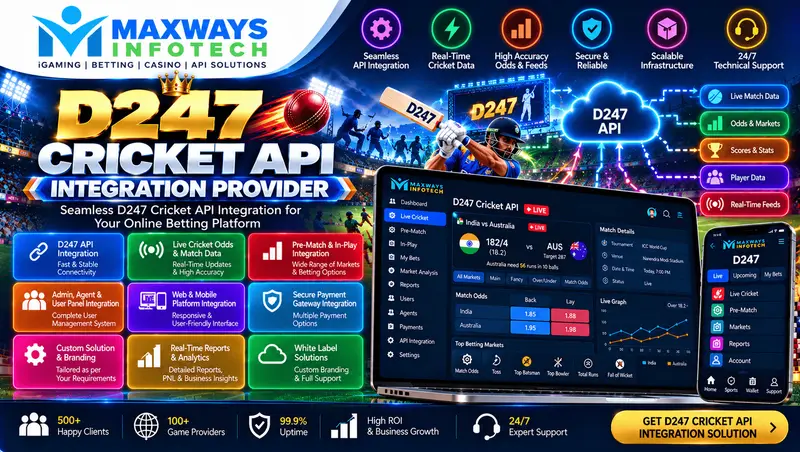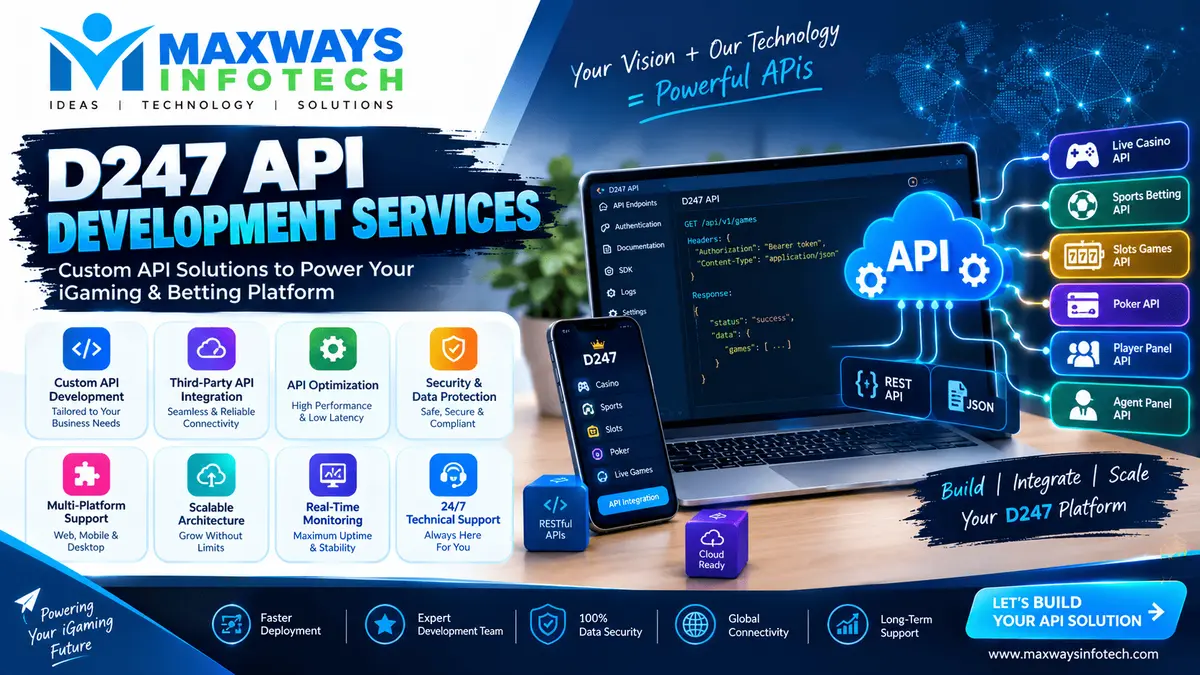
Explore D247 API Development Services for custom API development, secure integration, data connectivity, API testing, and ongoing technical support.
D247 API Development Services: Custom API Design, Integration and Support
D247 API Development Services should evaluate API compatibility, authorized access, custom development requirements, security, testing, and maintenance before starting a project. The right technical approach depends on the available API documentation and the intended application.
MaxWays Infotech provides a starting point for exploring software development and digital platform technology services. Businesses should review the company's published offerings and confirm the scope of any proposed API project before proceeding.
What Are D247 API Development Services?
D247 API development services refer to technical work associated with designing, building, integrating, or maintaining APIs for compatible D247-related software environments. The exact functionality depends on the API owner's documentation, available endpoints, permissions, and the project's requirements.
API development and API integration are related but different activities. API development creates or extends an interface, while API integration connects an existing application to an available interface.
Depending on the authorized project scope, API services may include:
-
Reviewing API documentation and technical requirements.
-
Developing custom endpoints for supported application functions.
-
Connecting compatible software components.
-
Mapping and validating data between systems.
-
Implementing authentication and access controls.
-
Testing API performance, errors, and compatibility.
-
Providing documentation and ongoing technical maintenance.
For broader context, explore this guide to D247 Panel Integration Services | Maxways Infotech
Why Businesses Need Custom API Development
A business may use several applications that were built independently. Without clearly defined interfaces, exchanging information between those applications can require additional custom logic and manual processes.
A well-designed API can help organize these connections and make future maintenance more manageable.
1. Application Connectivity
APIs allow compatible applications to exchange information through defined requests and responses. This can connect websites, mobile applications, backend services, reporting systems, and approved third-party tools.
2. Structured Data Exchange
Different applications may represent the same information in different formats. API development can establish consistent field names, identifiers, validation rules, and response structures.
3. Flexible Software Architecture
A modular architecture separates responsibilities between software components. When an interface is documented and maintained properly, developers can sometimes update one component without rebuilding the entire application.
4. Easier Troubleshooting
Logging, monitoring, documented response codes, and error handling help developers investigate failures and understand where a request stopped.
5. Support for Future Development
As business requirements change, APIs can provide a controlled way to introduce new compatible services or improve existing workflows. Versioning and backward-compatibility planning help reduce disruption.
These benefits depend on the quality of the implementation and the capabilities of the connected systems.
Core D247 API Development Services to Evaluate
Before selecting a provider, identify the technical work your project actually requires.
Custom API Design and Development
Custom API development begins with defining the functions an application needs to expose. This includes endpoint structure, request methods, required parameters, response formats, error codes, and access permissions.
A well-documented interface makes it easier for other authorized developers to understand and use the service.
API Integration and Configuration
Integration connects an existing API to a compatible application. Developers may need to configure authentication, map data fields, process responses, handle timeouts, and manage errors.
The project should specify which systems will be connected and confirm that the required endpoints are available.
Backend API Development
A backend API layer can separate business logic from the user interface. Depending on the application, it may handle validation, database operations, authentication, logging, caching, and communication with third-party services.
The architecture should keep sensitive credentials on the server rather than exposing them in public-facing application code.
Data API Integration
Applications that depend on external data need clear rules for retrieving, validating, storing, and updating records. Teams should confirm data freshness, pagination, permitted usage, retention requirements, and the source of authoritative information.
For additional information, reviewD247 API Integration Provider | Maxways Infotech
API Testing and Quality Assurance
Testing should cover successful requests as well as invalid inputs, expired credentials, unavailable services, duplicate requests, and unexpected responses.
A test environment or sandbox should be used where available. Production deployment should follow an agreed acceptance process.
API Maintenance and Technical Support
APIs may change as systems evolve. Maintenance can involve reviewing version updates, fixing integration defects, updating documentation, monitoring service health, and testing compatibility.
The project agreement should clearly define support responsibilities and response expectations.
How the D247 API Development Process Works
A structured development process helps teams establish realistic timelines, reduce uncertainty, and document project responsibilities.
Step 1: Requirement Analysis
Define the business objective, the applications involved, the information that needs to move between them, and the expected result.
Identify essential functions separately from optional enhancements.
Step 2: API Documentation Review
Review the official specification for supported endpoints, authentication, request parameters, response formats, usage limits, versioning, and error codes.
Confirm that the organization has the necessary authorization to access the required functions.
Step 3: Technical Architecture Planning
Design how applications will communicate and determine which system owns each important data field. Plan authentication, validation, logging, timeouts, recovery, and error handling.
Step 4: API Development or Integration
Build the required interface or connect the existing API using documented methods. Follow agreed coding standards and keep credentials and configuration data appropriately protected.
Step 5: Testing and Validation
Test normal workflows, edge cases, access restrictions, data consistency, timeouts, and failure recovery. Record defects and resolve them before deployment.
Step 6: Deployment
Deploy through a controlled release process. Keep the required configuration, access permissions, monitoring, and rollback procedures ready.
Step 7: Monitoring and Maintenance
Review service health, error rates, response times, and changes to external dependencies. Maintain documentation so future developers can understand and update the integration.
Security Best Practices for API Development
Security should be included in the original technical design rather than added only before launch.
Important practices include:
-
Authentication: Use an appropriate method supported by the API.
-
Authorization: Limit each service to the functions and data it needs.
-
Encrypted communication: Protect data in transit using secure connections.
-
Input validation: Reject malformed or unsupported requests.
-
Secret management: Store API keys and tokens securely on the server.
-
Rate limiting: Control excessive requests and protect service availability.
-
Monitoring: Track relevant errors and security events without exposing sensitive information.
-
Access reviews: Remove unnecessary permissions and review credentials periodically.
-
Data protection: Apply appropriate retention, privacy, and deletion policies.
For integrations involving personal or financial information, teams should also consider applicable legal requirements, auditability, incident response, and data minimization.
Common API Development Challenges
Even a carefully planned API project can face technical issues. Recognizing these risks early helps teams create suitable safeguards.
Authentication Errors
Incorrect credentials, expired tokens, or insufficient permissions can prevent a request from succeeding. Authentication failures should be logged safely and handled without exposing secrets.
Inconsistent Data Formats
Connected applications may use different date formats, identifiers, status values, or field names. A documented mapping layer helps maintain consistent interpretation.
Rate Limits and Timeouts
An API may restrict the number of requests or become temporarily unavailable. Developers should follow documented limits and use sensible timeouts and retry policies.
Duplicate Requests
Repeating a request that changes system state can cause duplicate operations. Where supported, idempotency keys and unique transaction references can help prevent this.
API Version Changes
An updated endpoint or response structure can break existing integrations. Version tracking, regression testing, and planned updates help reduce disruption.
Limited Documentation
Incomplete documentation can make development slower and introduce uncertainty. Confirm the available specifications and test access before committing to a delivery timeline.
API Development for Gaming-Related Platforms
Gaming-related platforms may connect several types of software, including game catalogues, account services, reporting tools, and approved third-party providers. Each integration should have a clearly defined purpose, documented permissions, and suitable testing.
Where an application requires exchange-market data or related interfaces, theD247 API Software Developers | Maxways Infotech provides additional technical context.
These are related technology topics, not confirmation that a particular D247 endpoint, integration, or third-party partnership is available. Always verify the actual capabilities and permitted use of the relevant API.
How to Choose a D247 API Development Services Provider
Selecting a provider should involve a review of its technical approach, project scope, and support arrangements.
Review Relevant Technical Experience
Ask how the provider handles API architecture, authentication, data mapping, testing, error management, and production troubleshooting. Request examples of relevant work where disclosure is permitted.
Request a Clear Project Scope
The proposal should describe the required endpoints, deliverables, exclusions, dependencies, milestones, testing requirements, and maintenance arrangements.
Confirm API Access and Authorization
Verify that the necessary documentation, credentials, and permissions are available. A provider's service description alone does not establish official access or a formal partnership.
Evaluate Security Practices
Discuss how credentials are stored, how permissions are controlled, how logs are protected, and how security issues are reported and addressed.
Clarify Ownership and Support
Determine who owns custom code, documentation, deployment configuration, and related project assets. Agree on how defects, updates, and third-party service changes will be handled.
Plan for Long-Term Compatibility
Choose an approach that accounts for API version changes, external dependencies, testing, and future maintenance. Clear documentation and code ownership make it easier to manage changes over time.
Businesses comparing related website development requirements can also read about custom bookies website development.
Frequently Asked Questions
1. What are D247 API development services?
The phrase describes API-related development or integration work associated with a D247 environment. The precise capabilities depend on the official API documentation, available access, and agreed project scope.
2. What is the difference between API development and API integration?
API development involves creating or extending an interface. API integration connects compatible applications through an existing or newly developed interface. Some projects require both.
3. Can an API be integrated into an existing website?
Yes, if the API supports the required functionality, the website's architecture is compatible, and the necessary access and permissions are available.
4. How long does API development take?
The timeline depends on project complexity, documentation, the number of endpoints, security requirements, existing software, testing needs, and third-party dependencies. A reliable estimate follows a technical assessment.
5. How can API integration security be improved?
Use appropriate authentication, least-privilege permissions, secure credential storage, encrypted connections, input validation, monitoring, and regular security testing.
6. What should be tested before an API goes live?
Test successful requests, invalid inputs, authentication failures, data consistency, timeouts, rate limits, duplicate-request handling, and recovery from service interruptions.
7. Does API development guarantee uninterrupted service?
No. Availability depends on the implementation, hosting infrastructure, network conditions, and external API providers. Monitoring and recovery procedures can reduce the impact of failures but cannot eliminate every outage.
Conclusion
D247 API Development Services can involve API design, custom development, application connectivity, testing, security, and ongoing maintenance, depending on the authorized technical requirements.Live Casino Web Development Services | Maxways Infotech
Businesses should start by confirming API capabilities and permissions, defining the project scope, and selecting an architecture that supports secure data exchange and maintainable software. Clear documentation and realistic testing criteria are essential for a dependable implementation.
Visit MaxWays Infotech to review the company's published services and determine whether they fit your software development requirements.
Compliance note: Any gaming-related software or API should be used only where legally permitted, with required licences and authorizations, appropriate age safeguards, responsible-use measures, and applicable privacy and data-protection controls.