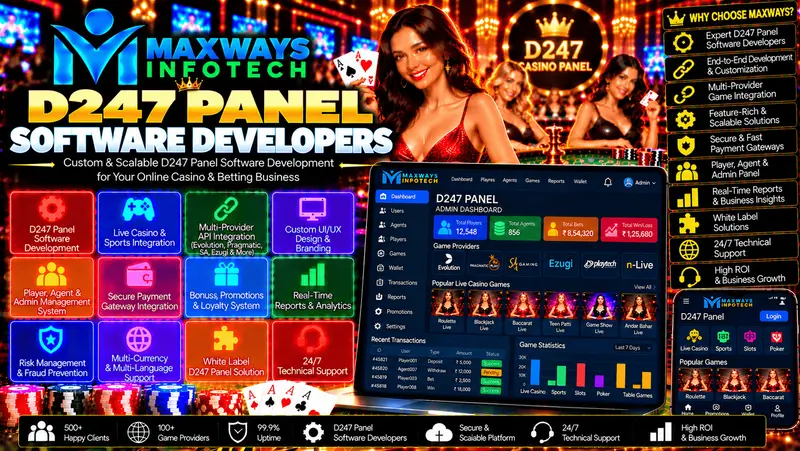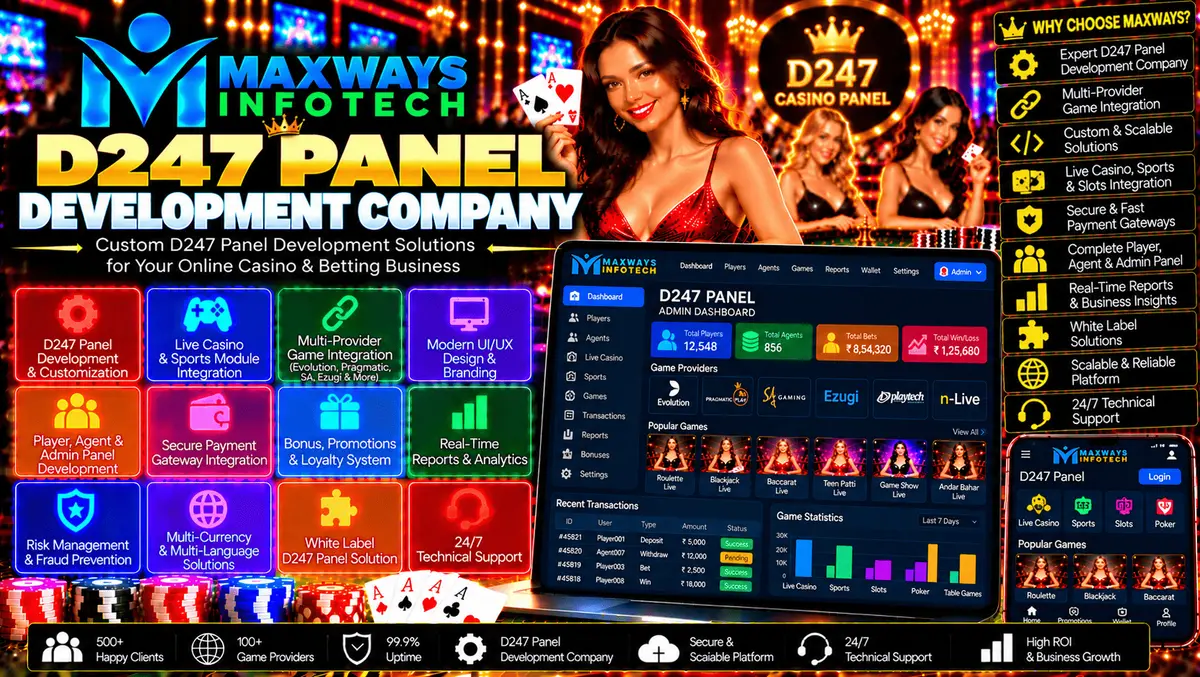
D247 Panel Development Company, custom dashboards, role-based access, API integration, security, software testing, and maintenance.
D247 Panel Development Company: Custom Panel Software and Development Guide
D247 Panel Development Company is a search phrase used by businesses exploring D247-related panel development and software solutions. The exact product requirements and available features should be confirmed with the relevant provider before development begins.
Depending on the project, panel development may involve custom dashboards, user and role management, reporting tools, API integrations, responsive interfaces, security controls, and ongoing maintenance.
At MaxWays Infotech, businesses can explore web development and software-related services. This guide explains the panel development process, important technical features, and the factors to review when selecting a development partner.
What Is D247 Panel Development?
Panel development involves building or customising a web-based administrative interface used to manage supported software functions and operational information.
The term D247 may refer to a specific product or platform in the market. Its exact functionality, ownership, licensing, and technical requirements should be verified rather than assumed from the name alone.
Depending on the agreed scope, a panel development project may include:
-
Custom dashboard design and development.
-
User accounts and role-based permissions.
-
Administrative configuration tools.
-
Reporting and data management.
-
Integration with documented third-party APIs.
-
Security testing and access controls.
-
Deployment, documentation, and technical maintenance.
Not every project requires all these components. A clear requirements document helps determine which features are essential and which can be introduced later.
Businesses exploring related website technology can also review casino-game-development-company-in-rajasthan for additional context about tailored web applications.
Why Choose a Custom Panel Development Company?
1. Functionality Built Around Requirements
A custom panel can be designed around specific administrative workflows instead of forcing every task into a fixed interface.
For example, a project may require particular reporting formats, configurable settings, separate access levels, or connections to existing business systems.
Before development begins, the team should document each required function and define how it will be tested.
2. Custom Dashboard Design
A well-organised dashboard helps authorised users locate information and complete administrative tasks efficiently.
Developers can plan page layouts, navigation menus, tables, forms, filters, and status indicators according to the intended workflow.
The design should prioritise readability and usability instead of displaying every available metric on one screen.
3. Centralised Administration
Depending on the project, a panel may bring supported administrative functions together in one interface.
Centralised administration can make it easier to manage settings, review records, and oversee permitted activities. However, each function should be clearly defined, and sensitive actions should remain restricted to authorised users.
4. Integration With Existing Systems
Some panel projects need to communicate with external software through APIs. Integration can help systems exchange information without requiring every component to be rebuilt.
Developers should assess API documentation, authentication, supported endpoints, data formats, rate limits, and error responses before implementation.
For a broader understanding of software connectivity, read the live-casino-panel-development-company.
5. Maintainable Software Architecture
A panel should be designed so that future developers can understand and update it.
Reusable components, consistent coding standards, version control, and technical documentation help reduce maintenance complexity.
The architecture should match the project's actual requirements rather than introducing unnecessary infrastructure.
Essential Features to Discuss With Developers
Administrative Dashboard
The dashboard is often the main interface for authorised staff. Depending on the project, it may display system status, configuration options, operational summaries, and links to other administrative modules.
Ask the development team to demonstrate how the dashboard will support your required tasks.
User and Role Management
A panel may need separate permissions for administrators, managers, and other authorised staff.
Role-based access control helps ensure that users can access only the functions necessary for their responsibilities.
Important considerations include secure authentication, permission changes, account deactivation, and audit records for sensitive actions.
Reporting and Record Management
Reporting features can help authorised teams review relevant operational information.
Before development, define the reports required, the source of each data field, how frequently information should be updated, and whether exports are needed.
Clear definitions help avoid inconsistencies between reports and source records.
API Integration
API integration should be based on documented and authorised interfaces. Developers should define how data is exchanged, how credentials are protected, and how failures are handled.
A reliable integration should include input validation, suitable timeouts, controlled retries, and logging that avoids exposing sensitive information.
Businesses interested in existing platform models can explore the diamond-exchange-web-development-company.
Responsive Interface
Administrative panels may be accessed from different devices. Responsive design helps the interface adapt to desktop, tablet, and mobile screens.
Tables, forms, navigation, and controls should remain usable at different screen sizes. Testing should cover the devices and browsers supported by the project.
Security and Data Protection
Security should be included from the beginning of the development process.
Depending on the application, safeguards may include HTTPS, secure authentication, role-based permissions, protected API credentials, software updates, backups, and activity logging.
If the panel processes personal or financial information, determine the applicable data-protection requirements and establish appropriate access and retention policies.
Maintenance and Technical Support
After deployment, a panel may need bug fixes, security updates, integration changes, and performance improvements.
The agreement should identify who handles these responsibilities, how support requests are submitted, and whether ongoing maintenance is included in the quoted price.
D247 Panel Development Process
A structured process helps keep development aligned with the intended requirements.
Step 1: Requirement Analysis
Document the purpose of the panel, required modules, user roles, integrations, reporting needs, and technical constraints.
Separate essential features from optional enhancements to keep the initial scope manageable.
Step 2: Product and Technical Verification
If the project depends on an existing D247-related product, verify its identity, documentation, licensing terms, and supported functionality.
Confirm that the intended customisations and integrations are permitted.
Step 3: Wireframes and Interface Design
Prepare the dashboard structure, navigation, forms, tables, and representative screen layouts.
Review the designs before implementation so that major usability issues can be addressed early.
Step 4: Development and Integration
Develop the agreed modules and connect authorised external services where required.
Use appropriate version control, secure configuration, code review, and documentation practices.
Step 5: Testing and Quality Assurance
Test the panel against the documented acceptance criteria.
Testing should cover permissions, data validation, responsive behaviour, integration failures, security controls, and browser compatibility.
Step 6: Deployment and Handover
Deploy the approved application using a controlled process. Provide the agreed documentation, configuration information, and access credentials through secure channels.
Monitoring and backup procedures should be established before production use.
Step 7: Ongoing Maintenance
After launch, review performance, resolve defects, update dependencies, and maintain compatibility with connected systems.
The support agreement should specify responsibilities, response expectations, and any charges for additional features.
Custom Panel Development vs Existing Software
Businesses should compare custom development with an existing panel solution before committing to a particular approach.
Custom panel development may offer more control over workflows, interface design, and technical architecture. It can also require more planning, development resources, and ongoing maintenance.
Existing panel software may provide a quicker starting point when its built-in features meet the project's needs. However, customisation options and ownership rights may be limited by the provider's agreement.
A hybrid approach combines an existing software foundation with selected custom modules.
The best option depends on the requirements, available budget, integration needs, ownership terms, and expected maintenance costs.
How to Select a D247 Panel Development Company
Verify the Product and Provider
Ask for the exact product name, relevant documentation, and a demonstration of the proposed solution.
Confirm which features are included and which require additional development or third-party services.
Review Relevant Experience
Examine examples of administrative dashboards, web applications, and integration projects.
Ask how the development team handles testing, security, documentation, and ongoing support.
Request a Detailed Proposal
A written proposal should identify the included modules, exclusions, deliverables, milestones, assumptions, and acceptance criteria.
This makes it easier to compare quotations accurately.
Check Ownership and Access
Confirm who owns custom code, interface designs, configuration files, documentation, and project data.
Also establish whether the business can export its data and move the application to another provider if required.
Compare Total Costs
Evaluate setup costs, development fees, hosting, software licences, API charges, support, and maintenance.
A lower initial quotation may not be the most economical option if essential functions or updates are charged separately.
For related development information, explore website development services in India.
SEO Best Practices for a Panel Development Website
Search engine optimisation should be planned alongside the website structure and content.
Use the Primary Keyword Naturally
The focus keyword, D247 Panel Development Company, can appear in the page title, main heading, introduction, and relevant sections.
Supporting phrases should be used only when they accurately describe the services offered. Avoid excessive repetition and pages that differ only slightly from one another.
Create Unique Metadata
Write a distinct title and meta description for each important service page. They should describe the actual offering rather than make unsupported claims about features or licensing.
Build Relevant Internal Links
Internal links help readers find related content and understand the relationships between pages.
Use descriptive anchor text and verify each destination before publishing.
Maintain Technical SEO
Review mobile usability, page speed, HTTPS, crawlable navigation, canonical URLs, and XML sitemap accuracy.
Optimise images and use meaningful alt text for informative visuals. Each important page should provide useful, original content.
Legal and Regulatory Considerations
Before developing or deploying a betting-related panel, confirm the applicable laws, licensing requirements, supplier permissions, privacy obligations, and responsible-use requirements for the intended markets.
Software access does not automatically authorise a business to operate gambling services. The contract should clarify the responsibilities of the software provider, operator, and other service partners.
Obtain qualified legal advice where necessary and ensure that the proposed use is permitted before launch.
Frequently Asked Questions
What does a D247 panel development company do?
It is a search term for companies offering development or customisation of D247-related panel software. The exact product, capabilities, and provider should be verified before entering into an agreement.
Can a panel be customised?
Customisation may include dashboard layouts, navigation, reporting, permissions, and compatible integrations, depending on the software and agreed scope.
Does panel development include API integration?
It can, but API integration is not automatically included in every project. Confirm the supported interfaces, permissions, documentation, and additional costs.
How long does panel development take?
The timeline depends on the number of modules, design complexity, integrations, testing requirements, and whether an existing software foundation is available.
What should be included in a development contract?
The contract should describe the scope, deliverables, payment terms, ownership, data access, support, maintenance, acceptance criteria, and applicable compliance responsibilities.
How can I estimate the cost?
Request an itemised proposal covering design, development, integrations, hosting, licensing, and maintenance. The price depends on the project's actual requirements.
Conclusion
Choosing a D247 Panel Development Company requires careful evaluation of the product, technical capabilities, customisation options, security, integration requirements, and long-term support.
Start by documenting the required features, verifying the software being offered, and comparing development proposals against clear acceptance criteria. This helps businesses make more informed decisions and understand the responsibilities involved before deployment.
Compliance note: Betting and gambling-related services must only be offered where legally permitted, with applicable licences, age safeguards, privacy protections, and responsible-use measures in place.D247 Panel Software Provider | Maxways Infotech