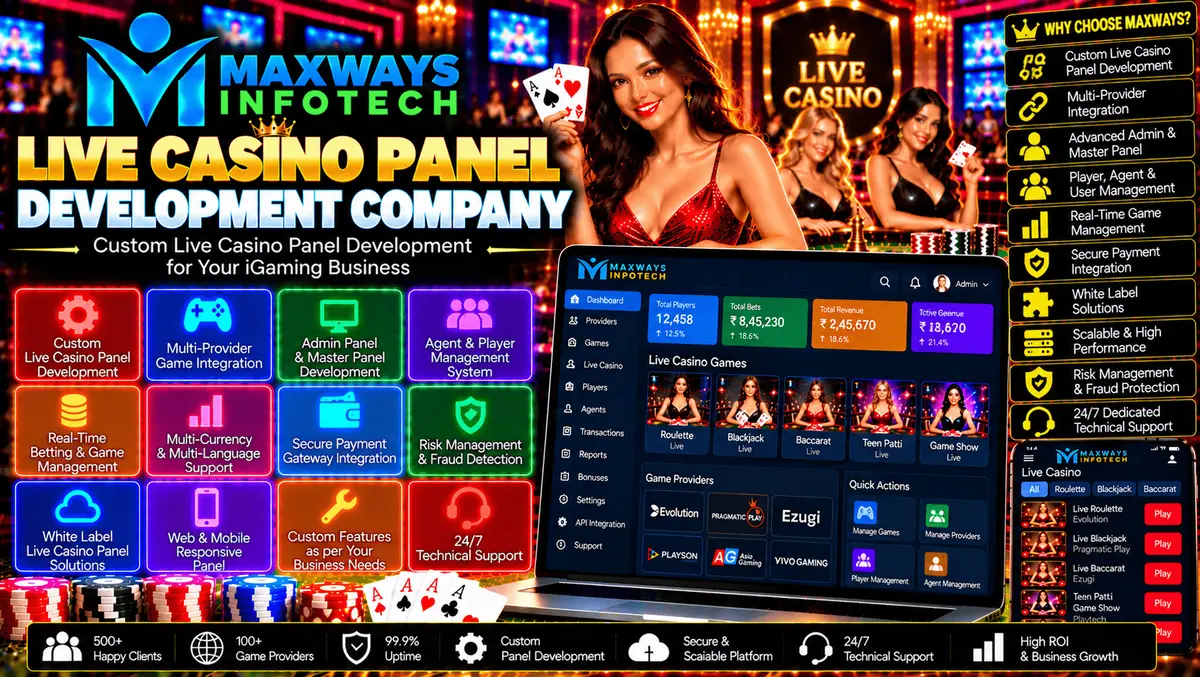
Live Casino Panel Development Company, admin dashboards, API integration, platform security, reporting, and custom software development considerations.
Live Casino Panel Development Company: Features, Architecture, and Custom Solutions
Introduction
A live casino platform requires more than a website interface. It may include administrative dashboards, user management, game integrations, reporting tools, security controls, and backend services that work together to support daily operations. A Live Casino Panel Development Company helps businesses plan and build these software components around their project requirements.
A well-designed panel can make platform administration more organised by bringing relevant settings, reports, system statuses, and authorised management functions into a structured interface. The exact features depend on the intended platform, its technical architecture, the providers involved, and the applicable legal requirements.
Businesses exploring software and digital development services can visit Maxways Infotech to learn more about its development capabilities.
What Is Live Casino Panel Development?
Live casino panel development involves designing and building administrative software used to manage supported functions of a live casino platform. The panel may connect with backend services, databases, authorised game providers, and reporting systems.
Rather than managing every task through separate tools, an integrated panel can provide authorised staff with a consistent interface for their responsibilities.
Depending on the project scope, a panel may include:
-
Secure administrator login and role-based permissions.
-
User and account status management.
-
Game catalogue and content configuration.
-
Integration status and system health information.
-
Reporting dashboards and audit logs.
-
Platform settings and configuration controls.
-
Support workflows and incident tracking.
-
Data export and maintenance tools.
These features should be defined during the requirements stage. A panel should expose only the functions that each authorised user needs.
Why Choose a Custom Live Casino Panel Development Company?
1. Software Designed Around Business Requirements
Every platform has different operational workflows. A custom development approach allows the panel layout, navigation, permissions, and reporting views to reflect those requirements.
For example, a support team may need an incident dashboard, while a technical administrator may need integration logs and service status information. Giving each role an appropriate view can reduce unnecessary complexity.
2. Centralised Administration
A well-planned panel can bring approved management functions into one interface. This can help authorised staff locate relevant information and follow consistent procedures.
Centralisation should not mean giving every administrator unrestricted access. Sensitive functions should remain protected by clear permissions and approval workflows.
3. Integration With Existing Platform Services
A panel often relies on APIs to retrieve information or submit authorised configuration changes. Clear API contracts help the panel communicate with backend services without duplicating important business logic.
For a related technical overview, explore the cricket-exchange-panel-developers, which discusses connected services, API architecture, and integration planning.
4. Easier Maintenance and Future Expansion
Modular software architecture can make it easier to maintain individual components and add features when requirements change. Documented interfaces and controlled releases help reduce the risk of changes affecting unrelated services.
Custom development still requires ongoing testing, security updates, and technical support. These responsibilities should be included in the project plan.
Essential Features of a Live Casino Administration Panel
Secure Login and Role-Based Access
The panel should provide secure authentication and assign permissions according to job responsibilities. Roles may differ for technical administrators, support staff, reporting users, and other authorised personnel.
Important controls include:
-
Strong authentication appropriate to the system's risk.
-
Least-privilege permissions.
-
Session expiration and secure logout.
-
Logging of important administrative actions.
-
Restricted access to sensitive configuration settings.
-
A documented process for revoking access.
The panel should also validate permissions on the server. Hiding a button in the interface is not sufficient protection for a sensitive operation.
Dashboard and System Overview
A dashboard can summarise important operational information without requiring staff to open multiple screens. Depending on the project, it may show service availability, integration health, recent errors, maintenance notifications, and reporting summaries.
Dashboard metrics should be clearly defined so users understand what each value represents and how frequently it is updated.
Game Catalogue Management
Where supported by the platform and provider agreements, administrators may need to review game listings, categories, availability, and associated metadata.
The panel should display accurate status information and distinguish between settings managed internally and those controlled by an external provider.
Changes to catalogue information should be validated and recorded so that administrators can investigate unexpected changes later.
API and Integration Monitoring
A live casino platform may communicate with external services for approved game access, session management, reporting, and other technical functions.
An integration dashboard can help technical staff review connection status, error counts, response times, and recent incidents. For relevant integration concepts, see the lotus-panel-provider.
API credentials should never be exposed unnecessarily in the panel. Sensitive values should be protected, and access to integration settings should be restricted to authorised personnel.
Reporting and Audit Logs
Reporting tools can help teams review operational trends and investigate problems. Useful reports depend on the project's requirements and may include system errors, integration status, administrative changes, and service performance.
Audit logs should record significant actions with suitable timestamps and references. They should also be protected from unauthorised modification and avoid collecting unnecessary personal or confidential information.
Support and Incident Management
A panel can provide a structured place to record technical incidents, assign responsibilities, track status, and document resolution steps.
For larger platforms, this can help teams distinguish application problems from external service failures and maintain a clear history of troubleshooting activity.
Technical Architecture Behind a Custom Live Casino Panel
A maintainable panel should be designed as part of the overall platform architecture rather than treated as an isolated website.
Frontend Interface
The frontend presents the dashboard, forms, tables, filters, notifications, and administrative controls. It should be responsive, accessible, and clear enough for staff to complete tasks without unnecessary navigation.
Form validation and helpful error messages can reduce input mistakes, but important validation must also take place on the backend.
Backend Services
Backend services enforce business rules, validate requests, check permissions, and communicate with databases or external APIs. Keeping sensitive operations on the server helps protect credentials and maintain consistent access controls.
The architecture should document which service owns each important data field and which component is authorised to change it.
Database and Data Management
The database may store configuration, administrative records, reporting data, and other information required by the panel.
Data models should be designed around actual requirements, with suitable access controls, backup procedures, retention rules, and recovery testing. Critical records should have clearly defined ownership to avoid conflicting updates.
API Integration Layer
An integration layer can separate provider-specific communication from the panel interface. This makes it easier to validate external responses, handle errors, and update an integration without rebuilding the entire user interface.
For data-focused connectivity, the lotus-cricket-betting-panel-developer offers further reading on data integration and reliability considerations.
Hosting, Monitoring, and Deployment
The hosting environment should match the project's expected workload and operational needs. Monitoring can help identify unavailable services, high error rates, slow requests, and infrastructure problems.
Production changes should follow a controlled release process, with appropriate testing, documented approvals, and rollback procedures.
The Live Casino Panel Development Process
A structured development process helps stakeholders agree on what will be delivered and how success will be measured.
Step 1: Requirements analysis
Document the intended users, workflows, required features, integrations, access levels, and reporting needs.
Step 2: UI/UX design
Create wireframes and interface designs for the dashboard, navigation, forms, tables, and status views. Review the designs with the people who will use the panel.
Step 3: Architecture planning
Define frontend and backend responsibilities, database structures, API contracts, security controls, and deployment requirements.
Step 4: Development
Implement the agreed features in manageable stages. Use version control, code reviews where appropriate, and documented configuration practices.
Step 5: Integration and testing
Test API communication, permission enforcement, data validation, error handling, and compatibility with supported services.
Step 6: Security and quality assurance
Verify that users cannot access unauthorised functions, sensitive information is appropriately protected, and expected workflows behave correctly under failure conditions.
Step 7: Deployment and handover
Deploy through a controlled process, configure monitoring, document the system, and provide an agreed handover to the responsible team.
Step 8: Ongoing maintenance
Plan for defect fixes, security updates, dependency changes, monitoring reviews, and future enhancements.
Security and Compliance Considerations
Security needs to be built into the panel from the beginning. An administration interface can control sensitive settings, so mistakes in permissions or authentication may create significant risks.
Important considerations include:
-
Protect administrator accounts with appropriate authentication.
-
Apply least-privilege permissions and review them regularly.
-
Validate requests and permissions on the backend.
-
Encrypt data in transit and protect stored credentials.
-
Keep software dependencies updated.
-
Maintain appropriate audit logs and backups.
-
Test recovery and incident response procedures.
-
Protect personal information through suitable access and retention controls.
Live casino services may also be subject to licensing, age restrictions, privacy rules, and other jurisdiction-specific requirements. The intended operating markets and responsibilities should be reviewed before development or deployment.
How Much Does Live Casino Panel Development Cost?
The cost depends on the scope and complexity of the project. A panel with a small number of administrative screens has different requirements from a custom platform with multiple integrations, reporting functions, granular permissions, and extensive testing.
Common cost factors include:
-
Requirements analysis and interface design.
-
Frontend and backend development.
-
Database and API integration work.
-
Authentication and security controls.
-
Reporting and audit functionality.
-
Hosting and deployment.
-
Testing, documentation, and handover.
-
Ongoing maintenance and support.
Request an itemised proposal that identifies the included features, exclusions, milestones, and assumptions. Agree on acceptance criteria so that delivery can be assessed against specific requirements rather than vague expectations.
How to Select the Right Development Company
When comparing development partners, consider their technical process and ability to maintain the finished product.
Review relevant experience. Ask how the team approaches custom dashboards, backend development, API integration, access control, and production troubleshooting.
Check the project scope. The proposal should list features, integrations, deliverables, milestones, and responsibilities.
Evaluate security practices. Ask how credentials are protected, permissions are tested, and administrative actions are audited.
Confirm documentation and ownership. Clarify ownership or licensing of custom code, designs, and project assets, as well as access to repositories and deployment documentation.
Discuss post-launch support. Establish who handles defects, updates, integration changes, monitoring, and future development.
Frequently Asked Questions
What does a live casino panel development company do?
It designs and builds administrative software for supported platform functions. This may include dashboards, role-based access, integration monitoring, reporting, configuration tools, and maintenance workflows.
Can a custom panel connect with existing software?
Yes, if the existing systems provide suitable interfaces and the integration is authorised. The development team should verify documentation, authentication requirements, data formats, and compatibility before implementation.
Is a custom administration panel secure?
Security depends on the design and ongoing maintenance. Strong authentication, server-side permission checks, protected credentials, audit logs, testing, and regular updates are important safeguards.
How long does development take?
The timeline depends on the number of features, integration complexity, design requirements, testing scope, and availability of technical documentation. A reliable estimate follows a requirements and architecture review.
Can the panel be updated after launch?
Yes. A maintainable implementation can support bug fixes, security updates, improvements, and additional approved features through a controlled development process.
What should a business prepare before starting?
Prepare a feature list, user roles, workflow requirements, required integrations, security expectations, budget range, maintenance needs, and information about applicable licences and operating markets.
Conclusion
A reliable Live Casino Panel Development Company should focus on more than the appearance of an administration dashboard. The panel needs a clear architecture, secure permissions, well-defined integrations, useful reporting, and a maintenance plan that supports the software over time.
By documenting requirements, testing critical workflows, and choosing a development partner with a transparent process, businesses can make better decisions about the design and implementation of their platform.
Compliance note: Live casino software should be developed, deployed, and operated only where legally permitted, with appropriate licences, age safeguards, privacy protections, responsible-use measures, and compliance with applicable regulations.all panel web developers| Maxways Infotech