Learn how to choose a Diamond Exchange Provider by comparing platform features, integrations, security, pricing, support, and contract terms.
Diamond Exchange Provider: How to Choose the Right Platform Partner
Introduction
Choosing a Diamond Exchange Provider is an important decision for businesses planning an exchange-based digital platform. The provider you select can influence how the platform is configured, how its administrative functions operate, how external services are connected, and how technical issues are handled after launch.
A suitable provider should offer more than a ready-made interface. Businesses need to understand the available software, supported integrations, account controls, reporting capabilities, security arrangements, commercial terms, and ongoing support.
Before making a decision, define the platform's requirements and compare providers against the same criteria. This approach helps you distinguish between a solution that looks attractive during a demonstration and one that fits your actual operational needs.
To explore software solutions and technology services, visit the Maxway Infotech website.
What Is a Diamond Exchange Provider?
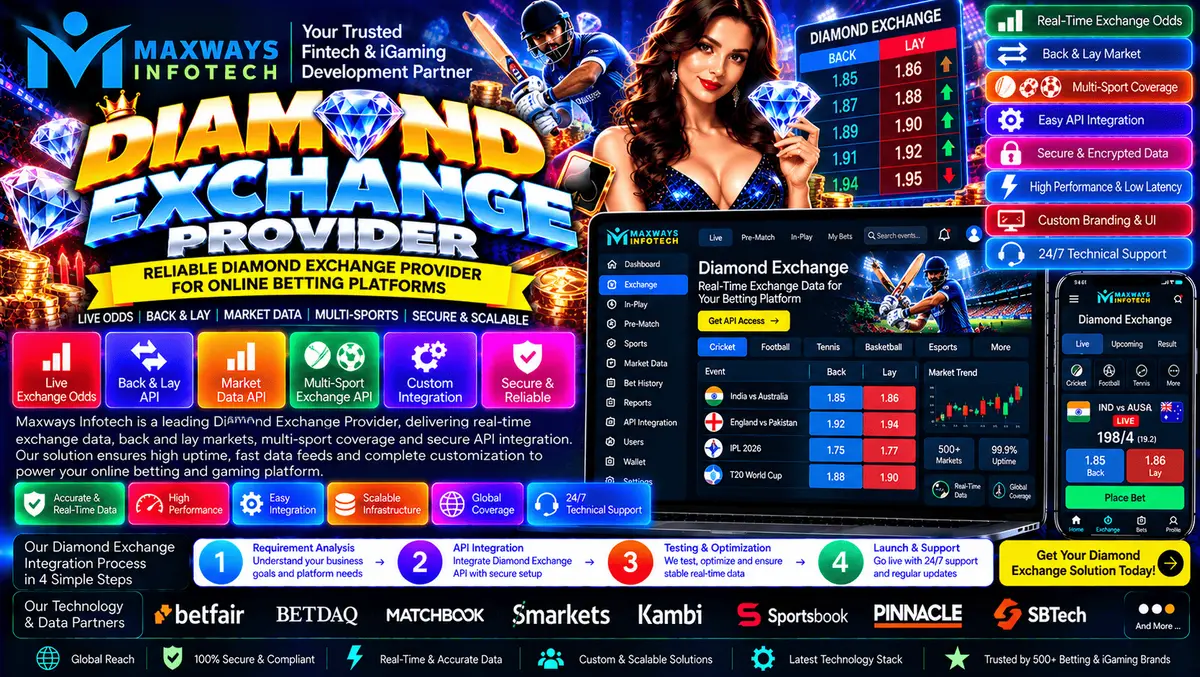
A Diamond Exchange Provider supplies or develops technology used to operate an exchange-style digital platform. Depending on its service model, the provider may offer a complete software package, a configurable exchange panel, custom development, third-party integrations, or technical maintenance.
In the sports exchange context, a platform may include market displays, event information, user accounts, administrative controls, reporting, and workflows for handling supported exchange activities.
However, providers do not all offer the same features. Some supply only software, while others may include hosting, setup assistance, integrations, and continuing technical support.
Before entering an agreement, request a clear description of what the provider supplies, what your business must manage, and which services involve additional charges.
What Makes a Good Diamond Exchange Provider?
A provider should be evaluated on its ability to meet your requirements over the full life of the project, not simply on how quickly it can demonstrate a working interface.
1. A Clear and Configurable Platform
A well-planned platform should support the functions required by the intended business model. This might include event displays, market configuration, user management, reporting, and administrative workflows.
Ask which functions are available in the standard package and which require custom development. Also establish whether configuration changes can be made by authorized administrators or require the provider's engineering team.
The objective is to avoid paying for unnecessary complexity while ensuring that essential functions are not missing.
2. Practical Administrative Controls
The administration panel is where authorized personnel manage the platform's permitted operational settings. Its design can affect everyday efficiency and the ability to investigate problems.
When evaluating a demonstration, look for:
-
Clear user and staff permission management.
-
Organized event and market configuration.
-
Accessible operational reports.
-
Records of important administrative changes.
-
Useful system-status information.
-
Search and filtering tools for reviewing records.
Administrative controls should be understandable and appropriately restricted. Sensitive operations should not be available to every staff member by default.
3. Reliable Integration Options
An exchange platform may need to connect with external data feeds, reporting tools, identity services, payment services, or other approved systems.
A provider should explain the integrations it supports and the conditions attached to them. Ask whether technical documentation is available, how integration failures are handled, and who maintains the connection when an external service changes.
Avoid assuming that an integration is included simply because the provider mentions it during a sales discussion. Get confirmation in writing.
4. Reporting and Operational Visibility
Reports help administrators understand activity, investigate discrepancies, and review how the platform is performing.
Depending on the product, reports may cover account activity, market status, transaction records, service errors, and historical operational data.
Check whether reports can be filtered by date, exported for further analysis, and accessed only by authorized roles. If the business requires customized reports, clarify whether these are included in the original scope.
How to Compare Diamond Exchange Providers
A structured comparison makes it easier to evaluate different proposals without getting distracted by marketing language.
Ask each shortlisted provider to respond to the same questions. This produces a more meaningful comparison than evaluating one supplier through a detailed demonstration and another through a short sales proposal.
Diamond Exchange Provider vs. Custom Software Development
A ready-made platform and a custom-built solution serve different purposes.
Ready-made platform: An existing product can reduce the amount of software that must be created from scratch. It may suit businesses whose requirements closely match the provider's standard functionality.
Custom development: A tailored solution gives the project team greater control over the design, workflows, and architecture. It can be useful when the requirements cannot be met by an existing package, although development and maintenance responsibilities may be greater.
Hybrid approach: An existing platform can sometimes be extended with selected custom features or integrations. The feasibility depends on the provider's architecture, available interfaces, licensing terms, and willingness to support modifications.
The right choice depends on the required level of control, implementation scope, available budget, technical capabilities, and long-term plans.
Understanding Pricing and Commercial Agreements
The cheapest initial quotation is not always the least expensive option over time. A provider's commercial proposal should distinguish between one-time costs, recurring charges, and usage-dependent expenses.
Setup and Configuration Charges
Initial fees may cover environment setup, interface configuration, installation, onboarding, or other agreed work. Confirm exactly what will be delivered before the setup phase is considered complete.
Recurring Software and Hosting Fees
Some providers charge a monthly or annual platform fee. Hosting, monitoring, maintenance, and support may be included or priced separately.
Ask whether the recurring fee can change during the contract and whether usage limits apply.
Customization and Integration Costs
Additional development may be required for bespoke reports, external systems, interface changes, or specialized workflows. The proposal should explain how extra work is estimated and approved.
Support and Maintenance
Confirm which updates and bug fixes are covered by the agreement. Ask how urgent incidents are prioritized, whether support is available outside standard business hours, and whether major upgrades incur additional fees.
Contract Renewal and Exit
Review the minimum term, renewal conditions, cancellation notice, data-export arrangements, and any migration assistance. These details matter if the platform's requirements change or the business decides to move to another provider.
Security and Platform Governance
Security is a core part of provider evaluation. A platform may process sensitive account information and operational records, so its access controls and maintenance procedures should be clearly documented.
Ask the provider how it handles authentication, role-based permissions, secure credential storage, audit logging, backups, vulnerability fixes, and incident reporting.
The agreement should identify who is responsible for maintaining the software, securing the hosting environment, investigating incidents, and communicating service interruptions.
If the platform includes financial or wagering-related functionality, additional safeguards may apply. Confirm the applicable licensing, user-eligibility, transaction-monitoring, privacy, and responsible-use requirements before the platform is operated.
A software provider's technical capabilities do not automatically authorize a business to offer regulated services. Legal obligations depend on the business model and the jurisdictions involved.
Questions to Ask Before Signing an Agreement
Before selecting a Diamond Exchange Provider, ask these practical questions:
-
Can you demonstrate the actual platform and its administrative functions?
-
Which features are included in the quoted package?
-
Which integrations are currently supported?
-
What are the hosting, monitoring, and recovery arrangements?
-
How are access permissions and administrative actions controlled?
-
What technical documentation will be supplied?
-
Who owns custom code, branding assets, and project documentation?
-
How are bugs, service interruptions, and urgent support requests handled?
-
What recurring charges or third-party costs should be expected?
-
What happens to business data and access when the contract ends?
Request written answers and compare them with the final proposal. This reduces the risk of relying on assumptions that are not reflected in the signed agreement.
Common Mistakes When Choosing a Provider
Selecting a Provider Based Only on a Demonstration
A polished interface does not prove that the platform has suitable reporting, access controls, documentation, or recovery procedures. Review the underlying workflows as well as the visual presentation.
Ignoring Technical Dependencies
A platform may depend on external services that have their own costs, restrictions, and availability limitations. Ask for a list of dependencies before approving the architecture.
Overlooking Ownership Terms
Clarify access to source code, design assets, domains, configuration files, and business records. Do not assume that paying for development transfers ownership of every component.
Failing to Test the Complete Workflow
Test normal operations and failure scenarios before launch. This includes invalid inputs, unavailable integrations, interrupted connections, permission restrictions, and reporting discrepancies.
Leaving Support Responsibilities Undefined
A vague promise of ongoing support is difficult to evaluate. Agree on support hours, response expectations, escalation procedures, and maintenance responsibilities.
How to Prepare Your Business Before Contacting a Provider
You can make the evaluation process more efficient by preparing a short project brief before requesting quotations.
Include the platform's purpose, target markets, required modules, user roles, integrations, reporting needs, security expectations, and preferred hosting arrangement.
Separate the requirements into three groups:
-
Essential for launch: Features required for the initial release.
-
Future improvements: Features that can be considered after the core platform has been tested.
-
External dependencies: Services, permissions, or approvals that must be arranged separately.
This gives providers a common basis for preparing proposals and helps your team identify where additional clarification is needed.
Frequently Asked Questions
What does a Diamond Exchange Provider offer?
Depending on the service model, a provider may supply exchange software, administrative panels, supported integrations, hosting, setup assistance, reporting, or maintenance. Confirm the exact scope with each provider.
How can I compare two providers fairly?
Compare their confirmed features, documentation, security arrangements, support terms, total costs, ownership conditions, and exit provisions against the same requirements checklist.
Is a ready-made exchange platform better than custom development?
Neither option is automatically better. A ready-made product may reduce initial development work, while custom software can provide greater control. The appropriate choice depends on the requirements and the total cost of ownership.
What should be included in a provider's quotation?
The quotation should describe the deliverables, implementation scope, integrations, setup charges, recurring fees, testing, documentation, support, and any exclusions.
Why are ownership and data-export terms important?
They determine how much control your business has over its assets and records, especially if you change providers or discontinue the service.
What should be checked before launching the platform?
Verify functionality, access permissions, reporting accuracy, security controls, integration behaviour, backup recovery, support arrangements, and the legal requirements applicable to the intended operation.
For additional technology guides and industry articles, visit the Maxway Infotech blog.
Conclusion
Choosing the right Diamond Exchange Provider requires a balanced assessment of platform capabilities, technical support, commercial transparency, security, ownership, and long-term maintainability.
Rather than relying on a low price or an attractive demonstration, define your requirements, request written proposals, test the important workflows, and clarify the responsibilities of each party before signing an agreement.
A careful selection process helps you understand what you are purchasing and whether the provider can support the platform's requirements beyond the initial setup.