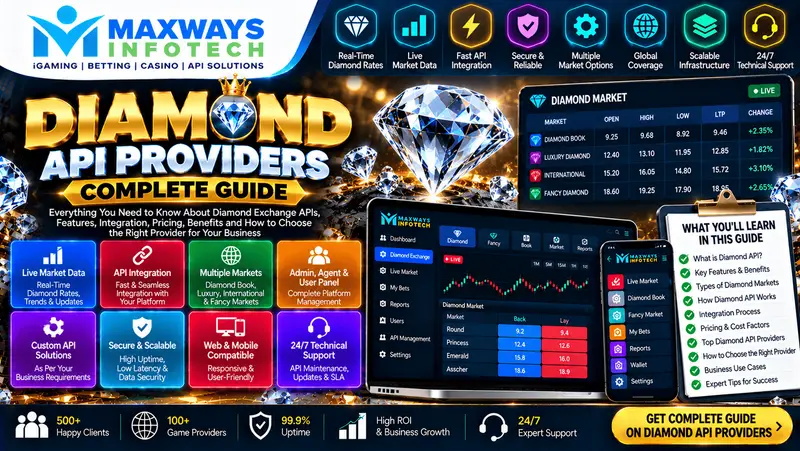
Compare Diamond Exchanges API providers by features, data updates, security, integration, support and pricing to select a suitable solution.
Diamond Exchanges API Providers: How to Compare Features, Integration and Reliability
diamond exchanges api providers is an important decision for businesses planning to develop or integrate an exchange-based sports platform. A suitable API can connect an application with supported market data, event information and other platform services, depending on the provider's capabilities and commercial agreement.
However, providers can differ considerably in their documentation, market coverage, update methods, authentication systems, integration requirements and support arrangements. Comparing these factors before development begins can help businesses make more informed technology decisions.
MaxWays Infotech provides software development and API integration services. Businesses exploring exchange-platform technology can use this guide to understand what to evaluate when comparing providers, planning an integration and preparing for long-term maintenance.
What Are Diamond Exchanges API Providers?
Diamond Exchanges API providers offer interfaces that allow compatible applications to communicate with supported exchange-platform services. The exact functionality depends on the specific provider, API package and permitted use.
Depending on the documented service, an integration may provide access to:
-
Supported sports events and market information
-
Market prices and status updates
-
Data feeds and event identifiers
-
Order-related operations, where available
-
Account connectivity and transaction references, where supported
-
Reporting and administrative information
Not every provider offers all these functions. Businesses should request current documentation and confirm which features are included before choosing a service.
For an overview of exchange API architecture and integration concepts, explore MaxWays Infotech's Diamond Exchange API guide.
Why Choosing the Right API Provider Matters
An API is not simply a connection between two applications. Its capabilities and limitations influence how a platform handles data, manages errors and supports future development.
1. Reliable Data Delivery
Applications that display frequently changing market information need a dependable method of receiving updates. Before selecting a provider, investigate update frequency, data timestamps, supported delivery methods and the process for recovering after an interruption.
A good integration should identify stale or delayed information rather than continue presenting it as current.
2. Compatible Technical Architecture
The API should work with the application's backend, database and frontend architecture. Check its authentication requirements, supported protocols, response formats and available development resources.
If the application already exists, assess compatibility before committing to a provider. A technically incompatible API can increase development time and maintenance costs.
3. Clear Documentation
Documentation helps developers understand endpoints, request parameters, authentication, error codes, rate limits and version changes.
A provider that supplies usable documentation and suitable test access can make integration easier to plan and validate.
4. Scalability and Performance
An application may experience increased traffic during major sporting events. Evaluate request limits, connection limits, response times and the provider's approach to service interruptions.
Performance should be measured through testing rather than assumed from promotional statements.
5. Long-Term Support
APIs can change over time. Providers may update endpoints, authentication requirements, data fields or commercial terms.
Before signing an agreement, clarify how updates are announced, how technical issues are escalated and what maintenance support is available.
Essential Features to Compare Between Diamond Exchange API Providers
The following comparison framework helps businesses assess providers against their actual project requirements.
| Evaluation area | What to verify |
|---|---|
| Market coverage | Supported sports, events and market types |
| Data updates | Delivery method, timestamps and update frequency |
| Market status | How open, suspended and closed states are represented |
| Authentication | Credential management and access restrictions |
| API limits | Request quotas, concurrency and connection rules |
| Error handling | Error codes, timeouts and recovery guidance |
| Testing access | Sandbox, sample responses and test credentials |
| Documentation | Endpoint specifications and versioning policy |
| Technical support | Support hours and escalation procedures |
| Commercial terms | Setup fees, subscriptions, limits and renewal conditions |
Use the same questions for every shortlisted provider. This makes it easier to compare the available services without relying solely on feature lists or marketing claims.
How to Evaluate a Diamond Exchange API Provider
Step 1: Define Your Project Requirements
Start by describing the application you intend to build or improve. Identify which data, market information and platform operations it requires.
Separate essential functions from optional features. This prevents the project from paying for unnecessary functionality or selecting a plan that lacks a critical endpoint.
Step 2: Request Official API Documentation
Ask each shortlisted provider for current technical documentation. Review the available endpoints, authentication methods, response structures, rate limits and error-handling requirements.
Confirm that the documentation covers your intended use case rather than assuming every advertised feature is accessible through the API.
Step 3: Verify Data Coverage and Update Methods
Confirm the events, markets and data fields that are available under the proposed package.
Ask how frequently information is updated, whether streaming connections or polling are supported, and how the application can detect stale data or recover after a disconnection.
Step 4: Review Security Requirements
Determine how the provider protects API access and what security responsibilities belong to your development team.
Recommended measures include secure credential storage, encrypted communication, least-privilege access, request validation and monitoring. Private API keys should not be exposed in public frontend code.
Step 5: Test Before Production
If an approved test environment is available, use it to validate normal requests and failure scenarios.
Test invalid credentials, rate-limit responses, network interruptions, delayed updates and changes in market status. Where order or financial operations are supported, verify duplicate prevention and reconciliation according to the provider's documented workflow.
Step 6: Compare Total Cost
Compare the complete cost of using each provider rather than looking only at the starting subscription fee.
Consider setup charges, recurring access fees, usage limits, development effort, hosting, testing, maintenance and support. Clarify which expenses are included and which are billed separately.
Step 7: Confirm Licensing and Permitted Use
Check the provider's agreement for commercial usage rights, data redistribution, geographic restrictions and any other relevant conditions.
The technical availability of an API does not automatically mean that every intended business use is authorised. Obtain qualified legal advice where required and verify applicable licensing obligations before launch.
API Integration: From Planning to Deployment
Once a suitable provider has been selected, use a structured implementation process.
Backend Integration
Build a backend service that communicates with the provider, handles authentication, validates responses and transforms external data into the format required by your application.
Separating the integration layer from the user interface makes it easier to maintain or replace the provider later.
Data Mapping and Validation
Map external event identifiers, market identifiers, timestamps and status values to your application's internal data model.
Use stable identifiers where available. Validate incoming responses and establish clear handling rules for missing fields, duplicate updates and inconsistent records.
Error Handling and Recovery
Networks can fail, requests can time out and external services can become temporarily unavailable. Define how the application detects these situations and recovers safely.
Use retry policies appropriate to the endpoint. For operations that modify records, follow the provider's documented duplicate-prevention rules rather than blindly resending requests.
Monitoring and Maintenance
Monitor response latency, error rates, connection health and data freshness after deployment. Establish a process for reviewing API updates and addressing compatibility problems.
Regular maintenance helps developers identify issues before they affect a larger part of the application.
Businesses planning a broader sports-data integration can also explore MaxWays Infotech's Sports Betting API services.
Common Mistakes When Selecting an API Provider
Choosing Only by Price
A low subscription fee may not include the data coverage, request limits or support your application needs. Compare total cost and confirmed functionality instead.
Assuming Every API Offers the Same Features
Providers differ in their supported events, data fields, update methods and order-related functionality. Verify every essential requirement in the documentation.
Ignoring Data Freshness
A successful API response does not necessarily mean the data is current. Use timestamps, freshness checks and clear interface states to identify delayed information.
Skipping Failure Testing
Testing only successful requests leaves the application unprepared for timeouts, disconnections, invalid responses and rate limits.
Overlooking Maintenance
API integrations require ongoing monitoring and occasional updates. Define maintenance responsibilities and support arrangements before production launch.
Failing to Review Commercial Terms
Confirm setup fees, renewal conditions, permitted data usage, rate limits and termination terms before committing to a provider.
Diamond Exchange API Provider vs. Custom Platform Development
An API provider supplies access to specified services, while a custom platform development project builds application functionality around those services.
Depending on the scope, a custom development project may include:
-
A responsive user interface
-
Backend services and database design
-
API authentication and data processing
-
Administrative tools and reporting
-
Error handling and monitoring
-
Testing, deployment and maintenance
The API itself may not include all these components. Businesses should establish which parts are supplied by the provider and which need to be developed separately.
If you are evaluating the software architecture of an exchange-based website, read the Diamond Exchange Website Source Code guide for related development considerations.
How MaxWays Infotech Can Fit Into Your Integration Planning
Businesses evaluating exchange-platform software may need assistance with backend development, third-party API connectivity, data mapping, testing and maintenance.
MaxWays Infotech offers software development services that can be assessed against a project's requirements. Before beginning an integration, define the scope, required provider access, expected deliverables and ongoing support needs.
Depending on the agreed project scope, planning may cover:
-
Requirements analysis and technical architecture
-
API documentation review
-
Backend and application integration
-
Data validation and error handling
-
Security and quality testing
-
Deployment and maintenance planning
Specific API access, features, third-party permissions and delivery timelines must be confirmed for each project. Visit the MaxWays Infotech homepage to explore the company's software development offerings.
Frequently Asked Questions
1. What should I look for in Diamond Exchanges API Providers?
Compare supported market data, update frequency, documentation, authentication, request limits, testing access, technical support, pricing and permitted commercial use.
2. Do all Diamond Exchange APIs provide live market updates?
No. Available update methods depend on the provider and package. Confirm whether the API supports streaming, polling or other update mechanisms and check the expected data freshness.
3. Can a Diamond Exchange API be integrated into an existing website?
Potentially, yes. Compatibility depends on the website's architecture, the API's technical requirements and the provider's access terms. A developer should review these factors before implementation.
4. How much does a Diamond Exchange API cost?
Costs vary by provider, feature set, usage limits, licensing, support and subscription model. Development, hosting, testing and maintenance may also be separate expenses. Request a detailed quotation for your requirements.
5. How can I test an API provider before choosing one?
Request official documentation and, where available, approved test credentials or a sandbox. Validate required endpoints, authentication, response quality, error handling and performance.
6. What security measures are important for API integration?
Use secure credential storage, encrypted connections, restricted access, response validation, monitoring and appropriate logging. Follow the provider's authentication and security guidance.
7. What is the difference between an API and exchange website source code?
An API provides access to defined services or data. Website source code is part of the application implementation. A complete platform may require both an API and separately developed website or backend components.
8. Is an API provider's service automatically legal to use for every business model?
No. The permitted use depends on applicable laws, licences, provider agreements and the intended functionality. Verify legal requirements and data rights before operating the application.
Conclusion
Selecting the right Diamond Exchanges API Provider requires a structured evaluation of technical compatibility, market coverage, data freshness, security, support and commercial terms.
Businesses should review official documentation, test the required functionality and understand the provider's limitations before beginning production development. A well-designed integration, supported by monitoring and maintenance, can make an application easier to operate and adapt as requirements change.
Start with a clear project specification, compare providers against the same criteria and confirm that the proposed use is permitted before deployment.
Compliance note: Any exchange or betting-related functionality should be developed and operated only where legally permitted, with the appropriate licences, data rights and safeguards.