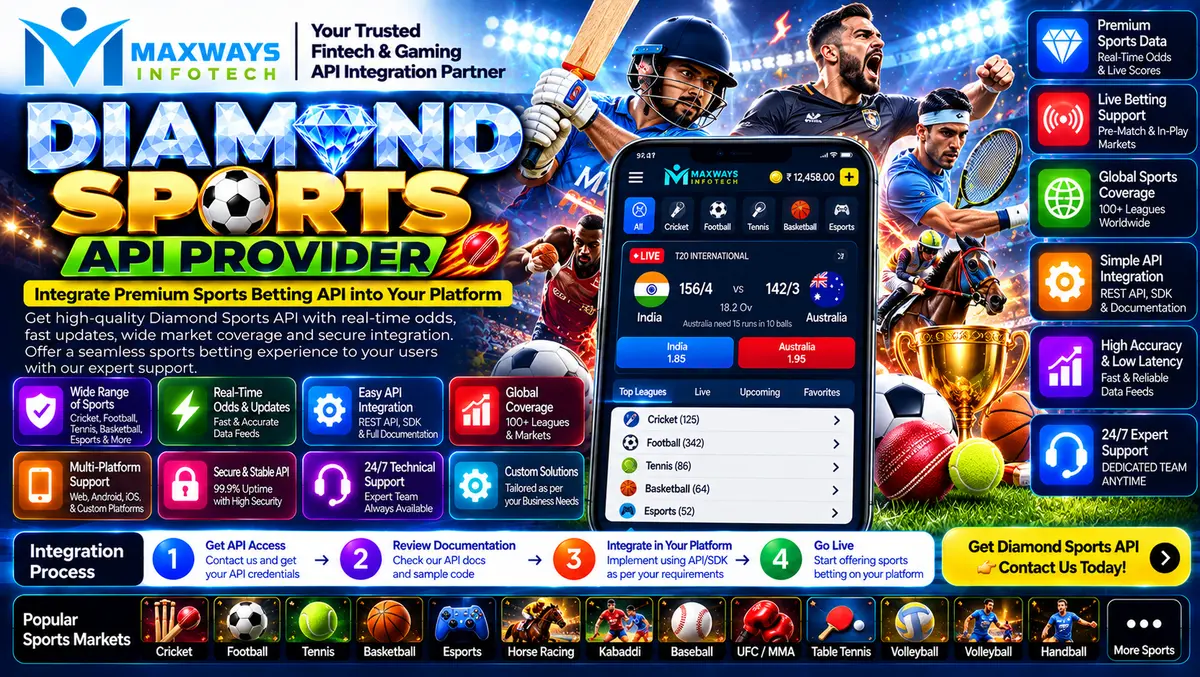
Explore Diamond Sports API Provider features, live scores, fixtures, player statistics, data quality, API integration, security, and provider selection.
Diamond Sports API Provider: Sports Data Integration for Digital Platforms
Sports technology platforms depend on accurate, well-organised information to keep fixtures, scores, team details, and match statistics consistent across different screens. A Diamond Sports API Provider is a search term used by businesses exploring sports-data services and integration solutions for websites, mobile applications, analytics tools, and other sports-related platforms.
Before selecting a provider, businesses should verify the exact product, available sports, data rights, supported endpoints, and service terms. The word “Diamond” may refer to a specific branded product, so its capabilities should be confirmed through the provider’s official documentation rather than assumed from the name alone.
This guide explains how to evaluate a sports API from a data-engineering perspective, with particular attention to data quality, event identification, update handling, and long-term integration maintenance.
What Is a Diamond Sports API Provider?
A sports API allows an application to request structured information from an external data service. Depending on the provider, available information may include fixture schedules, team and player profiles, match scores, event timelines, competition details, and historical statistics.
The precise coverage varies between products. Some APIs focus on one sport or competition, while others offer data across several sports. Access to live information, advanced statistics, or historical archives may also depend on the provider’s plan and licensing arrangements.
A useful first step is to request a sample response and compare it with the information your application needs to display. This reveals whether the data structure is suitable before developers commit to a larger integration.
Sports Data Features Worth Evaluating
1. Fixture and Competition Information
Fixture data establishes the foundation of a sports application. It helps the system organise events by sport, competition, season, participating teams, and scheduled start time.
A good data model should distinguish between an event’s unique identifier and its display name. Two competitions can feature teams with similar names, and the same teams may meet several times during a season.
When evaluating a provider, check whether its feed supplies stable event identifiers, competition identifiers, time-zone information, and event-status fields. These details make it easier to connect fixture records with later score and statistics updates.
2. Live Scores and Match Events
Live score data can change throughout a match. Depending on the sport and the provider, updates may include goals, wickets, points, cards, substitutions, penalties, or changes in match status.
The application must handle these updates without displaying contradictory information. For example, a delayed message should not automatically overwrite a newer score just because it arrived later.
Developers should examine whether the API provides event timestamps, sequence numbers, revision information, or other fields that help establish the correct update order. The availability of these fields depends on the particular feed.
3. Team and Player Statistics
Statistics can help users explore match performance and allow analysts to compare teams across competitions or seasons.
Potential fields include appearances, goals, assists, batting or bowling figures, player participation, and team-level performance metrics, depending on the sport.
Before integrating statistical data, confirm how each metric is defined. Different data sources may calculate or label the same metric differently. Consistent definitions and documented units are essential when information is compared across competitions.
4. Historical Data and Archives
Historical records support season summaries, performance comparisons, editorial content, and sports analytics.
A provider assessment should establish how far back the archive extends, which competitions are covered, whether records can be corrected, and whether historical data is available through the same API as current events.
Historical datasets should also retain the context needed to interpret a record correctly. A score without the event identifier, competition, season, or relevant status can be difficult to validate later.
How to Design a Reliable Sports API Integration
A dependable integration needs more than a request that returns JSON. It must handle incomplete data, temporary service interruptions, changing event states, and differences between provider-specific formats.
Step 1: Create a Normalised Data Model
Different sports and data providers may use different field names or structures. A normalisation layer maps these responses into a consistent internal format.
For example, the application might maintain separate entities for sports, competitions, teams, players, events, and event updates. Provider-specific identifiers can be stored alongside internal identifiers to preserve the relationship between records.
This approach makes it easier to change a data provider or add another source without rewriting every screen in the application.
Step 2: Choose the Right Data Delivery Method
A provider may offer polling, webhooks, streaming connections, or a combination of methods.
-
Polling requests updates at a defined interval and is relatively straightforward to implement.
-
Webhooks allow a provider to send notifications when supported events occur.
-
Streaming can deliver a continuing sequence of updates while a connection remains active.
The best option depends on the API’s actual capabilities, data freshness requirements, expected traffic, and cost. Confirm the available methods in the official documentation before choosing an architecture.
Step 3: Handle Duplicate and Out-of-Order Updates
Networks and distributed services can deliver repeated messages or updates in an unexpected order. An application should not assume that every incoming message is new or more recent than the previous one.
Where supported, use event identifiers, update timestamps, sequence numbers, and revision information to validate incoming records. Store the processing status of important updates and make repeated processing safe.
If a feed does not provide enough information to determine update order, document that limitation and use a cautious reconciliation strategy.
Step 4: Cache Data According to Its Purpose
Not every sports-data field needs to be refreshed at the same frequency.
Competition names and team profiles may change infrequently, while live scores can change repeatedly during an event. Applying the same caching policy to both can either waste API requests or leave important information outdated.
Define separate refresh policies based on the data type, provider limits, and the application's user experience requirements. Display a last-updated timestamp where it helps users understand the freshness of the information.
Step 5: Build Monitoring and Recovery
Monitoring should show whether the integration is receiving data and processing it successfully.
Useful measurements include request failures, response times, rate-limit errors, missing fields, delayed updates, connection interruptions, and differences between the latest provider record and the local database.
When an error occurs, use controlled retries with suitable backoff. Avoid retrying indefinitely or overwhelming the provider with repeated requests. For critical records, reconciliation jobs can compare stored information with a fresh response when the API supports that workflow.
Data Quality: A Key Provider Selection Criterion
A feed can respond quickly and still contain incomplete or inconsistent records. For this reason, data quality should be evaluated separately from raw API speed.
Consider checking:
-
Completeness: Are the required fields populated?
-
Consistency: Do identifiers and field formats remain stable?
-
Freshness: How old is the latest available update?
-
Traceability: Can a record be linked to its source and event?
-
Correction handling: How are amended scores or event statuses communicated?
-
Coverage: Are the required competitions and seasons included?
During a proof of concept, compare sample API responses with trusted reference records for a selection of events. Record discrepancies and ask the provider how corrections and coverage gaps are handled.
Avoid relying on unverified claims about absolute accuracy or guaranteed delivery speed. Request documented service levels and test results relevant to the intended use.
Security, Rate Limits and Data Rights
An API integration should protect both credentials and the information it processes.
Keep private credentials in protected server-side configuration or a suitable secrets-management system. Use HTTPS, validate responses, restrict access to integration services, and avoid exposing confidential keys in public frontend code or application logs.
The technical team should also review the provider's rate limits, authentication requirements, usage permissions, redistribution rights, and restrictions on storing or displaying its data. A feed that can technically be accessed is not necessarily licensed for every commercial purpose.
Before production deployment, document the expected request volume and ensure that the chosen plan supports the intended workload.
Who Can Benefit from Sports Data APIs?
Sports-data integrations can support a variety of legitimate digital products, subject to the relevant data licences and service terms.
Sports media websites can organise fixture pages, scoreboards, team profiles, and competition summaries.
Mobile sports applications can present schedules, event updates, player information, and historical records.
Analytics platforms can use structured data for trend analysis, comparison dashboards, and reporting.
Fantasy sports products may use player statistics and event information where the relevant data rights and applicable legal requirements permit that use.
Sports research teams can organise historical records for statistical analysis and performance studies.
The required data fields, update frequency, and commercial permissions will differ for each use case.
How to Evaluate a Diamond Sports API Provider
Before choosing a vendor, prepare a short technical evaluation that covers the following questions:
-
Which sports, leagues, competitions, and seasons are supported?
-
Does the API provide the required live and historical data?
-
What authentication methods, endpoints, and delivery options are available?
-
How are corrections, duplicate messages, and missing records handled?
-
What request limits and commercial usage restrictions apply?
-
Is there a test environment and clear integration documentation?
-
What support, maintenance, and service commitments are documented?
-
Can the data be stored, displayed, and redistributed for the intended product?
Use the answers to compare providers against a defined set of requirements rather than choosing based on the product name alone.
Sports API Information from Maxways Infotech
Businesses researching sports-data integration can explore the Maxways Infotech website for company information and relevant technology resources.
For projects that also involve legitimate payment-related or financial software components, the Fintech page may be useful when reviewing related integration topics.
Additional educational content and software articles are available on the Maxways Infotech blog.
Before selecting a specific sports API, confirm its current data coverage, licensing conditions, documentation, and technical support directly with the relevant provider. Do not assume that every feature discussed in this article is included in a particular package.
Frequently Asked Questions
What is a Diamond Sports API Provider?
It is a search term for a provider or product offering sports-data API services under the Diamond name. The exact product identity and available features should be verified through official documentation.
What information can a sports API provide?
Depending on the provider, an API may supply fixtures, scores, match events, team and player statistics, competition details, and historical records.
How can developers improve sports-data accuracy?
Use stable identifiers, validate incoming fields, handle updates in the correct order, monitor data freshness, and reconcile records where supported.
Is a live sports API the same as a historical sports API?
Not necessarily. Live feeds focus on current event updates, while historical APIs provide archived records. Some providers offer both, but coverage and access terms can differ.
What should businesses check before integrating a sports API?
Review data coverage, documentation, security, update methods, request limits, service commitments, commercial usage rights, and the ability to test the integration before launch.
Conclusion
Choosing a Diamond Sports API Provider requires a clear understanding of the data the application needs and how that information will be collected, processed, validated, and displayed.
A well-designed integration uses a consistent data model, sensible caching, careful update handling, and useful monitoring. Equally important are documented service expectations, appropriate security controls, and permission to use the data for the intended purpose.
Start with a small proof of concept, test real examples, document any limitations, and expand only after the integration meets the project’s technical and operational requirements.


