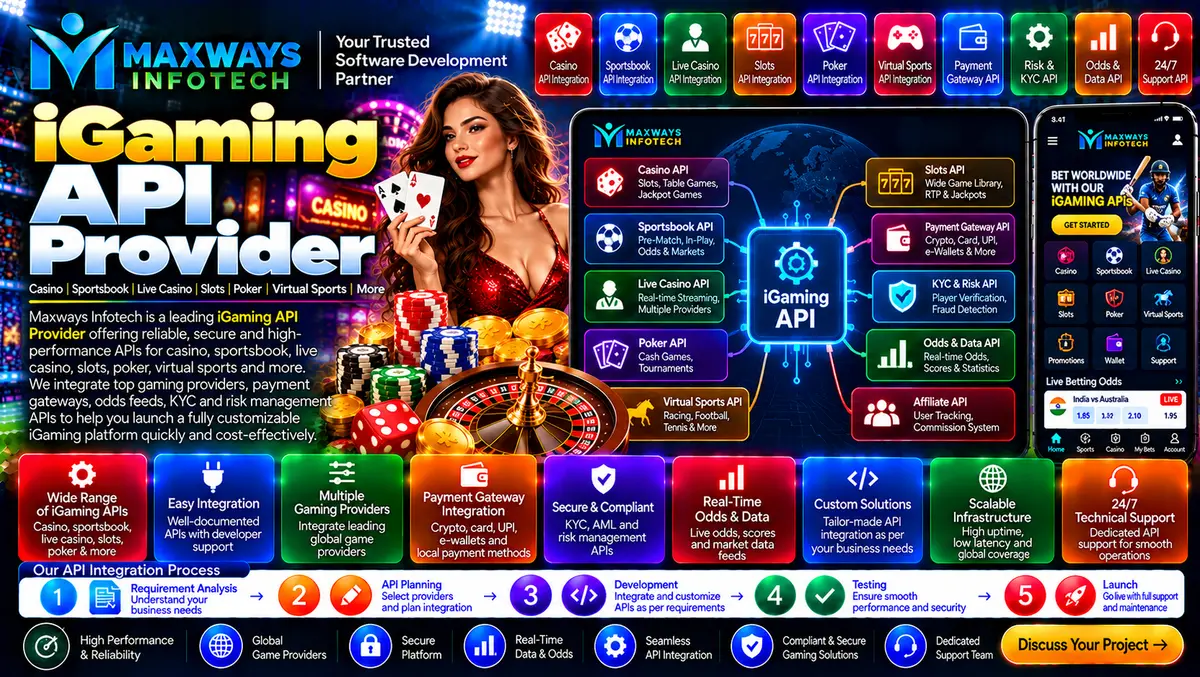
Explore how to choose an iGaming API provider with guidance on API integration, documentation, sandbox testing, security, reliability, and maintenance.
iGaming API Provider: How to Evaluate APIs for Reliable Gaming Platform Integration
Introduction
Choosing the right iGaming API provider is an important decision for businesses planning to connect gaming content, platform services, account systems, and operational tools. An API acts as a communication layer between applications, allowing different systems to exchange information without requiring every component to be developed independently.
However, selecting an API provider involves more than checking the available features. Businesses need to understand the provider's technical documentation, supported integrations, authentication methods, response formats, error handling, service commitments, and long-term maintenance approach. A poorly documented API can create delays, while an integration without proper transaction controls may introduce inconsistent records or operational problems.
Before selecting a solution, define the platform's requirements and review the relevant technology information available from Maxways Infotech. A structured evaluation can help businesses compare providers according to actual technical needs instead of relying on broad marketing claims.
What Is an iGaming API Provider?
An iGaming API provider supplies application programming interfaces that allow compatible software systems to exchange data and access specific functions. Depending on the provider's offering, these interfaces may support game catalogues, game sessions, account services, reporting, payment connections, or other platform capabilities.
The exact scope varies between providers. Some specialise in game aggregation, while others focus on particular services or complete platform integrations. Therefore, businesses should verify which capabilities are actually included in a provider's API rather than assuming every provider offers the same functionality.
An API-based approach can help teams integrate selected services into an existing application. It can also reduce the need to build every connected component from scratch. Nevertheless, the operator or platform owner remains responsible for evaluating the complete system, including security, data handling, licensing, and operational controls.
Common Types of iGaming APIs
Different APIs serve different purposes. Understanding these categories helps technical teams identify which integrations a project requires.
1. Game Aggregation APIs
Game aggregation APIs can connect a platform with multiple game providers through a common integration layer. Depending on the agreement, the API may expose game catalogues, metadata, launch requests, session information, and supported provider features.
When evaluating this type of API, check whether the catalogue is filtered by operator, region, currency, device, or other restrictions. Also confirm how unavailable games are represented and how frequently catalogue information is updated.
2. Player Account and Authentication APIs
Account-related APIs support defined interactions with player identity and session systems. These may include authentication, account status checks, profile information, and session validation.
The integration should clearly establish which system owns the player identifier, which service validates access, and how expired or revoked sessions are handled. Avoid sending unnecessary personal information between connected systems.
3. Wallet and Transaction APIs
Where permitted and applicable, wallet APIs communicate account balances and transaction events between a platform and an authorised service.
These integrations require particularly careful design. Requests must be authenticated, duplicate transactions must be handled safely, and reversals or failed operations must not leave inconsistent records.
Technical teams should confirm the provider's transaction model, supported currencies, precision rules, idempotency behaviour, and reconciliation process before implementation.
4. Reporting and Analytics APIs
Reporting APIs can provide structured information about platform activity, system events, or other agreed metrics. The available data depends on the provider and its commercial agreement.
Before relying on reporting endpoints, determine whether data is delivered immediately or in scheduled batches. Check timestamp conventions, pagination, historical retention, and whether records can be retrieved again after an interruption.
5. Payment and Identity-Service Integrations
Some platforms connect to external payment, identity-verification, or compliance services. These integrations may require separate commercial agreements, technical approval, and market-specific configuration.
A platform should not assume that an API connection automatically authorises a particular financial or gaming activity. Provider permissions, legal requirements, and operating conditions must be verified independently.
How to Evaluate an iGaming API Provider
A good provider evaluation should produce evidence that developers can test and business stakeholders can review.
Review the API documentation
Documentation should explain available endpoints, request parameters, response schemas, authentication, rate limits, error codes, and integration prerequisites.
Look for practical examples showing both successful and unsuccessful requests. If the documentation explains only the ideal scenario, developers may struggle when a request is rejected, a service becomes unavailable, or a transaction remains pending.
Ask whether the documentation is versioned and whether changes are announced before older interfaces are retired.
Verify the integration scope
Request a written list of supported features and clarify which ones require additional configuration or third-party approval.
A provider may advertise a broad set of capabilities while making only a subset available to a particular customer. Confirm the actual scope in the contract and technical specification.
Examine service reliability
Ask how the provider measures availability, response times, and service degradation. Request service-level commitments where appropriate and clarify what happens when a dependency is unavailable.
A reliability assessment should cover recovery procedures, incident communication, maintenance windows, and the responsibilities of each party.
Understand commercial terms
Pricing may depend on the number of integrations, usage volume, licensing arrangements, support level, or other contractual conditions.
Review setup charges, recurring fees, usage limits, renewal terms, and any restrictions on the use of connected services. A low initial price may not represent the lowest overall cost if substantial integration or maintenance work is required.
API Integration: A Step-by-Step Technical Approach
A structured integration process reduces uncertainty and gives the development team clear checkpoints.
Step 1: Map the business workflow
Start by documenting what the platform needs to accomplish. Identify which system initiates a request, which system processes it, where the result is stored, and which team is responsible for resolving failures.
For example, a game-session workflow may involve checking platform access, requesting a session, opening the supported game interface, and processing session events. The exact sequence must follow the provider's documentation.
Step 2: Establish the system boundaries
Define which application owns each type of data. Decide where user identity, account balances, transaction records, and reporting information are authoritative.
Clear ownership prevents two systems from independently treating different values as correct. It also makes troubleshooting easier when a response arrives late or contains unexpected information.
Step 3: Configure authentication securely
Use the authentication mechanism documented and approved by the provider. Depending on the API, this could involve scoped API keys, signed requests, or a supported token-based method.
Keep credentials outside public frontend code, restrict permissions to the required scope, and separate testing credentials from production credentials. Establish a process for credential rotation and revocation.
Step 4: Test in a sandbox environment
A sandbox allows developers to test integration behaviour without immediately connecting to production services. Check whether it supports the same important request formats, authentication rules, and error scenarios expected in production.
Testing should include invalid requests, expired sessions, timeouts, duplicate submissions, rejected operations, and recovery after temporary service interruptions.
Step 5: Validate the data contract
Compare the provider's request and response structures with the platform's internal data model. Confirm required fields, identifier formats, timestamp conventions, currency representation, and error handling.
If the two systems use different formats, implement a dedicated transformation layer instead of scattering conversion logic across unrelated application components.
Step 6: Prepare for production
Before launch, review configuration, credentials, monitoring, incident procedures, and rollback options. Confirm that the provider has approved the integration where approval is required.
Production readiness should be based on documented test results, not merely on a successful demonstration.
Handling API Errors, Retries, and Duplicate Requests
An API integration must account for situations in which a request does not produce an immediate, unambiguous result.
For example, a client may send a request and experience a timeout before receiving the response. The provider might have completed the operation even though the client never received confirmation. Sending the same request again without appropriate controls could produce duplicate activity.
To reduce this risk, developers should consider:
-
Idempotency: Use documented idempotency mechanisms for operations that must not be duplicated.
-
Retry rules: Retry only when appropriate, using defined limits and backoff policies.
-
Error classification: Distinguish validation errors, authentication failures, rate limits, timeouts, and server errors.
-
Transaction reconciliation: Compare records between connected systems to identify missing or inconsistent events.
-
Event verification: Authenticate incoming callbacks and reject invalid or replayed requests where applicable.
-
Operational logging: Record correlation identifiers and relevant status information without exposing secrets or unnecessary personal data.
Retries should never be treated as a complete recovery strategy. Some failures require reconciliation, manual review, or a provider-supported method for checking the original request's status.
Security and Data Protection Considerations
An iGaming API provider may handle sensitive platform data or communicate with services that have access to account information. Security requirements should therefore be established before implementation.
A technical review should include transport encryption, authentication strength, permission boundaries, secret storage, input validation, audit logging, and dependency management. Access to administrative endpoints should be restricted, and credentials should never be embedded in publicly accessible application files.
Teams should also determine what information the API collects, where it is processed, how long it is retained, and which parties can access it. Data-sharing agreements should reflect the actual integration rather than broad assumptions about provider capabilities.
For platforms involving real-money gaming or gambling, legal and regulatory checks are separate from technical testing. Confirm the applicable licences, jurisdictional restrictions, identity requirements, and player-protection obligations before launching any regulated functionality. Requirements vary by market, including across jurisdictions within India.
API Versioning and Long-Term Maintenance
An integration that works today may require changes when the provider updates its API. New fields, revised authentication methods, deprecated endpoints, and changed response formats can affect existing application code.
A maintainable integration should include a documented version policy, a process for reviewing provider announcements, and tests that identify unexpected changes. Where practical, isolate provider-specific logic in an adapter layer so that changes to one integration do not require modifications throughout the application.
Keep track of the active API version, dependencies, credentials, and integration owner. Establish a process for reviewing breaking changes and testing upgrades before production deployment.
Businesses evaluating connected technology solutions can also review the published information in the fintech section. Any financial or payment-related component should still be assessed against its own technical requirements, provider terms, and applicable regulations.
Measuring API Integration Performance
Performance should be measured from the perspective of the complete workflow, not just one API response.
Useful measurements may include:
-
Response-time percentiles: Track typical and slower responses instead of relying only on averages.
-
Error rate: Measure failed requests by endpoint and error category.
-
Timeout frequency: Identify operations that do not complete within the expected time.
-
Event-processing delay: Measure the time between an event being generated and being processed.
-
Reconciliation differences: Track mismatched or missing records between systems.
-
Recovery time: Measure how long it takes to restore normal operation after an interruption.
Set targets that match the application's requirements and the provider's documented service commitments. Alert thresholds should be based on meaningful operational impact, not arbitrary numbers.
Monitoring should also distinguish a provider outage from a problem in the platform's own network, application code, or database. This makes incident investigation faster and helps teams assign responsibility accurately.
Common Mistakes When Selecting an iGaming API Provider
Several avoidable mistakes can increase integration costs and operational risk.
Choosing based only on the feature list: A long list of endpoints does not prove that the integration is reliable or well documented.
Skipping sandbox testing: Testing only successful requests leaves important failure scenarios undiscovered.
Ignoring data ownership: Unclear ownership of identifiers and records can create inconsistent results across systems.
Overlooking version changes: An undocumented upgrade process can break production integrations unexpectedly.
Treating security as an afterthought: Weak credential handling or missing callback verification can expose sensitive operations.
Failing to define support responsibilities: Without clear escalation procedures, teams may lose time deciding who should investigate a failure.
Assuming API access guarantees compliance: Technical connectivity does not replace licensing, legal review, or provider approval.
Avoiding these mistakes begins with a written evaluation checklist, a defined integration scope, and evidence-based acceptance criteria.
Frequently Asked Questions
1. What does an iGaming API provider do?
An iGaming API provider offers interfaces that allow compatible gaming-platform components to exchange data or access specific services. Its exact capabilities depend on the provider's product and agreement.
2. How do I choose the right iGaming API provider?
Evaluate documentation quality, supported functionality, authentication, sandbox access, error handling, reliability commitments, integration costs, support arrangements, and applicable permissions.
3. Why is sandbox testing important?
Sandbox testing helps developers validate requests, responses, authentication, and failure scenarios before production use. The team should also check how closely the sandbox reflects production behaviour.
4. Can one API connect multiple gaming services?
Some aggregation APIs can connect a platform with multiple providers through a common interface. Coverage, availability, permissions, and integration requirements must be verified for the specific agreement.
5. How can API integrations avoid duplicate transactions?
Where supported, idempotency keys and duplicate-request handling can prevent the same operation from being processed repeatedly. Reconciliation and clear transaction-status checks provide additional safeguards.
6. Does an iGaming API provider handle all compliance requirements?
Not necessarily. Responsibilities vary between providers and operators. Each party should confirm its own legal, licensing, security, and data-protection obligations.
7. What should be checked before going live?
Verify credentials, permissions, production configuration, test evidence, monitoring, failure recovery, provider approval, support contacts, and any applicable regulatory requirements.
Conclusion
Selecting an iGaming API provider requires a careful balance of technical capability, integration reliability, security, commercial terms, and ongoing support. The right choice is not simply the provider with the largest feature list; it is the one whose documented capabilities and operating model fit the project's actual requirements.
By mapping workflows, testing error scenarios, validating data contracts, monitoring performance, and planning for version changes, businesses can make API integrations easier to maintain and troubleshoot.
For more software and technology insights, explore the Maxways Infotech blog. Use a structured evaluation process, document the evidence behind important decisions, and confirm all applicable legal and provider requirements before launching regulated services.