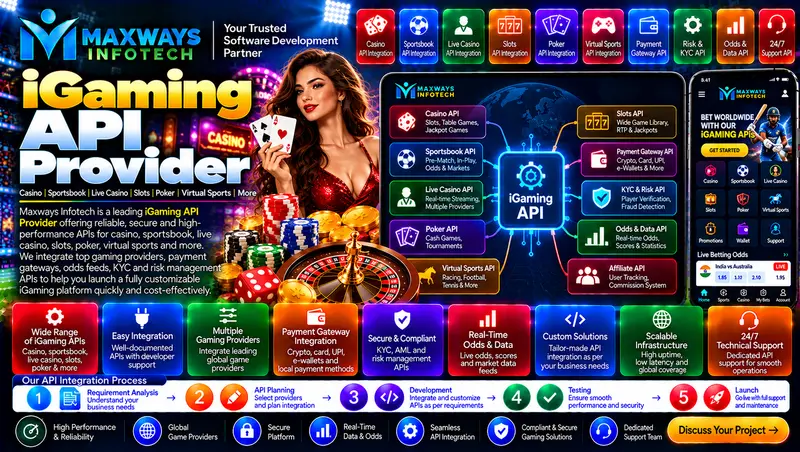
Explore how to evaluate an online casino API provider, including game integration, wallet compatibility, API testing, security, pricing, and maintenance.
Online Casino API Provider: Game Integration, Wallet Models, and Platform Connectivity
Introduction
An Online Casino API Provider supplies the technical interfaces that help an online gaming platform connect with external casino games and related services. These interfaces allow software systems to exchange information about game availability, session creation, player access, and other functions supported by the integration.
For businesses planning an online casino platform, choosing an API provider is a decision that affects more than the number of games available. The provider's catalogue structure, integration model, wallet compatibility, reporting capabilities, technical documentation, and support arrangements can all influence the development process.
Before selecting a solution, businesses should define their requirements, identify the services they need to connect, and assess the responsibilities involved in operating the complete platform. To learn more about the company and its published technology information, visit Maxways Infotech.
What Is an Online Casino API Provider?
An online casino API provider makes it possible for compatible applications to communicate with casino-related software services through documented interfaces.
Depending on the provider's offering, an API may support:
-
Retrieving available game information
-
Creating game-launch sessions
-
Checking supported currencies and languages
-
Connecting player-account systems
-
Communicating wallet and transaction events
-
Retrieving operational reports
-
Receiving status updates from external services
Not every provider offers all these functions. Some specialise in game aggregation, while others supply direct integrations with individual studios or additional platform components.
It is important to distinguish between a game provider, an API provider, and an aggregator. A game studio creates or supplies the game content. An API provider exposes particular software interfaces. An aggregator may combine content from multiple studios behind a common integration layer. A single business can perform more than one of these roles, depending on its product.
How Online Casino API Integration Works
The integration process connects the platform's existing components with the services offered by the provider. A typical workflow contains several stages, although the exact sequence depends on the API specification.
1. Game Catalogue Retrieval
The platform requests a list of games available to its account. The response may contain game identifiers, titles, categories, supported languages, images, and other metadata.
The platform can use this information to build searchable listings and organise games into relevant categories. Developers should confirm whether the catalogue changes dynamically and how frequently the latest information should be retrieved.
2. Game Selection and Session Creation
When a user selects a game, the platform may request a launch session through its backend. The API can return a session URL or another launch mechanism defined by the provider.
The integration should verify session expiry, permitted domains, user authentication, and supported device behaviour. Sensitive credentials must remain on the server rather than being exposed in browser code.
3. Game Session Management
After launch, the platform may need to handle return navigation, session expiry, interruptions, and status changes.
A well-defined session workflow makes it easier to determine whether a user can resume an existing session or needs a new one. It also helps support teams investigate problems without relying on incomplete browser-side information.
4. Event and Transaction Communication
Where the integration includes wallet functionality, the provider and platform exchange documented requests or callbacks for balance checks and transaction events.
These operations require clear transaction identifiers, validated requests, consistent response formats, and recovery procedures. The exact behaviour must follow the provider's approved technical specification.
Direct Game Integration vs. Aggregated API
Businesses generally evaluate whether to connect with individual game providers or use an aggregation service.
An aggregated API can reduce the number of separate technical connections, but it does not automatically remove all integration work. Game availability, regional permissions, settlement behaviour, and certification requirements still need to be verified.
The right model depends on the intended catalogue, technical resources, contractual terms, and long-term maintenance requirements.
Understanding Game Catalogue Management
A game catalogue is more than a collection of thumbnails. It is structured data that determines which games the platform can display and how users discover them.
A catalogue-management process should account for the following elements.
Stable game identifiers: Each game should have a reliable identifier that maps to the provider's record. Avoid using display names as unique keys because names can change or overlap.
Availability status: A game may be unavailable because of maintenance, account permissions, regional restrictions, or provider-side changes. The platform should not assume that every returned catalogue item can always be launched.
Metadata consistency: Different providers may use different category names, image formats, and language codes. A mapping layer can standardise these fields for the platform's interface.
Catalogue refresh: Define when catalogue data is refreshed and how changes are detected. If the provider supports incremental updates, they may reduce the need to retrieve the entire catalogue repeatedly.
Content permissions: Verify that each game is authorised for the intended operator, market, and use case before making it available.
A structured catalogue makes the interface easier to maintain and reduces confusion when new content is introduced.
Wallet Integration Models
Wallet architecture is one of the most important design decisions when an online casino API includes financial transaction processing. The provider's supported model should be understood before the platform's transaction services are implemented.
Seamless Wallet Model
In a seamless-wallet model, the platform generally remains responsible for the authoritative player balance. The game provider communicates with the platform's wallet interface for supported balance and transaction operations.
This model requires dependable communication between the systems. A transaction request may be repeated, delayed, or interrupted, so the wallet must handle duplicate requests and ambiguous outcomes correctly.
Transfer Wallet Model
In a transfer-wallet model, the platform and game service use a defined process to transfer funds into and out of a game-specific balance or account.
This approach introduces additional states that must be managed. Developers need to handle incomplete transfers, interrupted sessions, failed withdrawals, and reconciliation between the two systems.
How to Choose
The choice should be based on the provider's supported architecture, the platform's existing account system, transaction requirements, and operational controls. It should not be made solely on the basis of which model sounds simpler.
For either model, define transaction ownership, unique references, reversal rules, reconciliation procedures, and the expected response to service interruptions.
API Documentation and Sandbox Evaluation
A provider's documentation is a practical indication of how clearly its integration contract is defined. Before committing to development, technical teams should review the documentation and test the API using an approved sandbox.
What Good Documentation Should Explain
-
Authentication and authorisation methods
-
Available endpoints and required parameters
-
Request and response formats
-
Error codes and rate limits
-
Session creation and expiry rules
-
Callback verification requirements
-
Transaction identifiers and reversal behaviour
-
Versioning and deprecation policies
-
Sandbox credentials and testing procedures
Documentation should describe failure scenarios as well as successful requests. Developers need to know what happens when credentials are invalid, a session expires, a request times out, or an external service returns an unexpected response.
What to Test in the Sandbox
A useful test plan includes catalogue retrieval, game launch, expired sessions, invalid parameters, network interruptions, duplicate callbacks, and provider-side failures.
For wallet-enabled integrations, test the documented debit, credit, refund, and rollback scenarios where applicable. Confirm that repeated requests do not incorrectly apply the same transaction more than once.
A successful sandbox demonstration is only an initial milestone. Production readiness also requires security reviews, operational monitoring, provider approval where required, and a tested recovery process.
Security and Data Protection
An online casino API may exchange account information, session tokens, transaction details, or other sensitive data. Security must therefore be considered at every boundary between connected systems.
Important safeguards include:
-
Use encrypted connections for API communication.
-
Keep secret keys and credentials on the server.
-
Verify signatures or other authentication evidence on incoming callbacks where supported.
-
Apply access permissions according to the minimum required scope.
-
Validate request parameters and response data.
-
Prevent replayed or duplicated requests where relevant.
-
Record security events without logging passwords, secret keys, or unnecessary personal data.
-
Rotate credentials according to a documented policy.
-
Review dependencies and investigate unusual API activity.
Businesses should also document which organisation is responsible for each data-processing activity. This includes the information collected, its intended purpose, retention periods, access permissions, and procedures for handling security incidents.
Financial technology integrations may introduce additional considerations around payment processing, identity verification, and sensitive records. Businesses assessing these areas can review the published information in the fintech section, while separately confirming the technical and legal requirements applicable to their particular project.
Performance, Availability, and Failure Recovery
An API integration may work correctly during a demonstration but encounter difficulties under real operating conditions. Network latency, traffic spikes, provider maintenance, and temporary outages can affect the user experience.
A production integration should be designed around realistic failure scenarios.
Set Appropriate Timeouts
Every external request should have a defined timeout. Without one, a slow dependency can occupy application resources and delay unrelated requests.
Timeout values should reflect the operation being performed and the provider's documented service expectations.
Apply Controlled Retries
Retries can help recover from temporary failures, but they must be used carefully. Repeating a request that changes a balance or creates a transaction can produce duplicate activity if the API does not support safe retry handling.
Use the provider's documented idempotency mechanisms and transaction-status checks where available.
Monitor API Health
Track response times, error rates, timeouts, authentication failures, and unusual changes in request volume. Alerts should help the operations team distinguish between a provider outage and a problem within its own application.
Plan for Reconciliation
Where the integration involves transactions, compare the platform's records with the provider's reports or transaction history. Investigate missing, duplicated, or inconsistent records through a defined process.
Reconciliation should be part of routine operations, not something performed only after a customer reports a problem.
Pricing and Commercial Considerations
The cost of an online casino API depends on the services included and the provider's commercial model. A headline price does not necessarily reveal the total cost of operating the integration.
Before signing an agreement, clarify:
-
Initial setup and onboarding charges
-
API usage limits and additional usage fees
-
Game licensing and content-access terms
-
Revenue-sharing or other recurring charges, where applicable
-
Minimum commitments and renewal conditions
-
Support hours and incident-response arrangements
-
Integration testing and certification costs
-
Restrictions based on territory, product, or operator
-
Termination procedures and access to historical records
Ask the provider to distinguish included services from optional services and third-party charges. The agreement should also explain which party handles integration maintenance when an endpoint changes or a service is temporarily unavailable.
A transparent commercial proposal helps businesses estimate the full cost of ownership instead of comparing providers using an incomplete initial figure.
Legal and Operational Readiness
Technical access to an API does not automatically authorise a business to operate an online casino or make a particular game available in every market.
Before launch, confirm the applicable laws, licences, supplier permissions, age restrictions, privacy obligations, and player-protection requirements for the intended business model and jurisdiction. Requirements can differ significantly across countries and, in some cases, between regions within the same country.
Where real-money gaming or gambling is involved, obtain qualified legal advice before enabling the relevant functionality. Confirm that the provider's agreement permits the intended use and that the operator meets its own obligations.
Operational readiness should also include documented ownership of incidents, a process for suspending unavailable content, support escalation paths, and a plan for communicating material service disruptions.
How to Select an Online Casino API Provider
A
Request a demonstration and, where possible, test representative workflows with the provider's approved sandbox. Ask for written answers to unresolved questions and make sure technical assumptions are reflected in the project scope.
Frequently Asked Questions
1. What does an online casino API provider offer?
An online casino API provider offers interfaces that connect compatible platform software with casino-related services. The available functions may include game catalogue access, session creation, wallet communication, and reporting.
2. What is the difference between a casino API provider and a game aggregator?
A game aggregator typically combines content or integrations from multiple game studios behind a common interface. An API provider is a broader term for a business that supplies API-based services; the two roles can overlap.
3. Can an online casino API connect multiple game studios?
Yes, some aggregation APIs support multiple participating studios through one integration. Actual coverage depends on the provider's catalogue, agreements, operator permissions, and market restrictions.
4. Why is a sandbox important?
A sandbox allows developers to test documented API workflows before production deployment. It can help identify authentication errors, invalid requests, session problems, and transaction-handling issues without immediately affecting production systems.
5. What should developers check in wallet integration?
They should review transaction identifiers, balance ownership, duplicate-request handling, reversal rules, callback authentication, timeout behaviour, and reconciliation procedures.
6. How much does an online casino API cost?
Pricing varies according to the provider, game catalogue, licensing arrangements, usage, support, and contractual terms. Request an itemised proposal to understand the complete cost.
7. Does API integration guarantee legal compliance?
No. API integration is a technical connection, not a licence or legal approval. Businesses must independently verify the requirements that apply to their operations and intended markets.
Conclusion
An Online Casino API Provider can help connect a gaming platform with game content and related software services, but the quality of the integration depends on much more than catalogue size. Session management, wallet compatibility, security, documentation, monitoring, and commercial clarity all deserve careful evaluation.
Businesses should begin by mapping their required workflows, reviewing the provider's technical specifications, testing important failure scenarios, and confirming the permissions needed for their intended use. A documented integration plan makes development easier to assess and gives the team a clearer path for future maintenance.
For more technology-related articles and software insights, explore the Maxways Infotech blog. Use a requirements-based evaluation process and confirm technical, commercial, and legal readiness before putting a regulated service into operation.