Learn about iGaming website development services, from custom website design and responsive development to integrations, SEO, security, testing, and maintenance.
iGaming Website Development Services: A Practical Guide to Building a Professional Gaming Website
Introduction
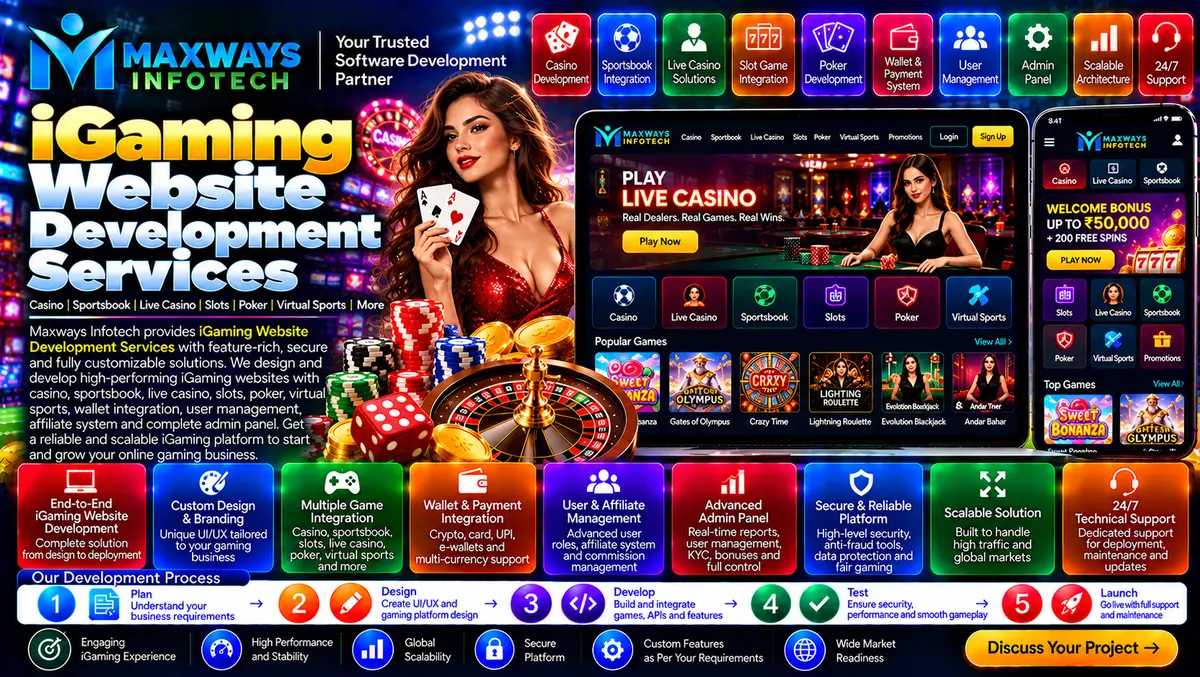
iGaming website development services help businesses plan, design, develop, and maintain online gaming websites tailored to their operational requirements. A professional website needs more than an attractive homepage. It should provide clear navigation, well-organised game categories, reliable account workflows, responsive page layouts, and an administrative system that makes everyday management easier.
Every project begins with different priorities. One business may need a content-focused gaming portal, while another may require a website connected to third-party game providers, account management tools, payment services, and reporting systems. Identifying these requirements before development helps teams select the right architecture and avoid unnecessary rework.
Businesses exploring digital product development can visit Maxways Infotech to review the company’s published information and understand its areas of work.
What Do iGaming Website Development Services Include?
The scope of iGaming website development depends on the intended product, target audience, integrations, and applicable regulations. A development project may cover the following areas.
1. Website Planning and Information Architecture
Before writing code, developers and product teams need to decide how visitors will move through the website. This includes organising pages, defining navigation menus, mapping user journeys, and determining which information should appear on each screen.
A well-planned structure might include:
-
Homepage and platform overview
-
Game categories and searchable listings
-
Account registration and login
-
User profile and account settings
-
Help centre and support pages
-
Privacy, terms, and relevant policy pages
-
Administrative dashboards and reporting tools
A clear information architecture makes the website easier to navigate and gives developers a practical blueprint for implementation.
2. Custom UI and UX Design
The design of an iGaming website should reflect its intended audience and functionality. Rather than relying on a generic template, designers can create layouts that suit the platform's content, branding, and navigation requirements.
Important design considerations include readable typography, consistent spacing, clear buttons, accessible forms, informative error messages, and predictable navigation. Visitors should understand where they are and what each action will do.
Design teams should also consider accessibility from the beginning. Keyboard navigation, suitable colour contrast, meaningful labels, and screen-reader-friendly structures can make the experience more usable for a wider audience.
3. Mobile-Responsive Website Development
A responsive website adjusts its layout to different screen sizes, including desktops, tablets, and mobile phones. This requires more than shrinking desktop pages to fit a smaller display.
Developers should test navigation menus, account forms, content cards, tables, and interactive elements on different screen sizes. Touch targets must remain practical, important information should not disappear, and pages should avoid unnecessary horizontal scrolling.
Responsive development also benefits maintenance because teams can often manage one adaptable website instead of separate desktop and mobile websites.
Core Features to Consider During Development
The right feature set depends on the project. The following table can help businesses define the scope before requesting a proposal.
These features should be prioritised according to actual business requirements. Adding every possible feature to the first release can increase development time and complicate testing.
Choosing the Right Website Architecture
Website architecture determines how the interface, backend services, databases, and external integrations communicate. A small informational portal may require a simpler structure than a platform handling user accounts, multiple integrations, and financial transactions.
Frontend development
The frontend includes the pages and interactive elements visitors use directly. Developers focus on consistent layouts, responsive behaviour, clear feedback, and efficient page rendering.
Backend development
The backend manages server-side logic, data access, authentication workflows, and communication with approved external services. Sensitive decisions should be handled on the server rather than relying on checks performed only in the browser.
Database design
Database structures should reflect how the platform stores users, content, permissions, configuration, and operational records. For systems that process transactions, financial records require carefully designed consistency, reconciliation, and audit mechanisms.
Third-party integrations
External services may provide identity verification, payment processing, game content, analytics, or customer support. Before integrating a provider, teams should review its documentation, authentication method, error responses, service availability, data handling, and commercial terms.
A modular architecture can make future changes easier by separating major responsibilities instead of placing every feature inside one tightly connected application.
Content Management and SEO Planning
Search visibility should be considered during website planning rather than added immediately before launch. A website can have technically sound code and still struggle to attract relevant visitors if its pages are poorly organised or provide little useful information.
Create a logical page hierarchy
Each page should serve a clear purpose. Category pages can explain the type of content available, while individual pages can provide specific details. Avoid creating many near-identical pages simply to target slightly different keywords.
Use descriptive page elements
Write unique page titles, useful meta descriptions, clear headings, descriptive image alt text, and readable URLs. These elements help search engines and visitors understand the subject of each page.
Improve technical SEO
Development teams should review:
-
XML sitemap generation
-
Robots directives and indexation settings
-
Canonical URLs where appropriate
-
Redirects and broken links
-
Structured data when relevant and eligible
-
Page speed and Core Web Vitals
-
Mobile usability
-
Duplicate or thin content
SEO should reflect the actual content and purpose of each page. Search performance cannot be guaranteed by development alone; it also depends on content quality, competition, technical implementation, and ongoing optimisation.
Security, Privacy, and Responsible Platform Design
Security is a core requirement for any website that manages personal information or sensitive account activity. It should be included in requirements, implementation, and testing instead of being postponed until the final launch stage.
A security review may cover password handling, multi-factor authentication where appropriate, session expiry, access permissions, rate limiting, secure API authentication, input validation, encrypted connections, and dependency updates.
Administrative interfaces deserve particular attention. Staff accounts should receive only the permissions needed for their roles, and sensitive actions should produce reviewable records.
If the website includes real-money gaming or gambling functionality, additional controls may apply, including identity verification, transaction monitoring, age restrictions, player-protection features, and jurisdiction-specific requirements. The exact obligations depend on the location, licence, and operating model.
Important: Technical development does not establish legal permission to offer gambling services. Before launch, obtain qualified legal advice and verify the applicable laws and licences for every intended market, including relevant Indian state and national requirements where applicable.
Testing Before Launch
Testing should confirm that the website behaves correctly in realistic situations, including when users make mistakes or external services become unavailable.
A useful testing plan includes:
-
Functional testing: Check registration, login, navigation, search, forms, and account settings.
-
Responsive testing: Verify layouts across different devices, browsers, and screen sizes.
-
Integration testing: Confirm that connected services handle successful responses, failures, timeouts, and retries correctly.
-
Security testing: Review access controls, authentication, input validation, and exposed endpoints.
-
Performance testing: Measure page loading, server response, and behaviour under expected traffic.
-
Accessibility testing: Check keyboard operation, form labels, focus order, and contrast.
-
User acceptance testing: Ask stakeholders to complete realistic tasks before approving release.
For transaction-enabled platforms, test scenarios should also cover duplicate requests, pending transactions, interrupted connections, failed payments, reconciliation, and clear status messages. A successful response from one service should not automatically be treated as proof that the entire workflow has completed.
How to Plan the Development Budget
The cost of iGaming website development services varies according to the project scope. A content-led website has different requirements from a custom platform with complex integrations, account management, and regulatory controls.
Common cost factors include:
-
Custom design and number of page templates
-
Frontend and backend complexity
-
Third-party licences and integration fees
-
Hosting, monitoring, and security requirements
-
Content migration and SEO implementation
-
Testing and independent security reviews
-
Maintenance, updates, and technical support
A practical way to control costs is to divide the project into phases. Start by defining the essential requirements, then separate launch-critical features from improvements that can be delivered later.
Ask prospective development partners for an itemised proposal explaining deliverables, assumptions, exclusions, milestones, ownership, third-party costs, and ongoing maintenance. This makes proposals easier to compare than a single unexplained price.
How to Select an iGaming Website Development Partner
Choosing a development partner requires more than comparing design samples. The team should be able to explain how it will turn the project requirements into a maintainable product.
Consider the following questions:
-
Has the team worked on technically comparable web applications?
-
Can it explain its proposed architecture and technology choices?
-
How will integrations and failures be tested?
-
Who owns the source code, design files, and project documentation?
-
How will sensitive data and administrative permissions be protected?
-
What testing and deployment process will be followed?
-
What support is available after launch?
-
Are third-party costs and legal responsibilities clearly documented?
Review relevant portfolio examples and request a demonstration where possible. A clear written scope and a realistic delivery plan are more useful than unsupported promises about launch dates, security, or search rankings.
Businesses also evaluating financial technology requirements can explore the fintech section for related published information. Any financial features in an iGaming project should be assessed separately for technical suitability, provider approval, and applicable compliance requirements.
Post-Launch Maintenance and Continuous Improvement
Launching the website is the beginning of its operational life, not the end of development. Software dependencies change, browsers evolve, integrations are updated, and user feedback reveals issues that may not appear during initial testing.
A maintenance plan should include regular backups, dependency patching, uptime monitoring, error tracking, security reviews, performance checks, and a documented recovery process.
Analytics can help identify confusing navigation, unsuccessful searches, frequently reported problems, and pages that need better content. Improvements should be prioritised using evidence rather than adding features simply because competitors have them.
It is also useful to establish release procedures. Changes should be tested before deployment, important configuration should be documented, and the team should have a plan for rolling back a release if a serious problem occurs.
Frequently Asked Questions
1. What are iGaming website development services?
They cover the planning, design, development, integration, testing, and maintenance of websites for online gaming products. The scope depends on the platform's functionality and operating requirements.
2. How long does iGaming website development take?
The timeline depends on the number of pages, complexity of the backend, third-party integrations, testing requirements, and regulatory reviews. A reliable estimate requires a defined project scope.
3. Can an iGaming website be customised?
Yes. Depending on the chosen architecture and licensing terms, a website can have custom layouts, navigation, content management, account workflows, reporting, and approved integrations.
4. Is mobile-responsive design important?
Yes. Responsive design helps users access website content and functionality across different screen sizes. Mobile behaviour should be tested throughout development, not just after the desktop version is complete.
5. What security features should an iGaming website include?
Depending on the product, important controls may include secure authentication, role-based access, session management, encrypted connections, input validation, monitoring, audit records, and regular security testing.
6. Can SEO be included in website development?
Yes. Technical SEO can be addressed through page structure, metadata, internal navigation, indexation controls, performance, mobile usability, and accessible content. Rankings are not guaranteed.
7. Does launching an iGaming website automatically make it legal to operate?
No. Website development and legal authorisation are separate matters. Operators must verify applicable laws, licensing conditions, and market restrictions before offering regulated services.
Conclusion
Professional iGaming website development services bring together website planning, thoughtful interface design, backend engineering, content organisation, security, testing, and ongoing maintenance. The strongest project plan begins with a clear understanding of what the website must do and how it will be operated after release.
Rather than selecting features based on a long checklist, define the user journeys, technical dependencies, compliance obligations, and measurable launch criteria first. This approach helps stakeholders make informed decisions about scope, budget, and future improvements.
For more technology and software-development articles, visit the Maxways Infotech blog and explore topics relevant to your project.