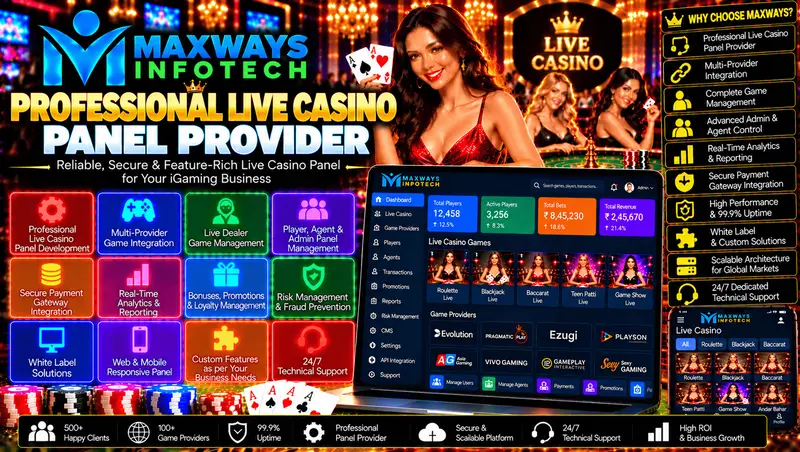
Discover live casino panel software developers for custom dashboards, secure administration, API integration, reporting tools, and platform maintenance.
Live Casino Panel Software Developers: Features, Benefits, and Custom Solutions
Introduction
A live casino platform requires more than a user-facing website. Behind the interface, administrative software helps authorised teams manage configurations, review system information, monitor integrations, and maintain technical workflows. Live Casino Panel Software Developers build the dashboards and supporting software that bring these functions together according to a project's requirements.
A well-planned administration panel should be intuitive, secure, and maintainable. It should present relevant information clearly while protecting sensitive settings and limiting access to authorised users.
Businesses exploring custom software and digital development services can visit Maxways Infotech to learn more about its capabilities.
What Do Live Casino Panel Software Developers Do?
Live casino panel software developers design, build, test, and maintain administrative interfaces and the backend components that support them. Their work may involve requirements analysis, interface design, database development, API integration, authentication, reporting, and deployment.
Depending on the project scope, an administration panel may include:
-
Secure administrator login.
-
Role-based permissions and access controls.
-
Platform configuration and content management.
-
Approved game catalogue information.
-
API connectivity and integration monitoring.
-
Reporting dashboards and audit logs.
-
Technical support and incident tracking.
-
System health information and maintenance tools.
The exact features should be documented before development begins. Each function should have a defined purpose, appropriate permissions, and clear acceptance criteria.White Label Live Casino Panel | Maxways Infotech
Why Choose Custom Live Casino Panel Software?
1. Administration Tailored to Business Needs
Every platform has different workflows and reporting requirements. Custom development allows the interface to reflect the tasks that authorised staff actually perform.
For example, technical staff may need integration status and error logs, while reporting users may need access to selected summaries. A tailored interface can organise these functions without giving every user unrestricted access.
2. Centralised Information
An administration panel can bring information from connected services into a consistent dashboard. This may reduce the need to switch between multiple tools and help staff identify important updates more quickly.
The usefulness of a centralised dashboard depends on accurate data, clear ownership of information, and suitable update intervals.
3. Integration With Existing Systems
APIs allow software components to exchange information through documented interfaces. A custom panel can use supported APIs to retrieve information, display service statuses, or submit authorised configuration changes.
For more technical background, explore the lotus-panel-provider.
4. Better Maintainability
A modular design can make individual components easier to test and update. Version control, automated testing, documentation, and controlled deployment procedures help reduce the risks associated with software changes.
Custom software still requires ongoing maintenance, security updates, and technical support.
Essential Features of a Live Casino Administration Panel
Secure Login and Role-Based Permissions
The panel should authenticate administrators and limit access according to each person's responsibilities.
Important controls include:
-
Strong authentication appropriate to the system's risk.
-
Least-privilege access.
-
Session expiration and secure logout.
-
Server-side permission checks.
-
Audit records for important actions.
-
A process for removing access when roles change.
Sensitive operations should not rely solely on buttons being hidden in the interface. The backend must enforce the relevant permissions.
Dashboard and Reporting Tools
A dashboard can display operational metrics, service health, integration errors, maintenance notifications, and other relevant information.
Reports should clearly define what each metric measures and where its data originates. Access to sensitive reports and export functions should be restricted appropriately.
Game Catalogue and Content Management
Where permitted by provider agreements, administrators may need to review game listings, categories, descriptions, or availability information.
The panel should distinguish between settings controlled internally and those managed by an external provider. Changes should be validated and recorded for troubleshooting and accountability.
API Integration and Monitoring
A panel may connect with authorised external services to retrieve information or manage supported workflows. Developers should account for authentication errors, timeouts, unexpected responses, rate limits, and API version changes.
For a related integration topic, see the reddy-anna-white-label-panel-provider.
API credentials should be protected on the server and never exposed unnecessarily in browser code or ordinary logs.
Audit Logs and Incident Management
Audit logs help authorised teams understand when important changes occurred and which account performed an action. Incident management features can document problems, assign responsibility, and track resolution.
Logs should be protected against unauthorised modification and should not collect unnecessary personal or confidential information.
Responsive Interface Design
An administration panel should work reliably across supported browsers and screen sizes. Clear typography, consistent navigation, accessible controls, and helpful error messages make the software easier to use.
Responsive design should be combined with proper input validation and backend security checks.
Technologies Used in Panel Software Development
The technology stack should be selected according to the existing infrastructure, expected workload, security requirements, and maintenance capabilities.
Frontend development: Frameworks such as React can support reusable components, dashboards, tables, forms, and filters.
Backend development: Technologies such as Node.js or PHP can implement business logic, permission checks, data processing, and API communication.
Database development: MySQL or MongoDB may be appropriate depending on the data model, consistency requirements, and query patterns.
API integration: A dedicated integration layer can separate provider-specific communication from the dashboard interface and standardise error handling.
Hosting and monitoring: The deployment environment should support appropriate access controls, logging, performance monitoring, backups, and recovery procedures.
No single technology stack suits every project. The choices should be documented along with the trade-offs that affect cost, performance, and long-term support.
The Development Process
Step 1: Requirements Analysis
Identify user roles, administrative workflows, required features, reporting needs, integrations, and security expectations. Define what is included in the project and what falls outside the scope.
Step 2: UI/UX Design
Prepare wireframes and interface designs for navigation, dashboards, forms, tables, and reporting screens. Gather feedback from intended users before implementation.
Step 3: Architecture Planning
Define frontend and backend responsibilities, database structures, API contracts, permissions, hosting requirements, and monitoring needs.
Step 4: Software Development
Build the agreed features in manageable stages. Use version control, code reviews where appropriate, and documented configuration practices.
Step 5: Integration and Testing
Test API communication, access control, input validation, data consistency, error handling, and compatibility with supported services.
Step 6: Security and Quality Assurance
Verify that users cannot access unauthorised functions, credentials are protected, and important workflows behave correctly under expected and failure conditions.
Step 7: Deployment and Handover
Release the panel through a controlled deployment process. Configure monitoring and provide the agreed documentation, operational procedures, and technical handover.
Step 8: Maintenance and Updates
Plan for bug fixes, security updates, dependency changes, integration maintenance, and future enhancements.
Security Considerations for Live Casino Panel Software
Security should be part of the development process from the beginning. An administration panel may control sensitive settings and expose important information, making access control and data protection especially important.
Recommended practices include:
-
Applying least-privilege permissions.
-
Using appropriate administrator authentication.
-
Validating permissions on the backend.
-
Protecting credentials and encrypting data in transit.
-
Keeping dependencies updated.
-
Maintaining appropriate audit logs.
-
Testing backup and recovery procedures.
-
Reviewing access rights regularly.
-
Defining incident response responsibilities.
Privacy requirements should also determine what information the panel collects, displays, exports, and retains.
How Much Does Live Casino Panel Software Development Cost?
The cost depends on the feature set, design complexity, integration requirements, security controls, testing scope, and maintenance agreement.
Common cost factors include:
-
Requirements analysis and interface design.
-
Frontend and backend implementation.
-
Database and API integration.
-
Authentication and access permissions.
-
Reporting and audit functionality.
-
Testing and security reviews.
-
Hosting and deployment.
-
Documentation and ongoing support.
Request an itemised proposal with clear deliverables, milestones, exclusions, and ongoing costs. Acceptance criteria help both parties evaluate whether the finished software meets the agreed requirements.
How to Choose the Right Development Partner
Review Relevant Experience
Ask potential developers how they approach custom dashboards, backend architecture, API integration, database design, security testing, and production maintenance.
Define the Scope Clearly
The proposal should list included features, integrations, deliverables, milestones, and assumptions. This reduces misunderstandings during development.
Evaluate Security Practices
Discuss authentication, permissions, credential storage, audit logs, vulnerability testing, and responsibility for security updates.
Confirm Code Ownership and Documentation
Clarify ownership or licensing rights for custom code, designs, and project assets. Confirm access to relevant source code, repositories, deployment documentation, and technical handover materials.
Understand Post-Launch Support
Ask who will handle defects, software updates, integration issues, monitoring, and future development. Support hours, response expectations, and exclusions should be documented.
Frequently Asked Questions
What do live casino panel software developers build?
They develop administrative dashboards and supporting software for approved platform functions, such as configuration, reporting, access management, integration monitoring, and incident tracking.
Can a custom panel connect with existing software?
Yes, when compatible interfaces are available and the integration is authorised. Developers should verify documentation, authentication, data formats, and compatibility before implementation.
Is a custom administration panel better than a ready-made solution?
Custom software offers greater control over workflows and features. Ready-made solutions may reduce initial development effort, but their flexibility depends on the available configuration options, licensing, and maintenance arrangements.
How long does panel development take?
The timeline depends on the features, design requirements, integration complexity, testing scope, and availability of technical documentation. A reliable estimate follows a requirements review.
Can the panel be updated after launch?
Yes. A maintainable panel can receive bug fixes, security updates, integration changes, and additional features through a controlled development process.
What should businesses prepare before development?
Prepare the feature list, user roles, workflows, integrations, security expectations, budget, timeline, and ongoing maintenance requirements.
Conclusion
Choosing suitable Live Casino Panel Software Developers means finding a team that can combine clear interface design with secure access controls, dependable integrations, useful reporting, and maintainable software architecture.
A well-defined scope, structured testing, and a clear maintenance plan can help businesses build administration software that meets their requirements and adapts as those requirements change.Live Casino Panel Software Provider | Maxways Infotech
Compliance note: Live casino software should be developed, deployed, and operated only where legally permitted, with appropriate licences, age safeguards, privacy protections, responsible-use measures, and compliance with applicable regulations.