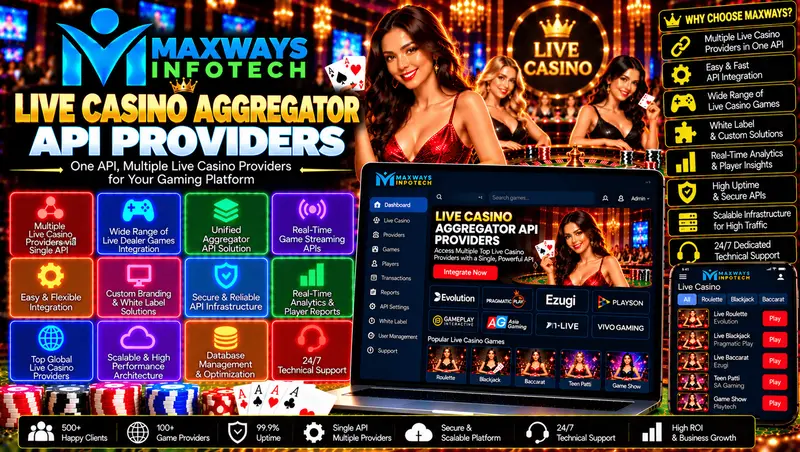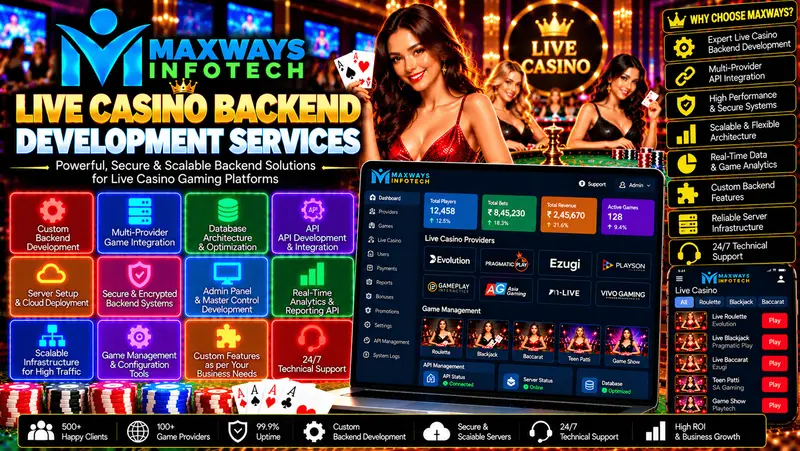
Live Casino Software Development Company, game integration, backend architecture, security, testing, and scalable platform solutions for your project.
Live Casino Software Development Company: Features, Architecture, and Development Guide
Developing live casino software requires a combination of application design, backend engineering, API integration, database management, and quality assurance. Each component must work together to provide a consistent experience across supported devices while maintaining secure communication between connected services.
A Live Casino Software Development Company can help businesses plan these technical components, evaluate software requirements, and develop an application around a defined project scope. The actual features depend on the chosen technology, available third-party services, budget, and applicable licensing requirements.
At Maxways Infotech, businesses can explore software and game development services when evaluating their digital product requirements. This guide explains the main components of live casino software, the development lifecycle, integration considerations, and factors to review before selecting a development partner.
What Is a Live Casino Software Development Company?
A live casino software development company designs, develops, integrates, tests, or maintains software associated with online live gaming experiences.
Depending on the agreed scope, a project may involve frontend development, backend services, administrative tools, authorized game-provider connectivity, user account workflows, reporting, and operational monitoring.
A typical software project may include:
-
Frontend interface: Responsive layouts, navigation, and accessible user interactions.
-
Backend architecture: Business logic, request processing, and communication between software components.
-
API integration: Connections to compatible external providers through documented interfaces.
-
Database management: Structured storage for authorized application records and configurations.
-
Administrative dashboard: Tools for managing supported settings, permissions, and operational information.
-
Quality assurance: Functional, compatibility, performance, and security testing.
-
Maintenance: Bug fixes, dependency updates, monitoring, and improvements after deployment.
Not every development company offers all these services. Businesses should confirm the deliverables and technical responsibilities before starting a project.
Why Is Live Casino Software Development Important?
A software platform depends on more than its visual interface. Its architecture must support communication, error handling, security, and maintenance throughout the product lifecycle.
1. A Consistent User Interface
Responsive design helps an application adapt to different screen sizes and supported browsers. A clearly organized interface can make navigation and account-related tasks easier to understand.
Design decisions should be based on usability testing and the actual needs of the intended audience.
2. Reliable Backend Communication
The backend coordinates application requests and communicates with authorized external services. Clear interface contracts and appropriate error handling help prevent failures from spreading between connected components.
3. Flexible Software Architecture
A modular architecture separates functions into manageable components. This can make it easier to update an integration or improve a particular service without rebuilding the entire application.
4. Better Testing and Maintenance
A defined testing process helps teams identify defects before release. Monitoring and maintenance also provide a structured way to investigate problems and respond to changes in dependencies.
5. Clear Operational Management
Administrative tools can provide authorized staff with access to supported configuration, reporting, and monitoring functions. Permission controls help ensure that each role can access only the features it needs.
Core Features of Live Casino Software
The required feature set depends on the business model and the technology being used. The following components are common areas to evaluate during project planning.
Responsive Frontend Development
The frontend presents information and provides the interface through which users interact with the application.
Development considerations include:
-
Mobile-friendly layouts.
-
Consistent navigation and page structure.
-
Accessible interface controls.
-
Clear loading, error, and unavailable-service messages.
-
Efficient loading of images and other assets.
-
Compatibility with the supported browsers and devices.
Performance should be measured using representative devices and realistic network conditions rather than assumed from design alone.
Backend Software Development
Backend services process requests, apply application rules, and coordinate interactions with databases and external APIs.
Important considerations include request validation, authorization, secure configuration, error handling, logging, and maintainable code structure.
The backend should also distinguish between successful requests, pending operations, and failed responses instead of treating every response as a completed action.
Live Video and Media Integration
Where a project includes live video, developers must establish how the media source will be delivered and displayed.
The implementation may need to account for:
-
Supported streaming protocols.
-
Browser and device compatibility.
-
Playback controls.
-
Connection interruptions.
-
Network latency and buffering.
-
Provider access restrictions.
-
Media-service availability.
The actual streaming architecture depends on the authorized provider and its technical specifications.
Game Provider API Integration
A compatible API may allow the application to communicate with an external game provider.
Depending on the API, supported functions may include retrieving game information, initiating authorized sessions, receiving status updates, or accessing reporting data.
Before implementation, confirm the available endpoints, authentication requirements, callback behaviour, test environment, and commercial permissions.
For a related technical overview, explore the live-casino-website-software-development. It discusses API communication, session management, transaction callbacks, and backend monitoring.
User Accounts and Permissions
If user accounts are part of the approved project scope, the application should provide secure authentication and clearly defined authorization rules.
Possible components include account registration, login workflows, session expiry, password recovery, role management, and account-status controls.
Sensitive account operations should be handled on the backend. Authentication alone should not grant unrestricted access to administrative or financial functions.
Administrative Dashboard
An administrative dashboard can help authorized personnel manage supported application settings and review operational information.
Depending on the requirements, it may include:
-
Role-based access.
-
Configuration management.
-
Integration status.
-
Error summaries.
-
Audit records.
-
Operational reports.
-
Support and maintenance tools.
Administrative actions should be logged where appropriate, and access should follow the principle of least privilege.
How Does Live Casino Software Development Work?
A well-defined development lifecycle helps businesses understand what will be delivered, how it will be tested, and how changes will be managed.
Step 1: Requirement Analysis
The project begins by defining its purpose, target devices, required functions, integration dependencies, and expected operating conditions.
The team should document essential features, exclusions, assumptions, acceptance criteria, and any third-party approvals needed before implementation.
Step 2: Technical Planning
Developers select an appropriate architecture, database approach, API strategy, deployment environment, and monitoring plan.
The goal is to choose technology that fits the project's actual requirements rather than adding unnecessary complexity.
Step 3: UI and UX Design
Designers create the page structure, navigation, interface components, and responsive layouts.
Stakeholders should review the proposed user flows before full development begins. This helps identify missing requirements early.
Step 4: Frontend and Backend Development
The development team implements the user interface and the backend services that support it.
The codebase should use clear component boundaries, documented interfaces, secure configuration, and consistent error handling.
Step 5: API and Service Integration
The application is connected to authorized third-party services using their documented interfaces.
Integration work should include request validation, authentication, response mapping, timeouts, error handling, and appropriate logging.
Step 6: Testing and Quality Assurance
The team tests functional requirements, supported devices, browser compatibility, access permissions, API failures, and performance.
Where external transactions or callbacks are included, testing should also cover repeated requests, delayed responses, and recovery from interrupted connections.
Step 7: Deployment
The application is deployed to the approved environment after the agreed acceptance criteria have been met.
The deployment plan should cover configuration, access permissions, backup arrangements, monitoring, and a process for responding to deployment issues.
Step 8: Maintenance and Improvements
After launch, the team may address defects, update dependencies, review logs, improve performance, and adapt the application to supported API changes.
Maintenance responsibilities should be agreed upon before the project enters production.
Technology Stack for Live Casino Software Development
There is no single technology stack suitable for every project. The choice depends on the team’s expertise, performance requirements, integration dependencies, hosting environment, and maintenance plans.
| Component | Technologies to evaluate |
|---|---|
| Frontend | HTML, CSS, JavaScript, React |
| Backend | Node.js, PHP, or other suitable server-side technologies |
| Database | MySQL, PostgreSQL, or another appropriate database |
| API communication | REST APIs or other provider-supported interfaces |
| Testing | Automated tests, integration tests, and browser testing |
| Deployment | Cloud or dedicated infrastructure suited to the project |
| Monitoring | Application logs, error tracking, and performance monitoring |
These are examples, not a guarantee that every technology is required or offered for a particular project. The development team should justify the final choices based on documented requirements.
Security and Reliability Considerations
Security should be designed into the platform from the beginning.
Protect credentials: Keep private API keys and service credentials on the server. Restrict access and use appropriate secret-management procedures.
Validate requests: Validate input data and enforce authorization checks before processing sensitive operations.
Secure API callbacks: Verify callbacks using the provider's documented authentication or signature-verification mechanism.
Apply access controls: Use role-based permissions and limit administrative access to authorized personnel.
Manage errors safely: Avoid exposing internal stack traces, private credentials, or sensitive system information to end users.
Monitor operational health: Track relevant errors, latency, availability, and failed integration requests.
Plan recovery: Define backup, incident-response, and service-recovery procedures appropriate to the application.
Test dependencies: Review third-party libraries, API versions, and configuration changes before releasing them to production.
Security requirements vary by architecture and jurisdiction. A technical implementation does not replace legal review or any required authorization.
Common Challenges in Casino Software Development
Integration Compatibility
Different providers may use different authentication methods, data structures, and session workflows. Documenting those differences helps developers avoid incorrect assumptions.
Unavailable External Services
An external API or media service may become temporarily unavailable. The application should handle failures gracefully and provide appropriate status messages rather than leaving users with a broken interface.
Performance Problems
Large assets, inefficient database queries, and slow external requests can affect responsiveness. Profiling and realistic load testing help teams identify the actual bottlenecks.
Inconsistent Data
Connected systems may process updates at different times. Stable identifiers, explicit data contracts, and reconciliation procedures can help teams investigate inconsistencies.
Changing Requirements
Late feature changes can affect architecture, timelines, and testing. A documented change-management process helps stakeholders understand the impact before approving additional work.
Ongoing Maintenance
Dependencies and external APIs may change over time. Maintenance planning should include version reviews, regression testing, and clear responsibility for resolving production issues.
How to Choose a Live Casino Software Development Company
Selecting a development partner requires evaluating technical ability, communication, scope, and ongoing support.
Consider the following questions:
-
What experience can the company demonstrate? Ask for relevant project examples and clarify the team's actual role.
-
How will the architecture be designed? Request an explanation of the frontend, backend, integrations, security, and deployment approach.
-
What exactly is included? Confirm the deliverables, third-party dependencies, exclusions, and acceptance criteria.
-
How will quality be tested? Ask about functional testing, API testing, browser compatibility, performance, and security reviews.
-
Who handles third-party approvals? Establish which licences, provider contracts, and API permissions must be obtained separately.
-
What happens after launch? Review maintenance options, support channels, response expectations, and update responsibilities.
-
How is project progress communicated? Agree on milestones, demonstrations, documentation, and approval points.
-
What are the legal requirements? Confirm the intended operating markets and obtain appropriate professional advice before launch.
Businesses can visit live-casino-website-development-services to explore its software and game development offerings and discuss the requirements of a potential project.
Custom Development vs. Ready-Made Software
Businesses generally evaluate two broad approaches when planning a software platform.
Custom Software Development
Custom development builds application components around specific requirements. It may offer greater control over architecture, workflows, and integrations, but the project requires clear specifications, development resources, testing, and ongoing maintenance.
Ready-Made Software
A ready-made solution may reduce the amount of initial development work when its features fit the intended use case. However, customisation, integration options, data portability, licensing terms, and future support should be checked carefully.
Which Approach Is Better?
The appropriate option depends on budget, delivery expectations, required flexibility, existing technology, and long-term ownership goals.
A technical assessment should compare the total cost of implementation and maintenance rather than looking only at the initial purchase price.
How SEO Fits Into Software Website Development
For companies marketing their software services online, search engine optimisation should be considered during website planning.
Useful practices include:
-
Creating original pages for distinct services.
-
Writing descriptive page titles and meta descriptions.
-
Using a clear heading hierarchy.
-
Providing useful internal links between relevant pages.
-
Optimising images and descriptive alt text.
-
Improving mobile usability and loading performance.
-
Maintaining accurate canonical URLs and XML sitemap entries.
-
Avoiding near-duplicate pages created only to target minor keyword variations.
Each landing page should offer information that matches its target search intent. Internal links should help readers discover related resources instead of repeating the same anchor text everywhere.
For more technical articles and development topics, visit the igaming-software-development-company.
Frequently Asked Questions
1. What does a live casino software development company do?
It may design, build, integrate, test, and maintain software components for live gaming experiences. The exact services depend on the company's capabilities and the agreed project scope.
2. Can live casino software be developed for mobile devices?
A project can be designed for supported mobile browsers or applications. Compatibility depends on the chosen frontend technology, media provider, API requirements, and testing across the intended devices.
3. Does live casino software development include API integration?
It can, but API integration should be confirmed in the project scope. The work may involve connecting approved third-party services and handling authentication, sessions, responses, and errors.
4. Which technology is best for casino software development?
There is no universal best stack. The right choice depends on application requirements, the development team's expertise, performance needs, provider compatibility, and long-term maintenance.
5. How long does a software development project take?
The timeline depends on the number of features, integration complexity, testing requirements, third-party approvals, and availability of project resources. A realistic estimate follows requirements analysis and technical planning.
6. What should be tested before deployment?
Testing should cover functionality, authentication, permissions, API responses, error handling, supported devices, performance, security, and recovery from service interruptions.
7. Is maintenance required after launch?
Yes. Software may require defect fixes, dependency updates, security reviews, monitoring, and compatibility changes when external services or requirements change.
Conclusion
Choosing a Live Casino Software Development Company involves evaluating the full software lifecycle, from requirement analysis and interface design to backend engineering, API integration, testing, deployment, and maintenance.
The strongest project plans define their technical scope clearly, protect sensitive information, test both successful and failed workflows, and establish responsibility for third-party integrations. Businesses should also assess ongoing maintenance and legal requirements before committing to a development approach.
To explore relevant software development services and discuss project requirements, visit Maxways Infotech.
Compliance note: Live casino-related software should only be developed and operated where legally permitted. Confirm applicable licensing and provider permissions, age safeguards, privacy protections, responsible-use measures, and regulatory obligations before launch.Cricket Book Software Development Company | Maxways Infotech