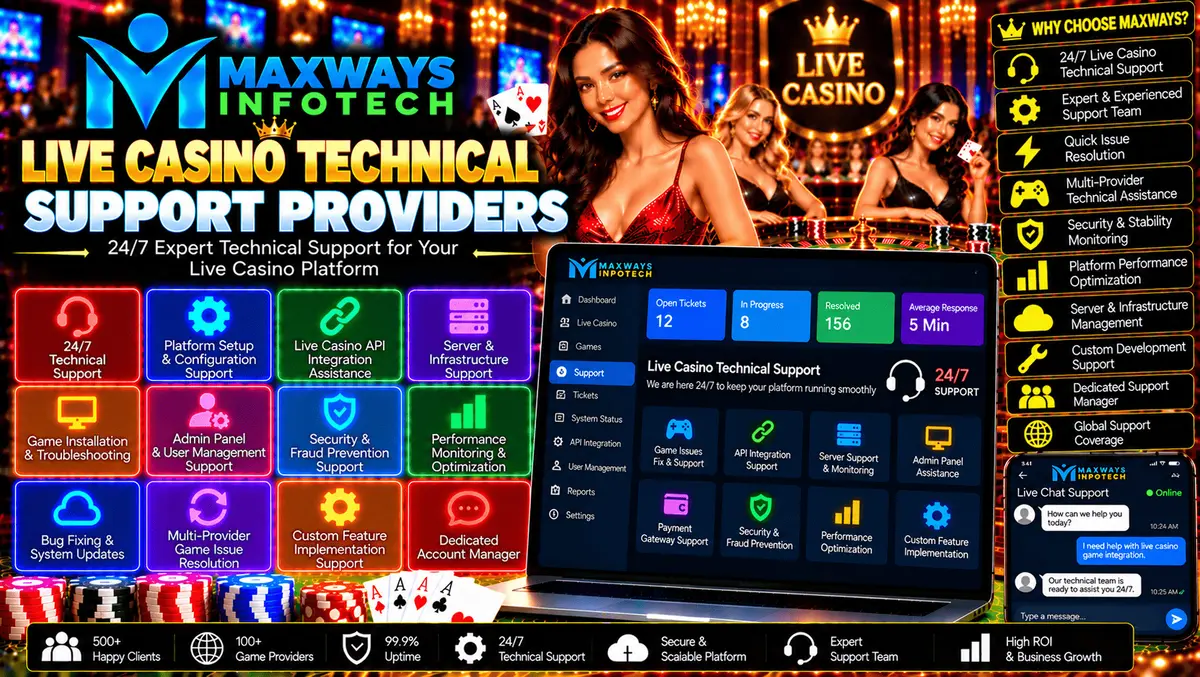
Learn how live casino technical support providers help with troubleshooting, API integration, platform monitoring, security, maintenance, and service reliability.
Live Casino Technical Support Providers: Services, Maintenance, and Platform Reliability
Introduction
A live casino platform depends on multiple technical components working together, including web applications, backend services, game integrations, databases, and monitoring systems. When one component experiences an issue, it can affect the overall platform experience. This is why Live Casino Technical Support Providers are important for businesses that need reliable technical assistance, software maintenance, and structured troubleshooting.
Technical support is not limited to fixing problems after they occur. It can also involve monitoring system performance, investigating integration errors, maintaining software, documenting incidents, and helping development teams prevent recurring issues.
Businesses exploring software development and technical services can visit Maxways Infotech to learn more about its digital development capabilities.
What Are Live Casino Technical Support Providers?
Live casino technical support providers help diagnose, resolve, and prevent technical problems affecting live casino software and related platform components. The exact scope depends on the service agreement, software architecture, and responsibilities assigned to each technology partner.
Support services may cover application errors, website performance, API connectivity, database issues, deployment problems, and communication between integrated systems.
Typical responsibilities include:
-
Investigating software errors and unexpected behaviour.
-
Troubleshooting approved third-party integrations.
-
Monitoring application availability and performance.
-
Supporting software updates and maintenance.
-
Reviewing logs and documenting incidents.
-
Coordinating with developers and technology vendors.
-
Helping maintain secure configurations and access controls.
-
Providing technical reports and recommendations.
A clearly defined support arrangement helps businesses understand which issues are handled by the support team and which require escalation to a software provider or infrastructure specialist.Live Casino Software API Provider | Maxways Infotech
Why Technical Support Matters for Live Casino Platforms
1. Faster Troubleshooting
Technical problems can originate from several places, including the frontend, backend, network, database, or an external service. A structured troubleshooting process helps narrow down the source of an issue before changes are made.
Support teams can review error logs, compare expected and actual responses, reproduce the problem in an approved test environment, and document the steps required to resolve it.
2. Platform Availability and Performance
Slow page responses, failed requests, or unavailable services can interrupt normal platform operations. Monitoring helps teams identify performance degradation and investigate whether the cause is related to application code, infrastructure capacity, database queries, or external dependencies.
Performance targets should be agreed in advance. A provider should explain what it monitors, how incidents are escalated, and how service availability is measured.
3. Reliable API Integrations
Live casino platforms may rely on APIs to communicate with game services and other approved systems. Integration problems can arise from authentication errors, expired sessions, incompatible response formats, rate limits, or provider-side outages.
Understanding cricket-betting-api-providers-in-india can help businesses recognise why clear interface definitions, error handling, and monitoring are important for connected software.
4. Better Software Maintenance
Software requires regular maintenance as dependencies, infrastructure, browsers, and external integrations change. Planned maintenance can include updates, compatibility testing, bug fixes, configuration reviews, and documentation improvements.
A maintenance schedule reduces the risk of leaving known technical issues unresolved for long periods.
5. Improved Incident Management
An incident management process defines how problems are reported, prioritised, investigated, resolved, and reviewed. It should identify who is responsible for each stage and how stakeholders receive updates.
For critical incidents, teams should record the impact, timeline, root cause where known, corrective action, and preventive measures. This creates a useful reference for future troubleshooting.
Common Technical Support Services
Application and Website Troubleshooting
Application support investigates errors in user interfaces, backend functions, forms, authentication flows, and other software components.
A useful troubleshooting process includes reproducing the issue, checking recent changes, reviewing relevant logs, identifying the affected component, and verifying the fix before release.
Changes should be tested in an appropriate environment whenever possible rather than applied directly to production without validation.
API and Third-Party Integration Support
API support focuses on communication between the platform and external services. This can involve request validation, authentication, timeouts, callback handling, response interpretation, and version compatibility.
For example, an integration may fail because a required field has changed or a remote service returns an unexpected status. Support engineers should identify whether the issue originates in the application, the integration layer, or the external provider.
For a related example, businesses can review the diamond-api-providers, which covers integration considerations such as authentication, system responsibilities, and error handling.
Database and Data-Consistency Support
Database-related issues may include slow queries, connection failures, missing records, or inconsistent information between connected systems.
Support teams should follow controlled procedures for database access and changes. Backups, audit logs, access restrictions, and tested recovery procedures are important safeguards when investigating problems involving important records.
If the platform processes transactions, the relevant authoritative records and reconciliation procedures must be clearly defined.
Server and Infrastructure Support
Infrastructure support can include reviewing resource utilisation, application logs, network connectivity, storage capacity, backup status, and deployment configuration.
Teams should establish clear responsibilities for cloud infrastructure, operating systems, certificates, DNS, network rules, and application hosting. This helps prevent delays when an incident crosses the boundary between software and infrastructure.
Software Updates and Bug Fixes
Maintenance support may include correcting confirmed defects, updating dependencies, testing compatibility, and preparing controlled releases.
A reliable change process should include version control, code review where appropriate, test results, release notes, and a rollback plan. The scope of support should specify whether new features are included or require a separate development agreement.
Monitoring and Technical Reporting
Monitoring can track service health, response times, error rates, resource utilisation, and integration failures. Alerts should be based on meaningful thresholds so teams can identify issues without generating excessive noise.
Technical reporting can summarise incident frequency, recurring problems, resolution progress, service trends, and recommended improvements. Sensitive information should be excluded or appropriately protected in logs and reports.
Businesses interested in data-related integrations can also explore the iGaming Data API Provider guide for considerations around data quality, monitoring, and dependable information exchange.
How to Choose the Right Live Casino Technical Support Provider
Choosing a support partner involves more than comparing prices or advertised availability. Businesses should evaluate the provider's technical process, communication practices, and ability to work within the existing software environment.
Check Relevant Technical Experience
Ask about experience with web applications, backend systems, databases, API integrations, hosting environments, and production troubleshooting. A suitable provider should be able to explain its investigation process and how it verifies a fix.
Review Support Availability and Response Targets
Clarify support hours, emergency coverage, escalation contacts, and response targets. A response time is not the same as a resolution time, so both should be explained in the service agreement.
Make sure the provider states how planned maintenance and third-party outages are handled.
Understand the Service-Level Agreement
A service-level agreement should define the services included, incident priorities, communication expectations, reporting, exclusions, and escalation procedures.
It should also explain whether the agreement covers software defects, infrastructure issues, vendor coordination, security incidents, or feature development.
Evaluate Security Procedures
Technical support may require access to production systems, logs, databases, or configuration settings. Access should be approved, limited to necessary responsibilities, and removed when no longer needed.
Ask how the provider protects credentials, manages remote access, records administrative activity, and handles suspected security incidents.
Confirm Documentation and Handover
Support work should not depend entirely on one individual’s knowledge. Request documentation of system components, known issues, troubleshooting steps, deployment procedures, and relevant escalation contacts.
A proper handover helps internal teams and future service providers understand the environment without repeating the same investigation.
Compare Cost With Scope
Support pricing can depend on coverage hours, system complexity, incident volume, response targets, and the skills required. Compare proposals by the actual services included rather than by the headline price alone.
For information about development services and related technical capabilities, visit Maxways Infotech.
Best Practices for Ongoing Technical Support
Businesses can improve support outcomes by preparing the platform before an incident occurs.
-
Maintain an accurate inventory of software components and integrations.
-
Keep technical documentation and escalation contacts up to date.
-
Establish monitoring and alerting for important services.
-
Apply updates through a controlled testing and release process.
-
Test backups and recovery procedures periodically.
-
Record incidents and investigate recurring causes.
-
Review access permissions and protect credentials.
-
Agree on responsibilities with external technology providers.
-
Schedule periodic reviews of support performance and unresolved risks.
These practices help teams move from reactive troubleshooting toward more predictable maintenance and continuous improvement.
Common Technical Support Challenges
Unclear Ownership
When several vendors manage different parts of a platform, it may be difficult to determine who should investigate an issue. A responsibility matrix can identify the owner of each component and define how cross-system incidents are escalated.
Incomplete Logs
Without relevant timestamps, request identifiers, or error details, diagnosing an issue can take longer. Logging should support investigation while avoiding the unnecessary collection of sensitive data or secret credentials.
Repeated Temporary Fixes
A temporary workaround may restore a service but leave the underlying cause unresolved. For recurring incidents, teams should document the root cause where possible and plan corrective action.
Poor Change Management
Untracked production changes can make problems harder to reproduce. Change records, testing, approvals, and rollback procedures help teams identify what changed and recover safely when needed.
Dependence on Third Parties
An issue may originate in an external API, hosting provider, or other dependency. The support agreement should explain how the provider coordinates with third parties and communicates when resolution depends on an external organisation.
Frequently Asked Questions
What do live casino technical support providers do?
They help investigate and resolve software, integration, infrastructure, and performance issues. Depending on the agreement, they may also provide monitoring, maintenance, incident reporting, and technical coordination.
Is technical support different from software development?
Yes. Technical support primarily focuses on diagnosing problems, maintaining existing systems, and restoring expected operation. Software development focuses on building or extending functionality, although the two services can overlap when a defect requires a code change.
What should a technical support agreement include?
It should describe service coverage, incident priorities, response targets, escalation procedures, security responsibilities, reporting, exclusions, maintenance activities, and the process for requesting additional work.
How can businesses reduce recurring technical issues?
Maintain useful logs, monitor important services, document incidents, test updates, review recurring failures, and implement preventive changes after investigating the underlying causes.
Should technical support be available around the clock?
That depends on the platform's operational requirements and the consequences of downtime. Businesses should select coverage based on risk, support budget, contractual obligations, and the availability of internal staff.
Why is API support important?
APIs connect separate software components. Support for these integrations helps diagnose authentication failures, timeouts, incompatible responses, and other communication problems that can affect overall platform reliability.
Conclusion
Choosing suitable Live Casino Technical Support Providers can help businesses maintain their software, investigate technical problems, manage integrations, and improve operational visibility. The most useful support arrangement combines clear responsibilities, secure access, structured incident management, and regular maintenance.
Before selecting a provider, compare technical expertise, response targets, documentation, security practices, and the exact services included in the agreement. A well-defined support process helps teams address problems methodically and plan improvements over time.
Compliance note: Live casino products and related services may be subject to licensing and other legal requirements. Any supported platform should operate only where legally permitted and maintain appropriate licences, age safeguards, privacy protections, responsible-use measures, and compliance with applicable regulations.Live casino api provider | Maxways Infotech