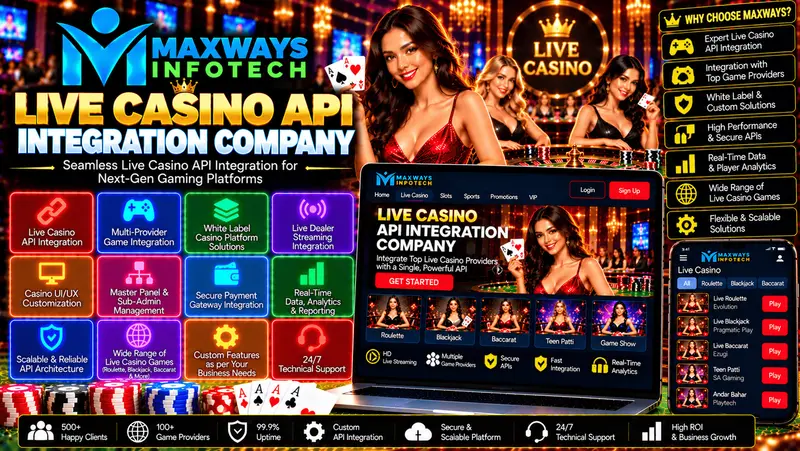
Explore live casino software API providers, integration features, backend connectivity, security, testing, and maintenance best practices.
Live Casino Software API Provider: Features, Integration, and Development Guide
Live Casino Software API Provider supplies API technology or related integration services that help connect authorised gaming software with websites, applications, and backend systems. The available features depend on the provider, its documentation, and the commercial agreement.
Choosing the right solution requires more than comparing advertised features. Businesses should evaluate API compatibility, authentication, documentation, performance, integration costs, maintenance, and legal permissions before beginning development.
At Maxways Infotech, businesses can explore software development resources when planning their digital platform requirements.
What Is a Live Casino Software API Provider?
A live casino software API provider offers an application programming interface (API), related software, or integration capabilities that allow compatible systems to exchange information.
An API defines how one application sends a request, how another system processes it, and what information is returned. This makes it possible to connect software components without requiring every function to be built into one application.
Depending on the provider, supported functionality may include:
-
Access to authorised game catalogues.
-
Game session creation and validation.
-
Integration with compatible platform services.
-
Supported account or player information exchange.
-
Administrative and reporting interfaces.
-
API documentation and technical support.
-
Error handling and integration monitoring.
Not every provider offers every feature. Businesses should confirm the exact capabilities and permitted use of an API before designing the platform around it.
Why Businesses Need Live Casino Software API Solutions
1. Connect Different Software Systems
An online platform may contain a website frontend, backend application, database, administrative dashboard, and external gaming services. APIs establish defined communication between these components.
A well-designed integration separates responsibilities and helps developers understand where information originates and which system is responsible for processing it.
2. Reduce Duplicated Development
When an authorised external service already provides the required functionality, integration may reduce the need to develop an equivalent system from scratch.
However, integration still requires backend development, authentication, testing, monitoring, and maintenance. The actual time and cost savings depend on the API's compatibility and documentation.
3. Support Flexible Platform Development
A structured API layer can make it easier to update a website, introduce additional supported services, or change individual components without redesigning the entire application.
Clear interface contracts and version management are important to prevent updates from breaking existing functionality.
4. Improve Technical Monitoring
API integrations can provide useful information about failed requests, response times, authentication issues, and service availability. Appropriate monitoring helps technical teams identify and investigate problems.
For businesses researching related game development capabilities, live-casino-website-developers-in-bengaluru are a relevant resource for understanding the wider software requirements of a digital platform.
Essential Features to Evaluate in a Live Casino Software API Provider
API Documentation
Good documentation explains available endpoints, authentication methods, request parameters, response fields, rate limits, and error codes.
Before selecting a provider, check whether the documentation includes examples, a testing environment, versioning information, and instructions for handling failed requests.
Game Catalogue and Session Support
Some APIs provide access to authorised game catalogues and supported session functions. These capabilities may allow a compatible website to retrieve game information or request a session through the provider's documented process.
Confirm which games, providers, and session operations are available. Do not assume that every API includes the same catalogue or functionality.
Authentication and Access Controls
APIs should verify that requests originate from authorised users or applications. Depending on the service, authentication may use tokens, restricted credentials, or other documented mechanisms.
Confidential credentials should be stored securely on backend systems and never exposed in public frontend code.
Error Handling and Reliability
External services may become unavailable, respond slowly, or return unexpected data. The integration should handle timeouts, invalid responses, expired credentials, and rejected requests in a predictable way.
For operations that could change account or transaction state, retry behaviour must be designed carefully to prevent duplicate actions.
Compatibility and Scalability
The API should be compatible with the website's backend, hosting environment, data model, and operational requirements.
Developers should test performance under realistic conditions and understand any rate limits or usage restrictions before estimating the platform's capacity.
Ongoing Technical Support
Ask how the provider communicates API changes, handles incidents, and supports developers during integration. Maintenance responsibilities should be documented before the project begins.
Live Casino Software API Integration Process
A structured integration process helps businesses verify compatibility and reduce avoidable development problems.
Step 1: Define the Project Requirements
Identify the features the platform needs, the systems it must connect to, the expected data flows, and the supported devices.
Document essential requirements separately from optional features. Confirm that the intended use is authorised and permitted in the target market.
Step 2: Review the API Specification
Examine the provider's documentation, authentication requirements, endpoint definitions, request formats, response structures, and usage limits.
If a sandbox is available, use it to validate the integration before connecting production systems.
Step 3: Design the Application Architecture
Determine which system manages each responsibility, including account information, game sessions, application logic, and reporting.
A clear architecture reduces duplicated responsibilities and makes it easier to investigate issues across connected services.
Step 4: Develop the Backend Integration
Implement the required API requests, validation rules, authentication, and response handling. Keep confidential credentials in secure server-side configuration.
The backend should validate incoming information before passing it to other application components.
Step 5: Test Functionality and Security
Test successful requests alongside invalid input, expired credentials, timeouts, unexpected responses, and provider outages.
Security testing should cover access permissions, sensitive-data handling, input validation, and the risk of exposing confidential information.
Step 6: Deploy and Monitor
Deploy the integration using a controlled release process. Configure monitoring, error reporting, and appropriate logging.
After launch, track performance and review provider updates so that changes can be tested before they affect production.
For a related example of casino API implementation guidance, explore live-casino-software-api-provider. The features and permissions available for any particular integration should be confirmed with the relevant provider.
Custom API Development vs Third-Party API Integration
Businesses should decide whether they need a custom API, an integration with an existing service, or a combination of both.
| Area | Custom API development | Third-party API integration |
|---|---|---|
| Main purpose | Create or extend software interfaces | Connect to an existing external service |
| Custom business logic | Can be tailored to requirements | Limited by the external API |
| Development work | Requires building and testing the interface | Requires connecting and testing the interface |
| External dependency | Depends on architecture | Usually depends on the provider |
| Maintenance | Custom code must be maintained | Integration code and provider changes must be managed |
Custom development can provide greater control over application logic, while a suitable third-party API may reduce duplicated work. The right option depends on technical requirements, costs, permissions, and maintenance needs.
How to Choose the Right Live Casino Software API Provider
Choosing a provider should involve a technical and commercial assessment rather than relying on a promotional feature list.
Consider the following questions:
-
Supported functionality: Does the API provide the specific features required by the project?
-
Technical compatibility: Can it work with the existing website and backend?
-
Documentation: Are integration instructions and error definitions available?
-
Security: How are credentials, access permissions, and sensitive data protected?
-
Performance: What information is available about response times, availability, and usage limits?
-
Support: Who handles integration problems and technical questions?
-
Pricing: Are setup fees, subscriptions, usage limits, and support costs clearly defined?
-
Compliance: Are the services and intended business model permitted in the relevant jurisdiction?
Request a written proposal that identifies the included services, development responsibilities, integration requirements, testing process, and ongoing support.
Common Challenges in Live Casino Software API Integration
Incompatible Technology
An API may not support the required functionality or existing software architecture. Review documentation and confirm feasibility before committing to a development schedule.
Authentication Errors
Expired credentials or incorrect permissions can prevent successful requests. Use secure credential management and monitor authentication failures.
External Service Outages
A connected provider may experience downtime. Implement appropriate timeouts, clear error states, and recovery procedures to reduce the impact on the website.
Unexpected API Changes
External services can change their endpoints, response formats, or authentication requirements. Maintain documentation and test updates before deploying them to production.
Unclear Costs and Responsibilities
Initial integration costs may not include provider subscriptions, additional usage fees, maintenance, or future upgrades. Confirm these costs and responsibilities in the agreement.
SEO Considerations for Live Casino Software Websites
A reliable API does not automatically improve search rankings. SEO depends on the website's content, structure, accessibility, performance, and relevance.
Important practices include:
-
Writing unique title tags and meta descriptions.
-
Using clear headings and descriptive URLs.
-
Ensuring important content is accessible to search engines.
-
Optimising images and page-loading performance.
-
Linking relevant service pages naturally.
-
Maintaining an accurate XML sitemap.
-
Avoiding duplicate pages created only for keyword variations.
-
Reviewing canonical URLs and indexing settings.
Businesses planning the user-facing side of their platform can explore igaming-software-api-provider.
Internal links should be relevant to each article's subject. Using different, descriptive anchor text across related posts helps readers navigate the site without making every article look identical.
Frequently Asked Questions
What does a live casino software API provider do?
A provider supplies API technology or related services that allow compatible applications to communicate with authorised gaming systems. The available functions depend on the provider's API and commercial agreement.
What is the difference between an API provider and an API developer?
An API provider supplies or operates the interface and associated service. An API developer creates, integrates, or maintains software that communicates through the interface. One project may involve both.
Can a live casino API be integrated into an existing website?
It may be possible if the website architecture is compatible and the API provider supplies the required documentation, access, and permissions. A technical assessment should confirm feasibility.
How much does live casino software API integration cost?
Costs depend on integration complexity, development requirements, provider fees, testing, security, and ongoing maintenance. A reliable estimate requires a review of the project scope.
How can businesses evaluate API security?
Review authentication, access controls, secure credential storage, encryption, input validation, monitoring, incident response, and regular testing.
Is API integration a one-time task?
No. Initial implementation is only one part of the work. Integrations may require ongoing monitoring, defect fixes, security updates, and changes when external providers update their APIs.
Conclusion
A Live Casino Software API Provider can supply the technology needed to connect compatible gaming services with websites and applications. The best solution depends on functionality, technical compatibility, documentation, security, pricing, and ongoing support.
Before selecting a provider, document the required features, review API specifications, confirm commercial permissions, and establish clear maintenance responsibilities. These steps help businesses make informed decisions and plan a more manageable integration.
To explore software development resources, visit Maxways Infotech. Any live casino-related platform should only be developed or operated where legally permitted, with appropriate licensing, age safeguards, privacy protections, and other applicable compliance measures.