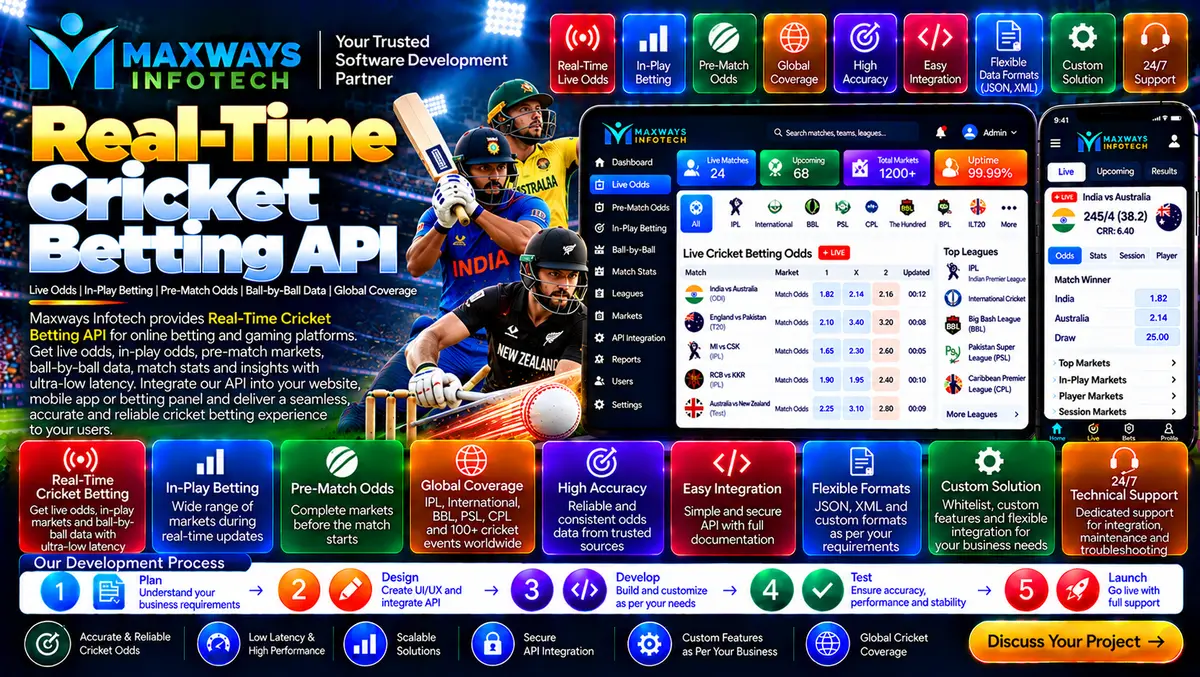
Explore Real-Time Cricket Betting API integration, live event processing, latency monitoring, reconnection strategies, scalability, security, and data freshness.
Real-Time Cricket Betting API: Architecture, Live Data Processing, and Reliable Updates
A Real-Time Cricket Betting API provides access to rapidly changing cricket information through software interfaces that applications can use to process live match data and supported odds markets. For developers, the challenge is not simply receiving an update quickly. The system must also determine whether the information is current, apply changes in the correct order, handle interruptions, and prevent outdated records from being presented as live.
Cricket makes this especially important because a single delivery can change the match situation. A boundary, wicket, no-ball, rain interruption, or innings break may require several parts of an application to update consistently. The quality of the integration depends on how these events are processed and communicated, not merely on the API's advertised speed.
Businesses exploring technology development can visit Maxways Infotech to review the company's published information. Before selecting a real-time data solution, developers should define their update requirements, verify the provider's documented capabilities, and confirm that the intended use is permitted.
What Is a Real-Time Cricket Betting API?
A Real-Time Cricket Betting API is an interface that supplies supported cricket information and, where included, odds or market updates while a match is in progress.
Depending on the provider, available information may include:
-
Live match status and score updates.
-
Ball-by-ball events and innings information.
-
Supported odds and market identifiers.
-
Market suspension or availability status.
-
Event timestamps and source identifiers.
-
Historical or current match snapshots.
These features are not guaranteed to be available from every provider. Some APIs focus on scores, while others provide odds data or additional streaming capabilities.
The distinction matters when planning an application. A live-score feed alone does not necessarily provide betting odds, and an odds feed does not automatically provide every ball-by-ball statistic.
1. Measure End-to-End Data Latency
Real-time performance should be measured across the complete journey from the source to the application interface.
A useful model separates the process into several stages:
-
The cricket event occurs.
-
The source confirms or records the event.
-
The provider processes the information.
-
The API delivers the update.
-
The application's backend validates and processes it.
-
The frontend displays the new state.
Each stage can introduce delay. Improving the application server will not eliminate delays that occur before the provider publishes an update.
Developers should measure the time spent at each stage wherever timestamps and tracing information are available. Useful metrics include median latency, 95th-percentile latency, timeout rate, and the age of the latest confirmed update.
Avoid promising a fixed number of milliseconds unless the result has been measured under representative conditions and is supported by the provider's documented commitments.
2. Choose the Right Update Delivery Method
Different applications have different update requirements. A REST API, WebSocket connection, or webhook-based integration can be appropriate depending on how data is delivered and how frequently it changes.
A hybrid approach can be useful. The application retrieves a complete match snapshot through a documented endpoint and then consumes incremental updates through a supported streaming connection.
The snapshot provides an initial state, while subsequent messages communicate changes. If the connection is interrupted, the application can request another snapshot to reconcile its local state.
Developers should choose the delivery method based on actual provider capabilities rather than assuming every Cricket API supports WebSockets or webhooks.
3. Process Cricket Events With a Consistent State Model
A live match should be represented as a state that changes as validated events arrive.
For example, an application may track the current innings, batting team, score, wickets, over, match status, and the time of the most recent update. The exact fields depend on the source and the application.
When a new event arrives, the processing layer should:
-
Identify the relevant match.
-
Validate the event's structure.
-
Check its event identifier or sequence information, when available.
-
Apply the event to the correct match state.
-
Save the updated state.
-
Notify connected clients if the state has changed.
This approach reduces the risk of different screens displaying conflicting information.
Cricket also requires careful treatment of extras, penalty runs, wickets, and over progression. Developers should rely on documented event definitions and appropriate cricket-scoring rules rather than calculating every score change from a simplified assumption.
4. Prevent Duplicate and Out-of-Order Updates
Real-time systems can receive duplicate messages, particularly when a provider retries delivery or an application reconnects after a network interruption.
Out-of-order events create another challenge. If a later event is applied before an earlier one, the displayed match state may become incorrect.
A robust integration can use the following techniques:
Event identifiers: Store unique identifiers when the provider supplies them so repeated events can be recognised.
Sequence numbers: Use documented sequence numbers to identify gaps or unexpected ordering.
Idempotent processing: Ensure that processing the same event twice does not apply the same score change twice.
State reconciliation: Compare the locally calculated state with a current authoritative snapshot when necessary.
Transactional updates: Where supported by the architecture, save the event record and corresponding state change together.
Not every provider exposes sequence numbers or replayable events. In those cases, the implementation should use the recovery options that are actually documented.
5. Keep Market Status Separate From Odds Values
For applications that consume odds data, the numerical price and the market's availability are separate pieces of information.
A provider may report a price and later indicate that the market has been suspended. The application should not assume that the last received price remains available simply because the value is still stored in its database.
A suitable data model can track:
-
Match and market identifiers.
-
Selection identifier.
-
Odds value and format.
-
Source identifier.
-
Observation timestamp.
-
Market status.
-
Last successful update time.
The user interface can then distinguish between an active market, a suspended market, and data whose freshness cannot be confirmed.
This is especially important during wickets, innings changes, rain interruptions, and other events when a market's status may change rapidly. The exact behaviour should follow the provider's documented market definitions and the application's permitted use.
6. Handle Reconnection Without Losing Match State
Network interruptions are inevitable in distributed applications. A reliable integration should define what happens when a streaming connection closes, messages stop arriving, or the provider temporarily becomes unavailable.
A recovery process may include:
-
Detect that the connection has failed or become stale.
-
Mark the stream as reconnecting.
-
Reconnect using the provider's documented procedure.
-
Request the latest complete state where supported.
-
Reconcile the recovered state with locally stored information.
-
Resume processing new events.
-
Record the interruption for monitoring.
Reconnecting alone is not always sufficient. The stream may resume with only new events and may not replay everything missed during the interruption.
A fresh snapshot can help restore the current state, while event history can help diagnose what happened during the gap if the provider supplies it.
The interface should not continue displaying an unqualified “LIVE” status when the application can no longer confirm that its information is current.
7. Manage Traffic During High-Profile Matches
Large cricket tournaments can create sharp increases in traffic. Many users may open the same match page simultaneously, even though the underlying data changes only occasionally.
If every browser independently requests the external API, the application may waste requests, exhaust its quota, or expose credentials.
A more efficient architecture places a backend service between the provider and the frontend.
The backend can retrieve or receive updates, validate the data, maintain the current state, and distribute relevant changes to connected users. A shared cache can serve repeated reads, while a message-broadcasting layer can distribute updates across application servers when necessary.
Developers should size the system using expected concurrent users, update frequency, payload size, provider limits, and measured load-test results.
Caching should also respect the freshness requirements of each data type. Static tournament information can often be cached longer than rapidly changing match data.
8. Build Monitoring Around Freshness and Correctness
A system can appear healthy because requests are returning successfully while the information being displayed is outdated. Monitoring must therefore examine the data as well as the infrastructure.
Alerts should reflect the expected update schedule and the requirements of the application. A period without new events may be normal, while a disconnected stream during active play may require investigation.
Logs should include useful identifiers and timestamps but must not expose API credentials or unnecessary sensitive information.
9. Protect Credentials and Separate Application Services
API credentials should be stored securely on the server, not embedded in public JavaScript or exposed through a mobile application's distributed source code.
The integration should use encrypted connections, restricted permissions, controlled credential rotation, and suitable request limits.
It is also helpful to separate responsibilities. The data-ingestion component can receive provider updates, the processing component can validate and apply them, and the delivery component can communicate the current state to authorised users.
This separation makes it easier to investigate errors and scale individual parts of the system. Projects that also process financial or account-related information may need additional access controls and audit records. Related software development information is available through Maxways Infotech's fintech page.
10. Test the System Before Production
Testing should cover both normal match progression and unexpected conditions.
Important scenarios include:
-
A boundary or wicket produces an update.
-
A delivery includes extras.
-
An event arrives more than once.
-
Updates arrive in an unexpected order.
-
The streaming connection drops during an innings.
-
The provider returns a rate-limit or server error.
-
A market changes status.
-
The latest snapshot differs from the locally stored state.
-
A large number of clients request the same match.
-
An update contains missing or malformed fields.
Load testing should measure the system under realistic conditions rather than relying on a small development environment. Recovery tests should also verify that the application does not double-count events or present stale information as current.
11. Review Licensing and Legal Requirements
API access does not automatically authorise every use of cricket data or odds information. Providers may set restrictions on commercial display, data storage, redistribution, and access by third parties.
Before launching a product, review the provider's licence and confirm that the planned use is covered. If the application includes betting or real-money functionality, obtain qualified legal advice about applicable laws and licensing requirements in each relevant jurisdiction.
Businesses targeting India should pay particular attention to the current rules concerning online money gaming and related activities. Technical integration is not a substitute for legal permission.
Frequently Asked Questions
What is a Real-Time Cricket Betting API?
It is an interface that supplies supported live cricket data and, depending on the service, odds or market updates. Its capabilities, delivery methods, and update frequency vary by provider.
Is a WebSocket always faster than REST polling?
WebSockets can deliver supported events without waiting for the next polling interval. However, actual end-to-end latency also depends on the data source, provider processing, network conditions, and application architecture.
How can duplicate live events be handled?
Use unique event identifiers and idempotent processing where possible. Sequence numbers and authoritative snapshots can also help identify gaps and reconcile the local state.
Why is data freshness important?
An API response may succeed while the returned information is already old. Monitoring update age helps an application distinguish current information from data that needs to be refreshed or labelled as stale.
Can one API connection serve multiple users?
A backend service can often consume a provider feed and distribute validated updates to many authorised users. The design must follow the provider's connection limits, licensing terms, and permitted redistribution rules.
Conclusion
A Real-Time Cricket Betting API requires more than rapid data delivery. Reliable event processing, consistent match state, reconnection handling, market-status awareness, traffic management, and meaningful monitoring are all essential parts of a dependable integration.
Developers should measure actual latency, test recovery scenarios, and make sure the interface clearly communicates when information is no longer current. They should also verify API capabilities, protect credentials, and confirm that the intended use is permitted.
For more software development articles and technology insights, explore the Maxways Infotech blog.