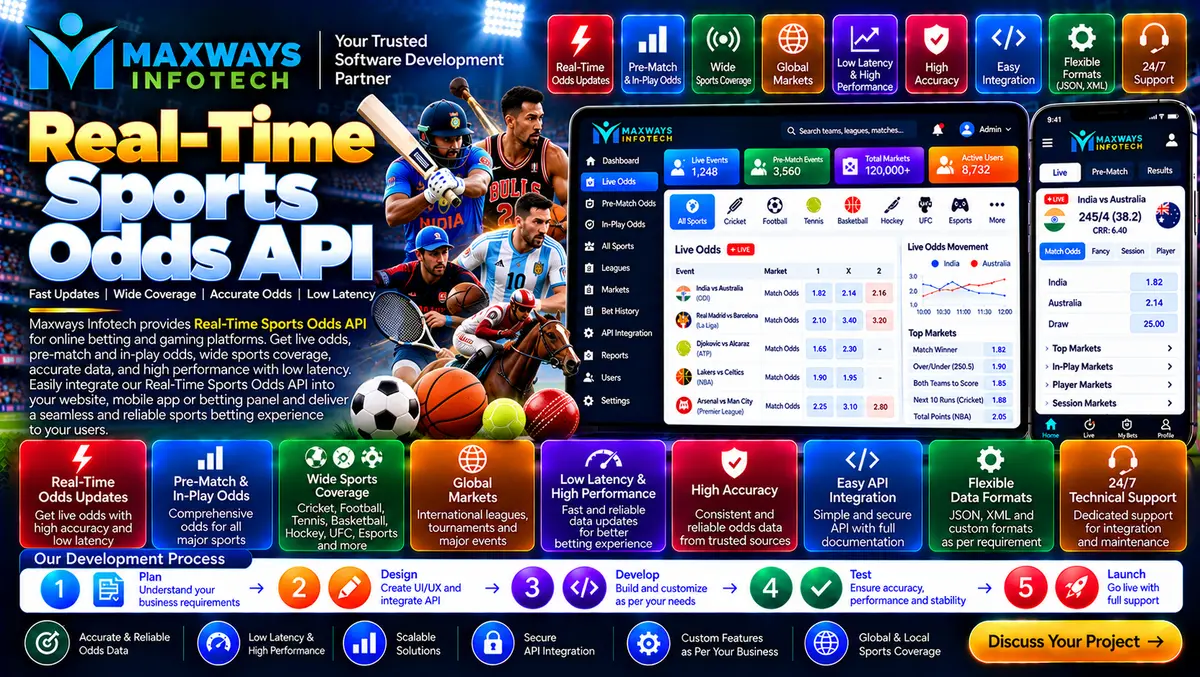
Learn about Real-Time Sports Odds API integration, latency measurement, data freshness, feed synchronisation, recovery strategies, monitoring, and secure data delivery.
Real-Time Sports Odds API: Latency Measurement, Feed Synchronisation and Performance
A Real-Time Sports Odds API helps applications access frequently updated sports odds and market information through a structured software interface. It can support sports analytics dashboards, data comparison tools, live event displays, and authorised applications that depend on timely information.
For developers, the central challenge is measuring how quickly data moves from its source to the user. An API response can be fast while the underlying information is already outdated. Similarly, an application may receive updates quickly but display them incorrectly because several data sources report different values or use different timestamps.
A successful real-time integration must therefore measure data freshness, manage multiple feeds, handle traffic efficiently, and communicate delays honestly. These engineering decisions are essential when a product depends on information that changes throughout a sporting event.
What Is a Real-Time Sports Odds API?
A Real-Time Sports Odds API provides access to sports odds information that can change as events progress. Depending on the provider, it may supply event identifiers, market descriptions, selections, odds values, timestamps, and availability information.
Some services support streaming updates, while others provide data through periodic requests. Historical snapshots, supported sports, and market coverage vary between providers.
Common applications include:
-
Live sports statistics and market dashboards.
-
Multi-provider data comparison systems.
-
Sports data research and visualisation.
-
Event monitoring applications.
-
Licensed sports information platforms.
Before implementation, developers should establish which data is available, how frequently it is updated, and what the provider's timestamp fields actually represent.
Understanding the Difference Between Latency and Freshness
Latency and freshness are related, but they are not the same measurement.
Latency measures the time taken for information to move between defined points in a system.
Freshness describes how recently the underlying information was observed or updated.
Consider a hypothetical example: an API responds in 80 milliseconds, but the data returned was last updated 12 seconds earlier. The response is fast, yet the information may be too old for a live display.
A useful monitoring system records at least two timestamps:
-
source_timestamp: when the provider says the information was generated or observed. -
received_timestamp: when the application received the record.
The exact meaning of each timestamp should follow the provider's documentation. If the source timestamp represents publication time rather than the original event time, the application should not interpret it as proof of when the market actually changed.
Developers should define freshness thresholds based on the provider's normal update behaviour and the application's requirements, rather than assuming that every sport needs the same refresh interval.
Measuring Performance Across the Entire Data Pipeline
An API integration contains several stages, and each stage can contribute to the overall delay.
A typical pipeline looks like this:
Data source → API provider → Ingestion service → Validation layer → Cache or database → Delivery service → User interface
Each component has a different responsibility.
Data source and provider
The application depends on how quickly the upstream provider receives and publishes information. This stage may be outside the application's direct control.
Ingestion service
The ingestion service receives data and records when it arrived. Heavy processing at this stage can create queues and increase delays during busy periods.
Validation and normalisation
Incoming records are checked for valid identifiers, timestamps, market definitions, and data formats. Consistent mapping prevents different providers from representing the same event in incompatible ways.
Storage and caching
The system stores or caches the latest accepted values. Cache rules must account for freshness, and older messages should not overwrite newer confirmed records.
Delivery and display
The delivery layer sends information to the relevant clients. Monitoring should include the time needed to deliver and render updates, not merely the time required for a backend request.
Separating these stages makes performance problems easier to diagnose. If users report delays, developers can investigate the relevant stage instead of assuming that the API provider is responsible for every issue.
Choosing Between Polling and Push-Based Delivery
The communication method can influence both update delay and infrastructure costs.
REST polling
Polling asks the API for updated information at a configured interval. It is straightforward to implement and can be suitable for snapshots, low-frequency updates, and providers that do not offer streaming.
However, a change may not be detected until the next request. Increasing the polling frequency can reduce that waiting period but also increases request volume.
WebSockets
WebSockets provide a persistent, two-way communication channel when supported by the provider. They can deliver updates without requiring a new HTTP request for every change.
Developers must still manage authentication, subscriptions, connection interruptions, and message ordering.
Server-sent events
Server-sent events provide a persistent connection for server-to-client updates. They may be appropriate when an application mainly receives information rather than sending messages through the same connection.
The correct choice depends on the provider's capabilities, hosting environment, and data requirements. Push delivery can remove the delay caused by waiting for the next polling interval, but it cannot remove delays that occur before the provider publishes the data.
Synchronising Data from Multiple Providers
Applications that use multiple data sources face a different challenge: the sources may not publish the same information at exactly the same time.
One provider may report an update before another. Their event identifiers may also differ, and the same market may be described using different labels.
A normalisation layer should establish consistent internal identifiers for:
-
Sports and competitions.
-
Events and participants.
-
Markets and selections.
-
Data providers.
-
Individual observations and update versions.
When two providers report conflicting values, the application should retain source attribution and apply a documented comparison policy. It should not automatically assume that the most recently received message is the most accurate.
For example, a message received later might describe an older observation that was delayed in transit. Source timestamps, version numbers, and provider-specific sequencing rules can help resolve such conflicts.
If the sources cannot be compared reliably, the application should mark the discrepancy for review rather than silently combining incompatible records.
Businesses exploring software development options can start with the Maxways Infotech homepage for company information and published services.
Handling Traffic Spikes Without Losing Updates
Sports data systems often experience uneven traffic. A large tournament or a major match can cause a sudden increase in active users, subscriptions, and update volume.
A system that performs well during quiet periods may develop processing queues or slow database queries when demand rises.
Several techniques can help.
Separate ingestion from client requests. Incoming provider data should not require every user request to trigger another upstream API call.
Use suitable caching. Store validated current-state data where permitted and serve repeated reads from an appropriate cache.
Apply backpressure. If updates arrive faster than downstream services can process them, the system needs a defined way to manage queues without silently losing important state changes.
Scale delivery services independently. The number of incoming provider updates may grow differently from the number of connected users.
Limit unnecessary subscriptions. Request only the events and markets that the application needs, where the provider supports selective subscriptions.
Test peak workloads. Simulate high traffic, multiple active events, slow consumers, and temporary provider failures before launch.
Performance targets should be based on measured results and agreed service requirements. Avoid publishing guaranteed response times unless they have been verified and can actually be supported.
Designing Reliable Recovery After a Feed Interruption
A live connection may fail because of network issues, a provider outage, a server restart, or a temporary authentication problem. Reconnecting is only part of the recovery process: the application must also establish whether it missed any updates.
A robust recovery procedure can include:
-
Detect the interruption using connection status or provider-supported heartbeats.
-
Record the last successfully processed sequence number or update version, if available.
-
Reconnect using controlled retries and increasing delays.
-
Reauthenticate and restore the required subscriptions.
-
Retrieve a fresh snapshot or replay missed events if the provider supports it.
-
Reconcile the recovered state with the application's current records.
-
Resume normal delivery only after the necessary consistency checks.
Duplicate and out-of-order messages should be handled according to the provider's documented protocol.
If historical replay is unavailable, a fresh snapshot may restore the current state, but it may not recover every intermediate change. The application should understand and document this limitation.
Percentile measurements, such as p50, p95, and p99, can show whether a system performs consistently or suffers from occasional severe delays. These figures should be measured using a clearly defined start point and end point.
Alerts should be tied to meaningful thresholds. For example, a rising queue depth combined with increasing processing delay may indicate that a service needs attention before the interface becomes noticeably outdated.
Security and Data Governance
Real-time systems need to protect credentials and control which services can access data.
API keys should be stored securely on the server. Applications should use encrypted connections, validate incoming payloads, restrict permissions, and avoid logging secret credentials.
For webhook integrations, verify that incoming notifications originate from an authorised source using the provider's supported authentication or signature mechanism.
Data governance is equally important when information is stored or redistributed. Providers may impose restrictions on retention, commercial display, historical analysis, or onward sharing. Review those conditions before building a public-facing product.
For applications involving financial workflows or data-intensive business software, the Maxways Infotech fintech page can serve as an additional resource for researching related development capabilities.
Any betting-related application must also undergo appropriate legal review for its intended jurisdiction. Access to an API does not, by itself, grant permission to operate a betting service.
A Practical Pre-Launch Checklist
Before deploying a Real-Time Sports Odds API integration, confirm that the development team has addressed the following:
-
The required sports, competitions, and markets are available.
-
Timestamp fields have documented meanings.
-
The application distinguishes source freshness from response speed.
-
Provider-specific identifiers map correctly to internal records.
-
Older or duplicate messages cannot silently corrupt current state.
-
Market and event status changes are handled explicitly.
-
Connection recovery and snapshot reconciliation have been tested.
-
Rate limits and traffic spikes are handled appropriately.
-
Monitoring covers ingestion, processing, and delivery.
-
API credentials are protected.
-
Data storage and redistribution comply with provider terms.
-
Applicable legal requirements have been reviewed.
Completing these checks helps establish whether the integration is ready for the application's intended workload.
Frequently Asked Questions
What is a Real-Time Sports Odds API?
It is an API that provides odds-related information for supported sporting events with updates delivered according to the provider's feed and service design.
Does real-time delivery guarantee fresh data?
No. Delivery speed and source freshness are different. A system should measure both and clearly identify information that may be outdated.
Is WebSocket always better than polling?
Not in every situation. WebSockets can suit frequent updates, while polling may be simpler for periodic snapshots or providers without streaming support. The choice depends on the actual workload and API capabilities.
How can developers measure API latency accurately?
Record timestamps at relevant stages of the pipeline and measure the time between clearly defined points. Source-data age should be measured separately from application processing and delivery delays.
What should developers do when a provider connection fails?
Use controlled reconnection, restore subscriptions, and retrieve a fresh snapshot or missed events when supported. Reconcile the recovered state before assuming that every update has been received.
For more technical articles and software-related information, visit the Maxways Infotech blog.
Conclusion
A Real-Time Sports Odds API is only as useful as the system that processes and presents its information. Fast responses matter, but accurate timestamps, reliable feed synchronisation, controlled recovery, and clear monitoring are equally important.
Developers should measure the full journey from data source to application interface, define how conflicting records are handled, and test how the system behaves during interruptions and traffic spikes. These practices help create a more dependable sports data application without making unsupported promises about speed or availability.
Before using or redistributing odds information, verify the provider's permissions and all applicable legal requirements.