Discover how to evaluate a Sports API Provider for sports coverage, data quality, update behaviour, documentation, pricing, security, and commercial usage rights.
Sports API Provider: How to Evaluate Data Coverage, Reliability and Integration
Choosing a Sports API Provider is an important decision for any business developing a sports statistics website, live-score application, analytics dashboard, or sports information platform. The provider determines which competitions and data fields an application can access, how the information is delivered, and what restrictions apply to storing or displaying it.
However, choosing a provider based only on the number of sports advertised or the lowest subscription price can lead to problems later. A service may cover a sport without supporting the particular league, season, statistics, or update frequency an application needs.
A more reliable approach is to evaluate each provider against a documented set of technical, commercial, and operational requirements before committing to an integration.
What Does a Sports API Provider Offer?
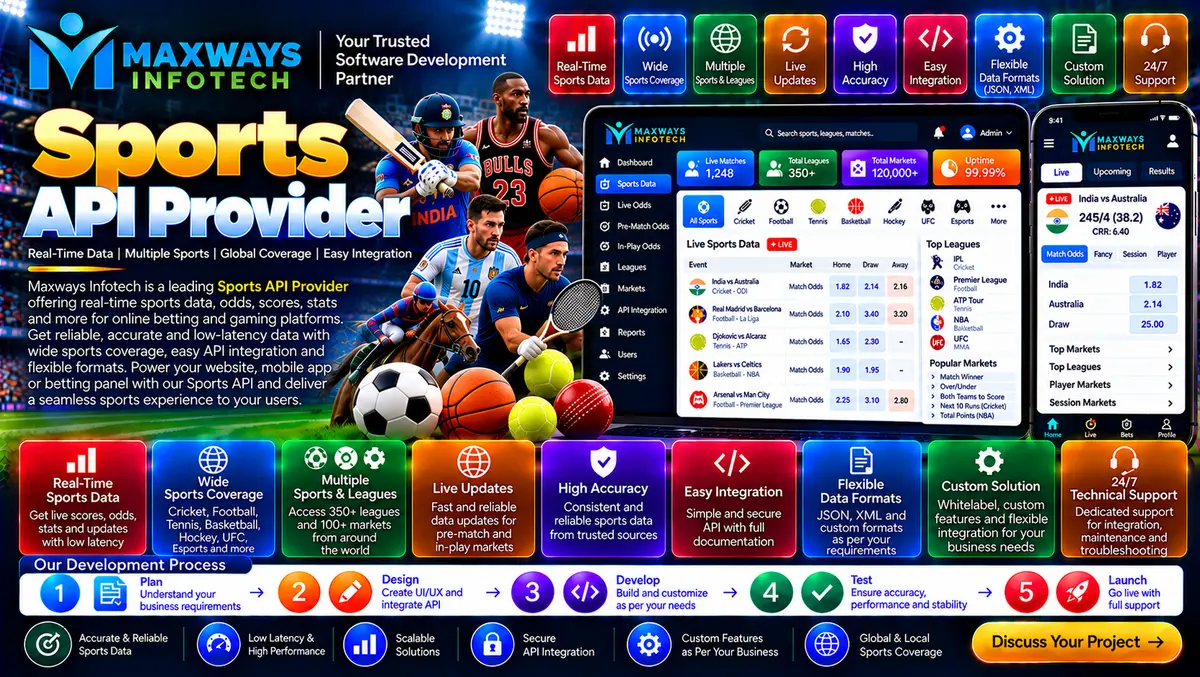
A Sports API Provider supplies programmatic access to sports-related information through documented interfaces. The exact scope varies between providers and products.
Depending on the service, available data may include:
-
Fixtures, schedules, and match results.
-
Live scores and event updates.
-
Team and player statistics.
-
Competition tables and standings.
-
Historical sports records.
-
Odds and market information, where offered.
-
Event metadata and other supporting information.
Not every provider offers all these features, and access may differ by sport, competition, subscription tier, or commercial agreement.
For example, a basic score application may require fixtures and final results, while an advanced analytics platform may need player-level statistics and several seasons of historical records.
Defining the intended application first helps prevent paying for unnecessary features or selecting a service that cannot meet essential requirements.
Businesses researching development options can visit the Maxways Infotech homepage for company information and published services.
1. Verify Actual Sports and Competition Coverage
Coverage should be evaluated at the level of the competitions and data fields your application needs, not just the provider's total sport count.
A provider may support football, cricket, basketball, and tennis but offer different levels of detail for each sport. One competition might include detailed player statistics, while another provides only schedules and final scores.
Before selecting a provider, prepare a coverage checklist that includes:
Sports: Which sports are essential at launch, and which may be added later?
Competitions: Are the specific leagues, tournaments, and seasons available?
Data depth: Does the provider supply scores only, or also the statistics and events required?
Historical coverage: How many previous seasons are accessible, if historical analysis is needed?
Availability: Are the required endpoints included in the proposed subscription?
Ask the provider to confirm important requirements in writing or demonstrate them through documentation and sample responses. A sport appearing on a coverage page does not automatically prove that every competition or endpoint is available.
2. Assess Data Quality and Consistency
A sports application depends on accurate, structured information. Missing event identifiers, inconsistent team names, and incorrect timestamps can create problems even when API requests succeed.
A provider evaluation should examine how data quality is maintained and communicated.
Stable identifiers
Event, team, player, and competition identifiers help applications connect records reliably. Stable identifiers are generally more useful than relying entirely on display names, which may change or appear differently across sources.
Consistent response structures
A predictable schema makes it easier to process data across different competitions. Check whether fields remain consistent and how the provider represents unavailable values, postponed matches, and corrected records.
Timestamp definitions
Understand whether a timestamp represents event time, source publication time, or the time a record was retrieved. These distinctions matter when displaying live information or comparing historical observations.
Correction handling
Ask how the provider communicates changes to previously supplied information. Applications should be able to recognise corrected data rather than treating every new response as an entirely unrelated record.
Data validation
During a trial, compare representative API responses with the provider's documented definitions and investigate missing or inconsistent fields.
3. Evaluate API Reliability and Update Behaviour
Reliability involves more than whether an endpoint responds successfully. The application also needs the data to arrive in a usable format and within the expected timeframe.
Useful questions include:
-
What update frequency is documented for the required endpoints?
-
Does the service provide a published availability commitment?
-
How are outages and planned maintenance communicated?
-
Are there usage limits or restrictions during busy events?
-
Does the provider offer a process for reporting data-quality issues?
-
What recovery options exist after an interrupted connection?
If the application requires live information, measure source freshness separately from response time. A quick response containing old information may not satisfy the application's needs.
Run tests during representative workloads where possible. The goal is to understand actual behaviour rather than rely solely on marketing descriptions.
4. Review Documentation and Developer Experience
Documentation directly affects implementation time and long-term maintenance.
A useful documentation set should explain authentication, endpoint behaviour, request parameters, response schemas, errors, rate limits, and versioning. It should also provide examples that developers can test.
Evaluate the following areas:
Authentication: Is the method clearly explained, and can credentials be restricted appropriately?
Response examples: Are the examples complete enough to understand nested objects and optional fields?
Error handling: Does the documentation explain how to respond to authentication failures, throttling, and server errors?
Versioning: How are breaking changes announced and introduced?
Testing: Is a sandbox or test environment available?
Support: Can developers contact the provider when documentation does not answer an integration question?
Good documentation reduces uncertainty, but it does not replace testing against the actual data and subscription being considered.
5. Compare Pricing and Total Cost of Ownership
The cheapest subscription is not necessarily the least expensive option over the life of a project.
API pricing may depend on request volume, sports coverage, historical access, update methods, or commercial usage. Some services use fixed subscription tiers, while others offer custom agreements.
A complete cost estimate should consider:
| Cost factor | What to investigate |
|---|---|
| Subscription | Monthly or annual base fee |
| Request quotas | Included calls and overage charges |
| Data coverage | Whether required competitions cost extra |
| Historical access | Additional fees or retention restrictions |
| Infrastructure | Hosting, caching, storage, and monitoring |
| Development | Initial integration and future maintenance |
| Support | Included assistance and any premium support fees |
| Commercial rights | Display, storage, and redistribution permissions |
Estimate likely request volume using realistic user activity, polling intervals, caching, and peak-event traffic. Then ask the provider to confirm the expected plan and any limits that could affect the project.
For software projects that also involve financial workflows or data-intensive business applications, the Maxways Infotech fintech page may be useful when researching related development capabilities.
6. Understand Data Licensing and Commercial Permissions
Access to an API does not automatically mean every returned record can be published, stored indefinitely, resold, or redistributed.
The provider's terms may distinguish between internal use, public display, commercial products, derived reports, and redistribution to third parties.
Before signing an agreement, clarify:
-
Which applications may use the data.
-
Whether commercial display is permitted.
-
Whether historical records can be retained.
-
Whether data may be shared with customers or partners.
-
Whether attribution is required.
-
What happens to stored data when a contract ends.
-
Which sports and territories are covered by the agreement.
These questions should be resolved before development becomes dependent on data that the final product is not authorised to use.
For betting-related information or functionality, verify applicable legal requirements for the intended jurisdiction. A provider agreement and successful API integration do not, by themselves, establish legal permission to operate a betting service.
7. Test the Provider Before Making a Long-Term Commitment
A proof of concept allows developers to validate important requirements with limited implementation effort.
Rather than testing only one successful request, build a small test application that exercises the endpoints the final product will actually use.
A useful evaluation process includes:
-
Retrieve representative events from the required competitions.
-
Verify the fields against the provider's documentation.
-
Check identifier consistency across related endpoints.
-
Measure update behaviour for the required use case.
-
Simulate missing data, timeouts, and rate-limit responses.
-
Test how the integration handles postponed or corrected events.
-
Estimate request consumption under realistic traffic.
-
Confirm commercial permissions and retention terms.
-
Record unresolved issues before final provider selection.
The proof of concept should answer the most important uncertainties first. If a critical competition or field cannot be verified, treat it as an unresolved requirement rather than assuming it will become available later.
8. Plan for Provider Changes and Future Expansion
An application can become difficult to maintain when every part of its code depends directly on one provider's response format.
A provider adapter or integration layer helps separate external API details from the application's internal data model.
For example, the adapter can convert provider-specific event IDs, field names, and status values into a consistent internal structure. If a provider changes its schema or the business later evaluates another source, the integration layer can contain much of the required adjustment.
This approach does not make provider switching effortless. Different services may offer different data coverage, licensing terms, or market definitions. It does, however, reduce unnecessary coupling and makes future changes easier to assess.
Documentation, automated tests, and monitoring should be maintained alongside the adapter so that schema changes are detected before they silently affect user
Frequently Asked Questions
What is a Sports API Provider?
A Sports API Provider supplies structured sports-related information through software interfaces. The data may include fixtures, scores, statistics, historical records, or odds, depending on the service.
How do I choose the right Sports API Provider?
Start by listing the sports, competitions, data fields, update requirements, and commercial permissions your application needs. Then test candidate providers against those requirements and compare total costs.
Are all Sports API Providers suitable for live applications?
No. Providers differ in update methods, data freshness, competition coverage, reliability, and subscription limits. Confirm the requirements of the specific endpoints you intend to use.
Does a Sports API Provider automatically grant commercial data rights?
No. Commercial display, storage, redistribution, and other uses depend on the applicable agreement and relevant law. Confirm permissions before deployment.
Why should developers use an integration layer?
An integration layer separates the application's internal data model from provider-specific response formats. This can make testing, maintenance, and future provider changes more manageable.
For additional technical articles and software-related resources, visit the Maxways Infotech blog.
Conclusion
Selecting a Sports API Provider requires a structured evaluation of coverage, data quality, reliability, documentation, cost, and usage rights. A provider's headline sport count or subscription price cannot answer every question about whether its data will fit a particular application.
Define the required data before comparing vendors, validate critical features through documentation and testing, and review the commercial agreement before building the final product around the service. This process helps reduce integration risks and gives the development team a clearer basis for long-term planning.
Always verify provider permissions and applicable legal requirements before using or redistributing sports data.