Explore Sports Odds Feed API architecture, snapshot synchronisation, incremental updates, message sequencing, connection recovery, feed monitoring, and secure data handling.
Sports Odds Feed API: Data Delivery, Feed Recovery and Reliable Integration
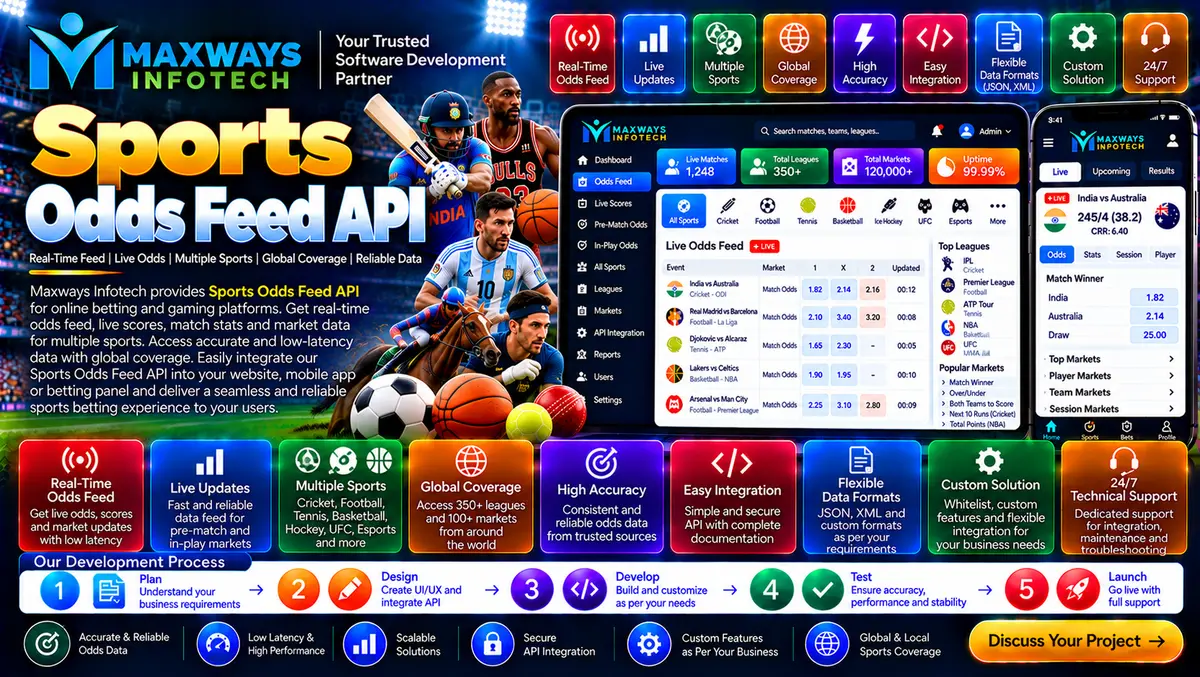
A Sports Odds Feed API delivers structured sports odds information from a data provider to an application or backend system. Unlike an integration focused only on retrieving individual records, a feed-based architecture is designed to keep a system supplied with updates as information changes.
For developers building sports statistics platforms, data dashboards, comparison tools, or authorised sports information services, the key challenge is maintaining a consistent view of the data while updates continue to arrive. A connection can remain open even when an application has missed messages, and a successful response does not guarantee that every change has been processed.
A reliable Sports Odds Feed API integration needs a clear delivery protocol, an initial data snapshot, a way to process subsequent changes, and a recovery strategy for interruptions. These elements help prevent incomplete or outdated information from silently entering the application.
What Is a Sports Odds Feed API?
A Sports Odds Feed API provides structured odds-related data through one or more delivery methods. Depending on the provider, it may supply event information, market definitions, selections, odds values, timestamps, and market status updates.
Some feeds deliver complete snapshots of the current event state. Others provide incremental messages describing changes that have occurred since an earlier point. Certain providers support both approaches.
A feed may be used for:
-
Sports information dashboards.
-
Market data comparison tools.
-
Sports analytics applications.
-
Event monitoring systems.
-
Data aggregation platforms.
-
Historical data collection, where permitted.
The exact coverage depends on the provider. Before development begins, confirm the supported sports, available markets, delivery protocols, update frequency, and data usage permissions.
Businesses researching software development options can explore the Maxways Infotech homepage for company information and published services.
How a Sports Odds Feed Differs from a Standard API Request
A conventional request-response API returns information when an application asks for it. A feed integration is designed to keep information updated through repeated retrieval, streaming, or another provider-supported delivery mechanism.
The distinction affects how developers manage application state.
With a request-response design, the application may request a fresh record whenever a user opens a page. With a feed-based design, the backend can process incoming changes and maintain a current representation for multiple users.
A feed architecture can reduce repeated requests for the same information, but it also introduces responsibilities around connection management, update ordering, and recovery.
The application needs to know:
-
Which snapshot represents its starting state.
-
Which updates have already been processed.
-
Whether any updates may have been missed.
-
How to identify duplicate messages.
-
When a new snapshot is required.
-
Whether the displayed data is still sufficiently current.
These requirements should be defined before selecting a delivery method.
Snapshot and Incremental Update Architecture
One useful feed design combines a full snapshot with incremental updates.
A snapshot represents the current state of the relevant data at a particular version or point in time. An incremental update describes a change that occurs after that state.
A simplified workflow is:
Request snapshot → Store initial state → Record version or cursor → Receive incremental updates → Validate and apply changes
The exact protocol varies by provider, but the underlying objective is to establish a known starting point and apply later changes consistently.
Step 1: Load the initial snapshot
The application retrieves the current state for the required events and markets. It validates the response and stores the records before marking the initial load as complete.
Step 2: Save the feed position
If the provider supplies a version, sequence identifier, cursor, or resume token, the application should persist it according to the provider's documentation.
This position helps the application identify where processing stopped and whether it can continue from the previous state.
Step 3: Apply incremental updates
Each incoming message is validated and associated with the correct event, market, and selection. The application then updates its stored state using the provider's sequencing rules.
Step 4: Commit the update and position consistently
Where the storage design permits, the processed record and the corresponding feed position should be committed together. Otherwise, a restart could cause the application to believe that an update was processed when its data change was never saved.
Step 5: Recover when continuity is lost
If the feed position is no longer available, the connection has been interrupted for too long, or the provider reports that updates are missing, the application may need to retrieve a new snapshot.
The provider's documentation determines whether missed updates can be replayed and how far back recovery is supported.
Preventing Duplicate and Out-of-Order Updates
A feed may deliver repeated messages because of retries, reconnections, or provider-specific delivery behaviour. Messages can also arrive in an order that differs from the order in which changes originally occurred.
If an application applies every message without validation, it may overwrite a newer record with an older one or process the same change repeatedly.
Several controls help prevent these problems.
Message identifiers: Use unique message IDs when the provider supplies them to detect repeated deliveries.
Version checks: Apply updates according to documented sequence numbers or version rules rather than assuming that arrival order always determines which update is newest.
Idempotent processing: Design message handlers so that processing the same update more than once does not produce an unintended duplicate effect.
Consistent event keys: Associate every update with the correct event, market, and selection identifiers.
Atomic state changes: Update related fields together when they represent a single logical state.
Not every provider guarantees consecutive sequence numbers or offers a unique identifier for every message. Developers should implement the rules actually documented by the source rather than inventing assumptions about the feed.
Handling Connection Interruptions and Feed Recovery
A persistent connection can fail because of network interruptions, service restarts, authentication problems, or provider maintenance. Reopening the connection does not necessarily mean that the application has recovered every change.
A recovery strategy should establish whether the previous feed position is still valid.
A practical procedure includes:
-
Detect the interruption using connection status, heartbeats, or provider-supported health signals.
-
Preserve the last successfully committed feed position.
-
Reconnect using controlled retry intervals.
-
Reauthenticate and restore the required subscriptions.
-
Resume from the saved position if the provider supports it.
-
Request a new snapshot if the saved position is invalid or the required history is unavailable.
-
Reconcile the recovered state before continuing normal processing.
The system should distinguish a successful reconnection from a successful data recovery. The first confirms that communication has resumed; the second confirms that the application's data state is sufficiently consistent to continue.
Designing a Reliable Feed Processing Pipeline
A Sports Odds Feed API benefits from a processing architecture that separates communication from data handling.
A typical pipeline includes:
Feed connector → Message validation → Event mapping → State processor → Database or cache → Consumer applications
Feed connector
The connector handles authentication, connection lifecycle, subscriptions, and transport-specific behaviour. It should not contain all the business logic for processing records.
Message validation
Incoming messages are checked for required identifiers, valid field types, supported versions, and expected structures. Invalid messages should be recorded for investigation rather than silently applied.
Event mapping
The mapping layer connects provider-specific identifiers to the application's internal event catalogue. This is important when different data sources use different IDs for the same fixture.
State processor
The processor applies updates according to the provider's ordering rules and the application's data model. It also handles duplicate detection and relevant market-status changes.
Storage layer
The storage layer maintains the latest accepted state and, where authorised and necessary, records historical changes. It should support the application's query patterns without making every consumer process the raw feed independently.
Consumer applications
Dashboards and other authorised services read from the validated application state. This reduces the need for each client to establish its own upstream connection.
Managing Storage and Feed Processing Costs
Feed-based systems can receive large numbers of messages, especially when many sports and events are active simultaneously. Storing every message indefinitely may be unnecessary, while discarding all history can make troubleshooting difficult.
A sensible storage strategy separates operational needs from historical analysis.
Current-state storage keeps the latest accepted information available for application queries.
Operational logs record processing failures, reconnections, and important state transitions.
Historical archives retain permitted observations when required for reporting, research, or auditing.
The retention period for each category should reflect the application's needs, infrastructure costs, and data licensing terms.
Developers can also improve efficiency by subscribing only to relevant events where supported, batching suitable storage operations, and separating ingestion workloads from heavy reporting queries.
Security and Data Permissions
Feed integrations should protect credentials and ensure that only authorised services can receive or modify the relevant information.
Keep API keys and access tokens on the server. Use encrypted connections, restrict credentials to the necessary permissions, and validate webhook signatures or other supported message-authentication mechanisms.
Operational logs should provide enough information to investigate feed problems without exposing secrets.
Data permissions also require careful review. A provider may allow feed access while restricting storage, public display, historical retention, or redistribution to third parties.
For projects involving financial workflows or data-intensive business applications, the Maxways Infotech fintech page may be useful when researching related software development capabilities.
Where a feed is used in betting-related functionality, confirm applicable legal requirements and authorised data usage before launch. Access to a feed does not automatically grant permission to operate a betting service.
Testing a Sports Odds Feed API
Testing should focus on the continuity of the data state, not just whether the first request succeeds.
Before deployment, test scenarios such as:
-
Initial snapshot loading.
-
Updates arriving during normal operation.
-
Duplicate message delivery.
-
Older messages arriving after newer updates.
-
A connection closing unexpectedly.
-
Reconnection using a saved cursor or version.
-
Recovery when the saved position is no longer available.
-
Invalid messages or unexpected schema changes.
-
High message volume and slow downstream consumers.
-
A market becoming suspended or changing status.
For each test, verify both the system's logs and the stored result. A successful connection is not sufficient if the application has lost an update or retained an inconsistent state.
Use a sandbox or simulated feed whenever possible. Confirm which recovery scenarios the provider supports and document any limitations before designing the final integration.
Frequently Asked Questions
What is a Sports Odds Feed API?
It provides structured sports odds information through a feed-oriented interface. Depending on the provider, it may deliver snapshots, incremental updates, or both.
What is the difference between a snapshot and an incremental update?
A snapshot describes the current state at a particular point, while an incremental update describes a change to that state. Using both can help an application initialise and maintain its data consistently.
Why does a feed need a recovery mechanism?
A connection interruption can cause updates to be missed. A recovery mechanism helps the application resume from a saved position or retrieve a fresh snapshot when necessary.
How can duplicate feed messages be handled?
Use provider-supported message IDs or version information, combined with idempotent processing and consistent event identifiers. The implementation should follow the provider's documented delivery guarantees.
What should developers evaluate before choosing a feed provider?
Review coverage, message formats, snapshot availability, incremental update behaviour, sequencing rules, reconnection support, rate limits, documentation, data permissions, and applicable legal requirements.
For more technical articles and software-related resources, visit the Maxways Infotech blog.
Conclusion
A Sports Odds Feed API is most useful when an application can maintain a consistent data state as information changes. Snapshots, incremental updates, message validation, sequencing rules, and recovery procedures work together to reduce the risk of missing or incorrectly applying updates.
Before choosing a provider, understand its delivery protocol, identify how continuity is maintained, and test what happens when connections fail or messages arrive unexpectedly. A clear feed-processing design makes the system easier to monitor, troubleshoot, and maintain.
Always confirm provider permissions and applicable legal requirements before storing, displaying, or redistributing sports odds information.