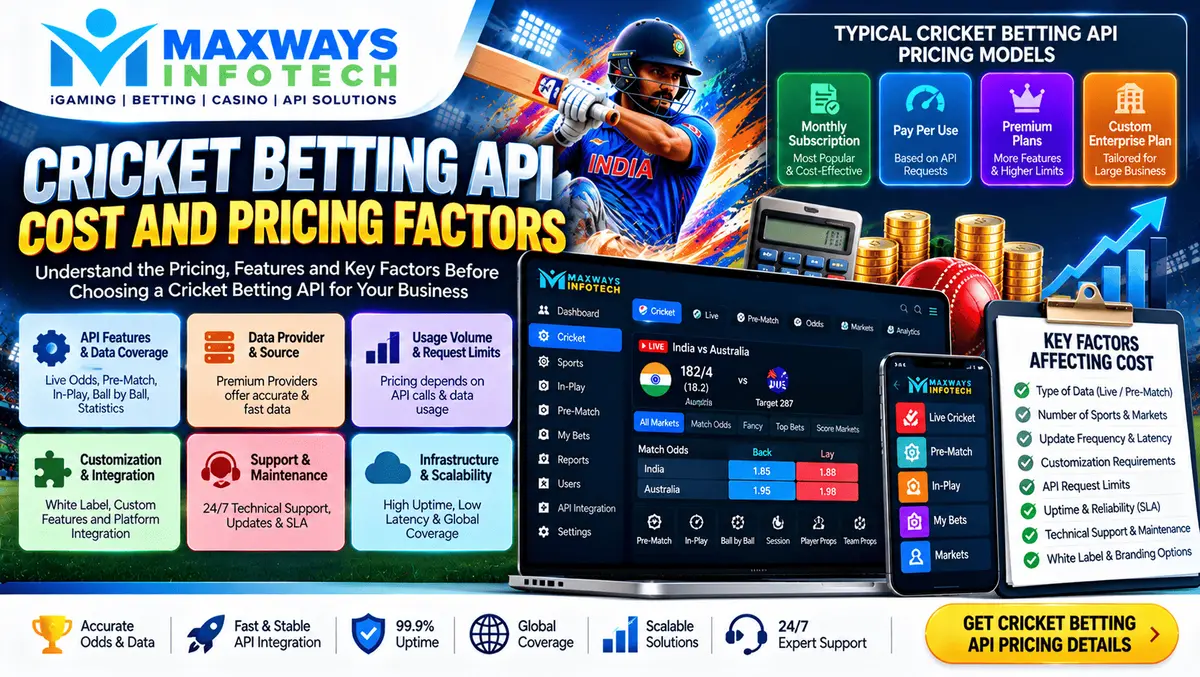
Explore cricket betting API costs and pricing factors, including data coverage, live odds, API limits, integration, hosting, testing and maintenance.
Cricket Betting API Cost and Pricing Factors: A Complete Guide
Understanding cricket betting API cost and pricing factors is an important step for businesses planning a cricket data platform, sports application or API-powered website. The total investment depends on the selected data provider, required features, integration complexity, usage limits, infrastructure and ongoing maintenance.
Some projects need only cricket fixtures and live scores, while others require ball-by-ball updates, player statistics, authorised odds feeds, custom backend development and administrative dashboards. These different requirements can lead to significantly different costs.
At MaxWays Infotech, businesses can explore sports API integration and custom software development options based on their project requirements. This guide explains the major pricing factors, potential additional expenses and practical ways to plan an API budget.
What Determines Cricket Betting API Cost?
There is no single price that applies to every cricket betting API. Providers use different pricing models, data licences, request limits and subscription packages. Development costs also depend on the application being built.
The total project budget can be divided into two main categories:
-
API and data costs: Fees charged by the selected provider for access to data, odds feeds, features and permitted usage.
-
Development and operating costs: Expenses for integration, backend development, hosting, testing, security, monitoring and maintenance.
Keeping these categories separate makes it easier to compare provider quotations and understand the total cost of ownership.
10 Important Cricket Betting API Pricing Factors
1. Cricket Data Coverage
The number and type of cricket competitions supported by an API can influence its price. A project requiring only selected match fixtures may have different needs from an application that requires extensive international, domestic and franchise competition coverage.
Before choosing a plan, check whether the provider supports:
-
International Test, ODI and T20 matches
-
Domestic cricket competitions
-
Franchise leagues and tournaments
-
Women's cricket, where required
-
Historical match results and statistics
-
Live match information and scorecards
Not every provider includes all competitions in every subscription. Confirm the actual coverage and any additional fees before purchasing access.
For more information about cricket data integration, explore the Cricket API Provider page.
2. Live Scores and Ball-by-Ball Data
The level of detail required from a cricket API affects the integration scope and may also affect the provider's fees.
A basic score endpoint may return the current score, innings and match status. A more detailed service may provide delivery-level events, batting and bowling figures, scorecards and other match information.
Consider the following requirements when comparing plans:
-
Current scores and match status
-
Innings and over information
-
Ball-by-ball events
-
Player and team statistics
-
Match results and historical records
-
Data freshness and update intervals
Ask the provider whether each feature is included in the quoted package and what restrictions apply to its use.
3. Pre-Match and Live Odds Feeds
Odds data can involve different commercial arrangements from standard cricket score data. Pricing may depend on the provider, available markets, event coverage, update frequency, usage permissions and subscription terms.
If your application requires odds integration, clarify whether the quote covers pre-match odds, live odds, supported markets, historical odds or other required fields.
Do not assume that a cricket score API includes odds feeds or sportsbook functionality. These services may require separate access and licensing.
You can review the Sports Betting API page for information about sports data and compatible API integration.
4. API Request Limits and Usage Volume
Providers may limit requests by minute, hour, day or subscription period. Some plans may also restrict concurrent requests or access to particular endpoints.
Your application's traffic and refresh strategy can therefore affect the subscription you need.
For example, a website that displays a small amount of match information may have different usage requirements from a busy application refreshing multiple scorecards throughout a match.
To estimate usage, identify:
-
Expected active users
-
Number of matches displayed simultaneously
-
Endpoints called by each screen
-
Required refresh frequency
-
Permitted caching and webhook options
-
Peak traffic during major matches
Estimate demand before selecting a plan, and confirm the provider's rate limits rather than assuming that unlimited access is included.
5. Custom API Integration and Backend Development
API access and API integration are different expenses. A provider may supply the data service, while developers build the application components needed to use it.
Development scope may include authentication, endpoint configuration, response parsing, data mapping, caching, error handling and connection to an existing website or application.
More complex projects may require a custom backend, multiple data sources, reporting tools, role-based permissions or an administrative dashboard.
The final development quote should clearly distinguish one-time implementation charges from recurring API subscription fees.
6. Website and Mobile Application Requirements
The target platform affects the amount of development and testing required.
A cricket information website may need responsive match pages, scorecards and tournament listings. A mobile application may require additional backend services, device testing, notification support and performance optimization.
Projects that serve multiple platforms can sometimes share a common backend, but the design depends on the existing technology and the selected API.
When requesting a quotation, specify whether you need a website, Android application, iOS application, administrative interface or a combination of these components.
7. Hosting and Infrastructure
The API subscription is not necessarily the only recurring technical expense. Depending on the architecture, your application may also need hosting, databases, caching, logging, backups and monitoring.
Infrastructure requirements can increase with traffic, data retention, application complexity and the number of connected services.
A practical estimate should consider:
-
Application and database hosting
-
Database storage and backups
-
Caching and background processing
-
Monitoring and alerting
-
Bandwidth and traffic volume
-
Security tools and access management
-
Disaster recovery requirements
Choose infrastructure based on realistic demand and expected growth instead of paying for unnecessary capacity at the beginning.
8. Security and Access Management
Security is a necessary part of a production API integration. Development work may include server-side credential storage, authentication, permission controls, encrypted communication, request validation and audit logging.
Additional requirements can increase the project scope, especially where the application connects multiple services or handles sensitive account information.
API keys should not be exposed in public browser code or mobile application bundles. Security requirements should be discussed during planning rather than added only after deployment.
9. Testing and Quality Assurance
Testing is another important cost factor that is easy to overlook.
A properly tested integration should handle successful requests as well as invalid credentials, timeouts, rate-limit errors, missing fields, delayed updates and service interruptions.
Testing may also include load testing, compatibility checks, data validation, security reviews and user acceptance testing.
The amount of testing required depends on the project's complexity and the consequences of a service failure. Include it explicitly in the project estimate.
10. Maintenance and Technical Support
API integrations require maintenance after launch. Providers may change endpoints, introduce new versions, adjust request limits or update data structures.
Ongoing expenses can include bug fixes, compatibility updates, monitoring, performance optimization, infrastructure maintenance and support arrangements.
Before signing an agreement, ask which maintenance services are included, how support requests are handled and whether API subscription renewals are billed separately.
Cricket Betting API Pricing Models
Different providers use different commercial models. Understanding the pricing structure helps businesses compare plans more accurately.
| Pricing model | How it works | What to verify |
|---|---|---|
| Subscription-based | Recurring payment for a defined package | Included features, renewal terms and restrictions |
| Usage-based | Charges depend on requests or consumption | Metering rules, quotas and overage fees |
| Feature-based | Pricing varies by data or functionality | Which endpoints and markets are included |
| Enterprise agreement | Commercial terms are negotiated for a larger requirement | Minimum commitments, support and service terms |
| Custom integration project | Development is quoted according to project scope | Deliverables, testing, maintenance and third-party fees |
These are common commercial structures, not a guarantee that every provider offers each model. Confirm the actual pricing options with your shortlisted vendors.
How to Calculate Your Cricket API Project Budget
A useful budget includes the provider subscription, development work and ongoing operating expenses.
Use this formula as a planning framework:
Total first-year budget = Initial API setup fees + API subscription fees + Development costs + Hosting and infrastructure + Testing and deployment + Maintenance and support
Also consider any additional data licensing, taxes, payment processing or other third-party charges that apply to your specific project.
Example Budget Worksheet
The following table is a planning template, not a price quotation. Enter actual vendor and development estimates to calculate your budget.
| Cost component | Your estimated cost |
|---|---|
| API setup or onboarding | ₹_____ |
| API subscription for 12 months | ₹_____ |
| Website or application development | ₹_____ |
| Backend and dashboard development | ₹_____ |
| Hosting and database | ₹_____ |
| Testing and deployment | ₹_____ |
| Maintenance and support | ₹_____ |
| Estimated first-year total | ₹_____ |
For an accurate estimate, request separate quotations for API access and development services. This makes it easier to identify recurring fees and compare providers on equivalent terms.
How to Reduce Cricket Betting API Development Costs
Reducing unnecessary work can help control the budget without compromising essential quality.
Start With Essential Features
List the features needed for the initial release. Integrate the required match data first, then consider additional statistics, reporting and other features when there is a clear business need.
Select the Right Subscription
Compare each provider's data coverage, limits, licensing and pricing. A low-cost plan may become expensive if it lacks the features your application requires.
Optimize API Requests
Avoid refreshing every endpoint more frequently than necessary. Use caching, background processing or webhooks where supported and permitted by the provider's terms.
Reuse Existing Software Components
If you already have a website or backend, assess whether it can support the integration. Reusing suitable components may reduce development effort, although compatibility and security must still be tested.
Include Maintenance in the Initial Plan
Plan for updates, monitoring and troubleshooting before launch. A clear maintenance agreement can make future costs more predictable.
Request a Detailed Project Estimate
Ask vendors to break down API access, development, infrastructure, testing and maintenance. A detailed estimate is easier to compare than a single combined price.
How to Choose an API Provider Based on Your Budget
The lowest subscription price is not always the best value. A provider with limited data coverage, strict request limits or insufficient documentation may require additional development or a more expensive upgrade later.
Evaluate these points before making a decision:
-
Data requirements: Does the API provide all the information your project needs?
-
Coverage: Are the required matches, tournaments and historical records available?
-
Performance: Are the update frequency and response times suitable?
-
Usage limits: Will the plan accommodate expected traffic?
-
Documentation: Can your development team integrate and maintain it efficiently?
-
Commercial terms: Are your intended data use and redistribution rights permitted?
-
Support: What assistance is available during integration and after launch?
-
Total cost: What are the first-year and ongoing expenses?
For related development information, see the Live Cricket API Provider page.
Why Businesses Consider Custom Cricket API Integration
A suitable integration connects the provider's available data to the application's specific requirements. Depending on the project scope, this can involve a custom backend, data normalization, application interfaces, monitoring and maintenance.
Businesses exploring cricket API development can also read D247 Cricket API Development Company for related technical information. The required features, third-party access and commercial terms should always be verified for the individual project.
For projects that need wider platform functionality, the iGaming Platform API page may provide additional context about platform integration concepts.
MaxWays Infotech's homepage is the starting point for exploring the company's software and API integration offerings.
Frequently Asked Questions
1. How much does a cricket betting API cost?
There is no universal price. Costs depend on the provider, data coverage, subscription plan, request limits, odds-feed access, licensing and technical requirements. Request a current quotation for your intended use.
2. What factors affect cricket API pricing the most?
Major factors include the number of competitions, required data fields, live update frequency, API request volume, commercial usage rights, subscription type and integration complexity.
3. Is cricket API access separate from development cost?
Often, yes. API access may be billed by a third-party provider, while website development, backend integration, testing and maintenance are separate expenses. Confirm what each quotation includes.
4. Does a live cricket API include odds data?
Not always. Some APIs focus on scores and match information, while others offer odds feeds or related functionality. Confirm the available endpoints and licensing terms.
5. Can API request limits increase the overall cost?
Yes. If usage exceeds a plan's limits, the provider may require an upgrade or charge additional fees. Estimate request volume and review the provider's billing rules before launch.
6. Are hosting and maintenance included in API pricing?
Not necessarily. Hosting, databases, monitoring, application maintenance and technical support may be billed separately from the API subscription.
7. How can businesses reduce cricket API costs?
Choose a plan that matches actual data needs, optimize request frequency, cache data where permitted, reuse compatible software components and request a clear cost breakdown.
8. What should be included in a cricket API quotation?
Ask for API subscription fees, data coverage, request limits, licensing, integration scope, testing, hosting assumptions, maintenance terms and any additional charges.
9. Can the same cricket API support a website and mobile app?
Potentially, yes. A shared backend can serve multiple applications when the API, architecture, capacity and provider usage terms support the arrangement.
10. Are there legal requirements for cricket betting API use in India?
The legal position depends on the intended functionality, business model and applicable laws and regulations. Obtain qualified legal advice and verify licensing, data rights and other requirements before operating a betting-related service.
Conclusion
Understanding cricket betting API cost and pricing factors helps businesses make better decisions before investing in a sports platform. Provider subscriptions, data coverage, odds-feed access, request limits, backend development, infrastructure, security and maintenance can all influence the final budget.cricket betting api provider india | Maxways Infotech
The best approach is to define your requirements, compare providers using the same criteria, verify data and licensing terms, and request a detailed estimate covering both initial and recurring expenses.
A clear budget and carefully planned integration can help businesses manage development costs while building a maintainable application that fits its intended purpose.
Compliance note: Betting-related functionality should only be developed and operated where legally permitted, with appropriate licences, data rights and safeguards in place.Sports betting website source code | Maxways Infotech