Discover how to evaluate a Cricket Betting API Provider through licensing, API testing, service-level agreements, security, pricing, and compliance checks
Cricket Betting API Provider: How to Evaluate the Right Technology Partner
Choosing a Cricket Betting API Provider involves more than comparing prices or checking whether an API offers cricket match data. Businesses need to understand the provider’s technical capabilities, licensing terms, integration process, maintenance policies, and ability to support a software product over time. A provider that looks suitable during a demonstration may create unexpected challenges if its documentation is incomplete, its API changes without notice, or its support process is unclear.
For businesses exploring sports technology and financial software solutions, Maxway Infotech provides a starting point for reviewing the company’s published technology information and understanding its broader software development focus. Before selecting any API partner, however, it is important to assess the actual product, contractual commitments, and permitted use of the data.
What Does a Cricket Betting API Provider Do?
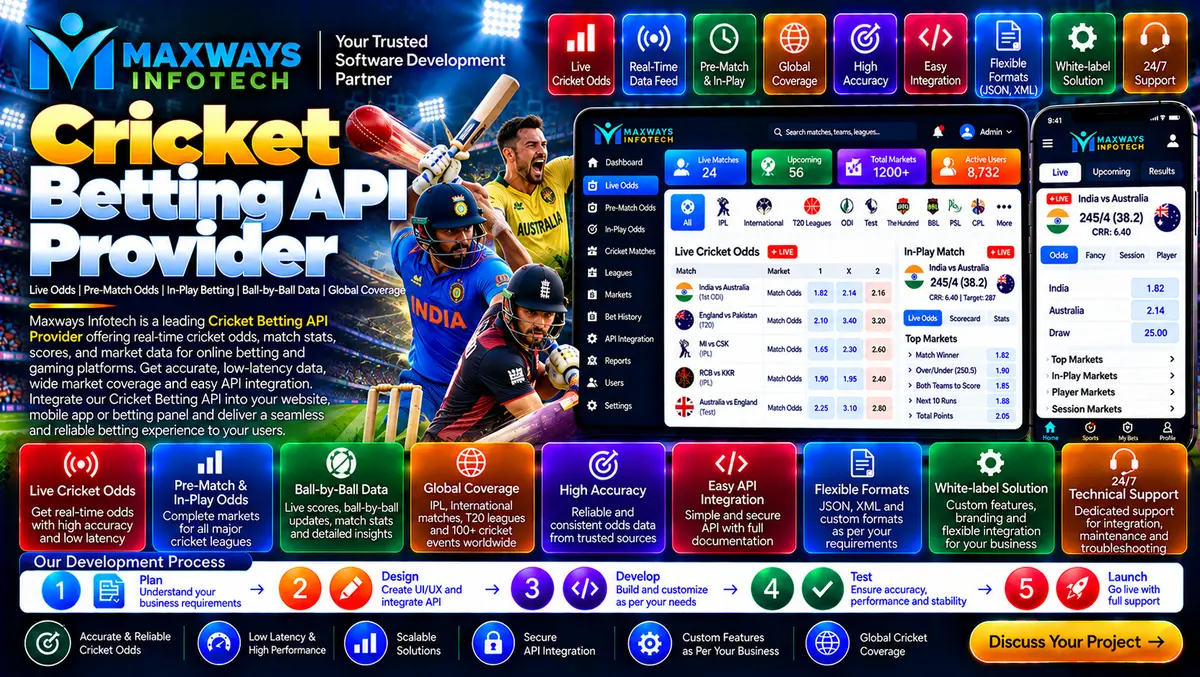
A cricket betting API provider supplies a software interface through which an application can access supported cricket-related information and functions. Depending on the product, this may include match schedules, team information, scores, player statistics, odds, market status, and match results.
The precise scope varies between providers. Some specialise in sports data, while others may offer additional integration components or platform-related services. These categories should not be treated as interchangeable.
For example, a developer building a cricket statistics dashboard may need fixtures, scorecards, and historical records. A more complex application may require frequent event updates, market status information, and carefully defined result-processing workflows.
The first step is therefore to identify the exact technical requirements rather than assuming every API includes the same features.
1. Evaluate the Provider's Contract Before Its Features
One of the most overlooked parts of choosing an API provider is the commercial agreement. Technical demonstrations can show how an API works, but they cannot establish whether the service will remain suitable under the agreed terms.
Review these areas before committing:
-
Data rights: Confirm which data can be accessed, stored, displayed, and redistributed.
-
Permitted applications: Check whether the licence covers your intended website, application, or analytical product.
-
Usage limits: Understand request quotas, connection limits, and any additional charges.
-
Territorial restrictions: Verify where the service and its data may legally be used.
-
Termination conditions: Review cancellation periods, refunds, and access after the contract ends.
-
Service continuity: Understand what happens if a data source is discontinued or a provider changes its product.
A low-cost API can become expensive if additional rights, higher usage tiers, or separate data packages are required later. A written agreement makes these limitations easier to identify before development begins.
2. Check How the API Handles Version Changes
An API may work correctly today and still create maintenance problems after an update. Providers sometimes change response fields, authentication requirements, endpoint structures, or rate limits. If an application depends directly on those details, even a small change can interrupt a production workflow.
Ask the provider how it manages API versions.
A reliable process should explain whether older versions remain available temporarily, how developers are notified about breaking changes, and whether migration instructions are provided. A sandbox environment should also allow developers to test changes before they reach production.
From a development perspective, an internal adapter layer can help isolate the application from provider-specific formats. Instead of connecting every application module directly to an external response, developers can convert the response into a consistent internal structure.
This approach can reduce the amount of code that needs modification when an endpoint or provider changes.
3. Test the API With Realistic Scenarios
A short demonstration is not enough to determine whether an API fits a real software project. Testing should cover normal responses as well as situations where the service behaves unexpectedly.
A useful evaluation plan includes the following scenarios:
Missing information: What happens if a match has incomplete statistics or an optional field is absent?
Delayed responses: Does the application handle slow requests without freezing the interface?
Rate limits: Does the API communicate request-limit errors clearly, and are retry rules documented?
Duplicate updates: Can the integration identify repeated events without processing them twice?
Interrupted connections: Is there a documented recovery method when a connection drops?
Incorrect assumptions: Does the integration validate response types, timestamps, and event identifiers before using the information?
Developers should record the results of these tests and compare them with the provider's documentation. This creates evidence for a technical decision instead of relying solely on a sales presentation.
4. Understand the Service-Level Agreement
A service-level agreement, or SLA, defines the provider's stated service commitments. It may cover availability, incident response, maintenance notifications, and remedies when agreed service targets are missed.
When evaluating a Cricket Betting API Provider, ask for specific definitions rather than accepting general promises of high uptime.
For instance, clarify how availability is measured, whether planned maintenance is excluded, and which monitoring period applies. Also distinguish between API availability and data freshness: an endpoint can respond successfully while returning delayed or incomplete information.
Support arrangements deserve the same attention. Confirm the available support channels, operating hours, escalation process, and expected response times for different incident severities.
A clear SLA will not prevent every outage, but it helps both parties understand their responsibilities when an issue occurs.
5. Review Security and Access Management
API credentials should be handled as sensitive application secrets. They should not be exposed in public repositories, browser-side code, screenshots, or unsecured configuration files.
A technical review should cover:
-
Authentication and credential rotation.
-
Encrypted connections using HTTPS.
-
Role-based access to dashboards and administrative functions.
-
Request logging without unnecessarily exposing secrets.
-
Rate limiting and abuse prevention.
-
Backup, recovery, and incident-response procedures.
For projects that include financial or account-related functionality, separate data access from transaction processing wherever possible. Each component should have clearly defined permissions, and sensitive actions should produce an appropriate audit trail.
Businesses comparing broader software integration approaches can also review the Fintech software information published by Maxway Infotech. The relevant requirements will depend on the actual project, its data flows, and the services being integrated.
6. Calculate the Total Cost of Ownership
The subscription price is only one part of the cost of adopting an API. Development, testing, infrastructure, maintenance, monitoring, and future migration can all affect the total investment.
Before making a decision, estimate:
A provider with a higher subscription fee may still offer better value if its documentation, testing tools, and support reduce ongoing maintenance. Conversely, an inexpensive service may be appropriate for a small project if its limitations are clearly understood.
Compare providers using the same requirements and expected workload to make the results meaningful.
7. Build a Vendor Evaluation Scorecard
A structured scorecard helps a team compare shortlisted providers consistently. Give each provider a score from 1 to 5 for each category, where 1 means poor or insufficient evidence and 5 means strong evidence supported by documentation or testing.
Multiply each score by its category weight and add the results to create a weighted comparison. The weights can be adjusted to match the project, but licensing and security should not be ignored simply because a provider offers more features.
Do not award a high score based only on marketing claims. Ask for documentation, test access, contractual details, or other evidence that supports the assessment.
8. Consider Compliance Before Launch
Technology access does not automatically grant permission to operate a particular service. Before deploying a betting-related application, businesses must independently verify the applicable laws, licensing obligations, data rights, payment restrictions, and other regulatory requirements in every relevant jurisdiction.
This is especially important for businesses operating in or targeting India, where online money gaming and related activities may be subject to specific legal restrictions and changes. Obtain qualified legal advice before launching any real-money betting functionality. An API provider's agreement should not be treated as legal authorisation for the application's intended use.
Where a project is limited to lawful sports statistics, research, media, or analytics, the permitted data usage and redistribution rights should still be confirmed in writing.
Frequently Asked Questions
What should I check before choosing a Cricket Betting API Provider?
Start with the intended use case, data licence, competition coverage, documentation, test access, service commitments, security controls, pricing, and support arrangements. Validate important claims through testing and written agreements.
Is a free API demo enough to make a decision?
No. A demo is useful for understanding the interface, but it may not reveal production limits, licensing restrictions, support quality, or how the provider handles failures. Test representative scenarios and review the contract before committing.
Why are API version updates important?
Version updates can change endpoints, response formats, authentication methods, or usage rules. A documented migration process and a test environment can help developers prepare for those changes without unnecessarily disrupting an application.
How can businesses compare API providers fairly?
Use the same requirements, test cases, expected workload, and evaluation scorecard for every shortlisted provider. Compare documented capabilities and total ownership costs rather than relying only on advertised features or starting prices.
Does buying an API guarantee legal permission to operate a betting platform?
No. API access and legal permission are separate matters. Businesses must verify applicable laws, licences, territorial restrictions, and data-use rights before launching a service.
Conclusion
Selecting a Cricket Betting API Provider is a technology and risk-management decision, not simply a feature comparison. Contract clarity, version management, realistic testing, service-level commitments, security, and long-term costs all influence whether an integration remains maintainable.
Businesses should shortlist providers against documented requirements, test their APIs before deployment, and verify that the intended use is legally permitted. For additional software development perspectives and technical articles, explore the Maxway Infotech blog.
A careful evaluation process helps teams make informed decisions, avoid preventable integration problems, and choose technology that fits the real needs of their project.